
数字化转型

Search documents
金融力量与城市温度共融共生 成都银行获评“最具社会责任上市公司”
Mei Ri Jing Ji Xin Wen· 2025-12-16 12:20
Core Viewpoint - Chengdu Bank has been recognized as the "Most Socially Responsible Listed Company" at the 2025 14th Annual Development Conference for Listed Companies, highlighting its commitment to social responsibility and sustainable development [1] Group 1: Business Performance - For the first nine months of 2025, Chengdu Bank achieved an operating income of 17.761 billion yuan, a year-on-year increase of 3.01%, and a net profit attributable to shareholders of 9.493 billion yuan, up 5.03% year-on-year [3] - As of September 2025, total deposits reached 986.432 billion yuan, an increase of 100.573 billion yuan or 11.35% since the beginning of the year, while total loans exceeded 847.481 billion yuan, growing by 104.9 billion yuan or 14.13% [3] - The bank's total assets surpassed 1.38 trillion yuan, reflecting a steady growth of 10.81% since the start of the year, with a non-performing loan ratio of 0.68%, indicating strong asset quality [3] Group 2: Strategic Development - Chengdu Bank has established three major business pillars: government-finance cooperation, entity business, and individual financial liabilities, successfully becoming the first city commercial bank in the West to exceed 1 trillion yuan in asset scale in 2023 [2] - The bank is focusing on new strategic planning to explore growth drivers in areas such as entity business, retail asset management, wealth management, and international business [2] - The bank's commitment to social responsibility is integrated into its development strategy, emphasizing service to the real economy and enhancing public welfare [1][6] Group 3: Innovation and Technology - Chengdu Bank has been recognized for its financial technology capabilities, maintaining a leading position among city commercial banks in China, with over 5 million mobile banking users and 1.43 million monthly active users as of mid-2025 [10] - The bank has launched a "Ruin Garden Benefit Enterprise" financial initiative to support industrial parks, aiming to provide over 50 billion yuan in credit support by the end of 2025 [7] - The bank has also issued 3 billion yuan in green financial bonds, leading the market in green credit with a compound growth rate exceeding 90% [8] Group 4: Community Engagement and Social Responsibility - Chengdu Bank has actively engaged in community service, conducting over 800 volunteer activities in the previous year, benefiting more than 24,000 people [11] - The bank has implemented a comprehensive service model to support major projects and industrial upgrades, with significant credit investments in the Chengdu-Chongqing economic circle [6][12] - The bank's commitment to social responsibility includes promoting agricultural finance services and supporting rural revitalization projects [12]

华昌达与上海交通大学上海智能制造研究院等签署《战略合作框架协议》
Zheng Quan Shi Bao Wang· 2025-12-16 11:24
Core Viewpoint - The strategic cooperation framework agreement signed between Huachangda, Shanghai Jiao Tong University, and Shanghai Intelligent Manufacturing Functional Platform aims to tackle key technological challenges in robotics and automation, promoting the transformation of scientific achievements into practical applications [1][2][3] Group 1: Cooperation Focus Areas - The collaboration will focus on digital simulation technology and platforms for embodied intelligence and humanoid robots in industrial scenarios, addressing application needs through joint technical research and platform development [2] - The partnership will also involve the development of application technologies for robotics, including technology transfer and joint research on overall application solutions [2] - Joint research will be conducted on embodied intelligence and humanoid robots, including the development of specific-purpose robots and their industrial applications [2] Group 2: Collaboration Model - The three parties may jointly apply for and establish national or provincial key laboratories, engineering research centers, or joint research centers as needed [2] - A "Shanghai Jiao Tong University - Shanghai Intelligent Manufacturing Functional Platform - Huachangda Intelligent Robot Joint Innovation Laboratory" will be established as a physical entity for daily technical exchanges and project cooperation [2] - The collaboration will leverage each party's strengths to support the implementation of embodied intelligence projects, including R&D support, policy compliance, and talent recommendations [2] Group 3: Impact on Huachangda - The agreement is expected to positively impact Huachangda in product development, talent cultivation, and technology upgrades, enhancing its global market competitiveness [3] - Huachangda is recognized as a leading industrial technology enterprise in the global automation field, focusing on providing comprehensive Industry 4.0 automation technology products and services [3] - The company's core business matrix includes four major sectors: overall solutions for Industry 4.0 automation technology, robotic automation technology solutions, logistics and warehousing automation solutions, and new energy automation technology solutions [3]

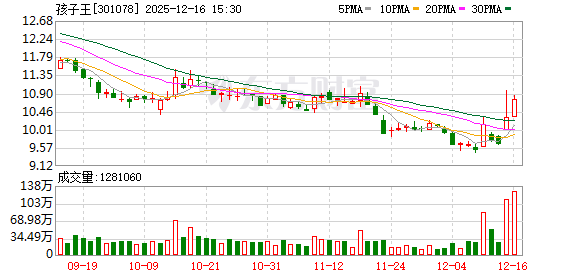
孩子王闯关港股IPO,拟募资用于收购、新增门店 汪建国的母婴帝国要讲新故事?
Mei Ri Jing Ji Xin Wen· 2025-12-16 11:19
Core Viewpoint - The company, Kidswant, is attempting to break through its growth anxiety in the mother and baby retail industry by submitting a prospectus for an IPO on the Hong Kong Stock Exchange, aiming for dual listing to address the slowdown in its core business growth [2][3]. Group 1: Company Overview - Kidswant is a leading comprehensive service provider for parent-child family consumption in China, focusing on the sale and service of mother and baby products, including food, clothing, consumables, and durable goods [3]. - As of September 30, 2025, Kidswant operates 3,710 stores across all provincial administrative regions in mainland China, including 1,033 self-operated parent-child family stores and 174 self-operated technology hair care stores [3]. - The company ranks first in the Chinese mother and baby product market by GMV, holding a market share of 0.3% in 2024, with the market expected to reach 39,950 billion RMB by 2024 and grow at a CAGR of 3.4% from 2020 to 2024 [3]. Group 2: Recent Developments - In July 2025, Kidswant acquired Siyi Group, expanding its business into the scalp and hair care market, which is projected to reach 61.1 billion RMB by 2024, with a CAGR of 9.1% from 2020 to 2024 [4]. - The company has faced performance pressures in recent years, prompting a dual strategy of acquisitions and seeking financing through the Hong Kong IPO [7][10]. Group 3: Financial Performance - Kidswant's revenue has shown consistent growth since 2022, with 2022 revenue at 85.2 billion RMB and 2023 revenue at 87.5 billion RMB, reflecting a year-on-year growth of 2.73% [9]. - The company reported a net profit of 1.05 billion RMB in 2023, down from 1.22 billion RMB in 2022, but is expected to rebound to 1.81 billion RMB in 2024, marking a 72.4% increase from 2023 [9]. - The company plans to use the funds raised from the IPO for product innovation, expanding its sales and service network, strategic acquisitions, enhancing digital capabilities, and general corporate purposes [10].

向“新”向“绿” 内蒙古新型工业化走深走实
Nei Meng Gu Ri Bao· 2025-12-16 11:06
Core Viewpoint - The article emphasizes the importance of industrialization as the foundation and core driving force for modernization in China, highlighting Inner Mongolia's efforts in promoting new industrialization through high-quality development and the integration of advanced manufacturing and renewable energy [1]. Group 1: Industrial Growth and Achievements - Since the 14th Five-Year Plan, Inner Mongolia's industrial output has significantly increased, with the total industrial added value expected to surpass 1 trillion yuan in 2024, achieving an annual growth rate of 9.3% and accounting for 38% of GDP, an increase of 5.6 percentage points from the end of the 13th Five-Year Plan [1]. - Inner Mongolia ranks 14th nationally in total industrial output, with over 90 types of industrial products maintaining the largest production capacity in the country [1]. Group 2: Structural Optimization - The region is focusing on optimizing its industrial structure, with traditional industries undergoing renewal and new industries accelerating their development, particularly in sectors like renewable energy, new materials, and high-end equipment [3][4]. - Inner Mongolia has implemented policies to promote the integration and restructuring of traditional industries, resulting in the exit of over 31 million tons of restricted production capacity in steel, coking, and other sectors [4]. Group 3: Green Development Initiatives - Inner Mongolia is committed to green development, with a focus on energy-efficient practices and the promotion of clean energy sources, achieving a total installed capacity of renewable energy exceeding 150 million kilowatts, leading the nation [6]. - The region has created 642 green manufacturing units, reflecting a growing emphasis on sustainable production practices [5]. Group 4: Digital Transformation - The integration of digital technologies into the manufacturing sector is a key focus, with significant advancements in automation and smart technologies, such as the implementation of unmanned operations in coal mining [9]. - Inner Mongolia has established a robust digital economy foundation, with over 95,000 5G base stations and a computing power scale exceeding 218,000 P, supporting the digital transformation of manufacturing [12].


亚太森博数字化转型两项成果获得省级大奖
Qi Lu Wan Bao· 2025-12-16 10:57
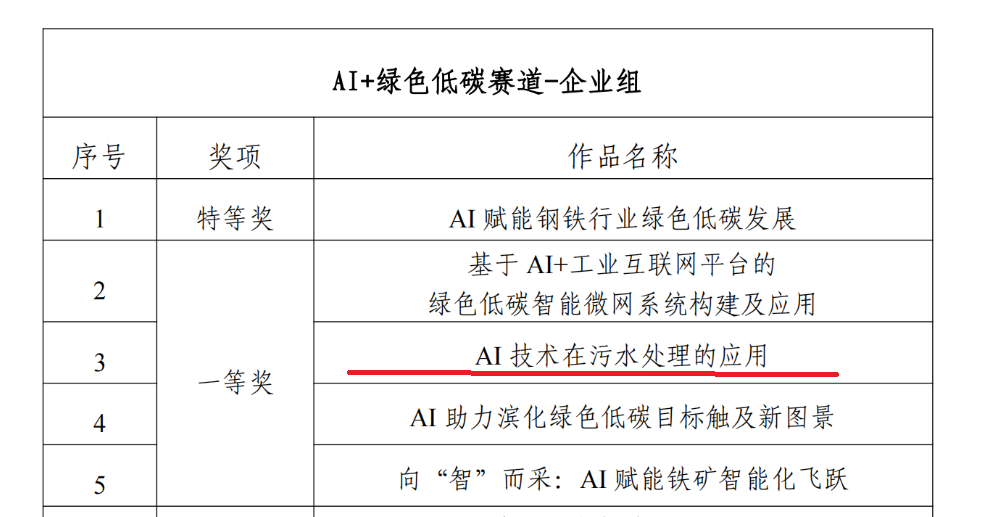
AI智能污水处理项目荣获 "首届山东AI+先进制造业创新应用大赛" | | | AI+绿色低碳赛道-企业组 | | --- | --- | --- | | 序号 | 奖项 | 作品名称 | | 1 | 特等奖 | AI 赋能钢铁行业绿色低碳发展 | | 2 | 等奖 | 基于 AI+工业互联网平台的 绿色低碳智能微网系统构建及应用 | | 3 | | AI 技术在污水处理的应用 | | 4 | | AI 助力滨化绿色低碳目标触及新图景 | | 5 | | 向"智"而采:AI赋能铁矿智能化飞跃 | 项目团队历经一年多的现场调研、数据收集、工艺优化、数字建模、硬件安装、单机测试等各环节,终于在2025年2月28日实现曝气池AI系 统成功上线。AI智能污水处理系统深度融合人工智能算法,实现了对污水处理全流程的精准预测、可视化与动态调控,不仅显著提升处理 效率与水质稳定性,更有效降低系统运行能耗,减少了药品消耗,是AI技术赋能传统环保、实现经济与环境效益双赢的创新实践,也为集 团内部提供可借鉴的数字化转型的应用场景,是制浆造纸行业无数处理第一个人工智能控制案例。 DPM智能运维项目荣获 "首届山东省数字工程师创新创意 ...
别吹了,智能体Demo能跑通和能上线,是两码事!| 极客时间
AI前线· 2025-12-16 09:40
Core Insights - The article discusses the emergence of Agentic AI, which represents a shift from passive tools to AI systems capable of autonomous decision-making and interaction with their environment [1][2][16] - The development of intelligent agents poses significant challenges for developers, requiring a deeper understanding of system engineering beyond just API usage [4][6] Development Challenges - Key challenges in developing intelligent agents include multi-agent collaboration, engineering implementation, domain specialization, and performance evaluation [5] - Developers often get stuck at the API level, missing the opportunity to transition from tool users to creators of intelligent systems [6] Training Program Overview - A training program titled "Agentic AI Development Camp" is introduced, aimed at equipping participants with the skills to build intelligent agents over five weeks [6][17] - The program covers practical aspects from installation to deployment, ensuring hands-on experience with real-world applications [6][10] Weekly Curriculum Breakdown - Week 1 focuses on enabling agents to perceive reality through external tool integration [10] - Week 2 emphasizes building complex collaboration capabilities among multiple agents [10] - Week 3 covers engineering delivery, including architecture design and full-stack development [10] - Week 4 is dedicated to establishing evaluation and monitoring systems for agents in production environments [13] - Week 5 focuses on creating domain-specific expertise through model fine-tuning [13] Practical Applications - The program includes six enterprise-level projects that allow participants to apply their knowledge and deliver commercially viable code and deployment solutions [11] - Participants will engage in various tasks, including building a travel planning agent and a deep research assistant, utilizing cutting-edge technologies [12][14] Future Implications - Agentic AI is positioned as a core engine for digital transformation over the next 5-10 years, emphasizing the importance of mastering this technology for future business development [16]

守正创新促进科技人才培养 华泰证券联合南京大学举办AI+创新创意大赛
Huan Qiu Lao Hu Cai Jing· 2025-12-16 09:33
今年,华泰证券与南京大学开展合作,以多元方式鼓励青年科技人才成长。公司一方面在南京大学设立 华泰证券科技奖学金,奖励计算机、人工智能、数学等专业的优秀学生;另一方面与人工智能、新闻传 播等学院深度合作,在AI赋能金融、AI创新内容生成和传播等多领域开展前瞻性探索,结合行业前沿 视角,为青年人创意的生长、展示和落地提供平台。 本次AI+创新创意大赛是双方首次联合举办人工智能领域的学生竞赛。自6月启动以来,针对华泰证券 提出的大模型上市公司财报分析、金融场景 API 工具调用研究、金融视觉大模型应用研究这三大主 题,学生们给出了多样化的解决方案。南京大学人工智能学院和华泰证券信息技术部专家还共同进行了 前期评审和辅导培训,帮助学生们进一步完善方案。最终,"慧视解图:金融文档图表智能问答系统"等 六个团队带来的解决方案分获一、二、三等奖。赛后,学生们还参观了"数字华泰"运营指挥中心,对科 技如何应用于实际金融场景有了更为具象的感受。 他们基于人工智能及大模型技术,尝试用创新方式解决金融业务场景中的真实问题。作为行业数字化转 型领跑者,华泰证券始终秉持守正创新的精神,不断弘扬践行中国特色金融文化,通过不断加强数字化 ...


女总裁上任5个月辞职,莆田富豪要带金字火腿造芯片
Guan Cha Zhe Wang· 2025-12-16 09:28
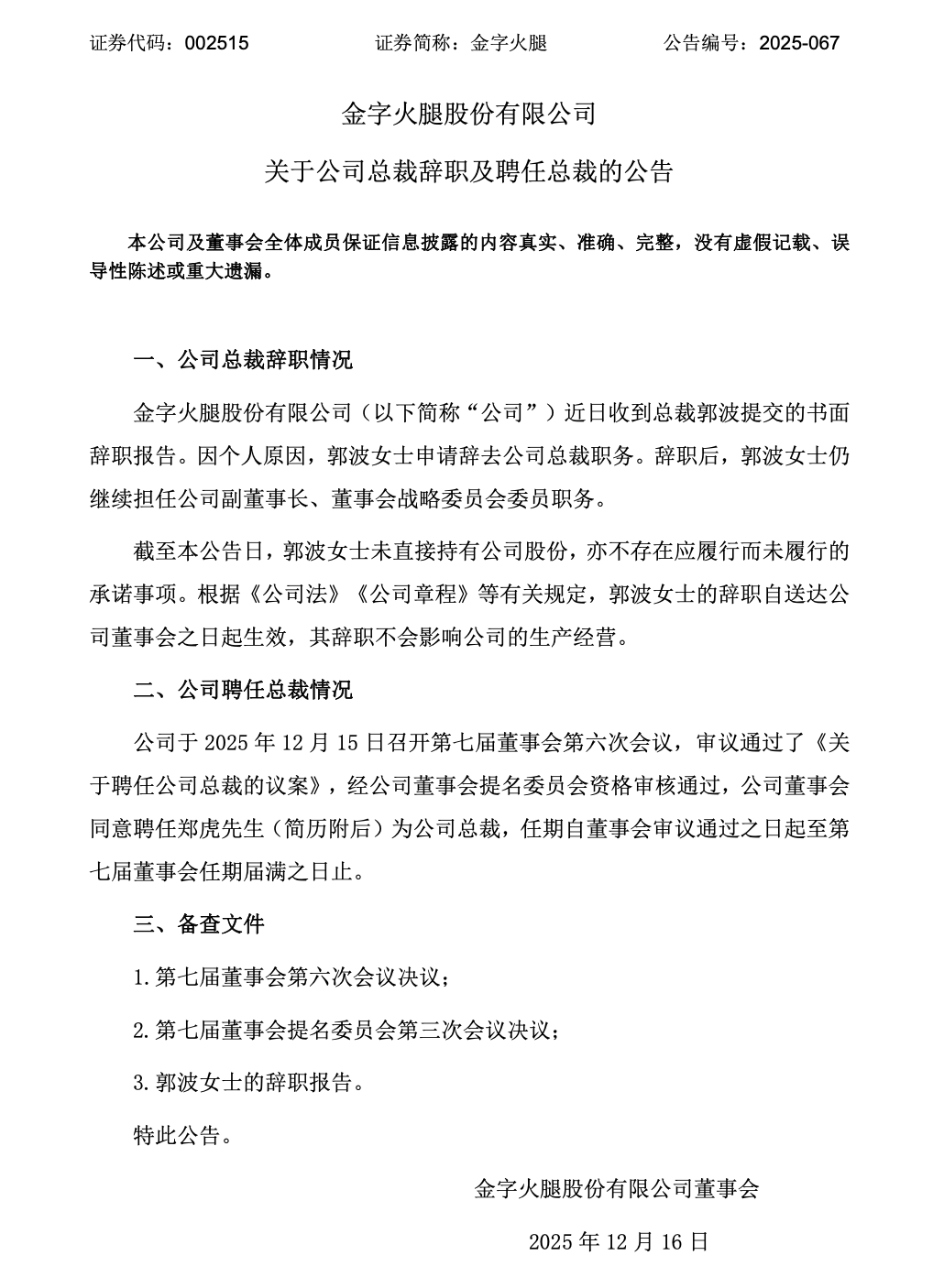
Core Viewpoint - The leadership of Jinzi Ham is undergoing a significant change with the appointment of Zheng Hu as the new president, following the resignation of Guo Bo just five months after taking office, indicating a shift in management strategy and potential for brand rejuvenation targeting younger consumers [1][10]. Management Changes - Guo Bo resigned from her position as president for personal reasons, while retaining her roles as vice chairman and a member of the board's strategic committee [1]. - Zheng Hu, a post-90s individual and son of the controlling shareholder Zheng Qingsheng, has taken over as president, marking a generational shift in the company's leadership [6][10]. Shareholding Structure - Zheng Qingsheng, the new controlling shareholder, holds 18.83% of the voting rights after acquiring shares from other shareholders, indicating a consolidation of control within the Zheng family [9][10]. - The Shi family, the original founders, have reduced their stake to approximately 7%-8%, relinquishing control and transitioning to a financial investor role [9][10]. Financial Performance - In the first half of the year, Jinzi Ham reported revenues of 170 million yuan, with a net profit of approximately 22.92 million yuan [11]. - The ham business remains the core revenue driver, contributing nearly 60% of total revenue, although sales volume has decreased by 14% year-on-year [12][13]. - For the first three quarters, the company experienced a revenue decline of 13.97% to 222 million yuan, with net profit down 26.25% to 22.01 million yuan [14]. Strategic Initiatives - The company is launching new products to adapt to market demands, including various types of ham and meat products, as well as exploring cross-industry innovations like ham ice cream [14][16]. - Jinzi Ham is also venturing into the semiconductor industry, establishing two chip companies and planning to invest up to 300 million yuan in acquiring a stake in Zhongzheng Microelectronics, aiming to leverage digital economy trends [16][19]. Market Position and Challenges - Jinzi Ham is recognized as a leading player in the traditional ham industry, but faces challenges from intensified market competition and changing consumer preferences [11][14]. - The company's past attempts at diversification into unrelated sectors have met with limited success, highlighting the risks associated with its investment strategies [19].

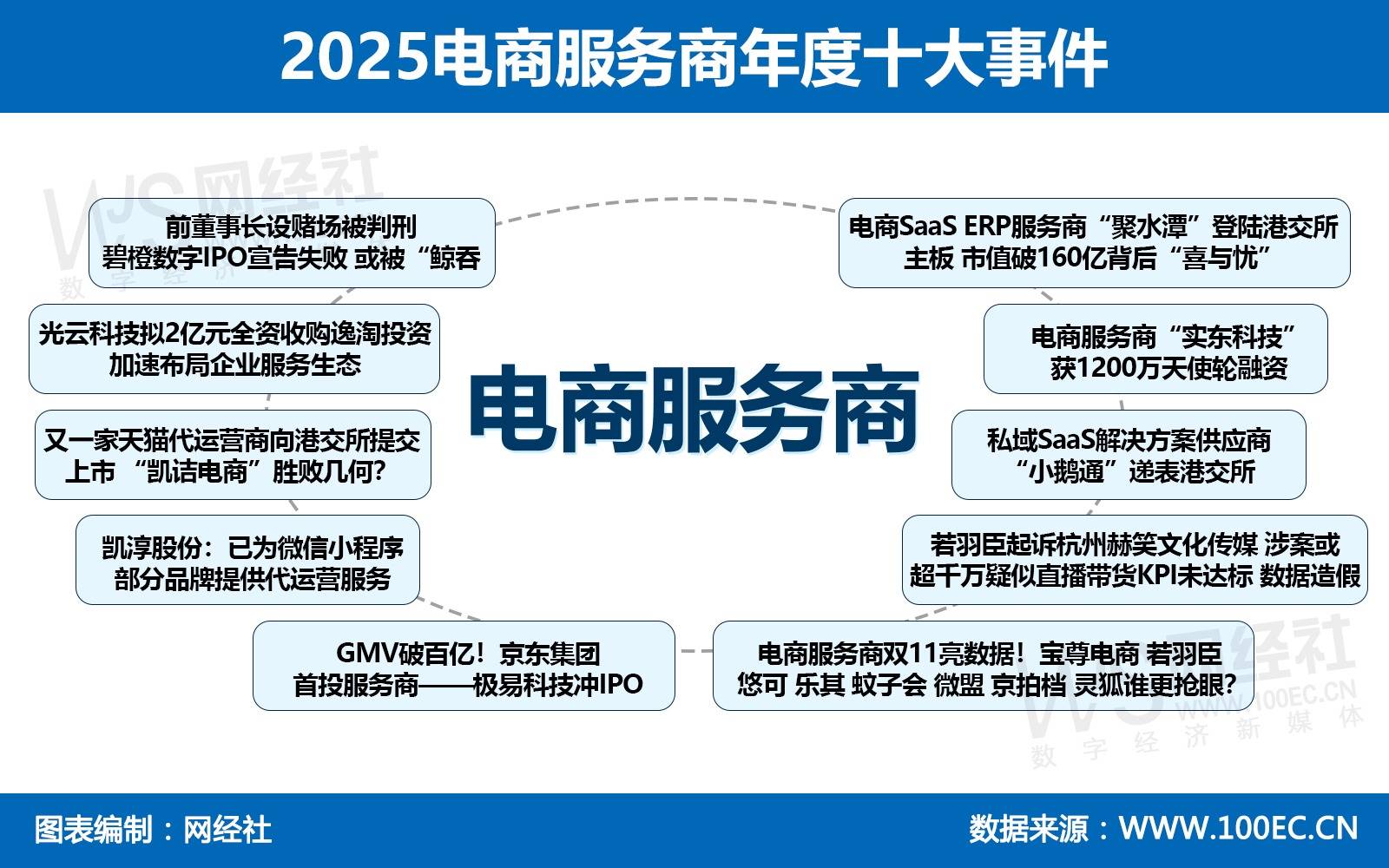
2025年电商服务商十大事件:聚水潭港交所上市 小鹅通递表 若羽臣陷千万讼案
Sou Hu Cai Jing· 2025-12-16 09:18
Core Viewpoint - In 2025, the Chinese e-commerce service industry experienced significant fluctuations in the capital market, with notable events including failed IPO attempts, successful listings, and strategic acquisitions among various service providers [1]. Group 1: Major Events - Event 1: The former chairman of Bicheng Digital was sentenced for operating an illegal casino, leading to the failure of its IPO and potential acquisition by DreamNet Technology [5]. - Event 2: Guangyun Technology plans to acquire Yitao Investment for 200 million yuan to enhance its enterprise service ecosystem [9]. - Event 3: Kaijie E-commerce submitted its IPO application to the Hong Kong Stock Exchange, raising questions about its potential success [5][9]. - Event 4: Kaichun Co. has begun providing operational services for brands on WeChat mini-programs, although the platform's features are still in testing [10]. - Event 5: Jindong Group's first investment in a service provider, Jiyi Technology, aims for an IPO after achieving over 10 billion yuan in GMV [5][14]. - Event 6: E-commerce SaaS ERP provider Jushuitan successfully listed on the Hong Kong Stock Exchange, achieving a market value of over 16 billion yuan [14]. - Event 7: Various e-commerce service providers showcased strong performance during the Double 11 shopping festival, highlighting the importance of AI tools and multi-channel operations [17]. - Event 8: Ruoyuchen filed a lawsuit against Hangzhou Hexiao Cultural Media, potentially involving over 10 million yuan, reflecting compliance challenges in the e-commerce industry [19]. Group 2: Financial Highlights - Jiyi Technology reported a GMV of 15 billion yuan in 2024, with over 1.7 billion yuan from the high-end beauty market, strengthening its position for market entry [14]. - Jushuitan's stock opened at 38.00 HKD, a 24% increase from its issue price, closing at 37.90 HKD, marking a 23.86% rise on its first trading day [14]. - Shidong Technology completed a 12 million yuan angel round of financing, indicating strong market recognition for its innovative approach in AI and new retail [22].
2025年中国连锁药店行业市场研究报告
硕远咨询· 2025-12-16 09:05
Investment Rating - The report does not explicitly state an investment rating for the industry Core Insights - The Chinese chain pharmacy industry is experiencing rapid growth, with the market size expected to exceed 1 trillion yuan by the end of 2024, indicating significant market potential [18] - The industry has maintained an average annual growth rate of over 10% in the past five years, driven by increased medical insurance coverage and rising consumer health awareness [20] - The market is becoming increasingly concentrated, with leading companies like Guoda Pharmacy, Yifeng Pharmacy, and Laobaixing Pharmacy dominating the market [39] Industry Overview - The chain pharmacy industry is defined as a collection of retail stores organized under a unified management system, sharing brand image, procurement channels, and service processes [4] - The industry has evolved from traditional single-store pharmacies to a more standardized and professional model, with significant growth in major cities [8] - The industry is categorized into three main types: direct chain pharmacies, franchise chain pharmacies, and mixed chain pharmacies [5] Market Size and Growth Trends - As of 2024, the number of chain pharmacy stores in China has surpassed 120,000, covering most provinces and major cities [18] - The industry is characterized by a "leading enterprises leading, regional strong players supporting" market structure, with significant market share held by top companies [18][39] - The growth of the industry is supported by government policies promoting healthcare consumption and capital market interest [10] Supply and Demand Analysis - Major chain pharmacy enterprises are concentrated in first-tier cities and economically developed second-tier cities, with a notable presence in eastern coastal regions [21] - The supply chain and logistics systems are crucial for improving operational efficiency and ensuring drug safety [24] - The variety of drugs offered includes prescription drugs, over-the-counter drugs, traditional Chinese medicine, and health products, catering to diverse consumer needs [26] Consumer Behavior and Preferences - The primary consumer groups include elderly patients with chronic diseases, young health management consumers, and families with regular medication needs [28] - Modern consumers prioritize drug quality, price transparency, and overall service experience, leading to a shift towards personalized health management services [31] - The integration of online and offline purchasing channels is becoming the mainstream trend in the pharmaceutical retail industry [34] Competitive Landscape - Leading companies like Guoda Pharmacy, Yifeng Pharmacy, and Laobaixing Pharmacy dominate the market, leveraging their financial strength and efficient supply chain management [37] - The market is highly concentrated, with the top ten chain pharmacies holding over half of the market share [39] - Regional competition varies, with intense competition in economically developed areas and significant growth potential in less developed regions [42] Policy and Regulatory Environment - The government has implemented strict regulations to ensure drug quality and safety, including licensing requirements and procurement standards [48] - Recent reforms in medical insurance policies have significantly impacted the operations of chain pharmacies, prompting them to optimize procurement and inventory management [50] - Regulatory measures are aimed at promoting standardized and compliant operations within the industry [51] Technological Development and Digital Transformation - The application of information technology, such as drug management information systems and customer relationship management (CRM) systems, is enhancing operational efficiency [58][59] - The integration of mobile payment and electronic prescriptions is transforming the purchasing process, improving customer experience [61] - The trend towards online and offline integration is driving the development of a comprehensive sales and service system [62]


