促消费

Search documents
胡衡华参加讨论并讲话
Xin Lang Cai Jing· 2026-01-29 18:46
Core Viewpoint - The government emphasizes the integration of investment in physical infrastructure and human capital to boost consumption and adapt to changing economic conditions [3]. Group 1: Investment Strategy - The government aims to address the contradiction between strong supply and weak demand by focusing on both physical and human investments [3]. - There is a need to shift investment priorities to improve infrastructure and public services, aligning with urban renewal and demographic trends [3]. Group 2: Consumption Enhancement - The strategy includes optimizing consumer supply to reflect the shift from goods consumption to service consumption and from uniform to diverse consumption [3]. - The government plans to create comprehensive scenarios that leverage local strengths and enhance innovation and service support [3]. Group 3: Employment and Policy Support - Efforts will be made to increase employment, reduce burdens, and improve policies to stimulate consumer spending [3]. - The government encourages committee members to actively contribute ideas and facilitate cooperation to promote consumption, investment, and stable growth [3].
江苏扬州:一场“扬味大集”燃动新春消费
Xin Lang Cai Jing· 2026-01-29 10:31
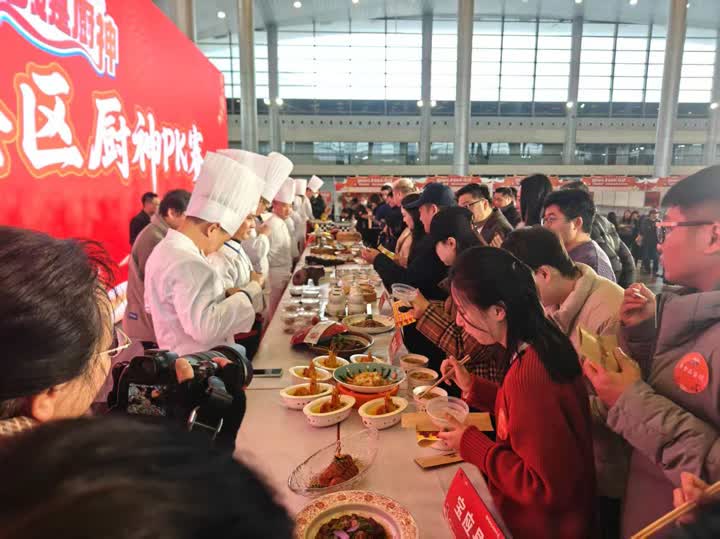
Core Insights - The "Yuegou Yangzhou · New Year Goods" promotional event successfully concluded, generating nearly 8 million yuan in sales over five days, significantly boosting consumer activity in Yangzhou during the Spring Festival [1][3][9] Group 1: Event Overview - The event featured nearly 160 merchants and over 2,000 unique products, creating a diverse shopping experience that included traditional goods, local delicacies, and cultural experiences [1][3] - The event was part of Yangzhou's broader "Come to Yangzhou · Celebrate the New Year · Prosperity" campaign aimed at enhancing consumer engagement during the festive season [1][9] Group 2: Sales Performance - The total sales during the event reached approximately 8 million yuan, with a notable increase in consumer participation and enthusiasm [3][9] - A significant highlight was the recharge area by Sinopec, which attracted over 1.8 million yuan in recharge transactions, showcasing the diverse spending habits of consumers [3] Group 3: Product Highlights - The event showcased a variety of local specialties, including Yangzhou's famous hairy crabs, geese, and various agricultural products, which were well-received by attendees [6][9] - Popular items included traditional snacks and innovative food products, with some brands reporting high sales volumes, such as over 500 chickens sold in a single day [3][6] Group 4: Consumer Engagement Strategies - The event integrated online and offline shopping experiences, with live streaming and promotional discounts enhancing consumer engagement [8][9] - Various promotional activities, such as trade-in subsidies for automobiles and home appliances, were implemented to encourage larger purchases [5][9] Group 5: Cultural Integration - The "I Am Chef" culinary competition featured 27 local delicacies, allowing consumers to experience Yangzhou's rich culinary heritage while shopping [9] - The event successfully combined traditional and modern elements, enriching the festive atmosphere and stimulating the local economy [9]

社会服务行业2026年投资策略:消费回暖在即,关注细分赛道复苏节奏
Southwest Securities· 2026-01-28 04:43
Core Insights - The report highlights a recovery in consumer spending, particularly in the tourism sector, with domestic tourism expected to grow significantly in 2025, with a projected increase of 16.2% in travel volume and 9.5% in tourism revenue [4][24] - The human resources sector is poised for growth due to ongoing government support and the integration of AI technologies, which are expected to enhance efficiency and reduce operational burdens [4][40] - The sports industry is set to expand rapidly, with clear policy direction aiming for a total industry scale of 7 trillion yuan by 2030, indicating substantial growth potential [4][59] Tourism Industry - The domestic tourism market is projected to maintain high growth rates, with urban residents expected to travel 4.996 billion times, a 14.3% increase, and rural residents 1.526 billion times, a 22.6% increase in 2025 [24][27] - Despite the growth, the tourism sector has not yet returned to pre-pandemic levels, with tourism revenue as a percentage of GDP at only 4.5% in 2025, compared to 5.7% in 2019 [27][28] - Consumer willingness to spend on tourism remains strong, with tourism consumption ranking first among various spending categories [31][30] Human Resources Industry - The human resources sector is characterized as a strong cyclical industry, benefiting from macroeconomic recovery and increasing demand for flexible labor solutions [33][38] - The penetration rate of flexible employment in China is significantly lower than in developed countries, indicating substantial growth potential as the market matures [48][49] - Government policies are increasingly supportive of the human resources sector, with a focus on protecting the rights of flexible workers and enhancing the overall market environment [38][40] Sports Industry - The sports industry is expected to see accelerated growth, with the total industry scale projected to reach 3.8 trillion yuan by 2024, and a target of 7 trillion yuan by 2030 [59][56] - The government's "National Fitness Plan" aims to increase the sports industry's contribution to GDP, with a target of 2% by 2025 [59][56] - The expansion of sports events, including new golf tournaments, is anticipated to drive growth and diversify revenue streams for companies in the sector [67][69] Investment Recommendations - The report recommends focusing on companies like Huangshan Tourism (600054.SH) and Lisheng Sports (002858.SZ), which are expected to benefit from favorable policies and market conditions [4][64][67] - Huangshan Tourism is projected to see revenue growth of 13.05% in 2025, with a net profit increase of 19.83% [64] - Lisheng Sports is expected to achieve significant revenue growth of 30.02% in 2025, with a turnaround to profitability anticipated [67]
河南许昌双轮驱动激活潜能
Jing Ji Ri Bao· 2026-01-28 02:50
Core Viewpoint - The city of Xuchang is focusing on boosting consumption and expanding effective investment through a series of key projects and initiatives in the first quarter of 2026, aiming to stimulate economic growth and ensure a strong start to the 14th Five-Year Plan [1][2] Group 1: Key Projects - Xuchang plans to commence 174 key projects in various sectors, including advanced manufacturing and infrastructure, in the first quarter of 2026 [1] - The city is set to implement over 280 new key projects this year, with a focus on thorough preparation and resource allocation [1] - There are 128 ongoing projects that will be closely monitored to ensure compliance with environmental protection measures and to accelerate construction progress [1] Group 2: Consumption Initiatives - Xuchang is prioritizing the implementation of "national subsidies" as a key focus for consumption stimulation in the first quarter [1] - The city is launching multiple promotional activities targeting key demographics, such as those returning home for the Spring Festival, to enhance consumer spending [1] - Efforts are being made to optimize the review and payment processes for trade-in policies in sectors like automobiles, home appliances, and digital products, aiming to make these areas consumption hotspots during the New Year [1]
国家为何拟在50城试点有奖发票?揭秘背后的以小搏大
Sou Hu Cai Jing· 2026-01-28 02:16
同时,有奖发票还有另一个重要功能,就是利用"概率激励"引导全国人民参与对依法纳税、合规开票的 监督。它一定程度上标志着中国财税治理进入了新的阶段:从以前依靠对土地出让金和重资产工厂 的"粗放征管",转向对微观消费、碎片化收入的"精细监管"。 国家统计局数据显示,2025年中国社会消费品零售总额约为50.12万亿元。其中,餐饮收入为5.8万亿 元。但在实际生活中,餐饮、零售、美容美发、家政服务等行业,存在着极高的"不入账交易",潜在的 税收流失不少。 有奖发票的底层逻辑是:国家拿出一定量的奖金,吸引14亿人去倒逼商家开票。只要大家养成了"消费 必开票"的习惯,那流失的税款就能被一点点收回来,实现以小搏大。 2026年1月28日 09:25北京今年初,财政部、商务部、国家税务总局决定联合开展有奖发票试点工作。 近日,三部门联合公示了50个拟开展有奖发票试点城市的名单,这项旨在进一步激发消费需求、释放消 费活力的惠民政策即将落地见效。 这次从国家层面上推动开展有奖发票试点,从政策设计之初就牢牢把握住"促消费"这一着力点。试点政 策从需求端发力,覆盖购物、外出就餐、旅游住宿、文体活动、生活服务等与居民"衣食住行"密切 ...
大力促消费 功夫不负“有心人”
Xin Lang Cai Jing· 2026-01-27 17:53
Group 1 - The core focus of Beijing's 2026 key work is to vigorously promote consumption, with a specific emphasis on enhancing residents' income and consumption capacity [1] - The government plans to formulate policies aimed at increasing urban and rural residents' income, addressing consumption bottlenecks to encourage residents to consume more [1] - The report outlines a roadmap for boosting consumption, focusing on both goods and services, and aims to optimize commercial layouts and improve the quality of traditional business districts [1] Group 2 - The integration of cultural, commercial, tourism, and sports events is seen as a significant opportunity to stimulate consumption, particularly through attracting non-local consumers [2] - The development of new consumption scenarios, such as leisure, fashion, and winter sports, is identified as a key strategy to activate consumer spending and expand the consumption supply chain [2] - The transition from high-speed economic growth to high-quality development highlights the critical role of consumption, necessitating a long-term strategy to cultivate new consumption habits and expand domestic demand [2]
【西街观察】大力促消费,功夫不负“有心人”
Bei Jing Shang Bao· 2026-01-27 14:56
Group 1 - The core focus of the 2026 work plan in Beijing is to vigorously promote consumption, with an emphasis on enhancing residents' consumption capacity through income increase policies [1] - The government aims to address consumption bottlenecks, ensuring that residents can, dare, and are willing to consume, with income being the primary barrier [1] - The central economic work conference has prioritized "domestic demand-led growth and building a strong domestic market" as the top task for 2026, explicitly requiring the formulation and implementation of urban and rural resident income increase plans [1] Group 2 - The report outlines a roadmap for "greatly boosting consumption," focusing on both goods and services, aiming for both stock and incremental growth [1] - For goods consumption, the strategy includes optimizing commercial layouts, enhancing the quality of traditional business districts, and addressing service gaps in communities and specialty streets [1] - The shift from a goods-centric consumption model to a balanced focus on both goods and services is crucial, with an emphasis on improving service consumption in sectors like education, health, and elderly care [1] Group 3 - The integration of cultural, commercial, tourism, and sports events is seen as a significant opportunity to stimulate consumption, particularly through attracting non-local consumers [2] - The "first store economy," "first launch economy," and "night economy" are interconnected, creating a multiplier effect that expands consumption space [2] - The current economic transition from high-speed growth to high-quality development highlights the critical role of consumption, necessitating a long-term strategy to cultivate new consumption habits and expand domestic demand [2]
让“开发票”成为习惯
Sou Hu Cai Jing· 2026-01-27 12:37
发票依然是税收征管的基础。发票记录了交易的主体、金额、时间等信息,是经济活动的"留痕"。税务 部门可以通过发票信息追踪资金和货物流向,掌握纳税人的真实经营情况,有效防止隐匿收入、虚列成 本等偷逃税行为。尤其在增值税领域,作为抵扣凭证,发票在"开票方"与"受票方"之间可形成牵制,通 畅抵扣链条。 同时,发票数据是税收大数据分析的核心来源,在税收征管的风险识别、行业比对和精准稽查等方面发 挥重要作用。 更重要的是,发票是消费者购买商品或服务的凭证,可以在维权、保修、退货等活动中保障消费者的合 法权益。 近日,商务部、财政部、税务总局对外公示拟开展有奖发票试点城市名单,包括北京、天津、上海、重 庆、大连等50个城市。今后在这些试点城市,居民在购物、就餐、旅游、住宿等过程中,取得票面金额 在一定额度以上的发票,均可参与发票抽奖活动。 有奖发票是低成本、广覆盖、见效快的促消费工具,核心是通过"小奖励" 撬动 "大消费",给消费增加 "抽奖乐趣",尤其是刺激餐饮、零售、文旅等高频刚需消费。当一张张发票化作抽奖机会,不仅是一个 有效激发消费热情的小惊喜,还是一篇推动规范市场秩序的大文章——挤压违法商户的生存空间,让合 规企 ...
烟台入选拟开展有奖发票试点城市
Qi Lu Wan Bao· 2026-01-27 12:24
Core Viewpoint - Yantai has been selected as a pilot city for a national prize invoice initiative aimed at stimulating consumer spending through incentive policies [1] Group 1: Program Details - The prize invoice initiative is a collaborative effort by the Ministry of Finance, Ministry of Commerce, and State Taxation Administration [1] - The program will cover eight major consumer sectors: retail, catering, accommodation, cultural arts, entertainment, tourism, sports, and residential services [1] - The trial period for the initiative is set for six months, during which consumers can participate in a lottery by obtaining eligible invoices [1] Group 2: Participation Requirements - To qualify for the lottery, invoices must meet four key criteria: a minimum face value of 100 yuan, must be a general VAT invoice, the purchaser must provide their real name, and the invoice must be issued in the name of an individual consumer [1] - The maximum prize amount for a single invoice is 800 yuan [1] Group 3: Implementation Timeline - Yantai's relevant departments are actively working on the implementation plan and technical platform integration, aiming to launch the prize invoice activity before the Spring Festival [2] - Specific lottery rules, prize settings, and redemption processes will be clarified and announced through official channels [2]
出政策办活动优场景,促消费今年继续加力
Ren Min Ri Bao· 2026-01-27 09:01
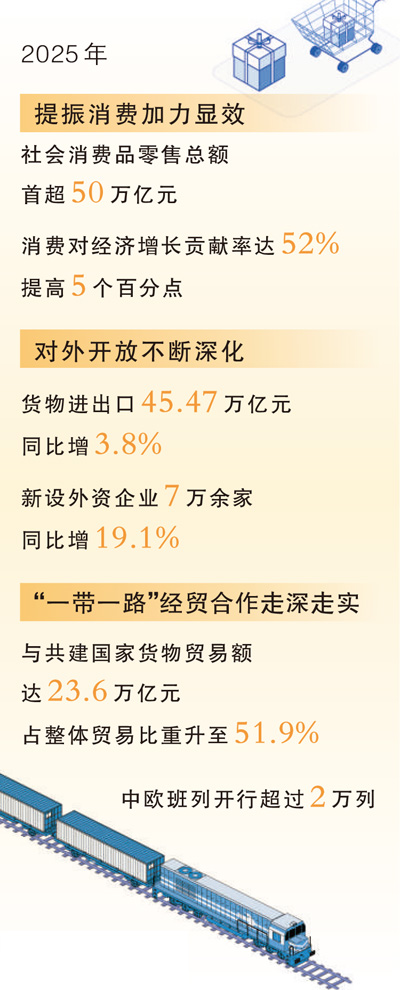
Core Insights - In 2025, China's total retail sales of consumer goods exceeded 50 trillion yuan for the first time, reaching 50.1 trillion yuan, with a year-on-year growth of 3.7% and a contribution rate to economic growth increasing by 5 percentage points to 52% [3][4] - The foreign trade maintained resilience, with total imports and exports reaching 45.47 trillion yuan, a year-on-year increase of 3.8%, and the number of newly established foreign-funded enterprises exceeding 70,000, up 19.1% [5][6] Economic Performance - The retail sales of consumer goods surpassed 50 trillion yuan, driven by policies and activities aimed at boosting consumption, with significant growth in both goods and service consumption [3][4] - The service retail sector saw a year-on-year growth of 5.5%, with specific services like cultural entertainment and tourism experiencing double-digit growth [3][4] Foreign Trade and Investment - The total value of goods traded with Belt and Road Initiative countries reached 23.6 trillion yuan, growing by 6.3%, which is 2.5 percentage points faster than overall trade growth [8] - The number of active trading entities exceeded 780,000, with private enterprises accounting for 57.3% of total foreign trade [5][6] Policy Initiatives - The Ministry of Commerce plans to enhance consumer support through policies, activities, and improved consumption environments, including trials for automobile circulation reforms and international consumption environment construction [4][5] - The government aims to attract foreign investment by optimizing support policies and ensuring equal participation of foreign enterprises in domestic consumption and procurement activities [6][7] International Cooperation - China signed 24 free trade agreements with 31 countries and regions, covering 45% of total goods trade, and actively participated in global trade discussions [8][10] - The "Belt and Road" initiative continues to deepen economic cooperation, with significant investments in infrastructure and trade facilitation projects [8][10]