
战略性新兴产业

Search documents
中央企业2025年成绩单发布 呈现哪些新变化?
Ren Min Ri Bao· 2026-01-28 23:08
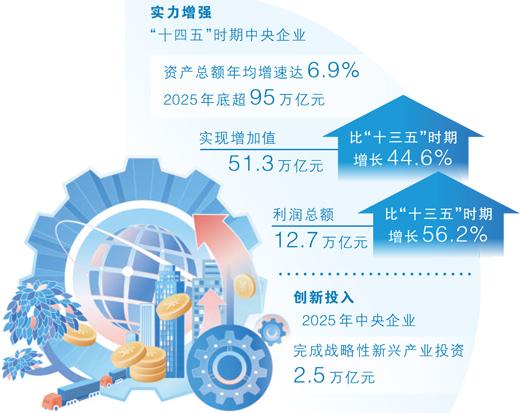
Core Insights - The State-owned Assets Supervision and Administration Commission (SASAC) announced that central enterprises achieved a total profit of 2.5 trillion yuan, fixed asset investment of 5.1 trillion yuan, and tax contributions of 2.5 trillion yuan by 2025, with total assets exceeding 95 trillion yuan by the end of 2025 [2] Group 1: Scale and Performance - During the 14th Five-Year Plan period, the total assets of central enterprises increased significantly, with an average annual growth rate of 6.9%, reaching over 90 trillion yuan [3] - The added value of central enterprises reached 51.3 trillion yuan, a 44.6% increase compared to the previous five-year period, while total profits grew by 56.2% to 12.7 trillion yuan [3] - Key product outputs, such as crude oil production, electricity generation, and electricity sales, saw substantial growth of 24.7%, 38.2%, and 40.7% respectively [3] Group 2: Investment in Innovation - Central enterprises invested over 5 trillion yuan in R&D during the 14th Five-Year Plan, with R&D intensity increasing by 0.27 percentage points and the number of technology talents rising by nearly 50% [3] - By 2025, R&D investment is projected to reach 1.1 trillion yuan, with significant achievements including the addition of 22 academicians and the formation of 23 innovation consortia involving over 100 entities [4] Group 3: Strategic Emerging Industries - In 2025, revenue from strategic emerging industries exceeded 12 trillion yuan, with a continuous annual growth of 1 trillion yuan, and their share of total revenue increased by over 10 percentage points compared to 2022 [6] - Investment in strategic emerging industries reached 2.5 trillion yuan, accounting for 41.8% of total investments [6] Group 4: Traditional Industry Transformation - Central enterprises are focusing on upgrading traditional industries, establishing 70 advanced intelligent factories and 39 projects recognized as national green low-carbon technology demonstration projects [8] - The integration of AI technology is being actively pursued, with significant investments in new infrastructure and the development of large models to support various industries [9] Group 5: Future Directions - In 2026, central enterprises will enhance procurement of first sets and batches of products, aiming for continuous growth in value added and alignment with national GDP growth [10][11] - The focus will be on increasing high-quality technological supply, improving foundational research investment, and accelerating the transformation of innovative achievements into productive forces [11]

央企在战略性新兴产业累计投资超10万亿元
Xin Lang Cai Jing· 2026-01-28 23:07
Core Viewpoint - The State-owned Assets Supervision and Administration Commission (SASAC) reported that since the beginning of the 14th Five-Year Plan, central enterprises have invested over 10 trillion yuan in strategic emerging industries, increasing their investment share from 22% to over 40% of total investments [1][2]. Group 1: Investment in Emerging Industries - By 2025, central enterprises are expected to complete an investment of 2.5 trillion yuan in strategic emerging industries, accounting for 41.8% of total investments [2]. - The revenue scale of central enterprises in strategic emerging industries is projected to exceed 12 trillion yuan by 2025, achieving a consistent annual growth of 1 trillion yuan over three years [2]. - The SASAC is drafting a document to guide central enterprises in cultivating new pillar industries, aiming for leapfrog development in major project investments and key field breakthroughs [2]. Group 2: Upgrading Traditional Industries - Central enterprises are leading large-scale equipment renewal actions, establishing 70 excellent smart factories and nurturing 6 leading smart factories by 2025 [3]. - The SASAC has been promoting the "AI+" initiative for two consecutive years, focusing on energy, manufacturing, and communication sectors to create over 1,000 application scenarios for artificial intelligence [3]. Group 3: Enhancing Supply Chain Resilience - Central enterprises are implementing key industry chain high-quality development actions, focusing on food security, energy resources, and high-end equipment to maintain the safety of the national supply chain [5]. - The SASAC aims to create a number of new pillar industries and strengthen layouts in fields such as new energy, aerospace, and quantum technology, while planning for future competitive sectors [5].
构建高能级创新平台体系推动科技创新和产业创新深度融合
Xin Lang Cai Jing· 2026-01-28 23:06
Core Viewpoint - The statement emphasizes the need to seize the historical opportunities presented by the new round of technological revolution and industrial transformation, advocating for the deep integration of technological and industrial innovation [2] Group 1: Technological and Industrial Innovation - The proposal suggests leveraging the advantages of characteristic industries to address shortcomings in innovation platforms by actively connecting with national laboratories and comprehensive national science centers to enhance basic research and original innovation capabilities [2] - It focuses on strategic emerging industries, aiming to attract scientists and core teams to establish new national-level technology innovation platform bases [2] Group 2: Management and Evaluation Systems - The recommendation includes optimizing management models to stimulate the vitality of innovation platforms by establishing a classification evaluation system oriented towards innovation value and industrial contribution, granting autonomy in fund usage and resource allocation to innovation platforms and researchers [2] - It also proposes a talent evaluation system based on innovation contributions and application of results to fully unleash the innovative potential of researchers [2] Group 3: Regional Collaboration - The statement advocates for coordinated regional development to promote the synergy of mountain and sea resources, deepening technological exchange and cooperation with the Yangtze River Delta and Guangdong-Hong Kong-Macau Greater Bay Area [2] - It supports joint applications for provincial science and technology project plans by coastal and mountainous cities, as well as cross-city industrial technology joint tackling and platform co-construction [2] Group 4: Enterprise Engagement - The proposal emphasizes strengthening the leading role of enterprises in promoting the deep integration of "two innovations" (technological and business innovation) by encouraging "chain leader" technology enterprises to lead the formation of innovation alliances [2] - It suggests establishing a regular cooperation mechanism between major research institutions and enterprises to support collaborative technological breakthroughs and the transformation of research results into industrial momentum [2]
2025年研发投入1.1万亿元、战略性新兴产业营收规模增长万亿元 两个万亿元,标注国资央企创新刻度(权威发布)
Ren Min Ri Bao· 2026-01-28 22:08
Core Insights - The State-owned Assets Supervision and Administration Commission (SASAC) announced that central enterprises achieved a total profit of 2.5 trillion yuan, fixed asset investment of 5.1 trillion yuan, and tax contributions of 2.5 trillion yuan by 2025, with total assets exceeding 95 trillion yuan by the end of 2025 [1] Group 1: Scale and Performance - During the 14th Five-Year Plan period, the total assets of central enterprises increased significantly, with an average annual growth rate of 6.9%, reaching over 90 trillion yuan [2] - The added value of central enterprises reached 51.3 trillion yuan, a 44.6% increase compared to the previous five-year period, while total profits grew by 56.2% to 12.7 trillion yuan [2] - Key product outputs showed stable growth, with crude oil production increasing by 24.7%, and electricity generation and sales rising by 38.2% and 40.7% respectively [2] Group 2: Innovation and R&D - Central enterprises invested over 5 trillion yuan in R&D during the 14th Five-Year Plan, with a nearly 50% increase in the number of scientific and technological personnel [2][3] - By 2025, R&D investment is projected to reach 1.1 trillion yuan, with significant achievements in major national technology projects [3] - Central enterprises are leading or participating in all 22 major national technology projects, overcoming 121 leading technologies [3] Group 3: Strategic Emerging Industries - In 2025, revenue from strategic emerging industries exceeded 12 trillion yuan, with a 41.8% share of total investment [4] - Central enterprises have invested over 10 trillion yuan in strategic emerging industries since the beginning of the 14th Five-Year Plan [4][5] - The focus on emerging industries is essential for optimizing structural layouts and ensuring future development [5] Group 4: Traditional Industry Transformation - Central enterprises are upgrading traditional industries by establishing smart factories and promoting green and intelligent transformations [6] - The construction of 70 excellent-level smart factories and 39 projects included in the national green low-carbon advanced technology demonstration project list reflects this transformation [6] Group 5: Technology and Infrastructure - Central enterprises are actively embracing artificial intelligence and investing in new infrastructure, enhancing computational resources to support large model training [7] - The development of high-value application scenarios in key industries such as energy and manufacturing is underway, with over 1,000 application scenarios being created [7] Group 6: Future Goals and Strategies - In 2026, central enterprises will focus on ensuring continuous growth in added value and optimizing various performance indicators [9] - The emphasis will be on enhancing technological innovation, with plans to increase the proportion of basic research investment and tackle key technologies [9] - Central enterprises will also accelerate the construction of pilot verification platforms to facilitate the transformation of innovative achievements into productive forces [9]
央企2025“成绩单”:资产超95万亿元 利润2.5万亿元
Xin Lang Cai Jing· 2026-01-28 21:00
Core Insights - By the end of 2025, state-owned enterprises (SOEs) are projected to have total assets exceeding 95 trillion yuan and achieve a total profit of 2.5 trillion yuan, with fixed asset investments reaching 5.1 trillion yuan and tax contributions of 2.5 trillion yuan [1][2] - R&D investment is expected to reach 1.1 trillion yuan, maintaining over 1 trillion yuan for four consecutive years, with significant advancements in various cutting-edge fields through the participation of over 100 innovative entities in 23 innovation alliances [1][2] - Investments in strategic emerging industries are projected to total 2.5 trillion yuan, accounting for 41.8% of total investments, with revenue from these industries exceeding 12 trillion yuan, marking a consistent annual growth of 1 trillion yuan for three years [1][2] Investment and Development - SOEs are expected to have over 70% of their revenue coming from sectors critical to national security, the economy, and public welfare by 2025 [2] - Cumulative investments and support funds are anticipated to reach 16.03 billion yuan and 11.41 billion yuan respectively, with training for 1.487 million personnel and procurement of agricultural products from poverty-stricken areas amounting to 19.83 billion yuan [2] - New enterprises such as China Yajiang Group and China Chang'an Automobile are being established, while existing companies like China FAW and China Tourism Group are integrating resources in sectors like power batteries and cruise operations [2] Future Directions - The State-owned Assets Supervision and Administration Commission (SASAC) aims to create new pillar industries by establishing market-oriented and specialized platforms for state capital operations, focusing on sectors such as new energy, new energy vehicles, new materials, aerospace, low-altitude economy, quantum technology, and 6G [2]
贵州今年将落实职工带薪错峰休假制度 山西林草局后勤中心多收居民电费
Xin Lang Cai Jing· 2026-01-28 19:57
Group 1 - Guizhou government plans to implement paid staggered leave for employees to boost consumption [1] - Guizhou's initiatives include optimizing consumption policies and promoting traditional sectors like dining and retail [1] - The government aims to stabilize key consumer goods such as automobiles and home appliances [1] Group 2 - Shenzhen's Nanshan District becomes the first district in China to achieve a GDP exceeding 1 trillion yuan [2] - Nanshan's GDP has grown from 7.8 billion yuan in 1990 to over 1 trillion yuan, marking significant economic development [2] - The district's strategic emerging industries, including AI and high-end medical devices, account for 60% of its GDP [2] Group 3 - Gansu's Dibe County experienced a 5.5 magnitude earthquake, causing damage to infrastructure but maintaining operational utilities [4] - The earthquake resulted in damage to 25 infrastructure sites, including municipal pipelines and heating systems [4] - Recovery efforts are underway, with primary pipelines already starting to be pressurized [4] Group 4 - Inner Mongolia plans to provide 124,000 job opportunities through its 2026 Spring Breeze Action employment initiative [5] - The initiative includes over 3,000 public service activities, with at least 900 focused on job assistance [5] - The program aims to facilitate employment for local laborers, including those seeking opportunities in Beijing [5] Group 5 - A collision between two fishing vessels in Hainan resulted in one sinking and two fatalities, with the captain facing potential criminal charges [6] - The incident highlights safety concerns in maritime operations, particularly under adverse weather conditions [6] - The economic loss from the accident is estimated at 1.5 million yuan [6] Group 6 - Increased safety patrols and protective measures have been implemented in Xinjiang following a snow leopard attack on a tourist [7] - The incident underscores the growing presence of snow leopards in the region due to improved ecological conditions [7] - Local authorities are enhancing public safety measures and awareness in areas frequented by wildlife [7] Group 7 - A fire incident in Chongqing led to a 50-meter crack in a residential building, attributed to damage from the fire [8] - Initial assessments indicate that the fire did not compromise the structural integrity of the building [8] - A third-party evaluation will be conducted to ensure safety and determine necessary remediation actions [8]

国务院国资委:去年央企资产总额突破95万亿元
Qi Huo Ri Bao Wang· 2026-01-28 18:44
Core Viewpoint - The State-owned Assets Supervision and Administration Commission (SASAC) outlines ambitious targets for central enterprises by 2025, including total assets exceeding 95 trillion yuan and profit reaching 2.5 trillion yuan, emphasizing the role of these enterprises in supporting national economic goals [1][2]. Group 1: Financial Performance and Investment - By the end of 2025, central enterprises are expected to achieve total assets of over 95 trillion yuan and profits of 2.5 trillion yuan, with fixed asset investments of 5.1 trillion yuan and tax contributions of 2.5 trillion yuan [1]. - During the "14th Five-Year Plan" period, central enterprises' total assets increased from 70 trillion yuan to 90 trillion yuan, with an average annual growth rate of 6.9% [1]. - The total profit of central enterprises reached 12.7 trillion yuan, marking a 56.2% increase compared to the previous five-year period [1]. Group 2: Research and Development - Central enterprises' R&D investment is projected to reach 1.1 trillion yuan in 2025, maintaining over 1 trillion yuan for four consecutive years, with 23 innovation alliances involving over 100 entities [1]. - Cumulatively, R&D investment during the "14th Five-Year Plan" exceeded 5 trillion yuan, with an increase in R&D intensity by 0.27 percentage points and a nearly 50% rise in the number of technology talents [2]. Group 3: Strategic Initiatives and Reforms - SASAC plans to focus on the "three concentrations" of state capital, emphasizing restructuring and integration to optimize the layout and structure of state-owned enterprises [2]. - Future initiatives include promoting high-quality mergers and acquisitions to acquire core resources and enhance technological capabilities, while reducing industry competition [2]. - The central enterprises' 2026 work plan emphasizes five key areas: improving quality and efficiency, enhancing technological innovation, optimizing layout, advancing reforms, and strengthening risk prevention [3].
云南两会观察:生态大省工业发展向“新”向“绿”
Zhong Guo Xin Wen Wang· 2026-01-28 17:20
Group 1 - The core viewpoint highlights the significant industrial growth in Yunnan province, with industrial added value surpassing 760 billion yuan and an average annual growth rate of 5.9% since the 14th Five-Year Plan [1] - Yunnan is focusing on green transformation and exploring the integration of ecological value with economic benefits, aiming to enhance traditional industries and develop strategic emerging industries [1] - The industrial added value in Yunnan is projected to increase from 563 billion yuan in 2020 to 762.9 billion yuan by 2025, with an average annual growth rate of 4.8% [1] Group 2 - The new industrial momentum in Yunnan is significantly strengthening, with the total output value of strategic emerging industries increasing by 3 percentage points compared to 2020 [2] - The annual growth rates for high-tech manufacturing and equipment manufacturing added value are 25.8% and 28.3%, respectively [2] - By 2025, the added value of the electronics industry, high-tech manufacturing, and equipment manufacturing is expected to grow by 22.7%, 17.6%, and 17.7% respectively, indicating robust growth [2] Group 3 - Yunnan's clean energy advantages are being rapidly transformed into industrial strengths, with the province's green electricity installed capacity and proportion ranking among the top in the country [3] - The carbon dioxide emissions per kilowatt-hour of electricity generated in Yunnan are the lowest in the country at only 0.13 kilograms [3] - By 2025, hydropower and solar power generation are expected to increase by 5.6% and 33.7%, respectively, with clean electricity accounting for 87.6% of the total [3] - The "new three" industries, represented by green aluminum, silicon photovoltaic, and new energy batteries, are rapidly emerging, with expected increases in added value of 75.9%, 12.1%, and 3.2% respectively by 2025 [3] - The green aluminum industry chain is projected to exceed 100 billion yuan in 2023 and reach 180 billion yuan by 2025 [3] - During the 15th Five-Year Plan, Yunnan aims to establish itself as a major clean energy base, strategic non-ferrous metal industry base, and a world-class tourism destination while enhancing its green aluminum, silicon photovoltaic, and phosphate chemical industries [3]
【新华解读】国资央企交2025年“成绩单” 今年工作重点将会有哪些?
Xin Hua Cai Jing· 2026-01-28 15:37
Core Insights - The central enterprises' total assets are expected to exceed 95 trillion yuan by the end of 2025, with a profit target of 2.5 trillion yuan and fixed asset investments of 5.1 trillion yuan [1] - The focus of state-owned enterprise reform has shifted from foundational reforms to aligning with national strategies and fostering new productive forces, with strategic emerging industries becoming the core engine of development [3][4] Group 1: Reform and Governance - The reform actions have achieved systematic breakthroughs in optimizing layout, improving governance, and strengthening supervision, with over 70% of revenue from central enterprises linked to national security and economic lifelines [2] - The enhancement of governance effectiveness is a key highlight, with the implementation of a personalized assessment mechanism where 76% of indicators are tailored to individual enterprises, promoting a shift from scale expansion to quality and efficiency [2][4] - The next steps will focus on further deepening reforms to address systemic barriers and prominent issues [2] Group 2: Strategic Emerging Industries - Central enterprises are expected to invest 2.5 trillion yuan in strategic emerging industries by 2025, accounting for 41.8% of total investments, with revenue from these sectors projected to exceed 12 trillion yuan [4] - Mergers and acquisitions are emphasized as crucial for industrial upgrades, with significant consolidations occurring in key sectors [4] - The integration of artificial intelligence with the real economy is creating new industrial opportunities, with initiatives like the "AI+" program being implemented [5] Group 3: Innovation and Technology - The focus on enhancing innovation capabilities includes increasing investment in basic research and establishing platforms for technology transfer [5][6] - Central enterprises are expected to play a significant role in the supply of intelligent computing facilities and AI solutions, creating vast market opportunities in various sectors [5][6] - The government is drafting policies to support the cultivation of emerging pillar industries, aiming to create a comprehensive system for technology sourcing and industrial incubation [6] Group 4: Future Development Goals - The State-owned Assets Supervision and Administration Commission (SASAC) has outlined five key work deployments for 2026, emphasizing high-quality development and ensuring value-added growth aligns with GDP growth [7] - The focus will be on optimizing layouts in sectors like renewable energy, low-altitude economy, and quantum technology, while also enhancing the integration of technology and industry [7][8] - Risk prevention and reform efforts will be synchronized, with mechanisms established to mitigate investment, debt, and overseas business risks [7]
最高法:惩治伪造或编撰数据、将他人商业秘密申请专利行为
2 1 Shi Ji Jing Ji Bao Dao· 2026-01-28 15:21
Core Viewpoint - The Supreme People's Court of China has reported on the operation of the national-level intellectual property case appeal mechanism after seven years, highlighting a significant increase in patent authorization and confirmation cases, particularly in invention patents, which have seen an annual growth rate of 31.8% [1] Group 1: Case Statistics - The number of patent authorization and confirmation cases accepted by the courts has been steadily increasing, with invention patents accounting for over 50% of these cases [1] - Cases related to strategic emerging industries have risen significantly, with their proportion increasing from less than one-quarter to around one-third [1] Group 2: Judicial Actions - The Supreme People's Court has taken a firm stance against dishonest practices, such as falsifying data and applying for patents on others' trade secrets, stating a clear "no" to these behaviors [1] - The court has actively referred cases involving patent agencies and agents engaging in self-representation to relevant authorities for further action, effectively punishing dishonest conduct [1]