指数增强

Search documents
聚焦“专精特新” 浦银安盛北证50成份指数基金今日发行
Quan Jing Wang· 2025-07-10 01:27
Group 1 - The core viewpoint of the news is the official launch of the Puyin Ansheng North Index 50 Component Index Fund, which is the only broad-based index on the Beijing Stock Exchange, selecting the top 50 securities based on market capitalization and liquidity [1][2] - The fund includes many specialized and innovative enterprises across emerging industries such as AI, humanoid robots, innovative pharmaceuticals, and new energy, showcasing both technological content and growth potential [1] - This launch signifies the deepening of Puyin Ansheng's "Global Sci-Tech Innovator" and "Index Family" brands, representing a significant move by financial institutions to implement technology finance initiatives [1] Group 2 - The North Index 50 Component Index Fund is part of Puyin Ansheng's strategic layout for index products, complementing existing index enhancement products and ETFs across major exchanges, thus achieving comprehensive tracking of various market segments [2] - This initiative further advances Puyin Ansheng's "Global Sci-Tech Innovator" brand by guiding long-term capital towards the main battlefield of technological innovation in the capital market, enhancing wealth management for residents, and sharing the dividends of China's "hard technology" development [2] - The fund enriches the "Index Family" product matrix, providing differentiated allocation tools for small and micro-cap growth styles, catering to investors' demand for high elasticity and high growth [1][2]
小盘股的盛宴!今年的“指增王”又新高了
Sou Hu Cai Jing· 2025-07-08 05:37
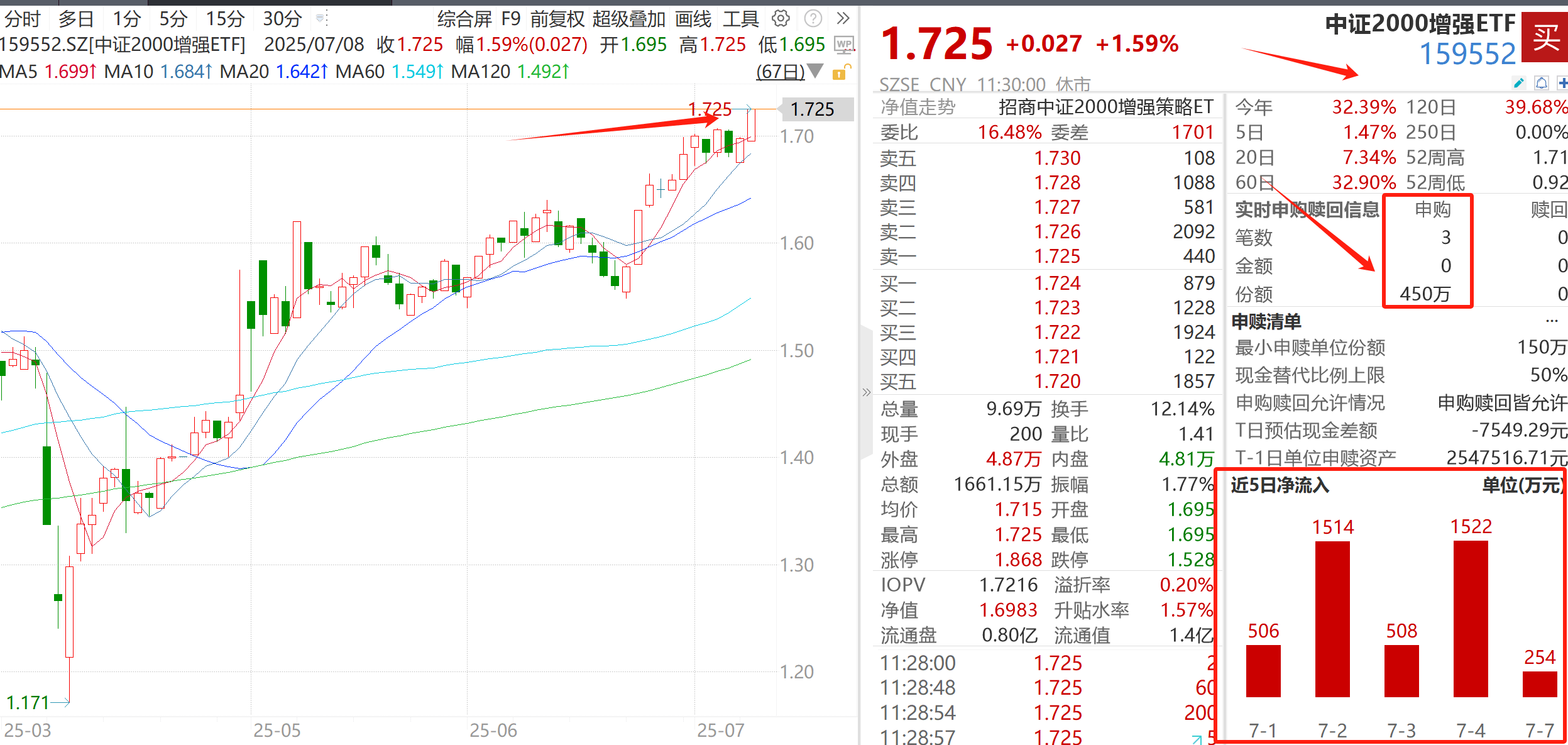
Core Insights - The small-cap stocks continue to lead the market, with the CSI 2000 Enhanced ETF (159552) experiencing a 722% increase in scale and approximately 32% returns year-to-date, making it a dual champion among broad-based ETFs [1][3] - The CSI 2000 Enhanced ETF has shown over 73% returns in the past year, with its scale and net value reaching historical highs throughout the year, demonstrating consistent and stable enhancement capabilities [3][5] Performance Comparison - Since the beginning of 2025, the CSI 300 index has risen by less than 1%, while the CSI 2000 has increased by 15%, highlighting a significant performance gap [5] - Historical data indicates that during market uptrends, small-cap stocks tend to outperform larger-cap stocks, with small-cap stocks having a median elasticity coefficient of 1.73 compared to 0.92 for large-cap stocks from 2010 to 2024 [5] Market Drivers - The strong performance of small-cap stocks this year is attributed to favorable market conditions, including significant rallies in February and April, and the recent performance of sectors like military and innovative pharmaceuticals [5] - Continuous liquidity easing signals from the central bank have lowered market funding costs, making small-cap stocks more sensitive to liquidity changes, which has been a crucial factor in their rise [5] Future Outlook - The future performance of the CSI 2000 Enhanced ETF will depend on two key indicators: the progress of mergers and acquisitions among small-cap companies and the earnings growth and recovery of small-cap indices in the upcoming semi-annual reports [6] - If these indicators are favorable, it could accelerate the small-cap stock market, potentially providing significant upside for the CSI 2000 Enhanced ETF [6]

上周新发募资逾53亿元 股基领跑债基降温
Zheng Quan Shi Bao· 2025-07-06 18:10
Group 1 - The overall market saw the establishment of 20 new funds last week, with a total issuance scale of only 5.328 billion yuan, marking the lowest weekly fundraising since April this year, with an average fundraising of only 266 million yuan per fund [1] - Despite the overall sluggish issuance market, there are structural highlights, with equity funds leading the way, accounting for 60.54% of the total issuance, reflecting institutional confidence in equity assets [1] - The issuance of bond funds has significantly cooled down, with only 3 products raising 1.067 billion yuan, a decline compared to previous strong performances [1] Group 2 - Passive index funds became the main force in new fund issuance last week, accounting for over 60%, with over 20 products launched covering popular sectors such as securities, technology, consumption, and pharmaceuticals [2] - Enhanced index funds are also favored by public fund managers, with several products launched to meet investors' demand for excess returns through quantitative strategies [2] - Although the overall scale of newly issued funds last week was limited, many institutions are preparing for the second half of the year, with multiple funds pending approval across various themes [2]
四大指增组合年内超额均逾8%【国信金工】
量化藏经阁· 2025-07-06 04:45
Group 1: Weekly Index Enhanced Portfolio Performance - The CSI 300 index enhanced portfolio achieved an excess return of 1.17% this week and 8.03% year-to-date [1][2] - The CSI 500 index enhanced portfolio recorded an excess return of 0.73% this week and 8.82% year-to-date [1][2] - The CSI 1000 index enhanced portfolio had an excess return of 1.10% this week and 13.66% year-to-date [1][2] - The CSI A500 index enhanced portfolio saw an excess return of 0.69% this week and 8.18% year-to-date [1][2] Group 2: Stock Selection Factor Performance Tracking - In the CSI 300 component stocks, factors such as single-season EP, EPTTM, and expected EPTTM performed well [1] - In the CSI 500 component stocks, factors like single-season ROE, DELTAROE, and single-season EP showed strong performance [1] - In the CSI 1000 component stocks, standardized expected external profit, EPTTM, and single-season EP were among the top performers [1] - In the CSI A500 index component stocks, expected EPTTM, EPTTM, and single-season ROE were notable factors [1] Group 3: Public Fund Index Enhanced Product Performance Tracking - The CSI 300 index enhanced products had a maximum excess return of 1.02%, a minimum of -0.37%, and a median of 0.08% this week [1] - The CSI 500 index enhanced products achieved a maximum excess return of 1.87%, a minimum of -0.44%, and a median of 0.38% this week [1] - The CSI 1000 index enhanced products recorded a maximum excess return of 1.06%, a minimum of -0.43%, and a median of 0.38% this week [1] - The CSI A500 index enhanced products had a maximum excess return of 0.73%, a minimum of -0.19%, and a median of 0.17% this week [1]

多因子选股周报:估值因子表现出色,四大指增组合年内超额均超8%-20250705
Guoxin Securities· 2025-07-05 08:27
- The report tracks the performance of Guosen JinGong's index enhancement portfolios and public fund index enhancement products, alongside monitoring the performance of common stock selection factors across different stock selection spaces [12][13][16] - Guosen JinGong's index enhancement portfolios are constructed based on three main components: return prediction, risk control, and portfolio optimization. These portfolios are benchmarked against indices such as CSI 300, CSI 500, CSI 1000, and CSI A500 [13][15] - The MFE (Maximized Factor Exposure) portfolio is used to test the effectiveness of individual factors under real-world constraints. The optimization model maximizes single-factor exposure while controlling for style, industry, stock weight deviations, and other constraints. The formula for the optimization model is: $\begin{array}{ll}max&f^{T}\ w\\ s.t.&s_{l}\leq X(w-w_{b})\leq s_{h}\\ &h_{l}\leq H(w-w_{b})\leq h_{h}\\ &w_{l}\leq w-w_{b}\leq w_{h}\\ &b_{l}\leq B_{b}w\leq b_{h}\\ &\mathbf{0}\leq w\leq l\\ &\mathbf{1}^{T}\ w=1\end{array}$ where `f` represents factor values, `w` is the stock weight vector, and constraints include style exposure (`X`), industry exposure (`H`), stock weight deviation (`w`), and component stock weight limits (`B_b`) [40][41][42] - The factor library includes over 30 factors categorized into valuation, reversal, growth, profitability, liquidity, corporate governance, and analyst dimensions. Examples include BP (Net Asset/Market Cap), single-quarter EP (Net Profit/Market Cap), and EPTTM (TTM Net Profit/Market Cap) [17][18] - Factor performance varies across different stock selection spaces. For CSI 300, factors like single-quarter EP, EPTTM, and expected EPTTM performed well recently, while factors like three-month volatility and expected net profit QoQ performed poorly [19][20] - For CSI 500, factors such as single-quarter ROE, DELTAROE, and single-quarter EP showed strong performance recently, whereas factors like one-year momentum and three-month reversal underperformed [21][22] - In the CSI 1000 space, factors like standardized unexpected earnings, EPTTM, and single-quarter EP performed well, while factors like non-liquidity impact and three-month institutional coverage lagged [23][24] - For CSI A500, factors such as expected EPTTM, single-quarter ROE, and expected PEG showed strong performance, while factors like one-year momentum and expected net profit QoQ underperformed [25][26] - In the public fund heavy index space, factors like expected PEG, expected EPTTM, and single-quarter EP performed well recently, while factors like one-month reversal and one-month volatility performed poorly [27][28] - Public fund index enhancement products are tracked for their excess returns relative to benchmarks. For CSI 300 products, the highest weekly excess return was 1.02%, and the lowest was -0.37%, with a median of 0.08% [29][33] - CSI 500 products showed a weekly excess return range of 1.87% to -0.44%, with a median of 0.38% [34][35] - CSI 1000 products had a weekly excess return range of 1.06% to -0.43%, with a median of 0.38% [36][37] - CSI A500 products showed a weekly excess return range of 0.73% to -0.19%, with a median of 0.17% [38][39]
2025上半年量化基金10强揭晓!小盘指增包揽前10!主动量化基金冠军收益超40%
私募排排网· 2025-07-05 02:37
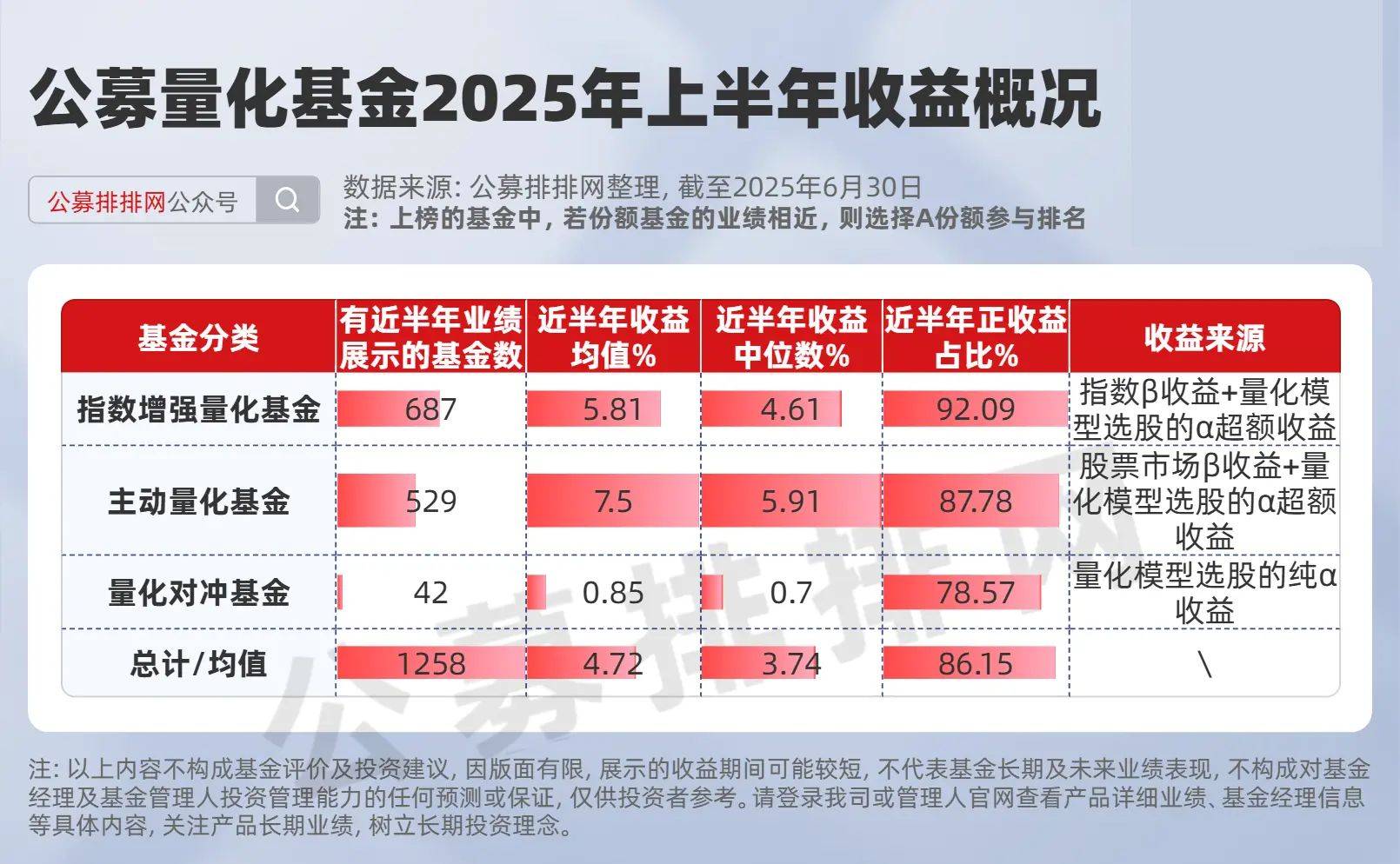
Core Viewpoint - The article discusses the performance of quantitative funds in the first half of 2025, highlighting the increasing popularity of quantitative trading amid market volatility and the significant returns achieved by various types of quantitative funds [3][4]. Summary by Category Overall Performance of Quantitative Funds - As of June 30, 2025, there were 1,258 quantitative funds with reported performance, achieving an average return of 4.72% and a median return of 3.74%, with 86.15% of these funds generating positive returns [4][6]. Types of Quantitative Funds - **Active Quantitative Funds**: These funds had the highest returns, with an average return of 7.5% and a median return of 5.91%. The positive return rate was 87.78% [5][6]. - **Index Enhanced Funds**: Although these funds had slightly lower returns, they had the highest positive return rate at 92.09%. The average return was 5.81% and the median was 4.61% [6]. - **Quantitative Hedge Funds**: These funds had the lowest performance, with an average return of 0.85% and a median return of 0.7%, and a positive return rate of 78.57% [6]. Top Performing Funds - The top 10 index-enhanced quantitative funds had a minimum return threshold of 18.77%, with funds tracking small-cap indices dominating the list. The top fund was managed by 创金合信基金, achieving a return of 37.17% [7][8]. - The top 10 active quantitative funds had a minimum return threshold of 24.64%, with 诺安基金 and 中加基金 leading the rankings with returns of 40.62% and 35.55%, respectively [12][14]. - The top 10 quantitative hedge funds had a minimum return threshold of 0.82%, with 中邮基金 and 富国基金 leading the performance [16]. Market Trends and Insights - The article notes that the increased focus on index-enhanced products is driven by several factors, including investor sentiment towards star fund managers, the introduction of attractive indices, and regulatory encouragement for index-based investments [9].

2025上半年量化基金10强揭晓!小盘指增包揽前10!
Sou Hu Cai Jing· 2025-07-03 11:05
Core Viewpoint - In the first half of 2025, the popularity of quantitative trading continues to rise amid increased activity in small-cap stocks and market volatility, with a significant number of quantitative funds showing positive returns [1][3]. Group 1: Performance of Quantitative Funds - As of June 30, 2025, there are 1,258 quantitative funds with an average return of 4.72% and a median return of 3.74%, with 86.15% of these funds achieving positive returns [1]. - Among the three categories of public quantitative funds, active quantitative funds have the highest returns, with average and median returns of 7.5% and 5.91% respectively [1]. - Index-enhanced funds, while slightly lower in returns, have the highest proportion of positive returns at 92.09% [1]. Group 2: Top Performing Funds - The threshold for the top 10 index-enhanced quantitative funds is set at 18.77%, with all top 10 funds tracking small-cap stock indices [3]. - The top three funds in the index-enhanced category are managed by 创金合信基金, 招商基金, and 长盛基金 [3]. - The top-performing index-enhanced fund, 创金合信北证50成份指数增强A, achieved a return of 37.17% in the first half of 2025 [5]. Group 3: Active Quantitative Funds - The threshold for the top 10 active quantitative funds is the highest at 24.64%, with the top three funds managed by 诺安基金, 中加基金, and 汇安基金 [8]. - The leading active quantitative fund, 诺安多策略A, recorded a return of 40.62% [10]. - The second-ranked fund, 中加专精特新量化选股A, achieved a return of 35.55% [11]. Group 4: Quantitative Hedge Funds - The threshold for the top 10 quantitative hedge funds is 0.82%, with 中邮基金, 富国基金, and 申万菱信基金 managing the top three funds [12]. - 工银瑞信基金 has two funds listed among the top 10 [12].
传统量化融入AI新策略 景顺长城中证A500指数增强基金正在发行中
Zheng Quan Ri Bao Wang· 2025-07-03 10:42
Group 1 - The core viewpoint of the news is the expansion of the Invesco Great Wall's "Index Enhancement Family" with the launch of the Invesco Great Wall CSI A500 Index Enhanced Fund, aiming to achieve excess returns through quantitative methods while effectively tracking the index [1] - The CSI A500 Index is designed to consider factors such as market capitalization, industry representation, ESG, and connectivity, representing core assets in China with high growth potential [1] - Historical performance indicates that the CSI A500 Index has demonstrated strong long-term performance and higher excess return creation capability, making it valuable for long-term allocation [1] Group 2 - The Invesco Great Wall CSI A500 Index Enhanced Fund will utilize a combination of traditional quantitative models and AI-driven strategies to achieve higher excess returns while controlling risks [2] - The fund will leverage Invesco Great Wall's unique quantitative system, employing three main types of quantitative models: excess return models, risk models, and transaction cost models for asset pricing assessment, risk control, and transaction optimization [2] - The quantitative team has integrated AI capabilities to enhance model adaptability to market conditions, focusing on data processing, price prediction, risk management, and real-time market sentiment monitoring to uncover hidden market patterns and non-linear pricing relationships [2]
指数复制及指数增强方法概述
Changjiang Securities· 2025-07-02 11:07
Quantitative Models and Construction Methods 1. Model Name: Optimization Replication - **Model Construction Idea**: Simplify the replication of index returns into an optimization model that minimizes tracking error[31][32] - **Model Construction Process**: 1. Define the return sequence of the portfolio as: $ \tilde{R}_{t} = \Sigma_{i=1}^{M} \widetilde{W}_{i,t} \cdot Y_{i,t} = Y_{t} \cdot \overline{W}_{t} $ where $ \widetilde{W}_{i,t} $ represents the weight of asset $i$ at time $t$, and $Y_{i,t}$ is the return of asset $i$ at time $t$[31] 2. Minimize the tracking error (TE): $ w = arg\,min\;TE $ $ TE = \frac{1}{T} \Sigma_{t=1}^{T} (\tilde{R}_{t} - R_{t})^2 $ where $R_{t}$ is the benchmark return at time $t$[32] 3. Add constraints: - Full investment: $ \Sigma_{i=1}^{N} w_{i} = 1 $ - Non-negativity: $ 0 \leq w_{i} \leq 1 $[33][35] 4. Incorporate style and industry neutrality constraints to reduce overfitting: $ z_{low} \leq \frac{X_{s}^{T}w - X_{s}^{T}\tilde{w}}{s_{b}} \leq z_{up} $ $ w_{low}^{I} \leq X_{I}^{T}w - X_{I}^{T}\bar{w} \leq w_{up}^{I} $[36] 5. Solve the optimization problem to determine the weights of individual stocks[37] 2. Model Name: Pair Trading - **Model Construction Idea**: Identify pairs of stocks or sectors with similar trends and exploit mean-reversion characteristics to generate excess returns[57] - **Model Construction Process**: 1. Identify pairs of stocks or sectors with stable relationships based on quantitative or fundamental analysis 2. Overweight weaker-performing assets and underweight stronger-performing ones 3. Capture excess returns when the price spread reverts to its mean, particularly during events like macroeconomic data releases or seasonal effects[57] --- Model Backtesting Results 1. Optimization Replication - **Annualized Return**: 5.76% - **Excess Return**: 3.74% - **Sharpe Ratio**: 0.41 - **Excess Drawdown**: 3.86% - **Excess Win Rate**: 72% - **Information Ratio (IR)**: 1.51 - **Tracking Error**: 2.22%[23][27] --- Quantitative Factors and Construction Methods 1. Factor Name: Quantitative Multi-Factor - **Factor Construction Idea**: Select long-term effective alpha factors and construct a multi-factor portfolio to achieve stable excess returns[46] - **Factor Construction Process**: 1. Define the multi-factor model: $ \begin{bmatrix} r_{1} \\ r_{2} \\ \vdots \\ r_{n} \end{bmatrix} = \begin{bmatrix} x_{11} \\ x_{21} \\ \vdots \\ x_{n1} \end{bmatrix} f_{1} + \begin{bmatrix} x_{12} \\ x_{22} \\ \vdots \\ x_{n2} \end{bmatrix} f_{2} + \cdots + \begin{bmatrix} x_{1m} \\ x_{2m} \\ \vdots \\ x_{nm} \end{bmatrix} f_{m} + \begin{bmatrix} u_{1} \\ u_{2} \\ \vdots \\ u_{n} \end{bmatrix} $ where $r_{i}$ is the excess return of stock $i$, $x_{ij}$ is the exposure of stock $i$ to factor $j$, and $f_{j}$ is the return of factor $j$[46] 2. Select effective single factors, such as volatility, short-selling intention, and liquidity, based on theoretical direction and empirical validation[48] 3. Construct a multi-factor portfolio by combining these factors and optimizing weights[47] 2. Factor Name: Negative Enhancement - **Factor Construction Idea**: Underweight stocks expected to underperform or incur losses, leveraging negative factors or events to generate stable excess returns[56] - **Factor Construction Process**: 1. Identify stocks with negative attributes, such as analyst downgrades, equity pledges, or poor earnings reports 2. Underweight these stocks in the portfolio to reduce potential losses and achieve alpha[56] 3. Factor Name: Machine Learning-Based Alpha - **Factor Construction Idea**: Use deep learning models like TCN (Temporal Convolutional Networks) to extract complex and effective alpha factors from price and volume data[52] - **Factor Construction Process**: 1. Train neural networks on historical price and volume data to identify patterns and relationships 2. Generate alpha factors that outperform traditional genetic programming methods in terms of depth and complexity[51][52] --- Factor Backtesting Results 1. Quantitative Multi-Factor - **Excess Return**: Stable across long-term horizons - **Key Factors**: Volatility, short-selling intention, liquidity, and local pricing[48] 2. Negative Enhancement - **Excess Return**: Achieved through underweighting stocks with negative attributes or events[56] 3. Machine Learning-Based Alpha - **Performance**: Demonstrated superior results compared to traditional factor generation methods[52] --- Index Enhancement Methods 1. IPO Enhancement - **Annualized Return**: 2.13% in 2025 - **Segment Performance**: Sci-Tech Innovation Board (4.34%), ChiNext (2.52%)[67][68] 2. Stock Index Futures - **Annualized Basis Spread**: - CSI 300: -6.75% - SSE 50: -2.48% - CSI 500: -13.60% - CSI 1000: -18.09%[72][73] 3. Block Trades - **Median Discount Rate**: 5.38% (2017-2025), 8.23% in 2025[74][75] 4. Private Placements - **Median Discount Rate**: 14.55% (2017-2025), 11.87% in 2025[77]
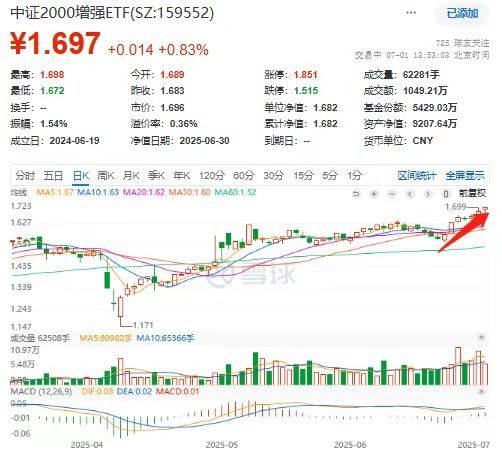
V型反弹!半年收益近30%的中证2000增强ETF(159552)三连阳再刷新高
Sou Hu Cai Jing· 2025-07-01 06:13
Core Viewpoint - The Zhongzheng 2000 Enhanced ETF has achieved a nearly 30% return in the first half of the year, outperforming its benchmark index by approximately 14% [1] Group 1: Performance Metrics - As of July 1, the Zhongzheng 2000 Enhanced ETF (159552) rose by 0.77%, reaching a new high [1] - Over the past five days, the ETF increased by 3.99%, by 5.67% over the past ten days, and by 8.16% over the past twenty days [1] - Year-to-date, the ETF has accumulated a return of 30.16% [1] Group 2: Market Insights - The effectiveness of small-cap stocks has been validated globally, attributed to investors' general aversion to small-cap stocks due to difficulties in obtaining accurate information [1] - This aversion leads to lower prices for small-cap stocks compared to larger stocks, resulting in higher expected returns [1] Group 3: Investment Strategy - The fund under China Merchants uses a multi-factor model for stock selection and portfolio optimization, incorporating traditional fundamental, technical, and advanced machine learning factors [1] - The fund aims for long-term stable excess returns while maintaining a balanced and conservative portfolio allocation, with strict control over tracking error [1] - The quantitative team at China Merchants has extensive experience in the index enhancement field, with a history of stable and high long-term excess returns from various enhanced funds [1]