太空数据中心

Search documents
A股超3800股上涨 139股涨停 商业航天多股爆发 中国卫星创历史新高
2 1 Shi Ji Jing Ji Bao Dao· 2026-01-12 05:14
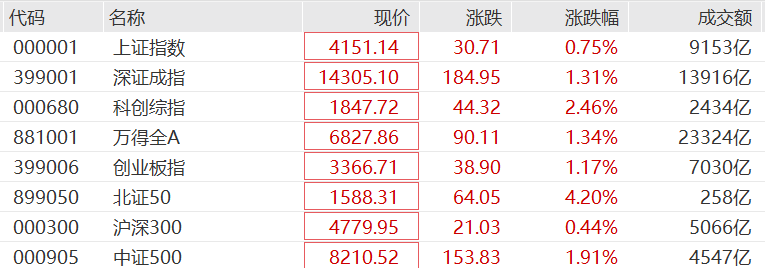
Market Overview - On January 12, A-shares saw a collective rise in the three major indices, with the Shanghai Composite Index up 0.75%, the Shenzhen Component Index up 1.31%, and the ChiNext Index up 1.17% [1] - The market's half-day trading volume exceeded 2.3 trillion yuan, an increase of over 478.1 billion yuan compared to the previous day [1] Stock Performance - The Shanghai Composite Index closed at 4151.14, with a rise of 30.71 points [2] - The Shenzhen Component Index reached 14305.10, increasing by 184.95 points [2] - The ChiNext Index was at 3366.71, up by 38.90 points [2] - Over 3800 stocks in the market rose, with 139 stocks hitting the daily limit up [1] Sector Performance - AI applications, commercial aerospace, photovoltaic, and retail sectors showed significant gains, while oil and gas, as well as coal sectors, experienced declines [2] - Notable stocks in the photovoltaic sector included Oriental Sunrise, Jiejia Weichuang, and Maiwei Shares, which saw increases of 16.08%, 12.71%, and 11.36% respectively [5] Lithium and Precious Metals - Lithium carbonate futures hit a high of 156,100 yuan per ton, marking a new peak since September 2023, with major lithium mining stocks also rising significantly [3] - Gold prices reached over $4600 per ounce, with a nearly 2% increase, and domestic gold jewelry prices also rose, leading to a collective rise in A-share gold stocks [3] Commercial Aerospace - The commercial aerospace sector remained active, with companies like China Satellite and Goldwind Technology seeing significant stock price increases [4] - China submitted an application for an additional 203,000 satellites, indicating a growing focus on satellite technology [4] AI Applications - AI application stocks surged, with companies like Worth Buying and Guangyun Technology hitting the daily limit up [7] - A significant breakthrough in AI-driven drug screening was reported by Tsinghua University, further boosting interest in AI-related stocks [7] Storage Market - The storage market is experiencing a price surge, with expectations of a 40-50% increase in prices by Q1 2026 due to rising demand from AI and server capacities [8] - Companies like Fudan Microelectronics and Aerospace Intelligence saw stock price increases of over 10% [8] Technology Sector Outlook - Recent reports suggest that China's technology sector is poised for significant growth, with expectations of surpassing the profitability of major US tech giants by 2026 [9]


光伏行业:太空光伏或成行业第二成长曲线,利好HJT、钙钛矿新技术
Dongxing Securities· 2026-01-11 11:46
Investment Rating - The industry investment rating is "Positive" [6] Core Insights - The space photovoltaic sector may become the second growth curve for the industry, benefiting HJT and perovskite technologies [3] - The demand for space photovoltaics is expected to grow significantly, with potential installation demand exceeding 800 GW if the proposed space data center concept is realized [3] - Leading companies are focusing on the space photovoltaic market, accelerating technology research and scenario exploration, indicating a shift from concept validation to explosive growth [3] Summary by Sections Market Demand - Solar energy is the preferred energy source for space activities, with increasing power requirements for satellites driving demand for larger solar wings [3] - The current market size is small but expanding rapidly, with a potential for significant growth in the future [3] Technology Development - The main requirements for space photovoltaic technology are high efficiency, lightweight, and adaptability to extreme temperatures and radiation [4] - The mainstream technology for space photovoltaics is currently gallium arsenide (GaAs), which has a conversion efficiency exceeding 30% but comes with high production costs of approximately 1000 RMB/W [4] - P-type HJT batteries are seen as a potential alternative due to their compatibility with space conditions, offering reduced weight and excellent low-temperature performance [4] Future Prospects - Perovskite tandem batteries are expected to become a key option for next-generation space photovoltaics, with theoretical conversion efficiencies reaching 45% and significant weight advantages over GaAs [5] - The flexibility of perovskite batteries allows for diverse solar wing designs, making them suitable for various space applications [5] Investment Strategy - The short-term acceleration of low Earth orbit satellites is expected to drive demand for space photovoltaics, while the long-term vision of space data centers opens up new opportunities [5] - HJT and perovskite technologies are viewed as optimal solutions for extreme space environments, benefiting related battery component manufacturers and equipment producers [5]
太空光伏赛道兴起 或催生万亿级市场
Zhong Guo Jing Ying Bao· 2026-01-09 09:07
Core Viewpoint - The photovoltaic industry is exploring opportunities in space photovoltaic technology, which is seen as a potential solution for future energy needs on Earth and in space, with major companies signaling their intentions to invest in this area [1][4]. Group 1: Industry Trends - Major players in the photovoltaic sector, such as JinkoSolar and Trina Solar, are emphasizing the importance of space photovoltaic technology for future energy solutions, particularly for deep space exploration and AI power shortages on Earth [1]. - The space photovoltaic market is projected to reach a trillion-dollar scale, becoming a core investment theme in the power equipment and renewable energy sectors by 2026 [1][4]. - The demand for space photovoltaic technology is driven by the growth of commercial space ventures and the need for efficient energy solutions in low Earth orbit satellite networks [4][5]. Group 2: Technological Developments - Current space photovoltaic systems predominantly use gallium arsenide solar cells, which are lightweight and efficient but expensive; however, P-type crystalline silicon and perovskite tandem cell technologies are emerging as potential alternatives [2][7]. - The transition from N-type to P-type silicon cells in space applications is influenced by their ability to withstand high-energy particle radiation and maintain performance over time [8][11]. - The development of perovskite tandem cells is expected to enhance efficiency and reduce weight, making them suitable for various space energy applications, including low Earth orbit communication satellites and solar power stations [10]. Group 3: Market Potential - The low Earth orbit satellite sector alone is anticipated to generate a trillion-dollar market, with significant growth expected in the space computing center market as well [5]. - The global space photovoltaic market is projected to reach a trillion-dollar scale by 2030, driven by the increasing demand for reliable and efficient energy solutions in commercial space applications [4][5]. - The competitive landscape in the commercial satellite sector is intensifying, with major companies like SpaceX and Google planning extensive satellite networks, further highlighting the need for advanced photovoltaic solutions [4].
港股概念追踪|万亿市场蓄势待发 商业航天2026年迎奇点时刻(附概念股)
智通财经网· 2026-01-09 00:33
Core Viewpoint - Blue Arrow Aerospace has signed a formal launch service contract with China Star Network and Yuanxin Satellite, indicating promising commercial prospects for bulk launch services in the future [1] Group 1: Satellite Internet Projects - The "GW Constellation" and "Qianfan Constellation" are two large satellite internet projects planned in China, with GW Constellation aiming to launch approximately 12,992 satellites, completing about 10% of deployment within five years and all launches by 2035 [1] - The Qianfan Constellation, operated by Yuanxin Satellite, plans to launch around 15,000 satellites, having completed six network launches with 108 satellites currently in orbit [2] Group 2: Policy and Industry Support - The Guangzhou Municipal Government has released a plan to accelerate the construction of a strong advanced manufacturing city by 2035, focusing on reusable rocket technology and providing a solid foundation for medium and large liquid rocket development [2] - Current commercial aerospace industry growth is supported by national policy and technological breakthroughs, entering a new era [2] Group 3: Market Outlook and Valuation - Analysts predict that the commercial aerospace sector will transition from concept speculation to performance realization, with a focus on rocket manufacturing, satellite networking, and downstream applications [3] - The space data center industry is moving towards commercial constellation deployment, with the first phase expected to generate over tens of billions in industry chain output value by 2027 [3] Group 4: Related Companies in the Aerospace Industry - Goldwind Technology holds an 8.3% stake in Blue Arrow Aerospace, which is one of the first private commercial rocket companies in China [4] - Shanghai Fudan is a leading domestic high-end FPGA technology provider, with potential growth driven by demand from commercial aerospace companies like SpaceX [4] - CIMC Anrui focuses on core equipment for low-temperature and high-pressure storage and transportation, supporting rocket launches with propellant storage and supply systems [4] - Asia-Pacific Satellite, a subsidiary of China Satcom, operates several satellites and is expected to benefit from the commercialization of aerospace technology [5] - Jun Da Co. has partnered with Shangyi Optoelectronics, specializing in satellite batteries and energy systems, enhancing its capabilities in the space photovoltaic industry [6]
顺灏股份:轨道辰光核心的核心任务是在地球晨昏轨道发射部署算力卫星
Zheng Quan Ri Bao Zhi Sheng· 2026-01-07 14:09
Core Viewpoint - Shunhao Co., Ltd. is focusing on deploying computational satellites in the Earth's dawn-dusk orbit to create a space data center, aiming to provide space-based computing services globally, with a long-term vision for commercial viability in the next 5 to 10 years [1] Group 1: Business Overview - The core task of the company is to utilize 24/7 uninterrupted solar energy and cosmic cold radiation conditions to develop space intelligence [1] - The "Sky Computing" service is expected to have clear commercial value within the next 5 years, while the "Ground Computing" service may take 5 to 10 years to compete with terrestrial data centers [1] Group 2: Challenges and Risks - The business is influenced by macroeconomic factors, industry policies, and market environment changes, which may affect the commercialization timeline and outcomes [1] - The space data center faces significant challenges such as strong radiation, difficult orbital maintenance, debris hazards, and regulatory issues related to data governance and space traffic [1]

顺灏股份:公司坚持“环保低碳新材料+生物大健康”双翼发展的战略布局
Zheng Quan Ri Bao Zhi Sheng· 2026-01-07 14:09
Core Viewpoint - The company is committed to a dual development strategy focusing on "environmentally friendly low-carbon new materials + biological health," with four main business areas: special environmentally friendly paper, printing products, industrial hemp deep processing, and new tobacco products [1] Group 1: Business Overview - The company has a strong foundation in the research, production, and sales of special anti-counterfeit environmentally friendly paper, which was its main business at the time of listing in 2011 [1] - The special anti-counterfeit environmentally friendly paper business includes vacuum aluminum foil paper and laser anti-counterfeit materials, primarily used in specific consumer goods and social consumer goods industries [1] - The printing business operates mainly through bidding projects, allowing the company to secure orders and produce according to customer specifications, offering high stability, large volume, multiple batches, high precision, strong anti-counterfeiting, and environmental friendliness [1] Group 2: New Business Ventures - Since its listing, the company has actively sought a second growth curve, expanding into new tobacco and industrial hemp businesses [1] - The industrial hemp business is primarily conducted by its wholly-owned subsidiary in Yunnan, focusing on the extraction and processing of CBD and other rare cannabinoids for domestic and export markets [1] - The new tobacco business is developed through its subsidiaries, which have established a certain scale of business revenue [1] Group 3: Strategic Investments - In June 2025, the company invested 110 million RMB to acquire a 19.30% stake in Beijing Rail Data Technology Co., which specializes in space data centers [1] - The company aims to leverage its platform and the technological advantages of both parties to explore more opportunities in the new materials sector [1]
顺灏股份:公司致力于提升上市公司质量
Zheng Quan Ri Bao Zhi Sheng· 2026-01-07 14:09
Core Viewpoint - The company is actively seeking transformation in the computing power industry to find a second growth curve amid the backdrop of US-China technology competition [1] Group 1: Industry Trends - The company notes that the US has already made investments in the space computing power sector, with projects like Starcloud backed by notable investors such as Nvidia and Sequoia, potentially launching the first computing power satellite by 2025 [1] - Domestic competitor Chengdu Guoxing Aerospace submitted its prospectus to the Hong Kong Stock Exchange in January 2025, which the company has analyzed in detail, focusing on the development of the domestic computing power satellite industry and Guoxing's financing valuations [1] Group 2: Company Strategy - The company believes that while the industry is still in its early stages, the continuous advancement of artificial intelligence technology is highlighting issues such as power shortages from computing growth, high costs of ground data center construction, and environmental impacts from large data centers [1] - Space data centers are emerging as the ultimate solution for AI computing power development due to their significant advantages in energy efficiency and environmental impact [1] - The main business of the company involves launching computing power satellites into dawn-dusk orbits to establish space data centers, providing computing power services to clients, with a focus on key technologies such as ultra-light solar wings, efficient radiative cooling plates, and modular in-orbit assembly [1] - The company's core technologies align closely with global trends in space computing power development, indicating a promising future for the industry [1]
太空光伏:地外可靠能源,剑指万亿市场
Hua Er Jie Jian Wen· 2026-01-07 07:22
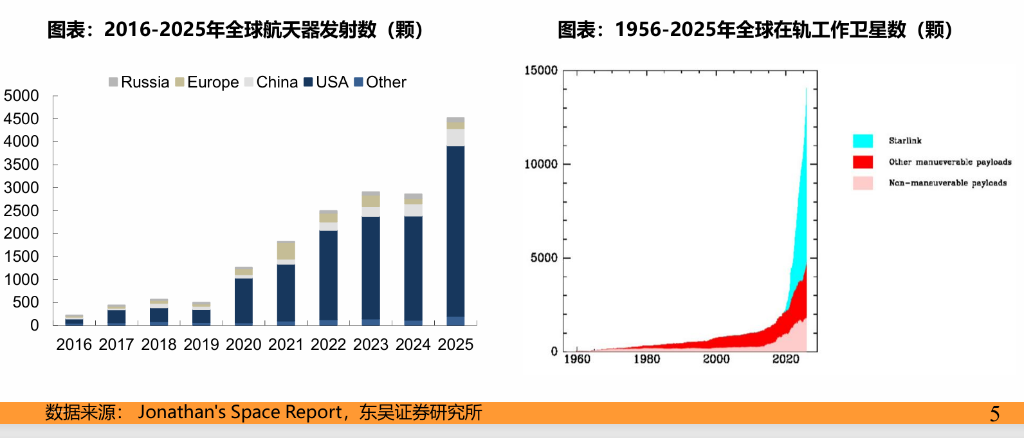
Core Insights - The maturity of reusable rocket technology is driving a significant decrease in launch costs, leading to a "Moore's Law" moment in commercial space, which is creating a massive demand for space photovoltaic systems [1] - By 2025, the number of global satellite launches is expected to exceed 4,300, representing a year-on-year growth of over 50% and a compound annual growth rate of 34% over the past decade [1][5] - The deployment of large satellite constellations will create a rigid demand for high-performance photovoltaic cells, potentially generating a market space of nearly 200 billion yuan for solar wings if 10,000 satellites are launched annually [5] Launch Cost and Frequency - The rapid rise of commercial space is primarily driven by the exponential decrease in launch costs, with SpaceX's Falcon 9 launch cost dropping to approximately $1,400-$1,800 per kilogram, significantly lower than traditional launch costs [6] - Global satellite launches are projected to exceed 300 by 2025, doubling from 2021 levels [6] Strategic Resource Competition - The scarcity of near-Earth orbital frequency bands and positions is accelerating deployment efforts by various countries, as these resources are non-renewable [9] - The U.S. currently leads in launch numbers and in-orbit satellites, while China is rapidly catching up with its "Thousand Sails" and "GW" constellation plans [9] Photovoltaic Systems in Satellites - The power system is crucial in satellite manufacturing, accounting for approximately 20%-30% of total costs, with solar wings representing 60%-80% of the power system's value [10] - As satellite payloads evolve, particularly in communication and computing, power demands are increasing, driving the development of larger and higher-power solar wings [10] Technological Pathways - The current technological landscape for space photovoltaics is characterized by diverse competition, focusing on balancing cost and performance [11] Space Computing and Future Potential - The demand for AI computing is pushing the space economy towards computing and data centers, with space offering ideal conditions for high-performance computing nodes [13] - If a 10 GW space computing system is realized, the solar wing market could reach several trillion yuan [13] Photovoltaic Technologies - Gallium Arsenide (GaAs) is the current mainstream choice in China, known for high efficiency and strong radiation resistance, but its high cost limits scalability [15] - Silicon solar cells are used by SpaceX for their Starlink satellites due to lower costs, despite lower efficiency [15] - Perovskite and tandem technologies are seen as potential disruptors, offering high energy-to-weight ratios and low manufacturing costs, although their stability in extreme space conditions needs further validation [15]
太空光伏梦想将照进现实,马斯克:建设太空AI计算中心!光伏大佬:同样一块板子,在太空的发电量比地球高出7至10倍
Mei Ri Jing Ji Xin Wen· 2026-01-06 05:37
Core Viewpoint - The potential of space photovoltaic technology is gaining attention, with significant interest from major companies in the industry, driven by advancements in satellite technology and the demand for energy in space applications [1][2]. Group 1: Space Photovoltaic Advantages - Space photovoltaic systems can generate 7 to 10 times more power than terrestrial systems due to the absence of atmospheric interference and consistent sunlight exposure [1]. - Unlike ground-based solar power, which relies on intermittent sunlight and requires energy storage solutions, space photovoltaic systems can provide stable energy output, reducing the need for extensive storage [2]. - The construction of low Earth orbit satellite constellations in China is expected to unlock substantial market potential for space photovoltaic applications [2]. Group 2: Market Potential and Applications - The demand for energy from SpaceX's Starlink and China's low Earth orbit satellite projects is driving the need for space photovoltaic systems [2]. - The planned satellite constellations in China include over 50,000 satellites across various applications, indicating a significant market for space photovoltaic technology [2]. - The development of space data centers is anticipated to create exponential growth in demand for space photovoltaic energy, as these centers will require substantial power for operations [3]. Group 3: Technological Developments - Current space photovoltaic technologies primarily include gallium arsenide and silicon products, with perovskite technology emerging as a promising alternative due to its potential for high efficiency and lower costs [5][6]. - Perovskite solar cells are expected to dominate the market in the long term due to their high power-to-weight ratio and cost-effectiveness compared to gallium arsenide [5][6]. - The transition to perovskite technology is seen as likely due to the high costs associated with gallium arsenide, which can be significantly higher than terrestrial silicon solar cells [6][7]. Group 4: Challenges and Considerations - Space photovoltaic systems must withstand extreme temperature variations, strong radiation, and corrosive environments, which pose challenges for battery longevity [7]. - The estimated cost for deploying 100 GW of space photovoltaic systems could reach hundreds of billions, not including launch and maintenance costs, highlighting the financial challenges ahead [7]. - The future of space photovoltaic technology is closely tied to the reduction of satellite launch costs, which will be crucial for making these systems commercially viable [7].

太空光伏梦想将照进现实!钙钛矿能否借机突围?
Jing Ji Guan Cha Wang· 2026-01-06 03:44
Core Viewpoint - Space photovoltaic technology is emerging as a market hotspot, with significant potential for high efficiency and consistent power generation compared to terrestrial solar power, despite challenges related to commercial space transportation costs [2][4][9]. Group 1: Market Potential and Applications - The construction of low Earth orbit (LEO) satellite constellations in China is expected to release substantial market potential, with plans for over 50,000 satellites across various applications [6][9]. - Major players in the photovoltaic industry, such as JinkoSolar and Trina Solar, are optimistic about the future of space photovoltaics, highlighting its advantages over ground-based systems [3][4]. - The demand for space photovoltaic systems is projected to grow exponentially with the development of space data centers, which require significant energy resources [6][7]. Group 2: Technical Advantages - Space photovoltaics can generate power more consistently than terrestrial systems, as they are less affected by weather and can operate continuously in space [5][9]. - The efficiency of solar panels in space can be 7 to 10 times higher than those on Earth, addressing issues of intermittency and degradation [2][4]. - Per square meter, gallium arsenide (GaAs) solar cells are significantly more expensive than silicon cells, but they offer superior efficiency and radiation resistance, making them suitable for space applications [10]. Group 3: Future Developments - The development of perovskite solar cells is seen as a promising future direction for space photovoltaics, combining high efficiency with lower costs compared to GaAs [9][10]. - The establishment of space AI computing centers, as proposed by Elon Musk, aims to deploy large-scale solar energy systems in space, potentially reaching capacities of 100GW to 500GW [8][9]. - The successful commercialization of space photovoltaics will depend on reducing satellite launch costs, which is critical for making the technology viable [10].