
居民存款搬家

Search documents
ETF盘中资讯|牛市重要信号,7月非银存款激增!“牛市旗手”大爆发,券商ETF(512000)狂飙5%,东财爆量涨11%
Sou Hu Cai Jing· 2025-08-15 05:59
Core Viewpoint - The A-share market is experiencing a significant rally, particularly in the brokerage sector, with the leading brokerage ETF (512000) surging by 5.5% and reaching a new annual high, indicating strong investor interest and market momentum [1][2]. Group 1: Market Performance - The brokerage ETF (512000) saw a trading volume exceeding 2 billion yuan, surpassing the previous day's total [1]. - All 40 constituent stocks of the ETF recorded gains, with notable performances from Changcheng Securities and Tianfeng Securities, both hitting the daily limit up [1]. - The leading brokerage stock, Dongfang Caifu, surged nearly 11%, with a trading volume exceeding 31 billion yuan [1]. Group 2: Financial Data Insights - Non-bank financial sector saw a net inflow of over 17.1 billion yuan, ranking second among 31 primary industries [1]. - In July, non-bank deposits increased significantly, reflecting a shift of household savings towards financial products, influenced by the recent bullish market [2]. - The People's Bank of China reported that in July, RMB deposits rose by 500 billion yuan, with non-bank deposits increasing by 2.14 trillion yuan year-on-year [1][2]. Group 3: Analyst Perspectives - Analysts suggest that the increase in non-bank deposits indicates a "see-saw effect" between household and non-bank deposits, driven by a recovering capital market and declining interest rates [2]. - The current market conditions are expected to continue, with recommendations to focus on brokerages and insurance companies that benefit from increased household investment [2]. - The active market environment is anticipated to drive both valuation and profitability for brokerages, supported by increased trading volumes and margin financing [2].





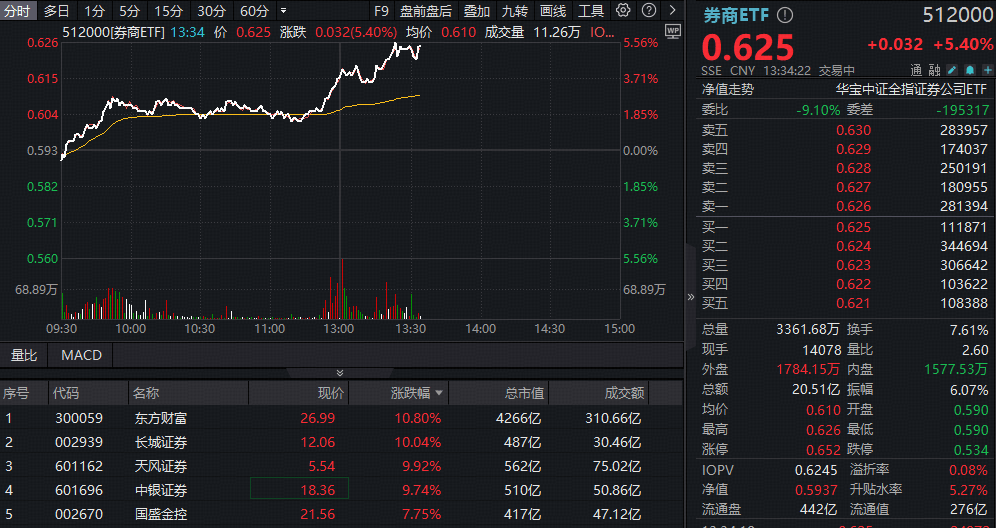
牛市重要信号,7月非银存款激增!“牛市旗手”大爆发,券商ETF(512000)狂飙5%,东财爆量涨11%
Xin Lang Ji Jin· 2025-08-15 05:45
Group 1 - The A-share market is experiencing a significant rally, with the leading brokerage ETF (512000) surging by 5.5% and continuously reaching new highs for the year, with trading volume exceeding 2 billion yuan [1] - All 40 constituent stocks of the ETF saw gains, with notable performances from Changcheng Securities, Tianfeng Securities, and Dongfang Caifu, which rose nearly 11% with trading volume surpassing 31 billion yuan [1] - The increase in non-bank deposits in July, amounting to 2.14 trillion yuan, reflects a trend of residents shifting their savings towards financial products, likely influenced by the ongoing "slow bull" market [2][3] Group 2 - The chief economist of Zheshang Securities indicated that the recovery of the capital market and declining interest rates are driving the shift of resident deposits, creating a "seesaw effect" between resident and non-bank deposits [3] - Analysts from Zhongjin Company suggest that the current market trend is not over, recommending attention to brokerage and insurance sectors that benefit from increased resident capital inflow [3] - The top brokerage ETF (512000) and its linked fund (007531) track the CSI All Share Securities Company Index, with nearly 60% of its holdings concentrated in the top ten leading brokerages, and the fund size exceeding 26.2 billion yuan [3]
股民:“我有一种再不进场就晚了的紧迫感”
Zhong Guo Jing Ying Bao· 2025-08-15 04:40
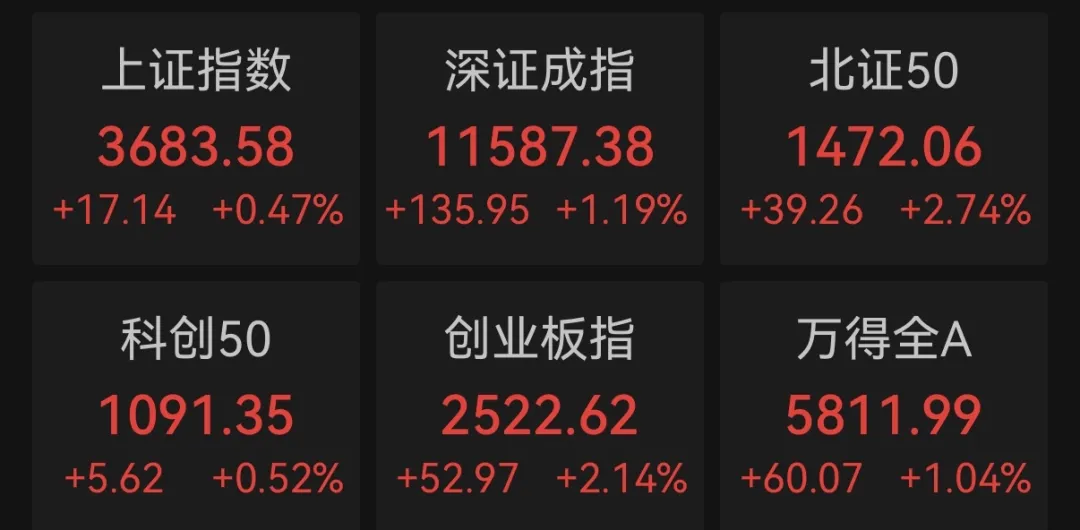
Market Overview - On August 15, A-shares experienced a rebound in early trading, with the ChiNext index leading the gains. The market showed significant divergence, with small and mid-cap stocks generally rising. The total trading volume in the Shanghai and Shenzhen markets reached 1.31 trillion yuan, a decrease of 103.8 billion yuan compared to the previous trading day, with over 4,400 stocks rising across the market [1][3]. Index Performance - By midday, the Shanghai Composite Index rose by 0.47%, the Shenzhen Component Index increased by 1.19%, and the ChiNext Index surged by 2.14%. The leading sectors included brokerage firms and financial technology, while bank stocks showed notable declines, and themes related to CPO and military industries weakened [3]. Financial Data Insights - According to data released by the People's Bank of China on August 13, July saw a significant increase in non-bank deposits, with a total increase of 2.14 trillion yuan, which is a year-on-year increase of 1.39 trillion yuan. In contrast, household deposits decreased by 1.1 trillion yuan, a year-on-year decline of 780 billion yuan. This shift indicates a trend of residents moving their savings into financial products, likely influenced by the recent "slow bull" market in stocks [4]. Market Activity and Investor Sentiment - The stock market's recovery and declining interest rates have driven the increase in non-bank deposits, creating a "seesaw effect" between household and non-bank deposits. The trading volume in the stock market remains high, with new account openings in July reaching 1.9636 million, a year-on-year increase of 70.54% and a month-on-month increase of 19.27% [4]. Investor Behavior - Investors are showing a sense of urgency to enter the market, as indicated by anecdotal evidence from new investors expressing a fear of missing out on potential gains. For instance, one investor noted that a colleague's investment in a pharmaceutical fund yielded a 15% return in just one month [4]. Cautionary Notes - Experts suggest that while the current market sentiment appears positive, investors should remain cautious of potential short-term corrections influenced by policy changes or external factors. They emphasize the importance of a long-term perspective in asset allocation and the need for new investors to respect market dynamics and focus on structural opportunities [5].
居民存款入市信号增强
第一财经· 2025-08-15 01:06
Core Viewpoint - The significant increase in non-bank deposits in July reflects a trend of residents shifting their savings towards financial products, influenced by a recovering stock market and declining interest rates [3][5][9]. Group 1: Non-Bank Deposits - In July, non-bank deposits increased by 2.14 trillion yuan, a year-on-year increase of 1.39 trillion yuan, while household deposits decreased by 1.1 trillion yuan, a year-on-year decrease of nearly 0.8 trillion yuan [5][6]. - The total increase in non-bank deposits from January to July reached 4.69 trillion yuan, which is 1.73 trillion yuan more than the same period last year, indicating a structural trend [5][6]. - Analysts attribute the increase in non-bank deposits to the end of the mid-year bank assessment period and the recent rise in the stock market, leading to a large-scale return of household deposits to wealth management products [5][9]. Group 2: Money Supply and Economic Activity - The growth rate of M2 (broad money) in July increased by 0.5 percentage points to 8.8%, exceeding market expectations of 8.3%, while M1 (narrow money) growth rate rose to 5.6%, marking a significant rebound over three consecutive months [5][6]. - The narrowing of the M1-M2 spread to -3.2% further confirms the enhanced liquidity of funds, indicating a shift from low-efficiency to high-efficiency states in both enterprises and households [6][9]. - The increase in M1 growth is seen as a positive signal for potential economic recovery, despite the ongoing challenges in the real estate market [6][12]. Group 3: Capital Market Expectations - There is a strong market expectation that capital markets will become a significant outlet for household deposits, with historical trends showing that each bull market is accompanied by a migration of bank deposits to capital markets [8][9]. - The estimated scale of maturing deposits is substantial, with approximately 105 trillion yuan maturing by 2025 and 66 trillion yuan thereafter, which could lead to significant liquidity impacts if these funds flow into any asset market [8][9]. - Analysts caution that while there is potential for a shift of funds into capital markets, the current low proportion of equity-related wealth management products may limit immediate large-scale movements [8][9]. Group 4: Monetary Policy Outlook - Despite recent market optimism, July's financial data indicates slow recovery in demand, with new credit showing a negative growth for the first time in 20 years, highlighting insufficient economic demand [11][12]. - The implementation of targeted fiscal subsidy policies is expected to reduce the need for broad monetary easing, with analysts suggesting that the likelihood of interest rate cuts may decrease [13][12]. - The overall sentiment is that while the economic environment remains challenging, there are signs of potential improvement in demand, supported by stable growth in social financing [12][13].

7月非银存款同比多增1.39万亿
Di Yi Cai Jing Zi Xun· 2025-08-15 00:54
Core Viewpoint - The significant increase in non-bank deposits in July reflects a trend of residents shifting their savings towards financial products, influenced by the recent bullish stock market and declining interest rates [1][2]. Group 1: Non-Bank Deposits - In July, non-bank deposits increased by 2.14 trillion yuan, a year-on-year increase of 1.39 trillion yuan, while household deposits decreased by 1.1 trillion yuan, a year-on-year decrease of nearly 0.8 trillion yuan [2]. - From January to July, non-bank deposits cumulatively increased by 4.69 trillion yuan, which is 1.73 trillion yuan more than the same period last year [2]. - Analysts attribute the increase in non-bank deposits to the end of the mid-year bank assessment period and the recent rise in the stock market, leading to a large-scale return of household deposits to wealth management products [2]. Group 2: Money Supply and Economic Indicators - The growth rate of M2 (broad money) in July increased by 0.5 percentage points to 8.8%, exceeding market expectations of 8.3%, while M1 (narrow money) growth rate was 5.6%, up by 1.0 percentage points from the previous month [2]. - The M1-M2 spread narrowed to -3.2%, indicating enhanced liquidity as funds are being converted from time deposits to demand deposits for consumption or investment [3]. - The significant acceleration in M1 growth reflects an improvement in the liquidity of funds, suggesting increased investment and consumption activity among businesses and households [3]. Group 3: Capital Market Expectations - There is a strong market expectation that capital markets will become a significant outlet for household deposits, especially with a large volume of maturing deposits anticipated in the coming years [4][5]. - Estimates suggest that approximately 105 trillion yuan of time deposits will mature by 2025, and an additional 66 trillion yuan thereafter, which could lead to substantial liquidity impacts if these funds flow into any asset market [5]. - Analysts note that while the trend of wealth flowing into capital markets is a long-term process, the current low attractiveness of bank deposits and ongoing asset scarcity may drive this shift [5][6]. Group 4: Monetary Policy Outlook - Despite recent market optimism, July's financial data indicates slow recovery in demand, with new credit showing a negative growth for the first time in 20 years, highlighting insufficient economic demand [7]. - The implementation of fiscal subsidy policies is expected to support the economy without necessitating further monetary easing, as the current environment allows for a more targeted approach to policy [8]. - Analysts believe that while the need for broad monetary easing may be reduced, the overall economic conditions are expected to improve gradually in the second half of the year [8].
7月非银存款同比激增 居民存款入市信号增强
Sou Hu Cai Jing· 2025-08-14 16:49
Core Viewpoint - The significant increase in non-bank deposits indicates a trend of residents shifting their savings towards financial products, influenced by a recovering capital market and declining interest rates [1][2][6]. Group 1: Non-Bank Deposits - In July, non-bank deposits increased by 2.14 trillion yuan, a year-on-year increase of 1.39 trillion yuan, while household deposits decreased by 1.1 trillion yuan [2]. - The total increase in non-bank deposits from January to July reached 4.69 trillion yuan, which is 1.73 trillion yuan more than the same period last year [2]. - Analysts attribute the shift from household deposits to non-bank deposits to the recent stock market rally and the end of the mid-year bank assessment period [2][4]. Group 2: Money Supply and Liquidity - The M2 growth rate increased by 0.5 percentage points to 8.8% in July, surpassing market expectations of 8.3% [2]. - M1 growth rate rose to 5.6%, a 1.0 percentage point increase from the previous month, indicating enhanced liquidity in the market [2][3]. - The narrowing of the M1-M2 gap to -3.2% suggests an increase in the liquidity of funds, as residents and businesses convert time deposits into demand deposits for consumption or investment [3]. Group 3: Capital Market Outlook - There is a strong expectation that capital markets will become a significant destination for the outflow of household deposits, supported by a large volume of maturing deposits [4][5]. - By 2025, approximately 105 trillion yuan of time deposits will mature, which could lead to substantial liquidity impacts if these funds flow into asset markets [5]. - The current environment of declining deposit attractiveness and ongoing asset scarcity is expected to drive more funds into the capital market, potentially increasing trading activity and stock price elasticity [6]. Group 4: Monetary Policy and Economic Signals - Despite recent market optimism, July's financial data revealed a slowdown in demand, with new credit showing a negative growth for the first time in 20 years [7]. - The implementation of fiscal subsidy policies is expected to support the economy without necessitating further monetary easing [8]. - Analysts suggest that while the economic recovery may be slow, the increase in M1 growth and the activation of deposits are positive signals for future economic momentum [7][8].
7月非银存款同比多增1.39万亿 居民存款入市信号增强
Di Yi Cai Jing· 2025-08-14 14:04
Core Viewpoint - The significant increase in non-bank deposits in July reflects a trend of residents shifting their savings towards financial products, influenced by the recent bullish stock market and declining interest rates [1][2][5]. Group 1: Non-Bank Deposits - In July, non-bank deposits increased by 2.14 trillion yuan, a year-on-year increase of 1.39 trillion yuan, while household deposits decreased by 1.1 trillion yuan, a year-on-year decrease of nearly 0.8 trillion yuan [2]. - From January to July, non-bank deposits cumulatively increased by 4.69 trillion yuan, which is 1.73 trillion yuan more than the same period last year [2]. - Analysts suggest that the increase in non-bank deposits is driven by the end of the mid-year bank assessment period and the recent rise in the stock market, leading to a large-scale return of household savings to financial products [2][5]. Group 2: Money Supply and Liquidity - The growth rate of M2 (broad money) in July increased by 0.5 percentage points to 8.8%, exceeding market expectations of 8.3%, while M1 (narrow money) growth rate rose to 5.6%, marking a significant rebound over three consecutive months [2]. - The narrowing of the M1-M2 spread to -3.2% indicates enhanced liquidity, suggesting that households and businesses are converting time deposits into demand deposits for consumption or investment [3]. Group 3: Capital Market Expectations - There is a strong market expectation that capital markets will become a significant outlet for household deposits, with historical trends showing that each bull market is accompanied by a migration of bank deposits to capital markets [4][5]. - The estimated maturity of fixed-term deposits is substantial, with approximately 105 trillion yuan maturing by 2025 and 66 trillion yuan thereafter, which could lead to significant liquidity impacts if these funds flow into asset markets [4]. Group 4: Monetary Policy Outlook - Despite recent market optimism, July's financial data indicates slow recovery in demand, with new credit showing a negative growth for the first time in 20 years, highlighting the core contradiction in the current economic environment [7]. - The implementation of fiscal subsidy policies is expected to reduce the need for aggressive monetary easing, with analysts suggesting that the probability of interest rate cuts may decrease due to the effectiveness of targeted fiscal measures [8].
国泰海通|宏观:货币与信贷:为何背离——2025年7月社融数据点评
国泰海通证券研究· 2025-08-14 13:29
Core Viewpoint - The divergence between money supply and credit is significant, with government departments playing a crucial role in the credit expansion process, leading to an enhanced pricing power of the private sector over assets after new money flows into it [1][8]. Group 1: Social Financing and Credit Data - In July 2025, the growth rate of social financing stock increased to 9.0% from the previous 8.9%, with new social financing amounting to 1.16 trillion yuan, a year-on-year increase of 389.3 billion yuan [2]. - New government debt reached 1.24 trillion yuan, a year-on-year increase of 555.9 billion yuan, while loans (according to social financing standards) decreased by 426.3 billion yuan, a year-on-year reduction of 345.5 billion yuan, with the loan balance dropping to a year-on-year growth of 6.9% from 7.1% [2]. - In July, credit decreased by 50 billion yuan, a year-on-year decrease of 310 billion yuan, indicating a decline in both corporate and household loans [3]. Group 2: Monetary Supply Trends - The M2 growth rate rose to 8.8% from the previous 8.3%, while M1 growth rebounded sharply to 5.6% from 4.6%, primarily due to a low base in the same period of 2024 and increased willingness to settle debts, which supported corporate deposits [3]. - The increase in M2 growth is attributed to a significant rise in residents' risk appetite, with some deposits being "moved" to risk assets amid a bullish stock market [3]. Group 3: Understanding the Divergence - The divergence between money and credit is characterized by the private sector's need to repair balance sheets, with government support for credit expansion playing a vital role [4][8]. - The influx of new money into the private sector has led to a noticeable enhancement in its ability to price assets, creating new monetary phenomena such as early mortgage repayments by residents and the migration of deposits to risk assets [8].

四年首次!重磅时刻重现!
格隆汇APP· 2025-08-14 10:33
Core Viewpoint - The A-share market is experiencing a slow bull market, characterized by significant trading volumes and a positive sentiment among investors, despite recent fluctuations in major indices [4][9][37]. Market Performance - The Shanghai Composite Index has surpassed the 3700-point mark for the first time since December 2021, with trading volumes exceeding 2 trillion yuan for two consecutive days [4][3]. - A total of 52 stocks reached their daily limit up, indicating strong market enthusiasm despite a general market pullback [9][4]. - The A-share market has seen a cumulative increase of over 11% in the Shanghai Composite Index and over 26% in the ChiNext Index over the past four months [9]. Fund Flows - Despite market adjustments, many sectors continue to see net inflows, particularly in financial technology, securities, and insurance, with net inflows exceeding 2 billion yuan in several sectors [9][11]. - The margin trading balance has surged to 2.046 trillion yuan, marking a significant increase reminiscent of the 2015 bull market [11]. Investor Behavior - There has been a notable shift in deposit flows, with a significant increase in non-bank deposits, suggesting a migration of funds from savings to the stock market [14][15]. - The number of new A-share accounts opened in July reached 1.9636 million, a 19.27% increase month-over-month and a 70.54% increase year-over-year, indicating heightened retail investor interest [15]. Institutional Support - Regulatory measures have encouraged long-term institutional investments, with over 504 billion yuan expected to enter the A-share market in 2025 from various institutional sources [16]. - The financial technology sector has been highlighted as a key area for investment, with significant inflows into related ETFs, such as the Financial Technology ETF (516860), which has seen a 125.8% increase in net asset value since the "924" market surge [34]. Sector Analysis - The financial technology sector has shown strong performance, with the Financial Technology Index recording a cumulative increase of over 143% in the past year, outperforming other major indices [32][36]. - Specific stocks within the AI, military, and robotics sectors have demonstrated substantial short-term gains, indicating a shift in investor preference towards high-growth sectors [19][20][22][24]. Future Outlook - Analysts predict a continued slow bull market, with potential for a transition to a faster bull market as more capital enters the market [37]. - Financial technology stocks are recommended for investment due to their high certainty and potential for significant returns, especially through ETFs that track the sector [34][36].

中信证券:居民存款“搬家”或已开始,在资产配置结构变化、投资情绪回升和风险收益比改善的推动下,部分资金可能会流向股市等风险市场
Sou Hu Cai Jing· 2025-08-11 00:54
Core Viewpoint - Since 2008, the wealth allocation preferences of Chinese residents have evolved through three stages: stable growth, accelerated accumulation, and deposit migration, with a notable shift towards financial assets and equity markets as deposit rates decline and investment awareness increases [1][2][3]. Group 1: Stages of Wealth Allocation - The first stage (2008-2017) was characterized by stable growth, with new deposit levels averaging around 4.7 trillion yuan, reflecting a focus on liquidity and conservative savings [1]. - The second stage (2018-2022) saw a significant increase in new deposits, reaching 17.8 trillion yuan in 2022, driven by regulatory changes and market volatility, leading to a defensive asset allocation with a shift in the deposit ratio to 25%:75% [2]. - The third stage (2023 onwards) indicates a decline in new deposits, with projections of 16.7 trillion yuan and 14.3 trillion yuan for 2023 and 2024 respectively, as funds begin to migrate from low-yield deposits to low-volatility assets and equities [2][3]. Group 2: Factors Influencing Capital Market Inflows - The shift in asset allocation from real estate to financial assets is expected to bring potential incremental funds to the capital market, as residents increasingly favor financial investments [3][4]. - The relative attractiveness of stocks has improved, with the Sharpe ratio for stocks surpassing that of bonds, indicating a growing appeal for equity investments among depositors [5][6]. - Recent adjustments in insurance product interest rates are anticipated to attract more savings into insurance products, further supporting the inflow of long-term capital into the stock market [6]. Group 3: Economic Indicators - Exports showed resilience in July, with growth rates exceeding expectations, particularly in trade with ASEAN and Africa, which may mitigate some downward pressures from U.S. demand [7]. - The Producer Price Index (PPI) showed improvement in July, although year-on-year figures remained unchanged, indicating mixed signals in the economy [7].
