
民生保障

Search documents
财政部:2025年按总体2%涨幅提高退休人员基本养老金水平,安排1000亿元对3周岁以下婴幼儿发放育儿补贴
Xin Lang Cai Jing· 2026-01-20 10:41
发布会上介绍,2025年财政政策持续加强民生保障。 今天(1月20日),国新办举行发布会,财政部相关负责人介绍发挥积极财政政策作用,推动经济社会 高质量发展有关情况。 发布会上介绍,2025年财政政策持续加强民生保障。 从以上这些数字可以看出,全国财政在民生保障方面的投入是持续增加和给力的,这些直达人民群众、 实实在在的普惠政策,有利于增强居民消费能力、激发消费意愿。 今天(1月20日),国新办举行发布会,财政部相关负责人介绍发挥积极财政政策作用,推动经济社会 高质量发展有关情况。 从以上这些数字可以看出,全国财政在民生保障方面的投入是持续增加和给力的,这些直达人民群众、 实实在在的普惠政策,有利于增强居民消费能力、激发消费意愿。 一是坚持就业优先导向,中央财政下达就业补助资金667.4亿元,充实稳就业政策工具,出台扩大 社会保险补贴范围、加大失业保险稳岗返还力度等政策,延续降低失业、工伤保险费率。 二是对于居民医保和基本公共卫生服务经费两项财政补助标准,分别提高至每人每年700元、99 元。2025年中央财政合计下达相关补助资金约4900亿元。 三是按总体2%的涨幅提高退休人员基本养老金水平,城乡居民全国基 ...
667亿就业补贴+养老金上涨!2025年有这些财政民生礼包
Yang Shi Xin Wen· 2026-01-20 08:13
1月20日,国新办举行发布会,财政部相关负责人介绍发挥积极财政政策作用,推动经济社会高质量发 展有关情况。 发布会上介绍,2025年财政政策持续加强民生保障。 三是按总体2%的涨幅提高退休人员基本养老金水平,城乡居民全国基础养老金最低标准每人每月提高 20元。2025年中央财政下达基本养老保险补助资金约1.2万亿元。 四是逐步推行免费学前教育,从幼儿园大班开始免保育教育费,惠及约1400万人。提高国家奖学金、助 学金标准,扩大覆盖面。 五是建立育儿补贴制度,全国财政安排1000亿元,对3周岁以下婴幼儿发放育儿补贴,并对补贴免征个 人所得税。 从以上这些数字可以看出,全国财政在民生保障方面的投入是持续增加和给力的,这些直达人民群众、 实实在在的普惠政策,有利于增强居民消费能力、激发消费意愿。 (文章来源:央视新闻) 一是坚持就业优先导向,中央财政下达就业补助资金667.4亿元,充实稳就业政策工具,出台扩大社会 保险补贴范围、加大失业保险稳岗返还力度等政策,延续降低失业、工伤保险费率。 二是对于居民医保和基本公共卫生服务经费两项财政补助标准,分别提高至每人每年700元、99元。 2025年中央财政合计下达相关补助 ...
投资结构不断优化
Jing Ji Ri Bao· 2026-01-19 22:23
Group 1 - In 2025, fixed asset investment (excluding farmers) reached 48,518.6 billion yuan, driven by large-scale equipment upgrades and the replacement of consumer goods [1] - Industrial investment grew by 2.6% year-on-year, contributing 0.9 percentage points to overall investment growth, with mining investment up by 2.5%, manufacturing investment up by 0.6%, and electricity, heat, gas, and water production and supply investment up by 9.1% [1] - Infrastructure investment in key areas saw significant growth, with pipeline transportation investment increasing by 36.0%, internet and related services investment up by 23.8%, and multimodal transport and agency investment rising by 22.9% [1] Group 2 - Equipment and tool purchase investment grew by 11.8% year-on-year, contributing 1.8 percentage points to overall investment growth, and accounted for 18.0% of total investment, an increase of 2.5 percentage points from the previous year [1] - High-tech service industry investment increased by 3.5% year-on-year, representing 5.6% of total service industry investment, up by 0.6 percentage points from the previous year [2] Group 3 - Investment in forestry rose by 28.5%, fisheries investment increased by 12.4%, and investment in electricity and heat production and supply grew by 11.1% [3] - The investment in agricultural and sideline food processing increased by 9.2%, while wholesale and retail investment grew by 5.6%, and accommodation and catering investment rose by 5.5% [3]
(经济观察)“暖”数据传递中国民生保障温度
Zhong Guo Xin Wen Wang· 2026-01-19 12:26
Group 1: Employment Stability - The overall employment situation in China remains stable, with an average urban survey unemployment rate of 5.2% in 2025, lower than the expected target of around 5.5% [1] - The unemployment rate in 31 major cities averaged 5.1%, consistent with the previous year, and remained between 5.0% and 5.3% throughout the year [1] - The unemployment rate for urban labor aged 30-59 was 4.0%, 1.2 percentage points lower than the national urban average, indicating a stable employment foundation for this demographic [1] Group 2: Income Growth - In 2025, the per capita disposable income of residents reached 43,377 RMB, reflecting a real growth of 5.0%, in line with economic growth [3] - Rural residents' income growth outpaced urban residents by 1.5 and 1.8 percentage points in nominal and real terms, respectively, leading to a reduction in the urban-rural income gap from 2.34 to 2.31 [3] - The growth in income is supported by stable increases in wage income, operating net income, and transfer net income [3] Group 3: Price Stability - The Consumer Price Index (CPI) in China remained stable in 2025, with a year-on-year increase of 0.8% in December, the highest since March 2023 [4] - The overall CPI for the year was flat compared to the previous year, while the core CPI, excluding food and energy, rose by 0.7%, an increase of 0.2 percentage points from the previous year [4] - Favorable climate conditions and sufficient supply of food contributed to the stability of prices, with ongoing policies aimed at boosting consumption expected to further support price stability [4]
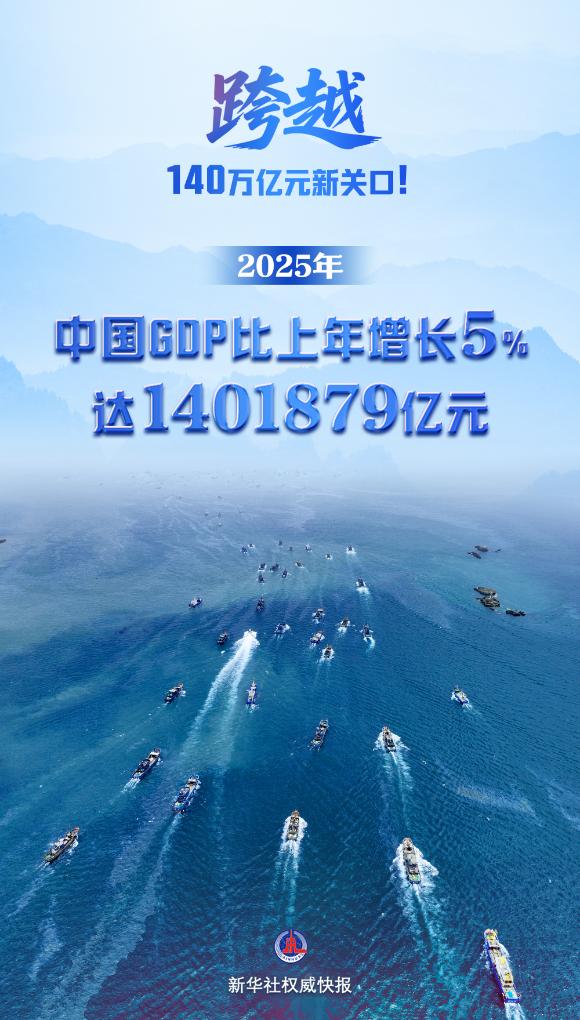
新华鲜报丨140万亿元!中国经济再上新台阶
Xin Hua Wang· 2026-01-19 10:32
Core Viewpoint - China's GDP is projected to exceed 140 trillion yuan by 2025, with a growth rate of 5% compared to the previous year, marking a significant milestone in the country's economic development [1][4]. Economic Growth - The National Bureau of Statistics reported that during the "14th Five-Year Plan" period, China's economy achieved a "four consecutive jumps" in total economic output, reaching milestones of 110 trillion, 120 trillion, 130 trillion, and now 140 trillion yuan [6]. - China's contribution to global economic growth is expected to be around 30%, making it a stable and reliable engine for global economic growth [6]. Economic Resilience - China's agricultural output has stabilized at 1.4 trillion jin for two consecutive years, and the manufacturing value added has remained the highest in the world for 16 years [7]. - The service sector's contribution to GDP has increased to 57.7%, supported by the world's largest and most comprehensive network infrastructure, which enhances the country's ability to withstand risks [7]. Innovation and Technology - China has entered the top ten in global innovation index rankings, with R&D expenditure intensity reaching 2.8%, surpassing the OECD average for the first time [8]. - Significant advancements in technology and innovation are evident, with notable achievements in various sectors, including the successful launch of the "Nine Days" drone and the entry of the first electromagnetic aircraft carrier [8]. Consumer Market Dynamics - The total retail sales of consumer goods have surpassed 50 trillion yuan, reflecting a 3.7% increase from the previous year, with new retail models like unmanned stores and warehouse membership stores experiencing double-digit growth [9]. - The per capita disposable income of residents has increased by 5.0%, and the urbanization rate has reached 67.89%, indicating positive progress in social welfare and public services [9].

德州|德州:办好关键小事 为民生幸福加温
Da Zhong Ri Bao· 2026-01-19 01:11
Group 1 - The establishment of the "Community Micro Business - Love for the Disabled" initiative in Dezhou has provided significant support for families with disabled members, enabling them to earn a monthly income of nearly 10,000 yuan by processing over 1,000 packages daily [1] - The installation of elevators in residential buildings has improved accessibility for residents, with Dezhou completing the installation of 175 elevators last year, bringing the total to 877, ranking third in the province [1] Group 2 - Dezhou has made notable progress in improving living environments, including the establishment of 130 party-building liaison points and addressing over 8,000 property management issues through community engagement [2] - The city has added 75,200 charging ports, reaching a total of 287,100, benefiting 90,900 households with power supply upgrades and reducing line faults by 90% [2] Group 3 - The city has equipped over 13,000 classrooms in more than 600 schools with eye-protecting lamps, achieving full coverage for grades 1-7, and implemented vision monitoring measures with a 100% electronic filing rate [3] - Over 330 schools have extended short breaks to 15 minutes, and more than 1,000 "micro playgrounds" have been developed to ensure students engage in at least 2 hours of physical activity daily [3] Group 4 - Dezhou plans to standardize and upgrade 1,624 village clinics by 2025, enhancing service capabilities and environments to provide quality medical services locally [4] Group 5 - The city is implementing a "signal enhancement" initiative to improve mobile network coverage in key areas, aiming for 98% compliance by the end of 2025, including 1,072 key locations [5] - Customized solutions are being developed for underground spaces to ensure stable network signals, enhancing connectivity for residents [5] Group 6 - The Dezhou Urban Management Bureau has launched a fruit and vegetable map to facilitate fresh produce sales, setting up 54 temporary sales points to support local farmers and improve urban management [6] - The bureau aims to transition urban governance from reactive to proactive service, enhancing city aesthetics and increasing public satisfaction through various initiatives [6]
若房价跌回10年前,一半人将亏本卖房!
Sou Hu Cai Jing· 2026-01-17 04:16
Core Viewpoint - The article highlights the alarming trend of declining real estate prices in China, suggesting that many homeowners may face significant losses if property values continue to drop to levels seen a decade ago [1][8]. Group 1: Current Market Conditions - Many second and third-tier cities have already seen property prices revert to levels from before 2016, indicating a broader trend of declining real estate values across the country [1][2]. - The current inventory of unsold homes is substantial, with some cities experiencing a de-stocking period exceeding 40 months, meaning it would take over three years to sell existing properties even if new construction ceased [2]. Group 2: Homeowner Financial Strain - Homeowners who purchased properties at peak prices in 2018 or 2019 may find their initial down payments lost if prices fall to 2016 levels, leading to potential losses on their total investment including principal, interest, and taxes [3][5]. - The high leverage used by homeowners during the property boom has resulted in significant financial strain, with household debt as a percentage of GDP rising from 39.5% in 2015 to 44% in 2016, creating a precarious financial situation for many families [5][7]. Group 3: Potential Consequences of Price Decline - A nationwide drop in property prices by over 50% could lead to widespread financial distress, particularly for investors and those with high leverage, as they may struggle to sell properties and meet mortgage obligations [8][9]. - The decline in property values could erode the perceived wealth of homeowners, leading to a loss of confidence and increased financial anxiety, especially among those who view their homes as their largest asset [8][9]. Group 4: Solutions and Future Outlook - The article suggests that stabilizing employment and increasing household income are crucial for improving market confidence and enabling homeowners to meet their mortgage payments [10]. - Enhancing the social security system and stabilizing housing price expectations are also recommended to prevent further declines and support struggling homeowners [10].

浙江发布2025年度政府“账本”
Sou Hu Cai Jing· 2026-01-17 02:33
Core Insights - Zhejiang's general public budget revenue for 2025 is projected at 886.51 billion yuan, reflecting a year-on-year growth of 1.8%, with tax revenue contributing 717.28 billion yuan, a 2.5% increase, accounting for 80.9% of the total budget revenue [1] - The province is committed to supporting technological innovation, with significant investments in major projects and platforms, including 3.351 billion yuan for provincial laboratories and 1.750 billion yuan for over 400 major technology projects [1] - A proactive fiscal policy is emphasized to stabilize and improve the economy, with a total funding guarantee exceeding 600 billion yuan for 2025, including 104.28 billion yuan from provincial funds [1] Economic Policies - Zhejiang is implementing the "Two New" policy to boost domestic demand, allocating 1.546 billion yuan for a consumption upgrade program, while also enhancing its open platforms to include offshore trade tax incentives [2] - The province is focused on optimizing the business environment for the private sector, with 99.3% of projects funded by the "4+1" special fund being private, and 80% of government procurement contracts awarded to small and micro enterprises [2] Social Welfare - In 2025, social welfare spending in Zhejiang is set at 952.996 billion yuan, making up 76.4% of the general public budget expenditure, continuing a trend of over two-thirds of budget spending directed towards social welfare for 22 consecutive years [2] - Specific allocations include 8.5 billion yuan for basic pension insurance and 2.637 billion yuan for childcare subsidies, alongside improvements in education and healthcare funding [3] Future Outlook - As 2026 marks the beginning of the "14th Five-Year Plan," Zhejiang's fiscal strategy will align with the "4+1" requirements and the provincial government's overall work deployment, aiming for decisive progress and a vibrant economic landscape [3]
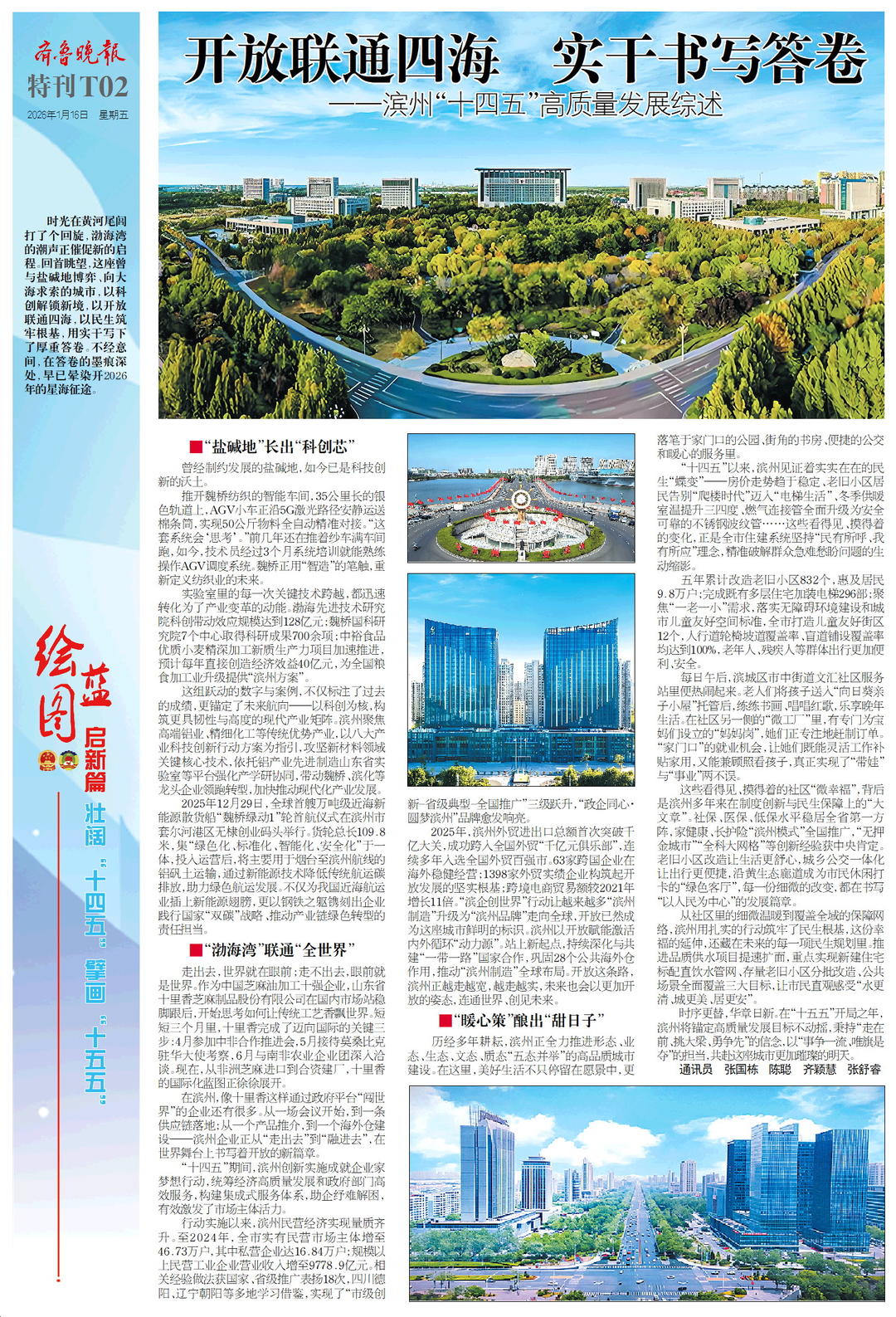
开放联通四海 实干书写答卷——滨州“十四五”高质量发展综述
Qi Lu Wan Bao· 2026-01-16 01:48
Core Viewpoint - The city of Binzhou is transforming from a saline-alkali land into a hub of technological innovation and open trade, focusing on enhancing its industrial matrix and improving the quality of life for its residents, with a vision extending towards 2026 [1][10]. Group 1: Technological Innovation - The previously limiting saline-alkali land has become fertile ground for technological innovation, exemplified by the intelligent workshop of Weiqiao Textile, where AGV vehicles operate along a 35-kilometer track using 5G technology for automated material handling [3][11]. - The Bohai Advanced Technology Research Institute has generated a technological innovation effect worth 12.8 billion yuan, while Weiqiao's research centers have produced over 700 scientific achievements [3][11]. - The project by Zhongyu Food for deep processing of high-quality wheat is expected to create an annual economic benefit of 4 billion yuan, contributing to the upgrade of the national grain processing industry [3][11]. Group 2: Green Shipping Initiatives - The launch of the world's first 10,000-ton offshore new energy bulk carrier, "Weiqiao Green Movement 1," marks a significant step in reducing carbon emissions in traditional shipping through the use of new energy technologies [4][12]. - This vessel, measuring 109.8 meters in length, will primarily transport aluminum ore between Yantai and Binzhou, showcasing the company's commitment to the national "dual carbon" strategy [4][12]. Group 3: International Trade and Economic Growth - Binzhou's foreign trade reached a record high, surpassing 100 billion yuan for the first time, entering the national "100 billion club" and maintaining its position among the top foreign trade cities in China [5][14]. - The number of private market entities in Binzhou is projected to reach 467,300 by 2024, with private enterprises accounting for 168,400 of that total, reflecting a significant increase in the local economy [5][14]. - Cross-border e-commerce trade has surged, increasing 11 times compared to 2021, indicating a robust growth in international trade activities [5][14]. Group 4: Community and Quality of Life Improvements - Binzhou has implemented various initiatives to enhance the quality of life, including the renovation of 832 old residential communities benefiting 98,000 households, and the installation of 296 elevators in existing multi-story buildings [8][15]. - The city has focused on creating child-friendly spaces and improving accessibility for the elderly and disabled, achieving 100% coverage for wheelchair ramps and blind paths [8][15]. - Community programs have been established to provide employment opportunities for parents, allowing them to balance work and family responsibilities effectively [9][16]. Group 5: Future Development Goals - As Binzhou enters the "14th Five-Year Plan" period, it aims to maintain a steadfast commitment to high-quality development, emphasizing innovation and collaboration between government and enterprises [17].
打出经济“开年组合拳”
Xin Lang Cai Jing· 2026-01-15 20:25
Group 1 - The article emphasizes the need to accurately unleash consumer potential through various initiatives [1] - It outlines plans to implement detailed guidelines for a consumption upgrade program in Hunan Province by 2026, alongside increasing the distribution of consumption vouchers [2] - The goal is to conduct over 500 promotional events in the first quarter and distribute nearly one million yuan in hot spring consumption vouchers to national tourists [2] - A systematic approach to spring cultural and tourism consumption is highlighted, including the implementation of a special action plan to boost cultural tourism consumption and the "Bring Customers to Hunan" plan [2] Group 2 - The article discusses the identification and preparation of 4,345 major projects in Hunan, with plans to advance them in the first quarter [3] - Key infrastructure projects include the Shaoyong, Tongji, Changgan, and Yichang railways, as well as the expansion of the G4 Beijing-Hong Kong-Macau Expressway and the renovation of Changsha Airport [3] Group 3 - The article mentions initiatives to support industrial enterprises in increasing production efficiency, including post-holiday resumption assistance and guidance for equipment upgrades [4] - It emphasizes the need for enhanced coordination and support for industries such as new-generation information technology, new energy, low-altitude economy, and electrical equipment [4] Group 4 - The article highlights efforts to promote high-quality development in the service sector, including stabilizing the real estate market and increasing financial support for the real economy [5] - It also mentions the steady development of the transportation industry and support for cultivating large-scale service enterprises [5] Group 5 - The article outlines strategies to stabilize and improve foreign trade and investment, including guiding production-oriented enterprises suitable for export to engage in foreign trade [6] - It emphasizes targeted investment attraction efforts and the implementation of the "Attracting Large, Strong, and Leading Enterprises" initiative [6] Group 6 - The article discusses the orderly advancement of winter and spring agricultural production, focusing on stabilizing grain and oil production and promoting livestock development [7] - It also mentions efforts to expand vegetable production and actively promote fishery development [7] Group 7 - The article stresses the importance of ensuring the safety of people's livelihoods, with a focus on stabilizing employment through over 2,000 online and offline recruitment events [8] - It highlights the need to ensure energy supply and safety during peak winter demand [8]