
关税政策

Search documents
美联储9月如期降息25个基点
Sou Hu Cai Jing· 2025-09-17 19:26
虽然,鲍威尔谈到了美国就业市场的疲软现象,但是鲍威尔也指出美联储的官员们并未对50个基点的降 息广泛支持。鲍威尔再次强调美联储的货币政策需要逐次会议决策,强调了数据的重要性。这再一次体 现了鲍威尔在货币政策方面的谨慎性。 9月17日,美联储如期在9月议息会议后宣布降息25个基点。 在会议后的记者招待会上,美联储主席鲍威尔在强调失业率有所上升的同时也指出通货膨胀仍然偏高。 鲍威尔在讲话中直接指出某些关税确实正在影响劳动力市场,而且由关税推动的价格上涨今年和明年将 继续。言下之意,鲍威尔将当前美国经济中就业市场疲软和通货膨胀粘滞的问题归咎于特朗普总统的关 税政策。 正如在先前文章中阐述的,笔者认为美联储在明年5月鲍威尔卸任前将延续针对货币政策的谨慎态度, 降息的幅度不会太大,速度也不会太快。 JerryZang 免责声明:本文内容及观点仅供参考,不构成任何投资建议。投资者据此操作,风险自担。一切有关市 场的准确信息,请以相关官方公告为准。市场有风险,投资需谨慎。 不过,从本次会议后公布的点阵图来看,本次与会的委员的观点的差异性在上升。这反映出美联储内部 观点的不一致性在上升。 从总体看,鲍威尔的讲话偏中性,并未对 ...

日本单月对美出口“五连降”,15%汽车关税生效后日美贸易会有起色吗?
第一财经· 2025-09-17 15:48
2025.09. 17 本文字数:1841,阅读时长大约3分钟 作者 | 第一财 经 潘寅茹 自4月美国特朗普政府宣布所谓的"对等关税"以来,日本对美出口就一路下滑。 日本单月对美出口已"五连降"(来源:新华社资料图) 相较于2024年时输美汽车关税仍高出数倍 日本财务省具体数值显示,8月日本对美贸易顺差收缩50.5%, 至3240亿日元,其中对美汽车出口暴跌28.4%是主要原因。在对美进口方面,同期增 长11.6%,至1.06万元日元。 在对美贸易中,汽车及零部件向来占据主导,约占日本对美出口总额的1/3。日本汽车制造商协会数据显示,去年日本对美国出口了近137万辆汽车, 美国是其最大的市场。去年日美之间的汽车贸易约合6万亿日元。 就在上述数据公布的前一天,据央视新闻报道,美国特朗普政府发布消息称,对日本汽车的进口关税将从美国东部时间16日0时1分,也就是日本时间 16日13时1分起,下调至15%。这一税率是在现行25%的关税减半至12.5%的基础上,加上现有2.5%的征税额计算得出的。 9月4日,美国总统特朗普签署行政令,正式实施美日贸易协定,对大部分日本输美产品征收最高15%的关税,包含汽车及零部件,部 ...
回旋镖飞回来了!关税战“报应”全到自己身上,美国群众不答应了
Sou Hu Cai Jing· 2025-09-17 09:55
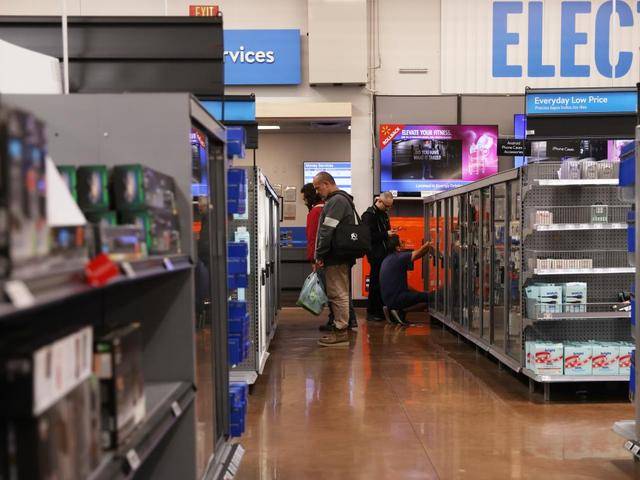
Group 1 - The core viewpoint of the article highlights that Trump's tariff policy has not improved the daily lives of American citizens, who are bearing the consequences of these policies [1][3][36] - Many Americans are facing increased difficulties in finding jobs, with a significant drop in new employment numbers reported by the Labor Department [5][7][10] - The article discusses the rise in functional unemployment, where individuals are employed but unable to afford basic living costs, indicating a hidden economic issue [12][19] Group 2 - The article notes a significant increase in consumer prices, with the Consumer Price Index (CPI) rising to 2.9% in August, impacting the affordability of everyday goods [21][25] - It mentions that many Americans are relying on credit cards to manage their expenses, leading to record-high credit card debt and overdue payments [30][34] - Despite the struggles of ordinary Americans, the stock market has been performing well, with major indices reaching new highs, creating a disconnect between the stock market and the economic realities faced by the populace [32][36]
日本对美出口连续5个月同比下降
Xin Hua Wang· 2025-09-17 07:49
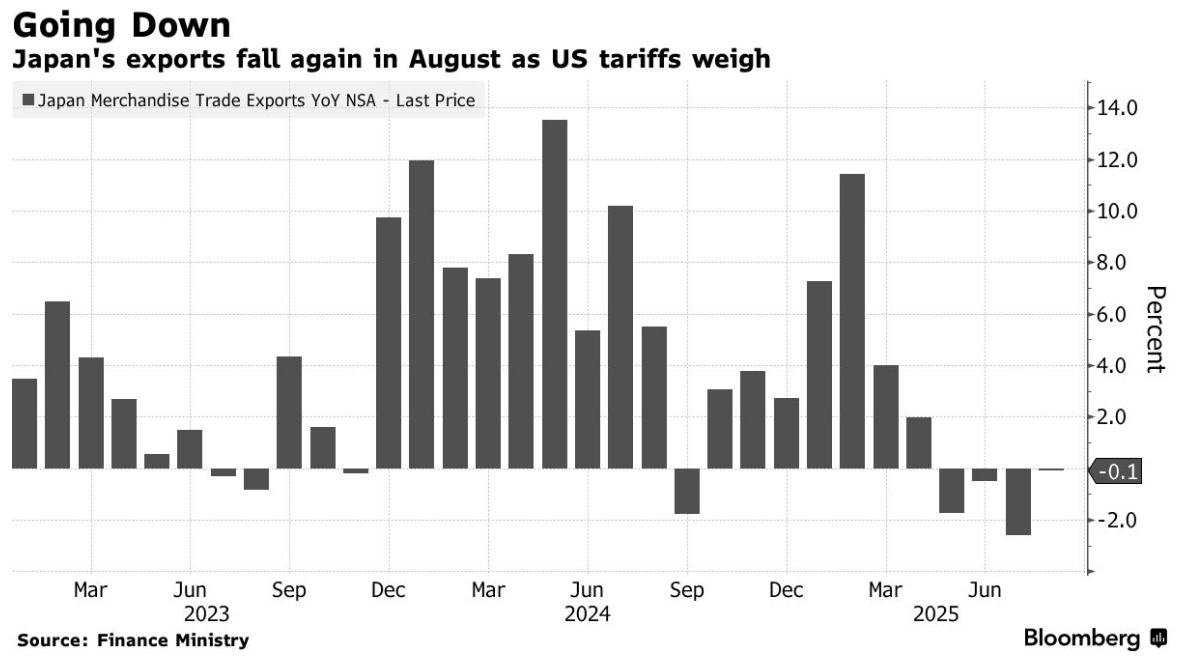
Core Viewpoint - Japan's exports to the United States fell by 13.8% year-on-year in August, marking the largest monthly decline in over four years, primarily due to the impact of U.S. tariff policies [1] Group 1: Trade Statistics - Japan's exports to the U.S. decreased to 1.39 trillion yen (approximately 9.5 billion USD) in August [1] - Overall exports from Japan declined by 0.1% year-on-year, while imports fell by 5.2%, resulting in a trade deficit of 242.5 billion yen (approximately 1.66 billion USD) for the month [1] Group 2: Affected Industries - Significant declines in exports were noted in sectors such as automobiles, construction and mining machinery, and semiconductor manufacturing equipment [1] - Exports of automobiles and auto parts account for about one-third of Japan's total exports to the U.S. [1] Group 3: Company Responses - To mitigate the effects of tariff policies, some Japanese automakers, including Toyota, have been forced to lower prices to maintain sales [1] - Companies like Mitsubishi and Mazda are actively reducing exports of low-margin vehicles to the U.S. and are seeking to expand sales in markets outside the U.S. [1]
日本单月对美出口“五连降”,15%汽车关税生效后日美贸易会有起色吗?
Di Yi Cai Jing· 2025-09-17 05:35
Group 1 - Since April, Japan's exports to the U.S. have been declining for five consecutive months due to the tariffs imposed by the Trump administration [1] - In August, Japan's overall trade deficit was 242.5 billion yen, a decrease of 65.9% year-on-year, with exports slightly down by 0.1% to 8.43 trillion yen [1] - Japan's exports to the U.S. in August fell by 13.8% year-on-year to 1.39 trillion yen (approximately 9.5 billion USD), marking an increase in the decline rate compared to July's 10% [1] Group 2 - Japan's trade surplus with the U.S. shrank by 50.5% in August to 324 billion yen, primarily due to a 28.4% drop in automobile exports [3] - The U.S. has reduced tariffs on Japanese automobiles to 15%, down from a previous rate of 25%, but this is still significantly higher than the pre-April rate of around 2.5% [4] - The analysis from Bloomberg Economics indicates that the 15% tariff level will still impact Japan's exports negatively in the future [5] Group 3 - Japan's strong economic performance in Q2 was supported by domestic demand, with GDP growth at an annualized rate of 1.0%, surpassing expectations [6] - However, there are concerns that upward revisions in private inventories may pressure economic growth in Q3, with a potential for negative growth [6] - Predictions suggest that the U.S. tariff policies could lead to a nearly 25% decline in Japan's exports to the U.S., threatening 0.5% of Japan's GDP [6]
关税突发!美印重启谈判!
证券时报· 2025-09-17 05:20
Core Viewpoint - The trade relationship between the United States and India is showing signs of thawing as new rounds of bilateral trade agreement negotiations have been restarted, although India remains cautiously optimistic about the outcomes [2][4][6]. Group 1: Trade Negotiations - On September 16, a new round of bilateral trade agreement negotiations was initiated in New Delhi, marking a positive signal in the previously strained relationship [4]. - The U.S. delegation, led by Brendan Lynch, aims to engage with Indian officials to restart trade discussions [4]. - The negotiations were originally scheduled for late August but were postponed due to the imposition of high tariffs on Indian goods by the U.S. [5]. Group 2: Tariff Impact - The U.S. has imposed a total tariff rate of 50% on Indian imports, significantly affecting trade dynamics [5][10]. - In August, India's exports to the U.S. dropped from $8.01 billion in July to $6.86 billion, indicating the immediate impact of the tariffs [11]. - Overall, India's total exports fell to $35.1 billion in August, the lowest in nine months, with a trade deficit narrowing to $26.49 billion [12]. Group 3: Economic Projections - Analysts predict that the U.S. tariff policy could result in a loss of approximately $8 billion in exports for India, particularly affecting sectors like gems, jewelry, textiles, and chemicals [14]. - A think tank estimates that India's exports to the U.S. could decline by over 40% by 2026, potentially dropping to around $50 billion [13]. - The tariffs are expected to threaten hundreds of thousands of jobs in key export sectors, including textiles and jewelry [13].

日本出口连降四月 对美贸易创四年最大跌幅
智通财经网· 2025-09-17 03:33
Core Viewpoint - Japan's exports have declined for the fourth consecutive month, primarily due to the impact of U.S. tariffs under President Trump's trade policies, particularly affecting trade with the U.S. [1][3] Export Performance - In August, Japan's export value decreased by 0.1% year-on-year, with automobiles and steel being the main contributors to this decline [1] - Exports to the U.S. saw a significant drop of 13.8%, with automobile exports falling by 28.4% and export volume down by 9.5% [3][4] - Exports to China decreased by 0.5%, while exports to Europe increased by 5.5% [3] Trade Balance - Japan's trade balance recorded a deficit of 242.5 billion yen (approximately 1.7 billion USD) [3] - The import value fell by 5.2%, which was worse than the consensus expectation of a 4.1% decline [3] Economic Implications - The ongoing decline in exports poses risks to Japan's fragile economic growth, potentially disrupting the desired cycle of inflation, wage growth, and overall economic expansion [3] - The impact of U.S. tariffs on Japanese companies, particularly in the automotive sector, may lead to cost-cutting measures that could suppress profit margins and wage growth [3][4] U.S. Trade Relations - Japan's trade surplus with the U.S. was 324 billion yen, indicating ongoing pressure from the U.S. to reduce this gap [5] - The recent trade agreement, which includes a reduction of tariffs on Japanese automobiles, may provide some relief, but its effectiveness will depend on Japan's commitment to invest 5.5 trillion yen as part of the agreement [4]
美国考虑对进口汽车零部件加征关税 行业反应不一
Xin Lang Cai Jing· 2025-09-17 01:43
Core Viewpoint - The U.S. Department of Commerce is considering imposing additional tariffs on imported automotive parts based on national security concerns, following previous tariffs on automotive imports [1] Group 1: Tariff Considerations - The Department of Commerce will review requests for additional tariffs on automotive parts in the coming weeks, focusing on national security implications [1] - In May, the Trump administration imposed a 25% tariff on automotive imports exceeding $46 billion annually, but later reached agreements with some countries to reduce these tariffs [1] - Domestic automotive manufacturers and industry associations can apply for tariffs on parts deemed significant for national defense [1] Group 2: Industry Response - The automotive industry is experiencing rapid technological advancements, including alternative power systems and autonomous driving features, necessitating the identification of new automotive products with defense significance [1] - Last month, the Department of Commerce announced tariffs on over 400 products, including many automotive parts, with an annual import value of $240 billion [1] - Industry associations, including the U.S. Chamber of Commerce, have urged the Department of Commerce to halt the expansion of tariffs, citing significant unexpected costs and complexities for U.S. businesses [1]
美国财政困局:关税是解药,还是毒药?
2025-09-17 00:50
Summary of Key Points from the Conference Call Industry or Company Involved - The discussion primarily revolves around the **U.S. fiscal situation** and the implications of **tariff policies** introduced by the Trump administration. Core Points and Arguments 1. **Unsustainable U.S. Fiscal Situation**: The total public debt held by the U.S. is nearing **$30 trillion**, accounting for **98%** of GDP, which is close to historical highs, raising concerns about the sustainability of U.S. debt assets and increasing global asset price volatility [1][2][3] 2. **Federal Spending Structure**: Mandatory spending constitutes about **60%** of federal expenditures, with net interest payments growing rapidly, surpassing defense spending and reaching **13%** of the budget. This rigid spending structure complicates efforts to reduce the fiscal deficit [1][3] 3. **Impact of Tariff Policies**: The Trump administration's tariff policies were intended to address fiscal issues, but the uncertainty surrounding these policies has accelerated the de-dollarization process, raising concerns about the demand for U.S. debt, particularly long-term bonds [1][4] 4. **Short-term Debt Renewal Pressure**: Although there is a significant amount of U.S. debt maturing in **2025**, the monthly maturity amounts are relatively dispersed, with **80%** being short-term debt, which alleviates immediate renewal pressures [4][5] 5. **Credit Rating Downgrade**: Moody's downgraded the U.S. sovereign credit rating from **3** to **21**, reflecting growing concerns about fiscal sustainability and market confidence in U.S. debt [2][6] 6. **Ineffectiveness of Tariff Increases**: Even with potential increases in tariffs, the projected revenue gains fall significantly short of the Trump administration's targets, with estimates suggesting only **$300-400 billion** annually, compared to the claimed **$6 trillion** over ten years [8][15] 7. **Historical Context of Tariff Policies**: The Smoot-Hawley Tariff Act of the 1930s serves as a historical example of how high tariffs can lead to retaliatory measures and a collapse in international trade, which could be a risk with current policies [9][12] Other Important but Possibly Overlooked Content 1. **Long-term Risks**: There are concerns about potential technical defaults or supply shocks, but these risks are considered limited due to historical political negotiations that have typically avoided defaults [2][5] 2. **Economic Implications**: The rising debt burden could crowd out private investment and consumption, limiting monetary and fiscal policy flexibility and exacerbating uncertainty around U.S. dollar assets [3][4] 3. **Political Dynamics**: The current political landscape, with the Republican Party controlling both houses of Congress, may reduce the likelihood of budgetary conflicts that could lead to technical defaults [5][6] 4. **Trade Volume Considerations**: The potential for reduced trade volumes and retaliatory actions from trading partners could undermine the effectiveness of tariff increases in generating revenue [15]
突传缓和信号!美印重启贸易谈判
Zheng Quan Shi Bao· 2025-09-16 23:53
Group 1 - The US and India have resumed bilateral trade agreement negotiations on September 16, signaling a potential thaw in their previously tense trade relations [1][2] - The US has imposed a total tariff rate of 50% on Indian imports, significantly higher than tariffs on other Asia-Pacific countries, which has led to a decline in India's exports to the US [2][4] - India's exports to the US fell from $8.01 billion in July to $6.86 billion in August, indicating the immediate impact of the US tariff policy [4][5] Group 2 - The overall export value of Indian goods decreased from $37.24 billion in July to $35.1 billion in August, marking a nine-month low [5] - The US is India's largest trading partner, with a total trade value of $78.35 billion in the first half of 2025, where India exported $56.3 billion and imported approximately $22 billion [5] - The imposition of high tariffs is expected to reduce India's exports to the US by over 40% by 2026, potentially dropping to around $50 billion [5][6] Group 3 - Key export sectors for India include textiles, jewelry, and gemstones, which are likely to face significant declines in export volumes due to the US tariffs [6] - Analysts estimate that the US tariff policy could cost the Indian economy billions of dollars, with approximately $8 billion worth of exports at risk [6] - The punitive trade measures by the US may negatively affect the stability of US-India relations, potentially inciting nationalist sentiments in India, which could pressure the Indian government to respond to the tariffs [6]