出口管制

Search documents
中美达成共识后,荷兰尴尬了
Huan Qiu Shi Bao· 2025-10-31 14:57
Core Viewpoint - The Dutch government faces a dilemma regarding the forced takeover of Nexperia, a subsidiary of the Chinese company Wingtech Technology, following a consensus reached between China and the U.S. on export controls [3][5]. Group 1: Company Actions and Responses - Wingtech Technology insists that any agreement to restore exports from Nexperia must include the reinstatement of CEO Zhang Xuezheng [3]. - The Dutch government invoked the 1952 Commodity Supply Act to take control of Nexperia's assets, citing national security concerns [3][4]. - Nexperia's factory in Dongguan, China, is one of the largest in the world, accounting for about half of the company's total production, and has recently seen significant reductions in output [4]. Group 2: Legal and Regulatory Context - The Amsterdam Court of Appeal ruled on October 7 to suspend Zhang Xuezheng's position, appointing a foreign individual to take over [3][4]. - The Dutch Ministry of Economic Affairs maintains that the takeover is in accordance with legal provisions, and Zhang's suspension is a result of an independent court investigation [4]. Group 3: Industry Implications - Nexperia supplies a significant number of chip components, playing a crucial role in the global automotive supply chain, with warnings from European automotive executives about potential production disruptions if supply is not restored [4]. - The recent actions by the Dutch government were partly influenced by the U.S. government's announcement of additional export controls on September 29, which affected subsidiaries like Nexperia [4].



美国暂停对中国造船301调查、暂停对等关税、取消“芬太尼关税”!
Sou Hu Cai Jing· 2025-10-31 11:52
Core Points - The recent US-China economic talks in Kuala Lumpur have led to significant agreements, including tariff adjustments and export control suspensions [2][3] - Both sides have shown a commitment to dialogue and cooperation, aiming to enhance economic stability and certainty in their trade relations [3] Group 1: Tariff Adjustments - The US will cancel the 10% "fentanyl tariff" on Chinese goods, while the 24% reciprocal tariff will remain suspended for another year [2] - China will adjust its countermeasures in response to the US tariff changes [2] Group 2: Export Control Measures - The US will suspend the implementation of its 50% penetrative export control rules for one year, while China will also pause its related export control measures for the same duration [2][3] - Both countries will work on refining specific plans regarding these export controls [2] Group 3: Maritime and Logistics Measures - The US will suspend its 301 investigation measures related to China's maritime, logistics, and shipbuilding industries for one year, with China reciprocating by pausing its countermeasures [3] - The postponement of higher port fees for Chinese vessels docking in the US has been announced [4] Group 4: Broader Economic Cooperation - Agreements were reached on fentanyl cooperation, expanding agricultural trade, and handling specific corporate cases [3] - The US has made positive commitments in investment areas, and both sides are looking to resolve issues related to TikTok [3]
港媒:中美达成共识后,荷兰在接管安世问题上进退两难
Huan Qiu Shi Bao· 2025-10-31 10:12
Core Viewpoint - The Dutch government's forced takeover of Nexperia, a subsidiary of the Chinese company Wingtech Technology, has led to significant tensions, with Wingtech demanding the reinstatement of CEO Zhang Xuezheng as a condition for any agreement to restore exports from China [1][3]. Group 1: Government Actions - On September 30, the Dutch government invoked the 1952 Commodity Supply Act to take control of Nexperia's assets, citing national security concerns [3]. - The Amsterdam Court of Appeal ruled on October 7 to suspend Zhang Xuezheng from his position, appointing a foreign individual to take over [3]. - The Dutch Ministry of Economic Affairs maintains that the takeover is in accordance with legal provisions and that Zhang's suspension is a result of an independent court investigation [3]. Group 2: Company Response - Wingtech Technology strongly opposes the takeover and urges the Dutch government to revoke the decision, denying any allegations of technology theft or commercial secret leakage [3]. - A company spokesperson emphasized that there is no need or reason for Wingtech to "steal" technology from its own subsidiary, asserting their legitimate ownership of Nexperia [3]. - The spokesperson also indicated that restoring full control and ownership of the company is essential for easing tensions and restoring stability [3]. Group 3: Industry Impact - Nexperia's factory in Dongguan, China, is one of the largest of its kind globally, accounting for about half of the company's total production, and has recently seen significant reductions in output [4]. - Nexperia supplies a large number of chip components, playing a crucial role in the global automotive supply chain, with European automotive executives warning that continued supply disruptions could lead to production halts [4]. - The company has informed employees and clients that it will continue to operate independently of its Dutch headquarters [4]. Group 4: International Context - Following a consensus reached during trade talks in Kuala Lumpur, the U.S. has agreed to suspend the implementation of its September 29 export control rules for one year, while China will also pause its related measures [5]. - The Dutch government is facing renewed pressure regarding the Nexperia issue in light of the U.S. suspension of export controls, highlighting a complex dilemma involving legal consistency, political credibility, and industrial survival [5].

中美贸易战按下暂停键:釜山会晤给世界经济吃下“定心丸”,24%“反制关税”暂停一年
Sou Hu Cai Jing· 2025-10-31 09:40
Group 1 - The meeting between Chinese President Xi Jinping and U.S. President Donald Trump on October 30 marks a significant historical moment, being their first meeting in six years and the first during Trump's new term [2] - The discussions focused on U.S.-China economic and trade relations, with both sides agreeing to enhance cooperation in these areas [2] - Following the meeting, the Chinese Ministry of Commerce announced the outcomes of negotiations in Kuala Lumpur, including the U.S. decision to cancel the 10% "Fentanyl tariff" on Chinese goods and to suspend the 24% "reciprocal tariff" for one year [2][4] Group 2 - The trade negotiations between the U.S. and China have been ongoing since May 2025, with five rounds of talks held, leading to significant tariff reductions and suspensions [3][4] - The recent agreements signify a new phase in U.S.-China economic relations, moving from a period of tension to a more strategic interaction [4] - Analysts suggest that the one-year suspension of tariffs aligns with the upcoming U.S. midterm elections, indicating a desire for a stable economic environment prior to the elections [4] Group 3 - The trade negotiations have highlighted vulnerabilities in the U.S. strategy, particularly in agriculture and rare earths, which are critical to the U.S. market's reliance on China [5] - China's import and export figures remain robust, with a total trade volume of 33.6 trillion yuan in the first three quarters of 2025, reflecting a 4% year-on-year increase [5][6] - Despite external challenges, China's economy has shown resilience, achieving a 5.2% growth rate in the same period, supported by strong export performance to non-U.S. markets [6]

X @外汇交易员
外汇交易员· 2025-10-31 03:03
Trade Policy - The Ministry of Commerce emphasizes that export controls are focused on security issues [1] - The Ministry of Commerce links security with development, stating that ensuring security enables better development and stronger security [1] Green Development - The Ministry of Commerce clarifies that green development is a concept [1] - The Ministry of Commerce addresses concerns about how China's rare earth regulations might affect its green development [1]
国泰君安期货所长早读-20251031
Guo Tai Jun An Qi Huo· 2025-10-31 02:08
Report Industry Investment Rating No information provided in the content. Core Viewpoints of the Report - On October 30, 2025, Chinese President Xi Jinping met with US President Trump in Busan. The China - US economic and trade teams reached consensus on issues such as the 301 measures on China's maritime, logistics, and shipbuilding industries, the extension of the suspension period of reciprocal tariffs, fentanyl tariffs and law - enforcement cooperation, agricultural product trade, and export controls. Overall, it's a "one - year truce" between the two countries, and the long - term competition and game between China and the US are certain [6]. - Glass is short - term weak and medium - term in a volatile market. In the short term, due to the industry meeting falling short of expectations, the market's expectation of supply - side contraction in the glass industry has significantly decreased, and with the real - estate market not improving significantly, the price is weak. In the medium term, the market may fluctuate repeatedly [7]. Summary by Relevant Catalogs Gold and Silver - **Core Viewpoint**: Gold should focus on US bank risks, and silver is in an oscillating rebound. Gold's trend strength is 1, and silver's is also 1 [10][13][15]. - **Fundamental Data**: Provided data on prices, trading volumes, positions, inventories, and spreads of gold and silver futures and spot in domestic and international markets, as well as exchange - rate data [13]. - **Macro and Industry News**: Included news such as the China - US leaders' meeting, the European Central Bank's "holding steady", the Bank of Japan's maintaining interest rates, and corporate earnings reports [13][16]. Copper - **Core Viewpoint**: The number of disturbing factors for copper has increased, and the price is oscillating. The trend strength is 0 [10][17][18]. - **Fundamental Data**: Presented data on copper futures prices, trading volumes, positions, inventories, and spreads, as well as spot prices and spreads [17]. - **Macro and Industry News**: Covered news like the China - US leaders' meeting, the European Central Bank's "holding steady", Indonesia's possible permission for copper concentrate exports, and changes in copper production of some companies [17][18][19]. Zinc - **Core Viewpoint**: Zinc is in a range - bound oscillation. The trend strength is 0 [10][20][22]. - **Fundamental Data**: Showed data on zinc futures prices, trading volumes, positions, spot premiums, and import and export profits and losses [20]. - **News**: Included the news of the China - US economic and trade teams reaching consensus [20]. Lead - **Core Viewpoint**: The continuous reduction of domestic and foreign lead inventories supports the price. The trend strength is 0 [10][23]. - **Fundamental Data**: Provided data on lead futures prices, trading volumes, positions, spot premiums, and import and export profits and losses, as well as inventory data [23]. - **News**: Mentioned the China - US leaders' meeting [23]. Tin - **Core Viewpoint**: Tin should focus on macro - level impacts. The trend strength is 0 [10][25][28]. - **Fundamental Data**: Offered data on tin futures prices, trading volumes, positions, inventories, and spreads, as well as spot prices and spreads [25]. - **Macro and Industry News**: Included news such as the China - US leaders' meeting, the European Central Bank's "holding steady", and corporate earnings reports [25][26]. Aluminum, Alumina, and Cast Aluminum Alloy - **Core Viewpoint**: Aluminum's price fluctuation is converging, alumina is slightly declining, and cast aluminum alloy follows electrolytic aluminum. Aluminum's trend strength is 0, alumina's is - 1, and cast aluminum alloy's is 0 [10][29][31]. - **Fundamental Data**: Presented data on prices, trading volumes, positions, inventories, and spreads of aluminum, alumina, and cast aluminum alloy futures and spot, as well as cost and profit data [29]. - **Comprehensive News**: Included news such as the Bank of Japan's maintaining interest rates and the US Senate's passing a resolution to terminate Trump's comprehensive tariff policy [31]. Nickel and Stainless Steel - **Core Viewpoint**: Nickel is in a narrow - range oscillation due to the game between smelting inventory accumulation and nickel - ore concerns. Stainless steel has limited downward potential and lacks upward drivers. The trend strength of both is 0 [10][32][34]. - **Fundamental Data**: Provided data on nickel and stainless - steel futures prices, trading volumes, positions, and prices and spreads in the industrial chain [32]. - **Macro and Industry News**: Included news such as Indonesia's taking over a nickel - ore mining area, China's suspension of a non - official subsidy for imported copper and nickel from Russia, and Indonesia's sanctions on mining companies [32][33]. Lithium Carbonate - **Core Viewpoint**: After the absolute price of lithium carbonate rises, attention should be paid to the switching of expectations between the Q1 off - season and lithium - ore resumption of work. The trend strength is 0 [10][35][37]. - **Fundamental Data**: Presented data on lithium carbonate futures prices, trading volumes, positions, basis, and prices in the industrial chain [35]. - **Macro and Industry News**: Included news such as the increase in lithium - carbonate prices, changes in production and inventory, a lithium - ore auction, and the G7's plan to establish a critical - mineral production alliance [36][37]. Industrial Silicon and Polysilicon - **Core Viewpoint**: Industrial silicon should focus on subsequent warehouse - receipt registration, and polysilicon is in a high - level oscillating state. The trend strength of both is 0 [10][38][40]. - **Fundamental Data**: Provided data on prices, trading volumes, positions, spreads, and inventories of industrial silicon and polysilicon futures and spot, as well as cost and profit data [38]. - **Macro and Industry News**: Included news about the release of the list of enterprises meeting the photovoltaic manufacturing industry's standard conditions [38][40]. Iron Ore - **Core Viewpoint**: Iron ore is in a relatively strong oscillation. The trend strength is 0 [10][42][43]. - **Fundamental Data**: Presented data on iron - ore futures prices, positions, spot prices, and spreads [42]. - **Macro and Industry News**: Included news of the China - US leaders' meeting [42]. Rebar and Hot - Rolled Coil - **Core Viewpoint**: Due to the repeated macro - level sentiment, rebar and hot - rolled coil are in a wide - range oscillation. The trend strength of both is 0 [10][45][46][48]. - **Fundamental Data**: Provided data on rebar and hot - rolled coil futures prices, trading volumes, positions, spot prices, and spreads [46]. - **Macro and Industry News**: Included news such as changes in production, inventory, and apparent demand, policies supporting commercial real - estate REITs, and the release of the 15th Five - Year Plan's suggestions [47][48]. Ferrosilicon and Silicomanganese - **Core Viewpoint**: Due to the repeated market sentiment, ferrosilicon and silicomanganese are in a wide - range oscillation. The trend strength of both is 0 [10][50][53]. - **Fundamental Data**: Presented data on ferrosilicon and silicomanganese futures prices, trading volumes, positions, spot prices, and spreads [50]. - **Macro and Industry News**: Included news such as price quotes of ferrosilicon and silicomanganese, changes in production and capacity utilization in different regions, and steel - mill procurement prices [50][52][53]. Coke and Coking Coal - **Core Viewpoint**: Coke is in a relatively strong oscillation, and coking coal is in a relatively strong oscillation due to the resonance of macro - level and sector - theme factors. The trend strength of both is 0 [10][54][55][56]. - **Fundamental Data**: Provided data on coke and coking - coal futures prices, trading volumes, positions, spot prices, and spreads [55]. - **Macro and Industry News**: Included news of the China - US leaders' meeting [56]. Logs - **Core Viewpoint**: Logs are in an oscillating and repeated state [57].
闻泰科技:要想重启安世半导体从中国出口,必须满足这一条件
Guan Cha Zhe Wang· 2025-10-31 01:08
Core Viewpoint - The Dutch government's forced takeover of Nexperia, a subsidiary of China's Wingtech Technology, has significant implications for Sino-Dutch relations and the global automotive supply chain, exacerbating the ongoing chip shortage crisis [1][4]. Group 1: Company Actions and Responses - Wingtech Technology has set a high bar for negotiations with the Dutch government, insisting that any agreement to resume exports from Nexperia must include the reinstatement of its former CEO [1]. - The spokesperson for Wingtech Technology denied any wrongdoing, asserting that there was no technology transfer or theft involved, and emphasized that technology sharing is a common practice in the semiconductor industry [3]. - Following the Dutch government's intervention, Nexperia's operations in China have been restricted, leading to a planned "four days on, three days off" work schedule, which poses challenges for supply chain localization [4]. Group 2: Impact on the Industry - The Dutch government's actions have caused a "major earthquake" in the global automotive supply chain, with European automakers facing potential production halts due to the chip supply shortage from Nexperia [5]. - A report indicated that 86% of major European companies in various industries rely on chips produced by Nexperia's Chinese facilities, highlighting the widespread risk to European industrial sectors [5]. - The Chinese government has expressed its opposition to the Dutch actions, emphasizing the need to avoid politicizing trade issues and maintain market principles [5].
中美经贸磋商结果公布,后续如何发展?
CAITONG SECURITIES· 2025-10-30 13:17
Group 1: Trade Negotiation Outcomes - The U.S. will reduce the fentanyl tariff by 10 percentage points, while China will lower retaliatory tariffs on U.S. agricultural products (such as soybeans) and energy[5] - Both sides will suspend the 24% reciprocal tariffs and the 50% export control measures for one year[5] - Maritime, logistics, and shipbuilding sanctions will also be paused for one year[6] Group 2: Market Implications - The outcomes align with market expectations and previous forecasts regarding rare earth controls and soybean purchases in exchange for tariff reductions[7] - After the tariff reductions, China's tariffs are now on par with Southeast Asia, only 5 percentage points higher than those of Europe and Japan, which is marginally beneficial for exports[7] Group 3: Future Developments - Tariff disputes are expected to evolve, with less likelihood of comprehensive increases in the future, and the fentanyl tariff may continue to be eliminated in subsequent negotiations[8] - Despite recent U.S. retreats in trade confrontations, ongoing competition suggests that conflicts may persist, particularly in electronics, new energy, and pharmaceuticals[8] Group 4: Risk Factors - There are risks of actual execution falling short of expectations, potential policy reversals, and changes in import-export policies[12]
美方暂停实施出口管制50%穿透性规则一年
财联社· 2025-10-30 08:38
中方将暂停实施10月9日公布的相关出口管制等措施一年,并将研究细化具体方案。 今天,商务部新闻发言人介绍中美经贸磋商成果共识时提到,美方将暂停实施其9月29日公布的出口管制50%穿透性规则一年。 ...

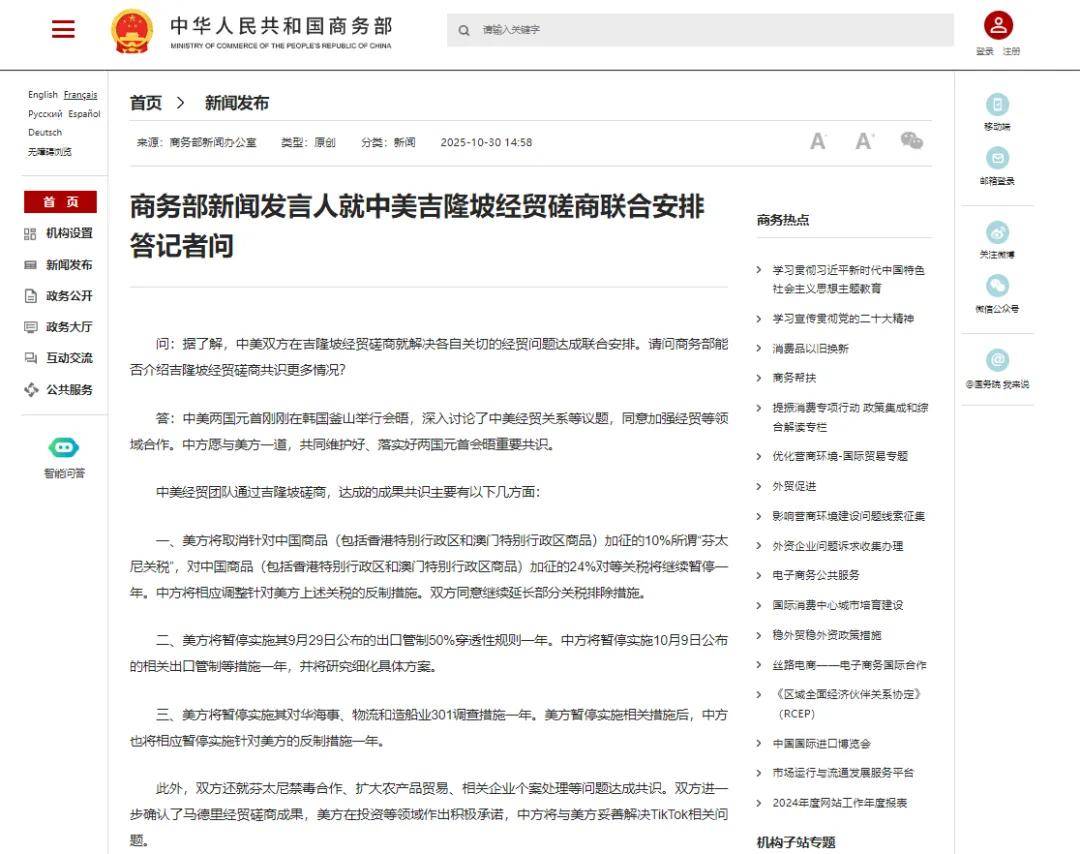
美方将取消针对中国商品加征的10%所谓“芬太尼关税”,24%对等关税继续暂停一年
Xin Lang Cai Jing· 2025-10-30 07:52
记者 辛圆 据商务部网站周四发布消息,商务部新闻发言人就中美吉隆坡经贸磋商联合安排答记者问。 记者提问称,据了解,中美双方在吉隆坡经贸磋商就解决各自关切的经贸问题达成联合安排。请问商务部能否介绍吉隆坡经贸磋商共识更多情况? 对此,发言人回应称,中美经贸团队通过吉隆坡磋商,达成的成果共识主要有以下几方面: 二是美方将暂停实施其9月29日公布的出口管制50%穿透性规则一年。中方将暂停实施10月9日公布的相关出口管制等措施一年,并将研究细化具体方案。 三是美方将暂停实施其对华海事、物流和造船业301调查措施一年。美方暂停实施相关措施后,中方也将相应暂停实施针对美方的反制措施一年。 此外,发言人提到,双方还就芬太尼禁毒合作、扩大农产品贸易、相关企业个案处理等问题达成共识。双方进一步确认了马德里经贸磋商成果,美方在投资 等领域作出积极承诺,中方将与美方妥善解决TikTok相关问题。 当地时间10月25日至26日,中美双方在吉隆坡举行经贸磋商。中国商务部国际贸易谈判代表兼副部长李成钢在磋商结束后对中外媒体记者表示,双方就妥善 解决彼此关注的多项重要经贸议题形成初步共识,下一步将履行各自国内批准程序。 李成钢介绍,过去两天 ...