
区域协同发展

Search documents
现代化基础设施网络激发协同发展活力
Shan Xi Ri Bao· 2025-12-16 22:53
Core Viewpoint - The construction of significant water and transportation infrastructure in Shaanxi province is set to enhance regional development and economic growth, with projects like the Dongzhuang Water Conservancy Project and the Hanjiang to Weihe Water Diversion Project playing pivotal roles in this transformation [1][2][3]. Infrastructure Development - The Dongzhuang Water Conservancy Project, a 230-meter high dam, has transitioned from construction to operational phase, providing essential flood control and water supply to the Weihe River basin [1] - The Hanjiang to Weihe Water Diversion Project utilizes long tunnels to supply water from the Han River to the Guanzhong Plain, further supporting regional water needs [2] - Shaanxi's "14th Five-Year Plan" emphasizes the development of a comprehensive transportation network, including a "米" shaped and five horizontal and two vertical transportation framework, to enhance connectivity and efficiency [3] Economic Impact - The integration of high-speed rail lines, exceeding 2000 kilometers in total length, is expected to significantly reduce travel times and enhance economic activity along the routes, creating a more interconnected economic landscape [3][4] - The establishment of a modern energy transportation system in northern Shaanxi, including a coal transport railway network and oil and gas pipelines, supports the region's energy supply and economic stability [5] - Shaanxi's GDP grew by 5.3% year-on-year in the first three quarters of the year, outperforming the national average, indicating strong economic resilience and growth driven by infrastructure investments [5] Regional Collaboration - The infrastructure projects are fostering deeper regional integration, with improved transportation facilitating economic collaboration between cities like Xi'an and Xianyang [4] - The coordinated development of the three regions—Guanzhong, southern Shaanxi, and northern Shaanxi—aims to enhance overall competitiveness and economic circulation within the province [5] Long-term Vision - The ongoing infrastructure developments are not only aimed at short-term economic stabilization but also at laying a solid foundation for sustainable, high-quality economic growth in the long run [6]
南哥,到底有多好?
3 6 Ke· 2025-12-16 07:45
Core Insights - The article emphasizes the importance of regional collaboration and integration among cities, particularly in the context of China's urban development strategy [2][3][4]. Policy Initiatives - The Central Economic Work Conference this year highlighted the need to strengthen coordination among key city clusters and deepen cross-administrative cooperation [2]. - Major provinces like Guangdong, Jiangsu, and Zhejiang have proposed initiatives to enhance city pair collaborations and urban integration [3]. Regional Collaboration Examples - The recent 15th National Games, co-hosted by Guangdong, Hong Kong, and Macau, is cited as a national model for regional collaborative development [4]. - The "Su Chao" event in Nanjing showcased the vibrant interactions among 13 cities, reflecting a unique local camaraderie [5][7]. Cross-Province Integration - In the "Lingxi Community" of Anhui's Chuzhou, half of the 16,000 residents are from Nanjing, illustrating a deep integration of living and working across provincial borders [11]. - The introduction of cross-province bus routes, such as the 861 line connecting Nanjing and Ma'anshan, has significantly increased passenger traffic [13]. Transportation Developments - The Nanjing-Ma'anshan intercity railway is nearing completion, with operations expected to start soon, enhancing connectivity in the region [15]. - The Nanjing urban area is developing a "one-hour commuting circle" and a "one-day living circle," transitioning from plans to reality [17]. Social Governance and Services - The Nanjing metropolitan area has implemented integrated public services, allowing residents to handle various administrative tasks across the region [19][20]. - The region has achieved a high level of service integration, with 200 frequently used services available online and across locations [20]. Historical Context - Nanjing's unique geographical position and historical ties with Anhui have fostered a strong regional identity and collaborative spirit [23][24][27]. - The historical context of Nanjing as a former capital and its administrative evolution has shaped its current collaborative approach with neighboring regions [24][29]. Governance Model - The Nanjing metropolitan area employs a flexible governance model characterized by decentralized decision-making and collaborative planning among city leaders [33][35]. - The establishment of the Nanjing metropolitan area has been marked by significant milestones, including the first cross-province urban area plan approved by the national government [32]. Economic Collaboration - The South Qiao-Pukou Industrial Cooperation Park exemplifies a successful model of shared investment and revenue distribution between Nanjing and Chuzhou [41][42]. - The innovative financial arrangements in the cooperation park have led to mutual benefits, enhancing regional economic development [42][44].


报告:京津冀地区已成为中国新能源和智能网联汽车重要基地
Zhong Guo Xin Wen Wang· 2025-12-15 12:31
Core Insights - The Beijing-Tianjin-Hebei (Jing-Jin-Ji) region has emerged as a significant base for new energy and intelligent connected vehicles in China [1] Group 1: Industry Overview - The total automobile production in the Jing-Jin-Ji region is projected to reach 2.85 million units in 2024, representing a year-on-year growth of 11.8% [1] - The production of new energy vehicles (NEVs) is expected to surge to 676,000 units, marking an impressive year-on-year increase of 154% [1] - The automotive industry in the region is anticipated to generate over 840 billion RMB in output value, establishing itself as the leading industry in the Jing-Jin-Ji manufacturing sector [1] Group 2: Regional Development Strategies - Beijing is focusing on market-oriented approaches to transform traditional automakers and develop leading NEV brands [1] - Tianjin is actively promoting the transition of vehicle manufacturers towards electrification, intelligence, and connectivity, while fostering the growth of ecosystem-driven NEV companies [1] - Hebei is centering its efforts around vehicle manufacturers and has collaborated with Beijing and Tianjin to release an industrial chain map, laying a solid foundation for future coordinated development [1] Group 3: Industry Chain Collaboration - The manufacturing industry chain in the Jing-Jin-Ji region is showing strong development momentum, forming a collaborative pattern across multiple industrial chains [1] - A preliminary collaborative framework for the new energy storage industry has been established, characterized by a gradient cooperation model of "Beijing innovation - Tianjin materials - Hebei manufacturing + scenarios" [1]

弄潮江海风正劲——解码万亿南通产业升级路
Shang Hai Zheng Quan Bao· 2025-12-14 19:43
Core Viewpoint - Nantong is accelerating its transformation into a significant growth pole for high-quality development in Jiangsu, leveraging its historical industrial foundation and geographical advantages to foster innovation and economic growth [5][13]. Economic Performance - Nantong's GDP reached 1 trillion yuan in 2020 and is projected to reach 1.24 trillion yuan in 2024, with a year-on-year growth of 6.2% [7]. - In the first three quarters of this year, Nantong's GDP was 978.89 billion yuan, reflecting a year-on-year increase of 5.4%, which is higher than the national average [10]. Industrial Development - Nantong is home to six major industrial clusters, with shipbuilding and high-end textiles recognized as national advanced manufacturing clusters, contributing significantly to the national output [11]. - The high-end textile industry is transitioning from "weaving" to "intelligent manufacturing," driven by technological innovation and global market expansion [11]. Historical Legacy - The legacy of Zhang Jian, a pioneer of modern industry in Nantong, continues to influence local entrepreneurs and the city's industrial ethos, emphasizing education and practical skills [8][10]. - The establishment of "Nantong Entrepreneur Day" and the "Zhang Jian Cup" awards institutionalizes the spirit of entrepreneurship in the region [9]. Strategic Initiatives - Nantong is focusing on coastal development as a key strategy for achieving the next trillion yuan in GDP, with a modern marine industry system being established [14][15]. - The city is enhancing its connectivity with Shanghai and Suzhou through multiple infrastructure projects, facilitating regional collaboration and industrial integration [16]. Innovation and Future Industries - Nantong is prioritizing future industries such as aerospace, marine technology, and renewable energy, aiming to capture technological advancements and drive economic growth [16]. - The establishment of "offshore incubators" in various districts is fostering innovation and attracting technology projects to the region [16].


研发在静安、生产在奉贤 破解美妆产业“研发难转换慢量产贵”痛点 静安奉贤双向赋能“美美与共”
Jie Fang Ri Bao· 2025-12-14 01:57
Core Insights - Shanghai is recognized as a major beauty city in China, with leading cosmetic brands and nearly one-third of the national retail sales of cosmetics coming from the city [1] - The two key districts in Shanghai's cosmetic industry are Fengxian, known for its production capabilities, and Jing'an, which serves as a hub for global cosmetic headquarters and innovation [2][4] Group 1: Industry Overview - Fengxian has established itself as a significant production base, housing nearly 40% of the city's cosmetic companies and is projected to account for 50% of the city's cosmetic output value by 2024 [2] - Jing'an is home to numerous high-profile beauty and skincare companies, including L'Oréal and Perfect Diary, and has launched the "Beauty Innovation Zone" initiative to create a comprehensive beauty economy ecosystem [2][5] Group 2: Collaborative Advantages - The collaboration between Fengxian and Jing'an aims to leverage their respective strengths: Jing'an's innovation and research capabilities with Fengxian's manufacturing prowess [4][7] - Fengxian's production facilities include a range of enterprises from major OEMs to flexible custom manufacturers, while Jing'an boasts top-tier medical resources and innovation centers [4][5] Group 3: Strategic Initiatives - The recent meeting between the two districts focused on developing a coordinated approach to enhance the beauty economy, emphasizing the importance of matching resources and capabilities [3][9] - The proposed model includes a closed-loop mechanism for innovation incubation and industrial transformation, aiming to create a nurturing environment for both emerging and established brands [7][9] Group 4: Market Dynamics - The synergy between the two districts is expected to reduce costs and enhance value across the entire supply chain, allowing companies to focus on core competencies while benefiting from established production capabilities [9][10] - This collaborative approach reflects a broader shift in Shanghai's industrial strategy, moving from competition to cooperation among districts to optimize resource allocation [9][10]


冲刺万亿GDP城市,温州胜算最大
Sou Hu Cai Jing· 2025-12-14 01:33
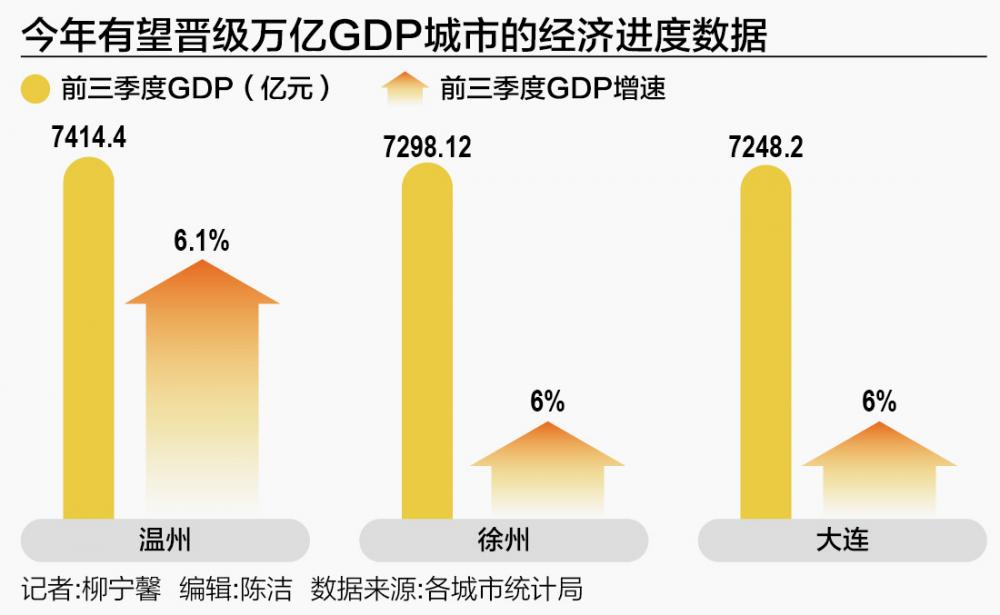
Core Viewpoint - Wenzhou is expected to surpass a GDP of 1 trillion yuan this year, with Xuzhou and Dalian also aiming for this milestone, indicating a trend of ordinary prefecture-level cities joining the ranks of trillion-yuan cities in China [1][3][4]. Group 1: Economic Progress of Cities - Wenzhou's GDP for the first quarter was 240.37 billion yuan, with a growth rate of 6.7%, and it is projected to reach 1 trillion yuan this year [2]. - Xuzhou's GDP for the first three quarters was 729.812 billion yuan, with a growth rate of 6.0% [2]. - Dalian's GDP for the first three quarters was 724.82 billion yuan, with a growth rate of 6.0% [2]. Group 2: Characteristics of Trillion-Yuan Cities - The expansion of trillion-yuan cities includes ordinary prefecture-level cities, with Wenzhou and Xuzhou being notable examples [2][3]. - Cities with GDPs between 700 billion and 800 billion yuan, such as Shaoxing, Yangzhou, Yancheng, and Jiaxing, are expected to be the main drivers for future growth towards the trillion-yuan mark [2][16]. Group 3: Implications for Urban Economic Structure - The trend of expanding trillion-yuan cities reflects a shift in China's urban economic landscape, moving from provincial capitals and sub-provincial cities to ordinary prefecture-level cities [3][17]. - The focus on high-quality urban development emphasizes the need for structural upgrades in industries, income levels, and green development, rather than just quantitative growth [3][18]. Group 4: Wenzhou's Economic Foundation - Wenzhou's economic growth is supported by a robust manufacturing base and a strong private sector, with 83% of its GDP generated by the private economy [7]. - The city aims to establish a dual trillion-yuan industrial cluster by 2025, combining traditional industries with emerging sectors such as digital economy and new materials [7]. Group 5: Future Prospects for Dalian and Xuzhou - Dalian aims to become a trillion-yuan city by 2025, focusing on high-quality development and modernizing its industrial structure [10][12]. - Xuzhou's government has set a target to exceed 1 trillion yuan by 2025, with a focus on becoming a regional hub in Jiangsu province [14][15].

温州、徐州、大连冲刺万亿GDP城市 谁将晋级?
2 1 Shi Ji Jing Ji Bao Dao· 2025-12-13 00:55
Core Viewpoint - The competition for cities to join the "trillion GDP club" is intensifying, with Wenzhou, Xuzhou, and Dalian as key contenders, highlighting a shift in China's economic growth dynamics towards ordinary prefecture-level cities [1][19][20]. Group 1: Economic Growth and City Development - Wenzhou is expected to surpass a GDP of 1 trillion yuan this year, with Xuzhou and Dalian also aiming for this milestone [2][21]. - Currently, there are 27 cities in the trillion GDP club, with notable representation from various regions including the Yangtze River Delta and the Pearl River Delta [2][21]. - The expansion of the trillion GDP club is characterized by the rise of ordinary prefecture-level cities, indicating a change in the economic landscape of China [2][21][35]. Group 2: Wenzhou's Economic Strategy - Wenzhou's economic growth is supported by a robust manufacturing base and a strong private sector, with 156.4 million registered private enterprises as of November 2025 [6][26]. - The city aims to establish a dual trillion industry cluster by 2025, focusing on both traditional and emerging industries [7][26]. - Wenzhou's industrial transformation has shown significant results, with traditional and emerging industries experiencing growth rates of 11.4% and 12.4% respectively in the first ten months of the year [7][26]. Group 3: Dalian's Economic Challenges and Opportunities - Dalian aims to achieve a GDP of 1 trillion yuan by 2025, with a current GDP of 9516.9 billion yuan projected for 2024 [10][31]. - The city has a strong traditional industrial base, particularly in the petrochemical sector, but faces challenges in transitioning to high-tech manufacturing [11][32]. - Dalian's strategic location and existing industrial foundation provide significant growth potential, despite current limitations in innovation and industry structure [11][32]. Group 4: Xuzhou's Growth Potential - Xuzhou's GDP reached 7298.12 billion yuan in the first three quarters of the year, with a target to exceed 1 trillion yuan by 2025 [12][33]. - The city is positioned as a key player in addressing the economic imbalance between southern and northern Jiangsu province [14][33]. - Xuzhou's development strategy includes leveraging its geographical advantages to become a hub for regional connectivity [14][33]. Group 5: Future Trends in Urban Economic Development - The trend of ordinary prefecture-level cities joining the trillion GDP club is expected to continue, with cities like Shaoxing, Yangzhou, Yancheng, and Jiaxing as potential candidates [15][35]. - The focus on urbanization and collaboration with nearby major cities is crucial for these cities to achieve sustainable growth [36][37]. - Future urban development will prioritize not only GDP growth but also the quality of growth, emphasizing metrics such as per capita GDP and innovation resources [38][37].
佛山深化区域紧密协作:结对发展五区协同、对外帮扶双向赋能
Nan Fang Du Shi Bao· 2025-12-12 14:54
Core Viewpoint - Foshan has made significant progress in regional collaboration and development over the past three years, focusing on the goal of becoming a "reformed and innovative experimental area for coordinated urban-rural development in Guangdong Province" [1] Group 1: Internal Regional Collaboration - Foshan has adopted a "whole city as one" approach to break down administrative barriers, establishing cooperation mechanisms between districts to promote balanced development [2] - From 2022 to 2024, Nanhai and Shunde allocated over 1.2 billion yuan in support funds to help Gaoming and Sanshui, with a total investment exceeding 8.2 billion yuan in rural revitalization projects [2] - A total of 27 industrial collaboration projects have been initiated, with an investment of approximately 16.2 billion yuan, successfully attracting quality projects to Gaoming and Sanshui [3] Group 2: Transportation Infrastructure Development - Significant progress has been made in cross-district transportation projects, including the operation of the Guangfo South Ring Intercity and the construction of the first phase of Metro Line 4 [3] - The completion of major road networks, such as the YunYong Highway and Longxiang Bridge, has improved connectivity between districts [3] Group 3: Public Service Development - A mechanism for educational collaboration has been established, creating 56 partnerships between schools in different districts, and enhancing healthcare services through collaborations between hospitals [4] - The cultural and tourism sectors have seen joint initiatives, with the establishment of the "Foshan West" cultural tourism belt and the formation of tourism associations to promote regional cultural exchange [4] Group 4: External Assistance Collaboration - Foshan has implemented a new provincial collaboration mechanism, enhancing partnerships with Maoming and Yunfu, with significant funding and project support [5][6] - The establishment of a management structure for assistance has led to the allocation of over 2.4 billion yuan in support funds, with 36 regular and 14 flexible personnel dispatched to assist in collaboration efforts [6] Group 5: Industrial Transfer and Economic Development - The collaboration with Maoming has resulted in the introduction of 145 industrial projects with a total planned investment of over 50.3 billion yuan, with 96 projects already landed [7][12] - The establishment of a 10 billion yuan industrial guidance fund has facilitated the attraction of projects, while the collaboration with Yunfu has seen the introduction of 97 projects with a total investment of 44.4 billion yuan [7] Group 6: Infrastructure and Industrial Park Development - The Foshan North New Industry Park has been recognized as a key area for industrial development, achieving an industrial output value of approximately 502.5 billion yuan in the first nine months of 2025 [11] - The park has attracted 21 projects with a total investment of about 6 billion yuan, contributing to the overall industrial ecosystem [12][13]
内蒙古陕西商会与阿拉善盟工商联开展调研座谈
Xin Lang Cai Jing· 2025-12-12 14:13
Core Insights - The meeting between the Inner Mongolia Shaanxi Chamber of Commerce and the Alxa League Federation of Industry and Commerce focused on industrial complementarity, project docking, policy implementation, and optimizing the business environment [1][3] - The Inner Mongolia Shaanxi Chamber of Commerce highlighted its development history and the layout of member enterprises, indicating interest from several members in investing in new materials and ecological tourism [1][3] - The Alxa League Federation introduced the distinct industrial advantages of Ejin Banner in areas such as new energy, modern agriculture, and ecological tourism [1][3] Investment Opportunities - Member enterprises from the Inner Mongolia Shaanxi Chamber of Commerce expressed intentions to conduct on-site investigations in modern agriculture and biomedicine in Alxa [1][3] - The meeting discussed the latest favorable policies for enterprises in Alxa, including tax incentives and a "direct line" for enterprise-related policies [1][3] - Emerging industries such as low-altitude economy and green energy were promoted as having significant investment potential [1][3] Collaborative Framework - Three key agreements were reached: establishing a regular communication mechanism, focusing on new materials, modern agriculture, and ecological tourism for project docking, and providing customized services for investors from Shaanxi [1][3] - The future collaboration will be based on the Silk Road Expo, promoting a model of "policy finding people, projects coming to the door, and warm services" to facilitate project implementation [2][4]
冲刺万亿GDP城市,这座地级市胜算大
2 1 Shi Ji Jing Ji Bao Dao· 2025-12-12 12:18
Core Insights - The expansion of the "trillion GDP club" is a significant highlight of regional economic development in China this year [1][4] - Wenzhou, Xuzhou, and Dalian are expected to join the club, with Wenzhou projected to surpass 1 trillion yuan in GDP this year [2][5][9] Group 1: Economic Performance of Cities - Wenzhou's GDP is expected to exceed 1 trillion yuan, with a growth rate of 6.3% projected for 2024, reaching 9,719 billion yuan [5] - Xuzhou's GDP for the first three quarters is 7,298.12 billion yuan, with a growth rate of 6.0% [15] - Dalian's GDP for the first three quarters is 7,248.2 billion yuan, with a growth rate of 6.0% [11] Group 2: Characteristics of the New Trillion GDP Cities - Among the three cities, two (Wenzhou and Xuzhou) are ordinary prefecture-level cities, indicating a trend of expansion beyond major cities [3][4] - The rise of these cities is expected to reshape China's economic landscape, with a focus on high-quality development and urban renewal [4][19] Group 3: Industrial and Economic Foundations - Wenzhou's economy is supported by a robust manufacturing base and a strong private sector, with 83% of its GDP generated by the private economy [6] - Dalian is focusing on high-quality development, with a strategic emphasis on modernizing its industrial structure and enhancing high-tech manufacturing [14][15] - Xuzhou, as a traditional industrial base, is also undergoing transformation to achieve its GDP goals by 2025 [16] Group 4: Future Trends and Implications - The trend of ordinary prefecture-level cities joining the trillion GDP club is expected to continue, with cities like Shaoxing, Yangzhou, Yancheng, and Jiaxing being potential candidates [17] - The focus will shift from mere GDP growth to the quality of growth, emphasizing structural optimization and the well-being of residents [20]
