
投资者保护

Search documents
1个月内7家退市公司接罚单
21世纪经济报道· 2025-11-03 13:17
Core Viewpoint - The article highlights the increasing regulatory scrutiny and penalties imposed on delisted companies in China's capital market, emphasizing that "delisting does not exempt from liability" has become a norm in market regulation [1][2][7]. Group 1: Regulatory Actions - Seven delisted companies have faced regulatory actions in October, including Pan Hai Holdings and Qingdao Zhongcheng, indicating a trend of strict enforcement against financial misconduct [1][2]. - Qingdao Zhongcheng was penalized for systematic financial fraud and failure to disclose significant lawsuits, with fines totaling 20.6 million yuan, including 7.5 million yuan for the company itself [2][4]. - Pan Hai Holdings received a penalty for failing to disclose breaches of financing contracts, with fines totaling 8.4 million yuan, including 4 million yuan for the company [4]. Group 2: Investor Protection Mechanisms - The China Securities Regulatory Commission (CSRC) has strengthened investor protection measures, particularly in cases of major violations leading to forced delisting [5][6]. - New guidelines encourage controlling shareholders to proactively compensate investors for losses incurred due to illegal activities, enhancing the legal framework for investor protection [6][7]. - Various compensation mechanisms, including civil damages for false statements and representative lawsuits, are being utilized to protect investors' rights in the context of delisting [6][7].



别想跑!1月内7家退市公司接罚单,A股“退市不免责”幻想破灭
2 1 Shi Ji Jing Ji Bao Dao· 2025-11-03 12:16
Core Viewpoint - The recent administrative penalties imposed on delisted companies such as Fan Hai Holdings and Qingdao Zhongcheng highlight the ongoing trend of strict regulatory oversight in China's capital markets, emphasizing that "delisting does not equate to exemption from accountability" [1][4]. Regulatory Actions - In October, seven delisted companies faced regulatory actions, including administrative penalties and investigations, indicating a comprehensive approach to enforcement across the IPO, operation, and delisting phases [1][4]. - Qingdao Zhongcheng was penalized for long-term systematic financial fraud and failure to disclose significant litigation in a timely manner, resulting in a total fine of 20.6 million yuan [5][7]. - Fan Hai Holdings received penalties for failing to disclose defaults on financing contracts, with overdue debts amounting to 5.943 billion yuan in 2022 and 2.6 billion yuan in 2023, leading to a total fine of 8.4 million yuan [7][8]. Investor Protection Mechanisms - The China Securities Regulatory Commission (CSRC) has strengthened investor protection measures, particularly in cases of major violations leading to forced delisting, encouraging proactive compensation from controlling shareholders [8][9]. - The introduction of various compensation mechanisms, including special representative litigation and advance compensation, aims to address investor losses effectively [8][9]. - The ongoing legal reforms and regulatory updates are designed to enhance the legal framework for investor protection, ensuring that accountability for delisted companies is firmly established [9].

证监会主席吴清发表署名文章:提高资本市场制度包容性、适应性
Zhong Guo Zheng Quan Bao· 2025-11-01 01:19
Core Viewpoint - The article emphasizes the need to enhance the inclusiveness and adaptability of China's capital market during the 14th Five-Year Plan period, focusing on direct financing, high-quality listed companies, and a vibrant market ecosystem [1][2][3][4] Group 1: Direct Financing Development - The focus is on actively developing direct financing through equity and bond markets, with reforms in the Sci-Tech Innovation Board and Growth Enterprise Market as key drivers [1] - There is a call to improve the identification and pricing mechanisms for technology innovation enterprises to support quality companies in going public [1] - The development of private equity and venture capital funds is encouraged, alongside a multi-tiered bond market system, including the promotion of green bonds and real estate investment trusts [1] Group 2: High-Quality Listed Companies - The article stresses the importance of optimizing the structure of listed companies to enhance investment value and support their transformation and upgrading [2] - Continuous reform in the mergers and acquisitions market is highlighted to improve the flexibility and convenience of refinancing mechanisms [2] - There is an emphasis on encouraging listed companies to return value to investors through cash dividends and share buybacks, while also reinforcing a regular delisting mechanism [2] Group 3: Long-Term Investment Environment - The creation of a market environment that attracts long-term capital is prioritized, with mechanisms to assess long-term funds being established [2] - The article advocates for the reform of public funds and the development of equity public funds to bind investor interests [2] - The promotion of a smooth cycle of fundraising, investment, management, and exit for private equity and venture capital funds is also mentioned [2] Group 4: Regulatory Enhancements - The need for a comprehensive and multi-dimensional regulatory system for securities and futures is emphasized to adapt to rapid market changes [3] - The use of modern technologies like big data and AI for effective monitoring and risk management is highlighted [3] - Strict enforcement against financial fraud and market manipulation is necessary to maintain a fair market order [3] Group 5: Market Openness - The article discusses the gradual expansion of high-level institutional openness in the capital market, promoting the coordinated development of onshore and offshore markets [3] - Enhancements to the Qualified Foreign Institutional Investor system and the facilitation of foreign investment participation are also mentioned [3] - The construction of world-class exchanges and investment institutions is a key focus area [3] Group 6: Market Ecosystem - The article calls for strengthening the legal framework of the capital market and revising relevant laws and regulations to create a fair market environment [4] - Investor protection mechanisms, including representative litigation, are to be improved alongside investor education initiatives [4] - The establishment of a positive public opinion environment that encourages innovation and tolerates failure is also emphasized [4]
中国证监会主席吴清:提高资本市场制度包容性适应性 更大力度支持科技创新 加力实施更具包容性的发行上市、并购重组等制度
Zheng Quan Shi Bao· 2025-10-31 18:20
Core Viewpoint - The article emphasizes the need to enhance the inclusiveness and adaptability of China's capital market system, focusing on supporting technological innovation and improving the overall quality of capital market development [1][2]. Group 1: Key Tasks and Measures - Actively develop direct financing through equity and bonds, with a focus on deepening reforms in the Sci-Tech Innovation Board and the Growth Enterprise Market to enhance service capabilities for real enterprises [2]. - Improve mechanisms for identifying and pricing innovative enterprises, and support high-quality companies in their public offerings [2]. - Strengthen the capabilities of intermediary institutions and promote the development of private equity and venture capital funds [2]. Group 2: Market Environment and Investor Engagement - Create a market environment that attracts long-term capital, ensuring that various types of long-term funds are willing to invest and remain in the market [3]. - Promote public fund reforms and develop equity public funds while enhancing the binding mechanisms between investor interests and fund performance [3]. - Encourage the circulation of private equity and venture capital funds to foster patient, long-term, and strategic capital [3]. Group 3: Regulatory Enhancements - Enhance the scientific and effective nature of capital market regulation by establishing a comprehensive regulatory system for securities and futures [3]. - Utilize modern technologies like big data and artificial intelligence to identify illegal activities and risks efficiently [3]. - Maintain a fair market order by strictly regulating against financial fraud, market manipulation, and insider trading [3]. Group 4: International Cooperation and Market Openness - Gradually expand the high-level institutional opening of the capital market, promoting the coordinated development of onshore and offshore markets [4]. - Improve the Qualified Foreign Institutional Investor system and enhance the convenience for foreign capital participation in the Chinese capital market [4]. - Support the construction of world-class exchanges and investment institutions, while strengthening the international financial centers in Shanghai and Hong Kong [4]. Group 5: Legal and Investor Protection Framework - Strengthen the legal framework of the capital market by revising relevant laws and regulations to create a fair and transparent market environment [4]. - Enhance investor protection mechanisms and promote rational, value-based, and long-term investment practices [4]. - Build high-end think tanks and talent teams to address strategic and foundational issues in the capital market [4].
股票市场持续稳定健康发展的国际经验借鉴研究
Zheng Quan Ri Bao Wang· 2025-10-31 12:52
Core Viewpoint - The article emphasizes the need for the sustainable development of China's A-share market amidst increasing global competition and market volatility, highlighting the importance of reforms in registration systems, delisting mechanisms, information disclosure, long-term capital entry, and investor protection to enhance market quality and resilience [2]. Group 1: Improvement of Registration System - The registration system should be continuously improved, focusing on information disclosure and market-driven mechanisms for listing and delisting [3]. - A-share IPO fundraising increased by 54.92% since the implementation of the comprehensive registration system, but the delisting rate remains low at 0.44%, indicating structural issues in market exit mechanisms [3][4]. Group 2: Enhancing Information Disclosure - There is a need to enhance the quality of information disclosure by refining content and standards, including detailed governance disclosures and industry-specific guidelines [5]. - Timely reporting and real-time disclosure of significant events should be optimized to reduce information delays affecting market performance [5]. Group 3: Establishing Efficient Delisting Mechanisms - An efficient delisting mechanism is crucial for orderly market entry and exit, with current A-share processes being lengthy and allowing for financial manipulation to avoid delisting [6]. - Recommendations include shortening the delisting warning period and streamlining the delisting process to improve market clearing efficiency [6]. Group 4: Promoting Internationalization and Industrial Upgrading - The article advocates for expanding market openness by easing foreign investment restrictions and enhancing cross-border trading mechanisms to attract international capital [8]. - The proportion of strategic emerging industry listings has increased to 83.58%, reflecting market support for innovation-driven economic growth [7]. Group 5: Financial Stability Mechanisms - Establishing a sizable stabilization fund is recommended, with a target size of 2% to 6% of total market capitalization to enhance market resilience [11]. - Additional market-based emergency tools should be developed to address liquidity crises and support long-term market stability [12]. Group 6: Strengthening Investor Protection - Strengthening regulations on major shareholder reductions is essential to maintain market stability and protect minority investors [14]. - The establishment of a dedicated legal framework for investor protection is suggested to ensure comprehensive safeguards for investors [15]. Group 7: Encouraging Long-term Investment - The article highlights the importance of long-term capital in shaping investment philosophies, suggesting tax incentives to promote long-term holding behaviors [17]. - A robust dividend policy is recommended to attract long-term investors and ensure stable returns, addressing the current low dividend rates in the A-share market [19].
涉嫌财务造假!688496,被证监会立案!
Zheng Quan Shi Bao· 2025-10-31 11:53
Core Viewpoint - Qingyue Technology (688496) has been placed under investigation by the China Securities Regulatory Commission (CSRC) for suspected false reporting of financial data, which may lead to severe penalties and potential delisting from the Shanghai Stock Exchange if found guilty [2][3]. Financial Performance - For Q3 2025, Qingyue Technology reported a revenue of 147 million yuan, a year-on-year decrease of 41.4%. The net profit attributable to shareholders was a loss of approximately 12.59 million yuan [4][5]. - The decline in revenue is primarily attributed to a reduction in sales of electronic paper modules compared to the same period last year [4]. - Year-to-date revenue until the reporting period was approximately 476 million yuan, reflecting a decrease of 13.64% compared to the previous year [5]. Company Background - Established in 2010, Qingyue Technology specializes in providing comprehensive solutions for IoT terminal displays and has grown into a leading high-tech enterprise in the industry [3]. - The company has multiple R&D centers and large-scale production lines across Jiangsu, Zhejiang, and Jiangxi provinces, focusing on PMOLED, electronic paper, and silicon-based OLED technologies [4]. Regulatory Environment - The CSRC has recently issued guidelines to strengthen the protection of small investors, emphasizing the crackdown on fraudulent activities and financial misreporting [6]. - Companies facing severe violations that could lead to mandatory delisting are encouraged to take proactive measures to compensate investors for losses incurred due to illegal activities [6].
涉嫌财务造假!688496,被证监会立案
Zheng Quan Shi Bao· 2025-10-31 11:24
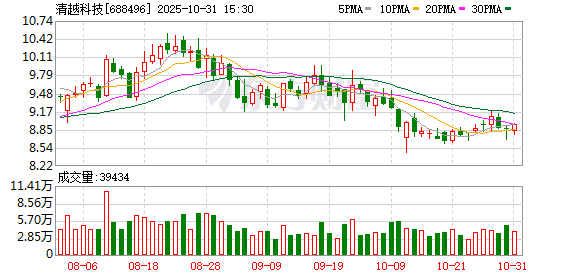
Core Viewpoint - Qingyue Technology (688496) has been placed under investigation by the China Securities Regulatory Commission (CSRC) for suspected false reporting of financial data, which may lead to severe penalties including mandatory delisting if found guilty [1][3]. Company Overview - Qingyue Technology, established in 2010, specializes in providing comprehensive solutions for IoT terminal displays and has grown into a leading high-tech enterprise in the industry [3]. - The company went public on the Shanghai Stock Exchange's Sci-Tech Innovation Board in December 2022 and has developed a diversified business model focusing on PMOLED, electronic paper, and silicon-based OLED technologies [3]. Financial Performance - For Q3 2025, Qingyue Technology reported a revenue of 147 million yuan, a year-on-year decrease of 41.4% [3][4]. - The net profit attributable to shareholders was a loss of approximately 12.59 million yuan, primarily due to a decline in electronic paper module sales compared to the previous year [3][4]. - Year-to-date revenue until the reporting period was approximately 476 million yuan, reflecting a decrease of 13.64% compared to the same period last year [4]. Market Context - As of October 31, the total market capitalization of Qingyue Technology was approximately 4.023 billion yuan [4]. - The CSRC has recently issued guidelines to strengthen the protection of small investors, emphasizing the crackdown on fraudulent activities and ensuring accountability for major violations that could lead to mandatory delisting [6].
涉嫌财务造假!688496,被证监会立案!
证券时报· 2025-10-31 10:47
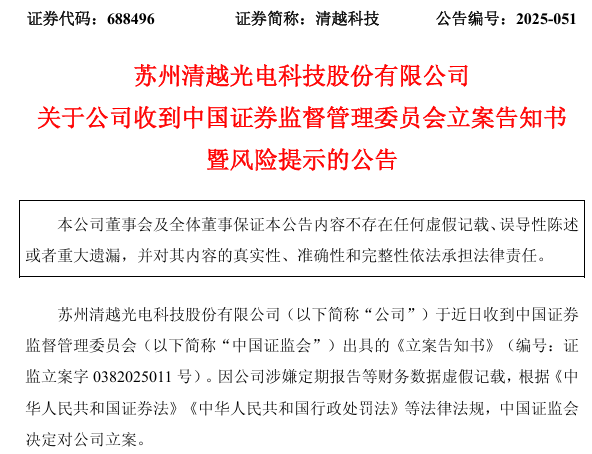
Core Viewpoint - Qingyue Technology (688496) has been placed under investigation by the China Securities Regulatory Commission (CSRC) for suspected false reporting of financial data, which may lead to severe penalties including potential delisting from the Shanghai Stock Exchange if found guilty [1][3]. Company Overview - Qingyue Technology, established in 2010, specializes in IoT terminal display solutions and has grown into a leading high-tech enterprise in the industry. The company went public on the Shanghai Stock Exchange's Sci-Tech Innovation Board in December 2022 [3]. Financial Performance - For Q3 2025, Qingyue Technology reported a revenue of 147 million yuan, a year-on-year decrease of 41.4%. The net profit attributable to shareholders was a loss of approximately 12.59 million yuan, primarily due to a decline in electronic paper module sales compared to the previous year [3][4]. - The company's total revenue for the year-to-date was approximately 476 million yuan, reflecting a decrease of 13.64% compared to the same period last year [4]. Market Capitalization - As of October 31, the total market capitalization of Qingyue Technology was approximately 4.023 billion yuan [4][5]. Regulatory Environment - The CSRC has recently issued guidelines to strengthen the protection of small investors, emphasizing the crackdown on fraudulent activities and financial misreporting. This includes holding controlling shareholders and actual controllers accountable for any illegal actions [5][6].

强监管严执法优机制 提升资本市场保护投资者权益质效
Shang Hai Zheng Quan Bao· 2025-10-30 18:28
Core Viewpoint - The vitality of the capital market is rooted in investor confidence, which is supported by a robust regulatory enforcement system. The China Securities Regulatory Commission (CSRC) emphasizes strict legal measures against various securities and futures violations, aiming to enhance regulatory efficiency and protect investor rights [1][2]. Regulatory Framework - The past five years have seen the continuous improvement of the capital market's regulatory framework, including the implementation of laws related to futures, derivatives, and private fund supervision, establishing a "zero tolerance" legal foundation [1][2]. - The regulatory focus has shifted from pre-approval to real-time monitoring, enhancing information disclosure and holding intermediary institutions accountable, thereby promoting a healthy market cycle [2]. Enforcement Measures - During the 14th Five-Year Plan period, a comprehensive punishment and prevention system has been established to address financial fraud and other serious violations, with a significant increase in administrative penalties for such offenses [2][3]. - A total of 2,214 cases related to financial fraud and market manipulation were administratively punished, with fines totaling 41.4 billion yuan, marking increases of 58% and 30% compared to the previous five-year period [2]. Investor Protection - The ultimate goal of strict regulation and enforcement is to protect investor rights. Recent improvements in regulations regarding share reduction, quantitative trading, and short selling have been made to enhance the investor protection system [3]. - The newly released guidelines on strengthening the protection of small and medium investors integrate investor protection into the entire capital market reform process, serving as an action guide for enhancing the quality of investor protection [3][4]. Market Ecology - A healthy capital market ecology begins with stringent regulatory constraints and effective enforcement, ultimately ensuring the protection of investor rights. Continuous improvements in the regulatory system and enforcement effectiveness will further optimize the investor protection mechanism, fostering a more orderly market environment [4].
持续增强资本市场包容性适应性
Sou Hu Cai Jing· 2025-10-29 22:40
Core Viewpoint - The speech by the Chairman of the China Securities Regulatory Commission (CSRC), Wu Qing, outlines a series of reform measures aimed at promoting high-quality development of the capital market during the 14th Five-Year Plan period, emphasizing the need for deeper reforms to enhance market inclusiveness and competitiveness in the face of global changes and technological innovation [1] Group 1: Support for Innovation Capital Formation - New industries and business models, particularly in artificial intelligence and biomedicine, require larger and more flexible capital investments due to their high costs and long return cycles, necessitating a supportive financing environment [2] - The CSRC has been deepening reforms in areas such as issuance and listing, mergers and acquisitions, and equity incentives to optimize the system and product supply, facilitating resource allocation towards innovation [2] - The introduction of the "1+6" policy for the Sci-Tech Innovation Board has improved listing standards and financing channels for quality tech companies, enhancing market efficiency and transparency [2] Group 2: Expansion of Foreign Investment - The CSRC is working to steadily expand high-level institutional openness in response to the evolving global economic landscape, with a focus on enhancing the attractiveness of Chinese assets to foreign investors [4][6] - The newly released optimization plan for the Qualified Foreign Institutional Investor (QFII) system aims to streamline the approval process and improve operational efficiency for foreign investors, encouraging long-term capital allocation in China [5] - As of now, there are 913 QFIIs in China, with a total asset scale exceeding 1 trillion RMB, indicating a robust framework for foreign investment [5] Group 3: Enhancing Investor Protection - The CSRC emphasizes the importance of protecting investors, particularly small and medium-sized investors, by strengthening risk prevention and regulatory measures [7] - A new set of 23 practical measures has been introduced to enhance investor protection throughout the issuance, listing, and delisting processes, aiming to create a fair trading environment [8] - The measures focus on establishing a comprehensive protection network that includes pre-warning, real-time regulation, and post-recovery mechanisms, thereby improving investor confidence and market integrity [8]