红利资产

Search documents
三大信号!白酒出现买点
Sou Hu Cai Jing· 2025-11-21 07:55
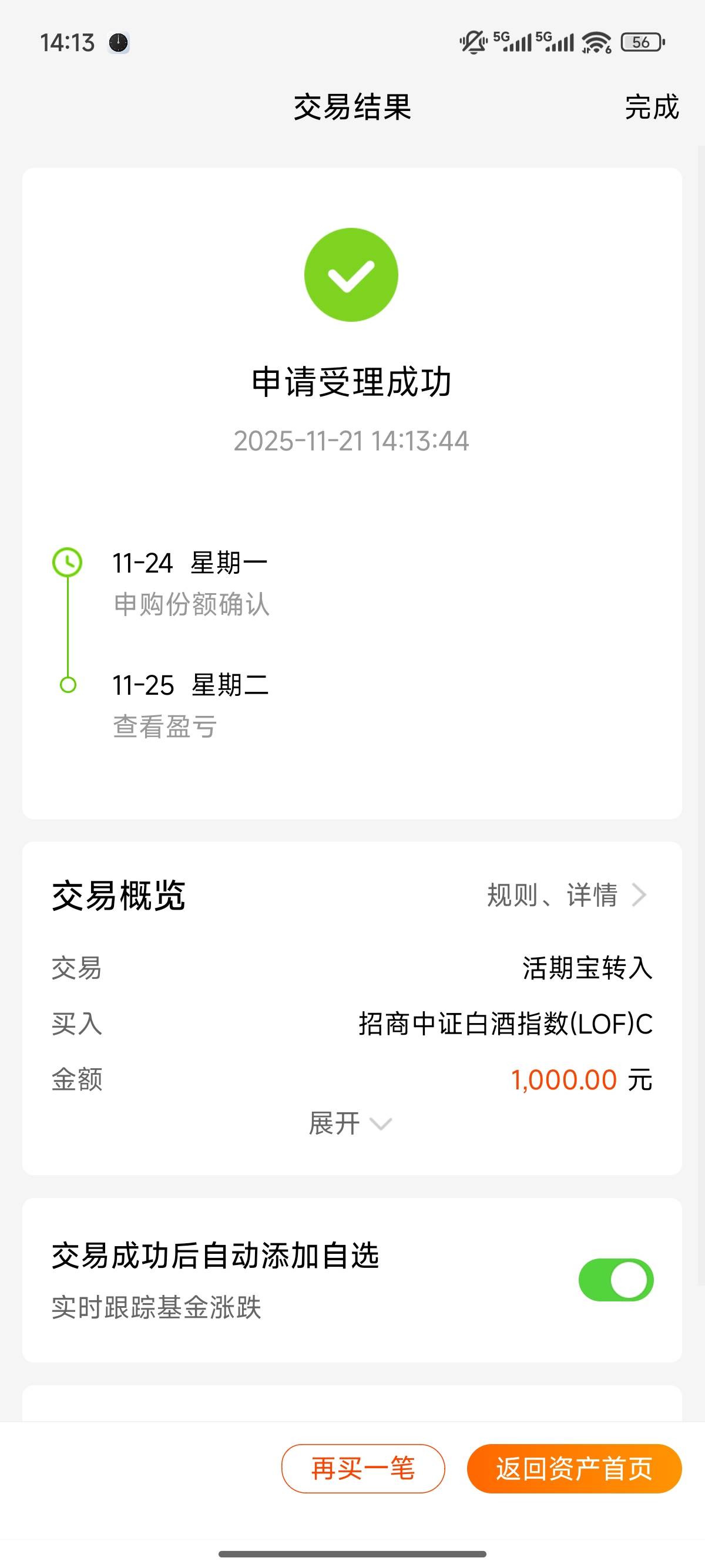
11月21日,在隔夜美股大跌情况下,A股也上演低开低走的走势,午盘跌1.88%,深证成指跌2.72%,创业板指跌3.18%,北证50跌2.78%,科创50跌2.61%, 万得全A跌2.41%,万得A500跌2.26%,中证A500跌2.18%,A股半日成交1.32万亿元。 锂电池产业链全线下挫;算力硬件题材集体回调,存储器、CPO方向领跌;光伏、英伟达、稳定币、消费电子、半导体概念股跌幅靠前。 市场近5000股下跌,悲观情绪下,难免有错杀的。 当前位置,白酒板块出现三个好消息:估值不高、三季度净流入、股息率高,这预示着白酒或许可以入手,感兴趣的可以看下招商中证白酒C,今天继续买 入1000元。 | 交易概览 | 规则、详情 > | | --- | --- | | 交易 | 活期宝转入 | | 买入 | 招商中证自酒指数(LOF)( | | 会额 | 1,000.00 元 | | | > 中田 | 我们来看看白酒板块具体情况: 1、估值不高 招商中证白酒C跟踪的指数是中证白酒(399997),市场上仅此一只跟踪的场外产品。 Wind数据显示,截至2025年11月20日,中证白酒指数近五年市盈率为19.97,历史 ...

震荡市“避风港”?4只红利/高股息权益理财近一月涨幅居前
2 1 Shi Ji Jing Ji Bao Dao· 2025-11-21 07:51
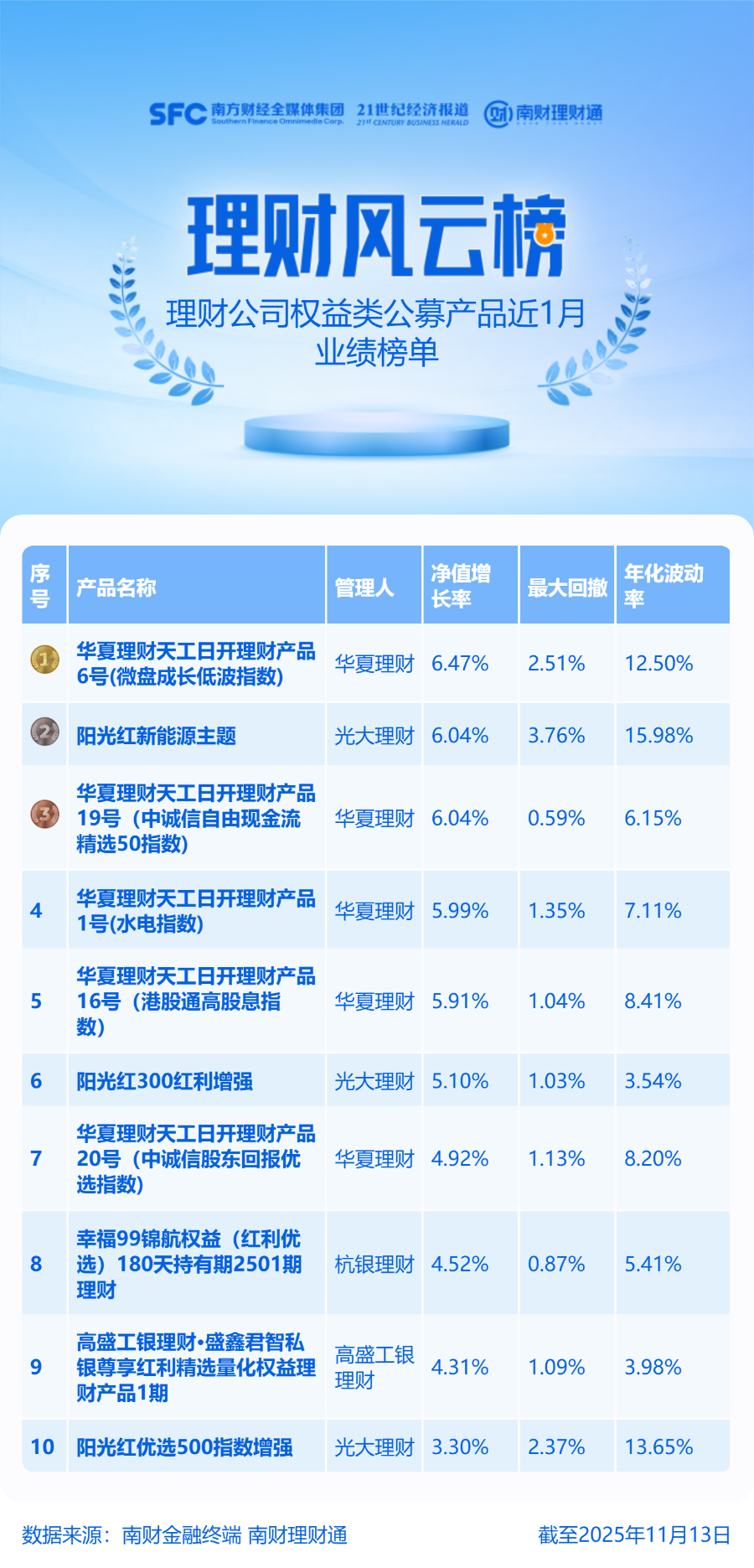
Core Insights - The article discusses the performance of equity public wealth management products from various financial companies, highlighting their net value growth rates and market trends during a specific period [5][6]. Group 1: Product Performance - The average net value growth rate of equity public wealth management products was 1.06% over the past month, with 48 sample products showing varied performance [5]. - Among the top-performing products, the "Hua Xia Wealth Management Tian Gong Daily Open Wealth Management Product No. 6" and "Everbright Wealth Management Sunshine Red New Energy Theme" both achieved over 6% growth [5][6]. - The average net value growth rate of the top 10 products listed was 5.26%, indicating strong performance in the current market [5]. Group 2: Company Rankings - Five wealth management companies were featured in the rankings, with Hua Xia Wealth Management having five products listed, followed by Everbright Wealth Management with three, and Goldman Sachs ICBC Wealth Management and Hangzhou Bank Wealth Management each with one [5]. - The products from Hua Xia Wealth Management consistently performed well, with multiple entries in the top rankings [5][6]. Group 3: Market Trends - The A-share market experienced fluctuations, with the Shanghai Composite Index oscillating around 4000 points, and the three major indices showing mixed results [5]. - The report indicates a structural market trend with increased rotation among sectors, suggesting that dividend and high-yield stocks are becoming a safe haven during market volatility [6][7]. - The "Everbright Wealth Management Sunshine Red 300 Dividend Enhancement" product reported a maximum drawdown of 3.76% and an annualized volatility of 15.91%, reflecting the high-risk, high-reward nature of thematic products [7].
?震荡市“避风港”?4只红利/高股息权益理财近一月涨幅居前
2 1 Shi Ji Jing Ji Bao Dao· 2025-11-21 07:50
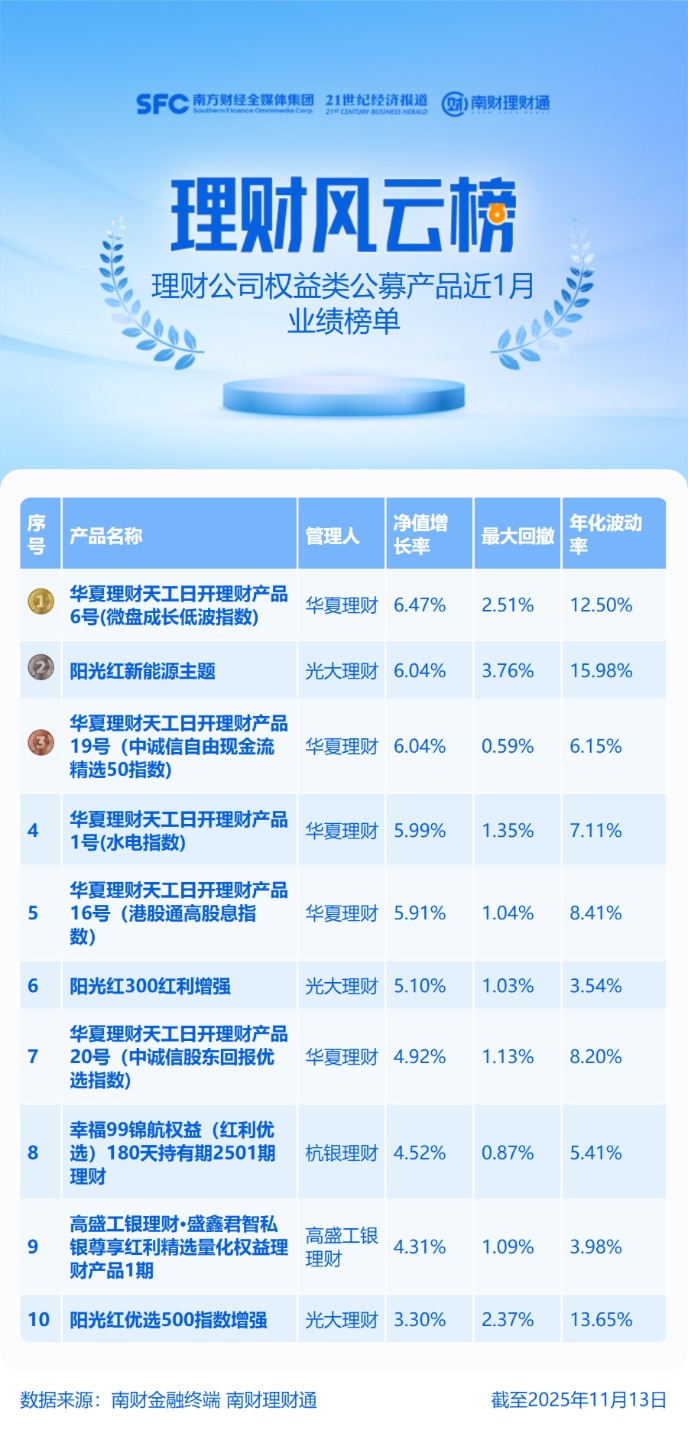
Core Viewpoint - The article discusses the performance of dividend and high-yield equity financial products in a volatile market, highlighting their potential as a safe haven for investors during market fluctuations [1][4]. Market Performance - After the National Day holiday, the stock market showed volatility, with the Shanghai Composite Index fluctuating around 4000 points from November 6 to November 13 [2]. - Over the past month (October 14 to November 13), the three major A-share indices had mixed results, with the Shanghai Composite Index and ChiNext Index rising over 3%, while the Sci-Tech Innovation Board Index fell by 2.77% [2]. Equity Financial Products - As of November 13, the average net value growth rate of equity public financial products was 1.06%, with 48 sample products showing varied performance; 18 products had negative growth rates [2]. - The top 10 products on the list had an average net value growth rate of 5.26% over the past month, with the top three products exceeding 6% growth [3]. Dividend and High-Yield Products - Four dividend and high-yield products made it to the list, with two products from Huaxia Wealth and one each from Everbright Wealth and ICBC Credit Suisse Wealth, all showing growth rates above 4% [3]. - The Huaxia Wealth "Tian Gong Ri Kai Financial Product 16" and Everbright Wealth "Sunshine Red 300 Dividend Enhancement" both exceeded 5% growth in the past month [3]. Industry Insights - The dividend sector is seen as having defensive and risk-averse attributes in the current A-share market environment, with structural market conditions leading to increased attention on dividend assets [4]. - Reports indicate that the market is expected to remain volatile, with a focus on the stable returns of dividend assets providing a safety net against market uncertainties [4]. - The Everbright Wealth "Sunshine Red New Energy Theme" product exhibited the highest drawdown (3.76%) and annual volatility (15.91%) among the top ten products, reflecting the characteristics of high-yield and high-volatility industry theme products [4].
震荡市“避风港”?4只红利/高股息权益理财近一月涨幅居前
2 1 Shi Ji Jing Ji Bao Dao· 2025-11-21 07:40
数据说明: 产品统计范围为理财公司权益类理财公募产品,统计截止日期为2025年11月13日,统计区间为近1个 月。 | 4 | 华夏理财天工日开理财产品 华夏理财 5.99% 1.35% 1号(水电指数) 7.11% 1号(水电指数) | | --- | --- | | | 华夏理财天工日开理财产品 | | ഗ | 16号 (港股通高股息指 华夏理财 5.91% 1.04% 8.41% | | | 数) | | 6 | 阳光红300红利增强 | 光大理财 5.10% | 1.03% | 3.54% | | --- | --- | --- | --- | --- | | 7 | 华夏理财天 开理财产品 20号(中诚信股須回报优 | 华夏理财 4.92% | 1.13% | 8.20% | | | 旋清版) | | | | | 8 | 幸福99锦航权益(红利优 选) 180天持有期2501期 理财 | 杭银理财 4.52% | 0.87% | 5.41% | | 9 | 高盛工银理财·盛鑫君智私 银尊享红利精选量化权益理 | 高盛工银 4.31% 理财 | 1.09% | 3.98% | | | 财产品1期 | ...
越跌越买!规模最大的恒生科技指数ETF、恒生互联网ETF连续16日获资金净申购
Ge Long Hui· 2025-11-21 01:56
Group 1 - The Hong Kong stock market opened lower today, with the Hang Seng Technology Index dropping by 2.21%, and the Hang Seng Internet ETF and Hang Seng Technology Index ETF falling by 2% and 1.6% respectively [1] - Despite the declines, there has been a net inflow of funds into the Hang Seng Technology Index ETF totaling 4.472 billion yuan over 16 trading days from October 30 to November 20, during which the index fell by 10.11% [1] - The Hang Seng Internet ETF also saw a net inflow of 2.518 billion yuan over the same period, despite a 10.24% decline [1] Group 2 - Recent adjustments in the Hong Kong stock market are attributed to factors such as the "AI bubble theory," tightening liquidity in the US market, and profit-taking by institutions after a more than 20% increase in the Hang Seng Technology Index this year [1] - The Hang Seng Technology Index has experienced a cumulative decline of over 18% since October 3, which may present a buying opportunity [1] - Positive factors include strong Q3 financial results and Q4 guidance from Nvidia, which may help alleviate concerns regarding the "AI bubble," along with Alibaba's upcoming financial report on November 25 [1] Group 3 - The Hang Seng Internet ETF has a weight of over 80% in leading internet stocks, with an AI content exceeding 90%, including major companies like Alibaba, Tencent, NetEase, JD.com, and Baidu [2]




险资狂扫红利资产 布局正当时?
Mei Ri Jing Ji Xin Wen· 2025-11-20 15:01
Group 1 - The core viewpoint of the articles indicates that "smart money," particularly insurance funds, is significantly increasing its allocation towards dividend-paying assets in the Chinese market, with the asset allocation ratio reaching 15.5% in Q3, nearing the historical peak of 16.1% in H1 2015 [1] - The allocation direction is clear, with substantial increases in investments in sectors such as banking, steel, and textiles, which are characterized by high dividend yields [1] - This trend signals that in an uncertain market environment, assets with stable cash flows and high dividend capabilities are becoming the "ballast" sought after by large funds [1] Group 2 - In addition to individual stocks, index investment is a primary method for accessing dividend assets, particularly for ordinary investors due to its lower entry barriers [2] - The article notes a significant change in dividend index investment strategies over the past two years, with traditional single dividend strategies no longer being mainstream; instead, more advanced strategies incorporating various factors are emerging [2] - For instance, the "Central Enterprise" buff has gained attention, as state-owned enterprises are under pressure to enhance dividend rates and investor returns due to "Central Enterprise Market Value Management" assessments [2] - Data shows that the Hong Kong stock Central Enterprise Dividend ETF (513910) tracks the Central Enterprise Dividend Index, with a one-year dividend yield of 5.67%, surpassing the 10-year government bond yield of 3.85%, making it an attractive option in a low-interest-rate environment [2]
持续加仓!资金流向分化
Zhong Guo Zheng Quan Bao· 2025-11-20 12:44
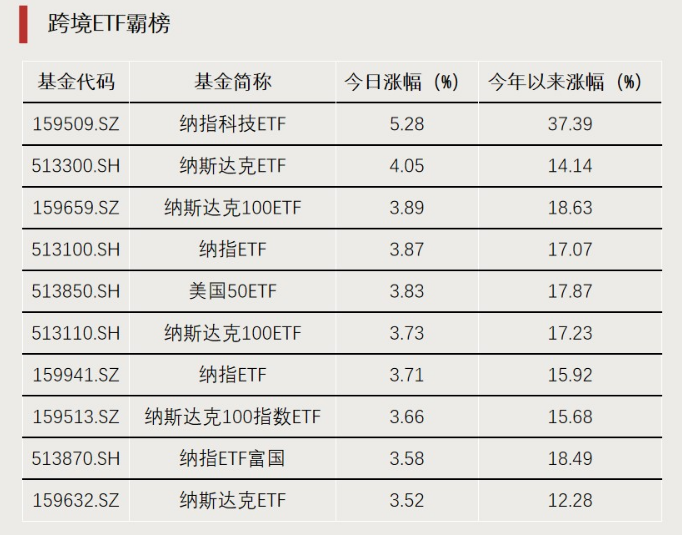
Market Overview - On November 20, over 1,300 ETFs in the market saw more than 200 ETFs closing higher, with 35 ETFs increasing by more than 1% [1] - The top-performing ETFs were all cross-border ETFs, each rising over 2%, particularly those targeting A-share assets in sectors like construction materials, real estate, and banking [2] Fund Flows - On November 19, the ETF market experienced a net inflow of approximately 8 billion yuan, with cumulative net inflows exceeding 50 billion yuan from November 14 to November 19 [3] - There was a notable divergence in fund flows on November 19, with large-cap broad-based ETFs experiencing net outflows while small- and mid-cap broad-based ETFs attracted investments [3][9] Top Performing ETFs - The top ten ETFs by performance on November 20 were all linked to overseas markets, primarily the US stock market, with eight of them tracking the Nasdaq 100 index [4] - The Nasdaq Technology ETF (159509) led the market with a 5.28% increase and a trading volume of 1.572 billion yuan, showing a premium rate of 20.06% [4][5] Underperforming ETFs - ETFs related to new energy and semiconductors on the Sci-Tech Innovation Board saw significant declines, with the top losers experiencing drops of over 3% [6] Fund Flow Analysis - The top ten ETFs by net inflow included several broad-based ETFs, with the CSI 500 ETF (510500) leading with a net inflow of over 1.06 billion yuan [8] - Conversely, large-cap broad-based ETFs like the CSI 300 ETF and the SSE 50 ETF faced substantial net outflows exceeding 1.2 billion yuan each [10] Investment Trends - There is a growing interest in dividend-paying assets as the year-end approaches, with discussions around high-dividend strategies becoming more prevalent [11] - Fund managers suggest that the current market conditions may lead to a balanced allocation between high-dividend stocks and growth sectors [11]
中国银行股价再创新高,市值突破2万亿大关
Huan Qiu Lao Hu Cai Jing· 2025-11-20 10:05
Core Viewpoint - The banking sector has shown significant activity, with China Bank's stock price rising 4.00% to a record high, driven by overall sector trends and solid financial performance [1][2] Group 1: Stock Performance - China Bank's stock closed at 6.24 yuan per share, with a market capitalization surpassing 2 trillion yuan [1] - The banking sector's dividend yield is approximately 4% over the past 12 months, attracting conservative investors seeking stable returns [1] Group 2: Financial Data - As of the end of Q3, China Bank's total assets reached 37.55 trillion yuan, a 7.1% increase from the end of last year [2] - For the first three quarters, China Bank reported operating income of 491.204 billion yuan, a year-on-year increase of 2.69%, and a net profit attributable to shareholders of 177.66 billion yuan, up 1.08% [2] Group 3: Dividend Distribution - China Bank has completed two dividend distributions for 2024, totaling over 71.3 billion yuan, and plans to distribute 1.094 yuan per 10 shares for the 2025 interim dividend, amounting to 35.25 billion yuan [2] - A total of 24 A-share listed banks have announced their 2025 interim dividend plans, with total cash dividends reaching 263.79 billion yuan [2] Group 4: Market Outlook - The recent rise in bank stocks is attributed to a market style shift, with stable performance and attractive dividends driving investor interest [3] - The trend of dividend-driven stock purchases is expected to continue until the end of December, indicating positive prospects for bank stock prices [3]

央国企体系不断优化,红利资产迎估值重塑,国企红利ETF(159515)盘中上涨0.08%
Sou Hu Cai Jing· 2025-11-20 02:14
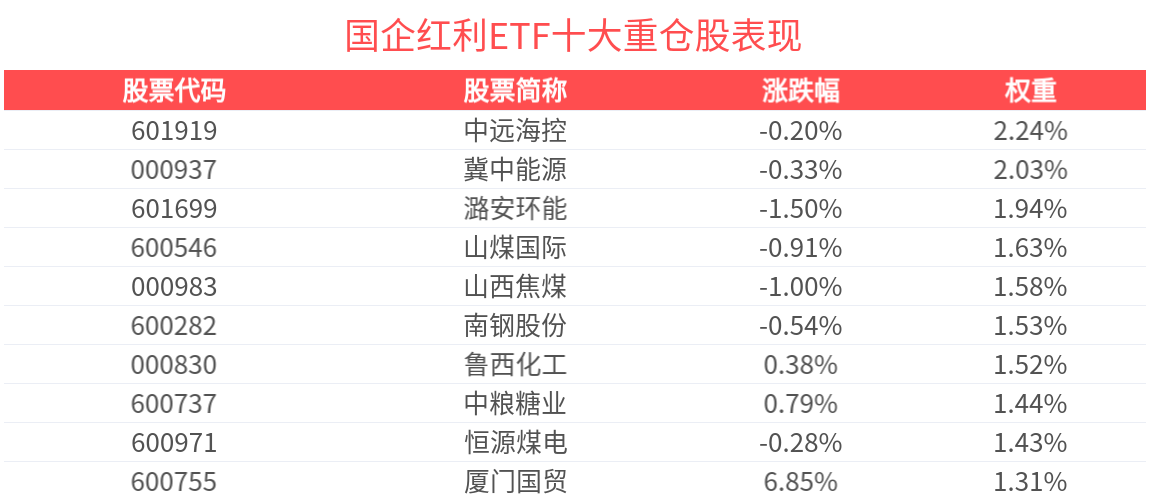
Core Viewpoint - The ongoing reform of state-owned enterprises (SOEs) is expected to enhance their operational efficiency and cash flow, leading to a stronger willingness and ability to distribute dividends, which may result in a revaluation of these companies [1][2]. Group 1: Market Performance - As of November 20, 2025, the CSI State-Owned Enterprises Dividend Index rose by 0.19%, with notable increases in stocks such as Xiamen International Trade (up 6.85%) and Bank of China (up 2.50%) [1]. - The National Enterprise Dividend ETF (159515) saw a slight increase of 0.08% [1]. Group 2: Characteristics of Dividend Stocks - Dividend stocks are characterized by stable dividends, strong profitability, and the ability to survive economic downturns. They typically exhibit high cash flow, mature earnings, and strong anti-cyclical capabilities [2]. - The CSI State-Owned Enterprises Dividend Index selects 100 listed companies with high cash dividend yields and stable dividends, reflecting the overall performance of high-dividend securities among state-owned enterprises [2]. Group 3: Investment Strategy - The current low valuation of dividend stocks relative to historical levels aligns with investment strategies that seek certainty in returns, particularly in a tightening monetary environment [2]. - The index's top ten weighted stocks account for 17.08% of the total index, indicating a concentrated investment in a few key players [2].
投资进化论丨在科技成长大热的当下,还有必要关注红利资产吗?
Sou Hu Cai Jing· 2025-11-19 06:48
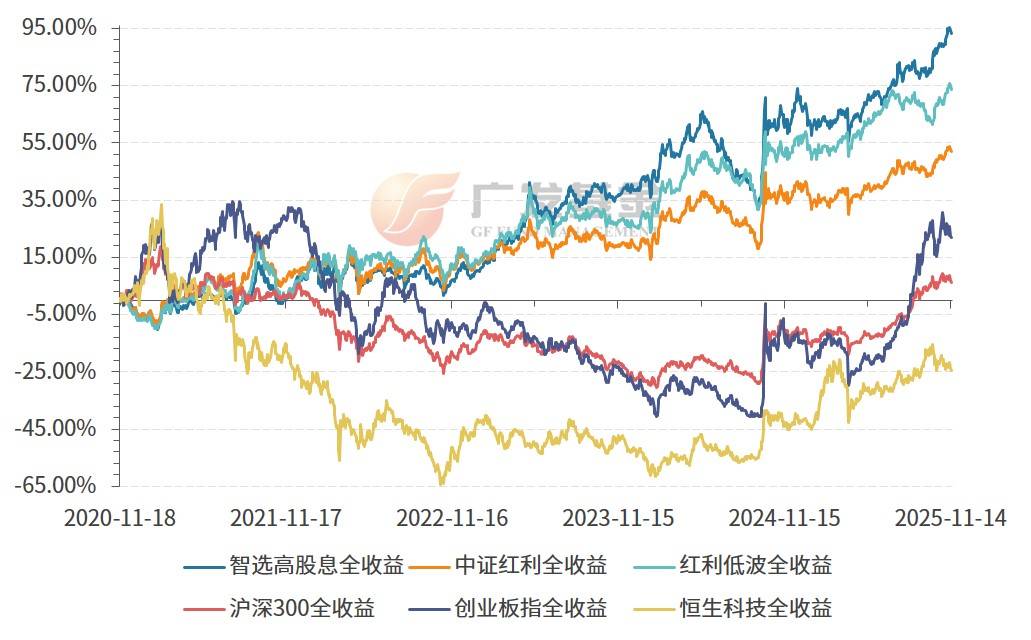
Core Viewpoint - The article discusses the resurgence of interest in dividend assets amid market volatility, suggesting that they can serve as a stabilizing component in investment portfolios, especially as technology growth stocks face pressure after significant gains [1][2][3]. Market Performance - Technology growth stocks have shown strong performance this year, while dividend value assets have lagged behind, leading to the perception of a "small year" for dividend assets [1]. - As of November 17, the ChiNext Index and the STAR 50 have declined by 4.11% and 9.45% respectively in the fourth quarter, while the CSI Dividend All-Return Index has increased by 5.37% during the same period [2]. Reasons for Renewed Interest in Dividend Assets - The first reason for the renewed focus on dividend assets is the high valuation of technology growth stocks, which has led to profit-taking and increased market volatility [3]. - The second reason is the growing trend of mid-term dividends among listed companies, with 1,035 companies announcing mid-term dividends totaling 735.69 billion yuan, surpassing last year's figures [3]. Long-term Investment Perspective - Investing in dividend assets requires a long-term perspective, as they are still subject to short-term price fluctuations typical of equity assets [4]. - Compared to the high volatility of technology growth indices, dividend indices exhibit more stable performance, with a generally lower degree of fluctuation over the past five years [4]. Historical Performance of Dividend Indices - Over the past decade, dividend indices have shown commendable performance, with annualized returns ranging from 8% to 11%, and annualized volatility generally lower than that of the CSI 300 All-Return Index [7][9]. - The "Smart High Dividend All-Return Index" has achieved an annualized return of 10.92% with a Sharpe ratio of 0.65, indicating strong relative performance [7][9]. Supporting Factors for Dividend Assets - The macroeconomic environment is favorable for dividend assets, with major economies entering a rate-cutting cycle and China's 10-year government bond yield around 1.8%, enhancing the appeal of dividend assets due to their higher dividend yields [10]. - Policy support for dividend distribution has been consistent, fostering a market atmosphere conducive to long-term and value investing [11]. - Insurance capital has significantly increased its allocation to dividend assets this year, reflecting a recognition of their value [12]. Conclusion - Overall, dividend assets are worth attention for both short-term resilience and long-term returns, making them suitable for inclusion in investment portfolios [13]. - For conservative investors, quality dividend index funds can be considered as core assets for long-term holding, while aggressive investors may benefit from diversifying their portfolios with dividend assets to reduce overall volatility [14].