自由贸易

Search documents
共话中国经济新机遇|综述:海南自贸港封关在即 国际商界看好中国市场新引力
Sou Hu Cai Jing· 2025-12-17 12:55
查代日认为,对已与中国签订中塞自贸协定的塞尔维亚而言,海南自贸港全面封关运作是接触中国消费 者的新机会,也是建立新的投资和技术伙伴关系的新机会,"我们将与中国商会的同事们共同打造这一 伙伴关系"。 新华社贝尔格莱德12月17日电 综述:海南自贸港封关在即 国际商界看好中国市场新引力 新华社记者金丹依 海南自由贸易港启动全岛封关运作在即,这一中国扩大高水平对外开放的标志性举措正引发全球商界广 泛关注。近日,多家国际行业组织、商业和金融机构分别从市场与行业等不同维度,热议海南自贸港封 关带来的机遇。 塞尔维亚工商会主席查代日近日接受新华社记者采访时表示,海南自贸港通过明确的政策支持和长期的 税收激励,致力于推动消费、服务和创新发展,以吸引更多国内外资源。海南自贸港全岛封关运作,积 极影响是全方位的。 国际商界人士普遍认为,海南自贸港封关运作,是中国通过制度型开放为全球企业提供确定性、共享中 国市场机遇的关键举措,有望为深化国际经贸合作注入新动能。(完) 海南自贸港封关运作后,将实施以"'一线'放开、'二线'管住、岛内自由"为基本特征的自由化便利化政 策制度。查代日表示,这是中国坚持扩大对外开放的重要一步,表明中国 ...
法德分裂两大阵营,“欧洲对峙”可能上演,欧盟同南方共同市场签署自贸协议要推迟?
Huan Qiu Shi Bao· 2025-12-16 22:47
Group 1 - The EU planned to sign a free trade agreement with the Southern Common Market (Mercosur) on December 20, but France has expressed strong opposition, leading to a potential delay in the signing [1][4] - The agreement aims to create a global free trade zone covering approximately 770 million people, which would be the largest trade agreement in EU history [2] - The agreement is expected to boost EU exports to Mercosur by up to 39%, with key exports including automobiles and chemical products, while Mercosur primarily supplies agricultural products and raw materials to Europe [2] Group 2 - France is actively seeking to block the agreement, citing concerns over agricultural protections, and has garnered support from Italy and other EU countries [4][5] - The German government views the agreement as a crucial step to enhance European competitiveness and reduce reliance on the US, especially in light of rising US protectionism [3] - South American countries, particularly Brazil, are growing increasingly frustrated with the EU's indecision, fearing that further delays could lead to more opposition to the agreement [5]
跨越山海,谱写中智合作新篇章(大使随笔)
Ren Min Ri Bao· 2025-12-16 22:30
Core Viewpoint - The 55th anniversary of diplomatic relations between China and Chile highlights the strong and evolving partnership, showcasing significant economic cooperation and mutual benefits over the years [1]. Group 1: Economic Cooperation - The China-Chile Free Trade Agreement (FTA) has led to a qualitative leap in economic relations, with trade volume projected to reach approximately $61.6 billion in 2024, which is 8.6 times the level before the FTA was implemented in 2005 [2]. - China has been Chile's largest trading partner for 15 consecutive years, serving as the primary export market and import source for Chile [2]. - Chilean products such as cherries, wine, and salmon are increasingly popular in China, while Chinese electric vehicles, photovoltaic equipment, and 5G technology are aiding Chile's energy transition and digital development [2]. Group 2: Investment and Infrastructure - Chinese investment in Chile has expanded significantly, with direct investments in 2024 reaching 23 times the level in 2006, and the stock being 150 times higher than in that year [3]. - Ongoing cooperation projects in areas like photovoltaic energy, ultra-high voltage transmission, and digital infrastructure are providing strong momentum for Chile's sustainable development [3]. - These investments are creating numerous job opportunities locally and facilitating technology transfer and industrial upgrades [3]. Group 3: Multilateral Cooperation and Global Trade - Amidst global economic challenges, China and Chile are committed to upholding multilateralism and free trade, enhancing communication and cooperation within multilateral frameworks [3]. - Both countries aim to promote an open world economy and inclusive globalization, which is beneficial for maintaining stable global supply chains and the interests of the Global South [3]. - The Chinese Communist Party's recent policy directions emphasize expanding high-level openness and fostering win-win cooperation, presenting new opportunities for China-Chile economic collaboration [4].
王毅会见海合会秘书长布达维
Xin Lang Cai Jing· 2025-12-15 00:43
当地时间2025年12月14日,中共中央政治局委员、外交部长王毅在利雅得会见海湾阿拉伯国家合作委员 会秘书长布达维。 王毅说,海合会是中东重要的次区域组织,多年来有力促进海湾国家团结合作、共 谋发展,国际影响力日益提升。早在海合会成立初期,中国就同海合会建立联系,中海关系发展历程和 中国改革开放进程基本同步,我们成为发展振兴的同路人、合作共赢的好伙伴。2022年底,习近平主席 同海合会各国领导人齐聚利雅得召开首届中海峰会,推动中海关系迈上新台阶,为中海关系发展开辟了 新前景、擘画了新蓝图。中方愿同海合会加强战略沟通,维护共同利益,合力应对变乱交织的国际局 势,为全球南方联合自强作出新的贡献。 王毅表示,中方支持海合会加强战略自主、增进团结协作、 践行多边主义,推进海合会一体化进程。希望双方在涉及彼此核心利益问题上继续相互坚定支持。中国 愿同海合会国家携手推进共建"一带一路",深化经贸、投资等领域互利合作,密切民间交往和人文交 流,夯实中海友好的民意基础。中方也愿同海合会国家加强多边协作,落实好习近平主席提出的四大全 球倡议,推动全球南方共同发展,携手构建人类命运共同体。作为负责任大国和联合国安理会常任理事 国 ...
国际观察|坚持团结合作 促进开放包容——“2025从都国际论坛”汇聚共赢发展的时代强音
Xin Hua She· 2025-12-10 11:23
Group 1 - The "2025 From Du International Forum" emphasized the need for dialogue and cooperation among nations to address global challenges, highlighting the importance of multilateralism and free trade as essential for common development [1][2][3] - Former leaders and representatives at the forum expressed concerns over rising unilateralism and protectionism, which threaten global cooperation and economic stability [2][3] - China's global initiatives, including the Global Development Initiative and Global Security Initiative, were recognized for their potential to foster international consensus and promote fair global governance [4][5] Group 2 - The forum participants acknowledged China's modernization as a valuable experience for developing countries, contributing to global economic stability and growth [6][7] - Former leaders noted that China's development achievements, including poverty alleviation, serve as a model for other nations, enhancing China's role in the international arena [7] - The importance of EU-China cooperation was highlighted, with calls for mutual benefits and collaborative efforts to promote development [7]
国际观察丨“2025从都国际论坛”汇聚共赢发展的时代强音
Bei Jing Ri Bao Ke Hu Duan· 2025-12-10 10:03
Group 1 - The forum emphasized the need for dialogue over confrontation and cooperation over zero-sum approaches to address global challenges [3] - Participants highlighted the rise of unilateralism and protectionism, urging a commitment to multilateralism and free trade as essential for global development [2][4] - The forum discussed China's global initiatives, which are seen as contributing to international consensus and promoting fair global governance [4][5] Group 2 - Former leaders acknowledged China's modernization as a valuable experience for developing countries, providing stability and certainty to the global economy [6][7] - The forum participants noted that China's economic growth is crucial for global development, with expectations for continued high-quality growth during the 14th Five-Year Plan [7]
知名经济学家盘和林:2025是创新年,希望2026年是个创新应用落地年|请回答2025
Sou Hu Cai Jing· 2025-12-10 04:16
Group 1 - The core viewpoint is that China has become increasingly powerful, transitioning from looking up to developed countries to a position of strength where it can influence global trade and economic negotiations [3] - In 2025, China is expected to be a year of innovation, while 2026 is anticipated to be a year where innovative applications are implemented [2][6] - The rapid advancement of technology in China is leading to societal changes, with a shift from traditional stability to a more fast-paced, urgent environment [4] Group 2 - The key term for 2025 is "革故鼎新" (reform and innovation), emphasizing the need for continuous learning and adaptation in the face of rapid technological changes [5] - There is a concern that while many technological innovations exist, they often lack practical application and user demand, highlighting the importance of aligning technology with market needs [6] - The expectation for 2026 is that more conceptual technologies will be integrated into real-world applications, bridging the gap between innovation and practical use [6]

中德经贸互动有哪些新看点?德外长:愿在安世半导体问题上发挥作用
Di Yi Cai Jing· 2025-12-09 10:22
Group 1: China-Germany Economic Relations - The Chinese government hopes that the German and European automotive associations will influence the European Commission to resolve the electric vehicle anti-subsidy case promptly [1] - Recent interactions between China and Germany have been frequent, with discussions focusing on economic relations and cooperation in the automotive sector [1][2] - German companies continue to invest in China, indicating a commitment to the Chinese market despite operational challenges [1][2] Group 2: Semiconductor Supply Chain Issues - The Chinese government emphasizes the importance of stabilizing the semiconductor supply chain, particularly in light of the issues surrounding ASML and export controls [4][5] - The German government is willing to enhance dialogue and cooperation with China to address supply chain disruptions and maintain free trade [5] - The semiconductor supply chain crisis has led to temporary work reductions in German companies, highlighting the impact of chip shortages on the automotive and machinery sectors [6] Group 3: Automotive Industry Dynamics - German automotive companies are increasing their investments in China and deepening strategic partnerships, reflecting a robust collaboration in the automotive supply chain [7] - Despite competitive pressures, German car manufacturers are innovating in production processes to maintain their advantages in quality and efficiency [7] - The German automotive industry is facing challenges but remains focused on the Chinese market, with ongoing discussions about the EU's regulations on combustion engine vehicles [7][8] Group 4: Economic Sentiment and Recovery - Germany's economic recovery is slow, with the Sentix index indicating a decline in investor confidence, marking it as a "stumbling block" for the Eurozone [8] - The establishment of a special fund of around €500 billion aims to boost infrastructure investment, although its effects may not be felt until 2026 [9] - The revival of the military industry is seen as a significant factor in Germany's economic growth, contributing positively to GDP recovery [9]
德国新政府外长首访华,中方希望“为合作而来”,中德高官就外交经贸交换意见
Huan Qiu Shi Bao· 2025-12-08 23:06
Core Points - The visit of German Foreign Minister Baerbock to China is deemed essential for direct and in-depth communication between the two nations, highlighting the importance of cooperation over conflict [1][2] - The discussions during the visit focus on economic relations, addressing export restrictions affecting German industries, and the need for stable global supply chains [3][4][5] Group 1: Diplomatic Engagement - Baerbock's visit is characterized as a "deep diplomatic journey," emphasizing the significance of direct communication amid complex geopolitical dynamics [4][7] - The meetings with Chinese officials, including the Foreign Minister and Commerce Minister, reflect a mutual commitment to enhancing understanding and cooperation [2][3] Group 2: Economic Cooperation - The core focus of the visit is on strengthening economic ties, with both sides recognizing the importance of a stable and reliable global trade relationship [5][6] - Germany views China as its most important trading partner, with ongoing discussions about semiconductor and rare earth supply chains being critical to both economies [6][8] Group 3: Strategic Issues - The discussions also touch upon broader strategic issues, including the need for cooperation in addressing global challenges such as climate change [6][8] - The visit aims to restore normal diplomatic relations and enhance Germany's leadership role in EU-China relations, which is seen as vital for both parties [7][8]
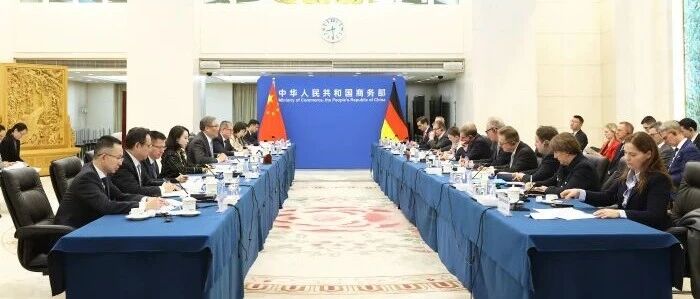
德国外长:感谢中国
第一财经· 2025-12-08 14:16
Core Viewpoint - The meeting between Chinese Commerce Minister Wang Wentao and German Foreign Minister Baerbock emphasizes the importance of strengthening China-Germany economic and trade relations, supporting free trade, and maintaining a multilateral trade system centered around the WTO [2][3][4]. Group 1: China-Germany Economic Relations - Wang Wentao highlighted the need to implement the important consensus reached by the leaders of both countries, focusing on opportunities presented by China's "14th Five-Year Plan" [3]. - The Chinese side encourages German companies to deepen cooperation in traditional sectors and explore new emerging fields, transforming the "opportunity list" into a "results list" [3]. - The Chinese government seeks a fair, open, and non-discriminatory policy environment for Chinese enterprises in Germany [3]. Group 2: Global Supply Chain Stability - Wang Wentao pointed out the rising trend of politicization and security concerns in economic issues, which severely disrupts global supply chain stability [3]. - The Chinese government is addressing German concerns regarding export controls and semiconductor issues, implementing a general licensing system for rare earths, and providing exemptions for semiconductor export licenses [3]. - The emphasis is placed on the need for the Dutch government to cease inappropriate administrative interventions to stabilize the semiconductor supply chain and prevent risks in the global automotive and consumer goods industries [3]. Group 3: Cooperation on Common Interests - Baerbock acknowledged China as Germany's most important economic partner, expressing a willingness to strengthen dialogue and practical cooperation on WTO reform, circular economy development, and climate change [4]. - The German government appreciates China's efforts in implementing a general licensing system for rare earths and is willing to collaborate on semiconductor issues to find long-term effective solutions [4].