
虚拟资产

Search documents
港股回购潮暂缓,机器人、虚拟资产再融资“狂飙”
Di Yi Cai Jing· 2025-07-24 10:50
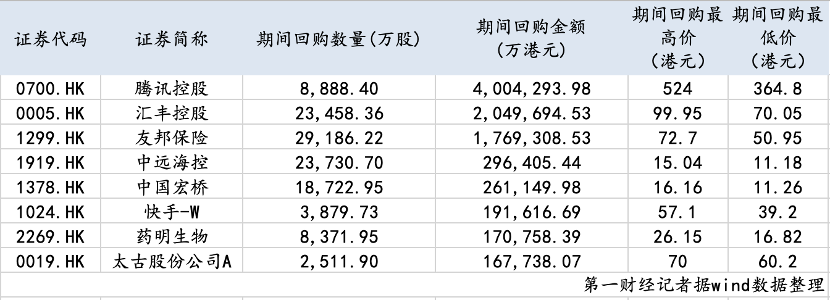
Group 1: Market Trends - The Hong Kong stock market is experiencing a trend of "slowing buybacks and surging refinancing," with a significant increase in refinancing activities, up 183% year-on-year [1][7] - The buyback scale in July has contracted, with only 70 companies participating, totaling HKD 93.66 billion, a drop from previous months [2][3] - The total buyback amount for the year has exceeded HKD 1 trillion, reaching HKD 1,038.63 billion, with a notable increase from previous years [2][6] Group 2: Buyback Activities - The top five companies in buyback activities account for over 80% of the total buyback amount, with Tencent and HSBC leading at HKD 400.43 billion and HKD 204.97 billion respectively [3][4] - The buyback amount relative to market capitalization has increased significantly from 0.09% in 2021 to over 0.75% in 2024, indicating a growing trend in buybacks [2][6] Group 3: Refinancing Dynamics - The refinancing trend is primarily driven by emerging sectors such as automotive, robotics, and biotechnology, contrasting with traditional industry leaders [7][9] - BYD has raised the highest amount in refinancing at HKD 435.09 billion, representing 26.45% of the total refinancing scale for the year [7][8] - The flexibility of Hong Kong's refinancing mechanisms allows companies to raise funds efficiently, particularly in high-cost sectors like robotics and biotechnology [9] Group 4: Future Outlook - The future of buyback and refinancing activities will depend on market performance and liquidity changes, with the Hang Seng Index showing strong upward movement recently [10][11] - Analysts maintain an optimistic outlook for the Hong Kong market, citing low valuations and continued inflows of capital [10][11] - A structural market trend is anticipated, with potential sector rotations as companies report their semi-annual earnings [11]


毕马威:2025年香港资产管理和私募股权展望报告
Sou Hu Cai Jing· 2025-07-24 07:39
Core Insights - The KPMG report highlights the resilience of Hong Kong's asset management and private equity industry amidst global uncertainties, projecting growth opportunities and challenges ahead [1][11][12]. Industry Overview - By the end of 2024, the total assets under management in Hong Kong's asset and wealth management sector is expected to reach HKD 35.1 trillion, reflecting a year-on-year growth of 13% and a significant net inflow increase of 81% [1][16]. - The IPO market in Hong Kong is performing strongly, with HKD 107.1 billion raised in the first half of 2025, driven by a surge in "A+H" listings and a robust pipeline from sectors like TMT and healthcare [1][19]. Industry Consolidation - The report notes an acceleration in industry consolidation, with global and Hong Kong asset management firms pursuing mergers and acquisitions to achieve scale and efficiency, leading to the emergence of a "multi-strategy super market" model [1][25][26]. Regulatory Developments - The Hong Kong Securities and Futures Commission (SFC) is enhancing scrutiny on asset management firms, focusing on private fund management deficiencies and liquidity risk management, while also introducing guidelines for AI governance and virtual assets [1][32][60]. Tax Environment - Reforms to the Unified Fund Exemption (UFE) are expected to broaden the exemption scope and enhance the attractiveness of the tax environment, potentially drawing more funds and investors to Hong Kong [1][41][42]. Private Equity and Alternative Investments - The mainland China market remains a significant area for private equity, with Hong Kong asset managers positioned to capitalize on the growing interest in alternative assets from investors [1][46][47]. - Emerging markets like India and Southeast Asia present new investment opportunities, while mature markets such as Japan and Australia offer stable investment paths [1][48]. Cross-Border Opportunities - The opening of the mainland market provides Hong Kong asset managers with a unique position to serve the global allocation needs of mainland investors, supported by ongoing improvements in cross-border financial mechanisms [2][55]. Artificial Intelligence - The application of AI in asset management is moving towards systematic implementation, driven by the need for operational efficiency and cost reduction, although challenges related to data privacy and regulatory compliance remain [2][59][60]. Virtual Assets - Hong Kong is advancing in the virtual asset space, having granted licenses to ten virtual asset trading platforms, with expectations for growth in related products and services [2][64][66]. Tokenization - The rise of tokenization technology is set to transform wealth management, with regulatory support paving the way for new investment opportunities, although challenges in market liquidity and infrastructure need to be addressed [2][71][72].

传统金融机构对数字资产浪潮的拥抱
Minsheng Securities· 2025-07-24 05:50
Investment Rating - The report maintains an "Outperform" rating for the industry [1]. Core Insights - The report highlights the rapid growth and adoption of stablecoins, with their transaction volumes surpassing those of traditional financial systems like Visa and PayPal [7]. - It emphasizes the regulatory advancements in Hong Kong, particularly the introduction of the "Stablecoin Regulation Draft," which is expected to enhance compliance and foster innovation in the virtual asset market [23]. - The report anticipates an influx of institutional players into the virtual asset trading services, driven by regulatory clarity and the expansion of service offerings by Chinese brokerage firms [60]. Summary by Sections Section 1: Industry Chain, Application Scenarios, and Profit Models - Stablecoins have emerged as a more efficient medium for on-chain transactions compared to fiat currencies, significantly simplifying the process of trading cryptocurrencies [4]. - As of May 2025, the total market size of stablecoins is approximately $247.2 billion, with an average rolling transaction volume of $2.29 trillion, which is 1.7 times that of Visa [7]. - The most popular stablecoins are fiat-backed, such as USDT and USDC, which account for 64% and 25% of the market share, respectively [13]. - The report outlines the different types of stablecoins, including fiat-collateralized, crypto-collateralized, algorithmic, and commodity-backed stablecoins, each with its own advantages and disadvantages [10][12]. - The profitability of stablecoin issuers primarily comes from interest income generated from reserve assets, with Tether's interest income reaching $4 billion in 2023 [16]. Section 2: Institutions Expected to Accelerate Entry into Virtual Asset Trading Services - Chinese brokerage firms are rapidly expanding into virtual currency services, with Guotai Junan International being the first to obtain a Virtual Asset Service Provider (VASP) license [60]. - The report notes that as of July 2025, 43 brokerages and one bank have upgraded their licenses to provide virtual asset trading services, indicating a growing trend in the market [64]. - The report identifies 11 licensed Virtual Asset Trading Platforms (VATPs) in Hong Kong, which are crucial for retail investors to access virtual asset investments [66]. Section 3: Investment Recommendations - The report maintains a positive outlook on the development of the virtual asset trading market in Hong Kong, driven by government policies and the anticipated expansion of market participants [83]. - It suggests that the ongoing regulatory framework will facilitate the tokenization of real-world assets, providing new avenues for revenue generation for brokerages [83].
2025年香港资产管理和私募股权展望报告-毕马威
Sou Hu Cai Jing· 2025-07-23 08:14
Industry Overview - The total assets under management in Hong Kong's asset and wealth management industry are projected to reach HKD 35.1 trillion by the end of 2024, reflecting a year-on-year growth of 13% and a significant net inflow of funds increasing by 81%, showcasing the industry's resilience [1][12][17] - In the first half of 2025, the IPO financing amount reached HKD 107.1 billion, the highest since 2021, driven by "A+H" listings contributing 72% and strong reserves in technology and healthcare sectors [1][20][12] - Hong Kong's strategic position as a core hub for asset management benefits from the increasing importance of Asia in the global asset management landscape, with growth rates surpassing the global average [1][12][21] Industry Trends - The global asset management industry is experiencing accelerated mergers and acquisitions starting from 2024, continuing into 2025, as firms seek scale advantages and operational efficiencies [1][25][26] - The emergence of a "multi-strategy super market" model is noted, catering to the complex investment needs of Asia's growing middle class [1][25][26] - Cost efficiency is a critical factor driving consolidation, with larger firms leveraging economies of scale for technological innovation, while smaller firms face competitive pressures [1][26][27] Regulatory Developments - The Hong Kong Securities and Futures Commission (SFC) will enhance scrutiny of asset management and wealth management firms in 2025, focusing on deficiencies in private funds, liquidity risk management, and cybersecurity controls [2][30][34] - The unified fund exemption (UFE) system in Hong Kong is set to improve, expanding the exemption scope to include private credit and enhancing tax certainty, which is expected to attract more fund managers and investors [2][40][41] Private Equity and Alternative Investments - Despite geopolitical tensions affecting foreign investor sentiment in mainland China, there is active participation of RMB funds, and the secondary private equity market is developing [2][46][48] - Hong Kong asset management firms are positioned to capitalize on wealthy investors' interest in alternative assets, with opportunities in emerging markets like India and Southeast Asia, as well as in developed markets like Japan and Australia [2][46][48] Technological Advancements - The integration of artificial intelligence in asset management is progressing towards systematic implementation, with regulatory bodies issuing guidelines [3][12] - The virtual asset sector is undergoing regulatory normalization, with ten trading platforms licensed and stablecoin regulations approved, indicating a move towards a more structured environment [3][59][60] Family Offices - Hong Kong has introduced incentives to attract ultra-high-net-worth individuals, with expectations of a 43% increase in family offices [3][12]

券商ETF大动作,持续五周吸金!三重共振打开投资新局面
券商中国· 2025-07-23 06:22
Core Viewpoint - The brokerage sector is experiencing a significant rally, driven by a combination of strong fundamentals and increased market activity, with expectations for continued growth in performance and valuation [1][3][7]. Group 1: Market Performance - As of July 23, the securities company index has surged 14.46% since its low on June 23, indicating strong market sentiment [2]. - The A-share market's trading volume reached 162.65 trillion yuan in the first half of the year, a year-on-year increase of over 60%, reflecting heightened trading activity [4]. Group 2: Financial Performance - In Q1 2025, the overall revenue of the brokerage industry grew by 20.93% year-on-year, with net profit increasing by 79.56%, driven primarily by self-operated investments and brokerage services [3]. - Among 29 listed brokerages that released mid-year earnings forecasts, the average net profit growth is projected to be between 171.03% and 203.81%, with some firms expecting over tenfold increases [5]. Group 3: Valuation and Funding - The current price-to-book (PB) ratio of the securities company index is approximately 1.5, significantly below the 2.25 peak during the 2015 bull market, indicating substantial potential for valuation recovery [6]. - Institutional investors have low exposure to the brokerage sector, with only 0.5% of public equity fund holdings allocated to this sector, suggesting room for increased investment [6]. Group 4: Industry Trends - The brokerage industry is undergoing transformation through policy support and technological innovation, enhancing growth potential [8]. - The annualized return on equity (ROE) for listed brokerages has improved from 5.45% in 2023 to 6.74% in Q1 2025, reflecting better quality driven by scale and efficiency improvements [8]. Group 5: Innovation and Future Growth - The sector is actively exploring new growth engines, including virtual assets and AI technologies, with firms like Guotai Junan International leading in virtual asset trading services [10][11]. - The integration of AI in operations is enhancing efficiency and customer experience, marking a shift from conceptual strategies to practical applications [11]. Group 6: Long-term Value and Investment Tools - The brokerage sector is characterized by high volatility but offers long-term growth potential due to the expanding Chinese capital market, which has seen a significant increase in retail investors and listed companies [12][14]. - The brokerage ETF (159842) provides an efficient way for investors to participate in the sector's recovery, with a low management fee of 0.15% and a strong correlation to market performance [16][19].
传媒互联网产业行业周报:稳定币法案落地后的新增投资路径-20250720
SINOLINK SECURITIES· 2025-07-20 09:56
Investment Rating - The report maintains an optimistic outlook on the Hong Kong stock market, particularly regarding new IPOs and sectors such as stablecoins, new consumption, and innovative pharmaceuticals [3][10]. Core Insights - The report highlights new investment paths following the implementation of stablecoin legislation, emphasizing the positive sentiment towards Hong Kong and U.S. Chinese stocks, with a notable shift towards new concepts and small-cap stocks [3][10]. - There is a sustained bullish view on virtual assets, including stablecoins, with recommendations for traditional virtual asset companies and infrastructure assets related to blockchain technology [3][10]. - The report identifies potential risks associated with overseas Chinese assets, particularly concerning U.S.-China tariff issues, and suggests monitoring the progress of global tariff negotiations [3][10]. Industry Situation Tracking Education - The Chinese education index increased by 2.10% from July 14 to July 18, outperforming the CSI 300 and SSE 50 indices, while underperforming the Hang Seng Tech Index [11]. - Notable stock performances include a 25.09% increase for Fenbi and a 14.37% increase for Dongfang Zhenxuan, while New Oriental saw a decline of 3.39% [11][19]. Luxury Goods - The luxury goods sector faced slight pressure, with a 6% year-on-year decline in Burberry's sales revenue for Q1 of FY2026, although the decline was less severe than previous periods [25]. - The report notes that the jewelry segment remains a growth driver, with Richemont's jewelry sales increasing by 11% year-on-year [31]. Coffee and Tea Beverages - The coffee sector maintains high growth, while the tea beverage sector shows signs of recovery, benefiting from summer demand and delivery subsidies [5][28]. E-commerce - The e-commerce sector is experiencing slight pressure, with a slowdown in overall growth and intensified competition among platforms [5][34]. - The report highlights a 742.95 billion yuan online retail sales figure for the first half of 2025, reflecting an 8.5% year-on-year growth [37]. Streaming Platforms - The streaming media index rose by 7.8%, outperforming both the Hang Seng Index and the Hang Seng Tech Index [38]. - Notable stock performances include a 12.08% increase for NetEase Cloud Music and an 11.37% increase for Tencent Music [38]. Virtual Assets & Internet Brokers - The global cryptocurrency market capitalization reached $392.19 billion, with Bitcoin and Ethereum prices increasing by 0.4% and 19.9%, respectively [40][43]. - The report emphasizes the positive trend in virtual assets following the passage of the GENIUS Act in the U.S., which establishes a regulatory framework for stablecoins [49].





易方达、巴克莱同步举牌中州证券,港股券商板块因虚拟资产机遇崛起
Mei Ri Jing Ji Xin Wen· 2025-07-19 14:34
Core Viewpoint - The recent interest from major institutions like E Fund and Barclays in Zhongzhou Securities has drawn significant market attention, highlighting the potential growth prospects of the brokerage sector [1][2]. Group 1: Institutional Investment - On July 11, Barclays purchased approximately 125 million shares of Zhongzhou Securities, achieving a holding ratio of 12.46% [2]. - E Fund acquired 5.27% of Zhongzhou Securities, increasing its total shares to 62.96 million [2]. - The stock price of Zhongzhou Securities surged over 75% on the same day, closing with a gain of 47.48% [1]. Group 2: Market Context - The surge in brokerage stocks on July 11 was linked to news regarding stablecoins [2]. - The brokerage sector has seen a strong performance, with major firms reporting significant profit growth, indicating a robust equity market [4]. Group 3: Future Outlook - Analysts suggest that the brokerage sector is undervalued and underweighted, with H-shares showing more advantages compared to A-shares [4]. - The price disparity between A-shares and H-shares indicates potential investment opportunities, with current premiums for A-shares over H-shares being substantial [4][5].
潘渡比特币ETF在港交所上市,计划推出可供稳定币认购的产品
Zheng Quan Shi Bao Wang· 2025-07-19 00:51
Group 1 - Pando Limited's Bitcoin ETF (02818.HK) officially launched on the Hong Kong Stock Exchange on July 18, 2023, marking it as the first Bitcoin ETF approved for listing in Hong Kong this year [1] - The Bitcoin ETF aims to provide investors with an investment opportunity that closely tracks Bitcoin price performance, allowing Hong Kong investors to trade using existing securities accounts through cash or physical redemption options [1] - The ETF is benchmarked against the CME CF Bitcoin Index (Asia-Pacific Closing Price) and seeks to deliver investment returns that correspond closely to Bitcoin prices before fees [1] Group 2 - Pando Limited's CEO, Ren Junfei, stated that the successful listing of the Bitcoin ETF significantly enhances Pando's existing financial product ecosystem and promotes the deep integration of digital assets with traditional finance in Hong Kong [2] - Pando has previously launched two actively managed ETFs in 2022, which have gained market recognition and led to a record high in overall asset management scale [2] - The company plans to collaborate with more virtual asset trading platforms (VATPs) and aims to launch a stakable Ethereum (ETH) product in the second half of the year, currently in discussions with regulators regarding operational aspects [2] Group 3 - Pando is a licensed company providing virtual asset management services and has obtained licenses from the Hong Kong Securities and Futures Commission for various categories, allowing it to offer virtual asset-related services [3] - The company has public fund qualifications and has issued two actively managed ETF products, accumulating extensive experience in digital asset management and compliance [3] - Pando is committed to providing diversified investment solutions, attracting a wide range of investors [3]
香港加速打造全球虚拟资产中心
Shen Zhen Shang Bao· 2025-07-17 18:06
Group 1 - The virtual asset market is rapidly developing, with Hong Kong accelerating its efforts to establish itself as an international virtual asset center, attracting Chinese brokerage firms to enter the market [1] - The Hong Kong government views Web3.0 and virtual assets as core strategies to reshape financial competitiveness, having released the "Virtual Asset Policy Declaration" in 2023 to support industry innovation [1] - The Hong Kong Securities and Futures Commission (SFC) has tightened regulations, implementing a "dual license" system for virtual asset trading platforms, with 11 institutions already obtaining formal licenses [1] Group 2 - Hong Kong is exploring the issuance of an official stablecoin, the "Digital Hong Kong Dollar," aimed at providing an anchor asset for the virtual economy and enhancing cross-border payment capabilities [2] - Companies listed in Hong Kong are accelerating their layout in the Web3.0 sector, covering various areas such as trading platforms, data analysis, and asset tokenization [2] - OSL Group, as Hong Kong's first licensed virtual asset trading platform, reported a 79% year-on-year revenue increase to HKD 375 million in 2024, with a trading volume exceeding HKD 100 billion [2] Group 3 - Other Hong Kong-listed companies, such as Boyaa Interactive, Victory Securities, and Blueport Interactive, have also made moves in the cryptocurrency space, with stock price increases of 97%, 176%, and 60% respectively this year [3]


全球首只!人民币代币化基金在香港问世,业内正探索全天候交易潜力
Hua Xia Shi Bao· 2025-07-17 15:05
Core Insights - The launch of the "Huaxia Renminbi Digital Currency Fund" marks the world's first tokenized fund denominated in Renminbi, filling a market gap and supporting Hong Kong's ambition to become a global virtual asset center [1][2][3] - Tokenized funds utilize blockchain technology to represent ownership through digital tokens, enhancing transparency and enabling trading on compliant virtual asset platforms [2][6] - The fund aims to contribute to the internationalization of the Renminbi and meet the growing market demand for Renminbi-denominated products [3][4] Industry Developments - The tokenized fund market is expanding, with projections indicating that the global tokenized currency fund market could exceed $400 billion by 2030 [4] - Hong Kong's government has been actively promoting financial innovation and asset tokenization, establishing a regulatory framework to support the development of tokenized funds [5][6] - The introduction of the "Huaxia Renminbi Digital Currency Fund" is part of a broader strategy to diversify asset allocation options for investors, with the fund being one of three tokenized funds launched by Huaxia Fund (Hong Kong) [2][3][7] Market Dynamics - The fund employs a "traditional + digital" dual distribution model, involving six distributors, including four securities firms and a licensed virtual asset exchange [2][6] - The increasing adoption of tokenized funds is seen as a significant entry point for institutions into digital assets, with traditional financial institutions exploring opportunities in the cryptocurrency space [6][7] - The launch of this fund is expected to drive further exploration of investment strategies and asset tokenization in the coming years, with a focus on enhancing operational processes through blockchain technology [7]