
自动驾驶

Search documents
自动驾驶之心企业服务与咨询正式推出!
自动驾驶之心· 2025-11-28 00:49
Core Insights - The article highlights the launch of enterprise services by the company "Automated Driving Heart," which aims to support businesses in the autonomous driving sector through various consulting and training services [1][2]. Group 1: Company Services - The company has developed nearly 50 courses focused on self-driving and embodied technology, catering primarily to the consumer market in its initial two years [1]. - The newly introduced enterprise services include brand promotion, industry consulting, technical training, and team upgrades [4]. - The company has accumulated nearly three years of industry consulting and training experience, along with a substantial expert talent pool and a fan base of nearly 400,000 across platforms [1]. Group 2: Partnerships and Collaborations - The company has established collaborations with multiple domestic universities, vocational colleges, Tier 1 suppliers, original equipment manufacturers (OEMs), and embodied robotics companies [2]. - The goal is to reach more companies in need of upgrades and to promote advancements in the autonomous driving field [2].

阿布扎比投资办公室(ADIO)宣布与滴滴自动驾驶达成战略合作
Shang Wu Bu Wang Zhan· 2025-11-27 16:20
Core Insights - Abu Dhabi Investment Office (ADIO) has announced a strategic partnership with Didi Autonomous Driving to enhance the development of the Smart and Autonomous Vehicle Industry Cluster (SAVI) [1][2] - The collaboration aims to solidify Abu Dhabi's regional leadership in next-generation mobility technology and innovation [1] Group 1 - Didi Autonomous Driving will officially join the SAVI industry cluster in Abu Dhabi [2] - The partnership will focus on innovation in autonomous driving technology, cultivation of AI talent, and building an industrial ecosystem [2] - This initiative is expected to inject strong momentum into Abu Dhabi's goal of becoming a hub for future mobility [2]


百亿独角兽的溃败始末
虎嗅APP· 2025-11-27 13:37
Core Insights - The article discusses the sudden downfall of Haomo Zhixing, once hailed as a pioneer in China's autonomous driving sector, culminating in a work stoppage announcement that signals its likely closure [2][3] - The company's crisis is attributed to high product costs, an imbalanced business model, and intensified competition, highlighting the survival challenges faced by non-leading firms in the autonomous driving industry [2][3] Company Overview - Haomo Zhixing was established in November 2019 and quickly became a unicorn with a valuation exceeding 10 billion yuan after raising nearly 1 billion yuan in A-round financing by the end of 2021 [4] - The company’s diverse shareholder structure includes major investors like Meituan, Hillhouse, and Qualcomm, with total financing exceeding 2 billion yuan [4] - The appointment of former Baidu executive Gu Weishao as CEO in 2021 aimed to integrate automotive resources with tech flexibility, but this led to a "positioning dilemma" [4] Business Performance - Haomo achieved significant milestones, including the mass production of its HPilot system, with over 100,000 units installed, becoming the first in China to implement autonomous driving technology [5] - However, the company struggled with over-reliance on a single client and failed to capitalize on announced partnerships due to insufficient product competitiveness [7] - The company’s diversification into passenger vehicle assistance, logistics vehicles, and smart hardware led to resource dilution, with logistics vehicle sales stagnating and hardware business failing to gain traction [7] Financial Challenges - The financing environment for the autonomous driving sector cooled significantly post-2023, with total financing dropping from 93.2 billion yuan at its peak to 20 billion yuan in 2024, concentrating capital among leading firms [7] - Haomo only secured 300 million yuan in 2024, and by 2025, industry financing was expected to decline by another 40%, exacerbating the cash flow issues for independent suppliers like Haomo [7] Technological Misalignment - Haomo's technological strategy became misaligned as it clung to high-precision mapping solutions while competitors shifted towards "map-free" and end-to-end model approaches, leading to a significant lag in technological advancement [9][10] - The company’s commitment to high-precision mapping resulted in delays in achieving its urban coverage goals, with only 8 cities operational by 2025 compared to over 200 for leading firms [10] - Haomo's data collection efforts were limited to 250 million kilometers, while competitors amassed over 1 billion kilometers, further widening the technological gap [10] Competitive Landscape - The rapid evolution of the automotive intelligence sector left little room for adjustment, with Haomo's cost structure at 8,000 yuan per unit compared to competitors' 4,000-7,000 yuan [12] - The lack of vertical integration in chip, algorithm, and hardware development hindered Haomo's ability to reduce costs and compete effectively in the mainstream market [12] - Competitors like Momenta captured over 60% of the market share through aggressive data accumulation and product delivery capabilities, further marginalizing Haomo [14] Industry Implications - Haomo's decline reflects systemic challenges faced by independent suppliers in the autonomous driving sector, as many companies have ceased operations since 2025, indicating a deep industry reshuffle [16] - The shift in automotive manufacturers towards self-developed solutions and the adoption of third-party technologies by major players like BYD and Geely highlights the changing dynamics in the market [16][17] - Independent suppliers must establish unique value propositions in cost control or advanced technology to avoid becoming interchangeable commodities in a competitive landscape [17][18] Future Outlook - To survive, Tier 1 independent suppliers must build irreplaceable technological barriers or cost advantages, and foster open, win-win ecosystems to mitigate risks associated with manufacturer dependencies [20] - The industry is expected to transition towards a multi-dimensional competition focused on cost control, data efficiency, and scenario penetration, with successful players either achieving full-stack capabilities or excelling in specific verticals [22]

自动驾驶不载人,这家公司悄悄在街头干成了全球第一
财富FORTUNE· 2025-11-27 13:05
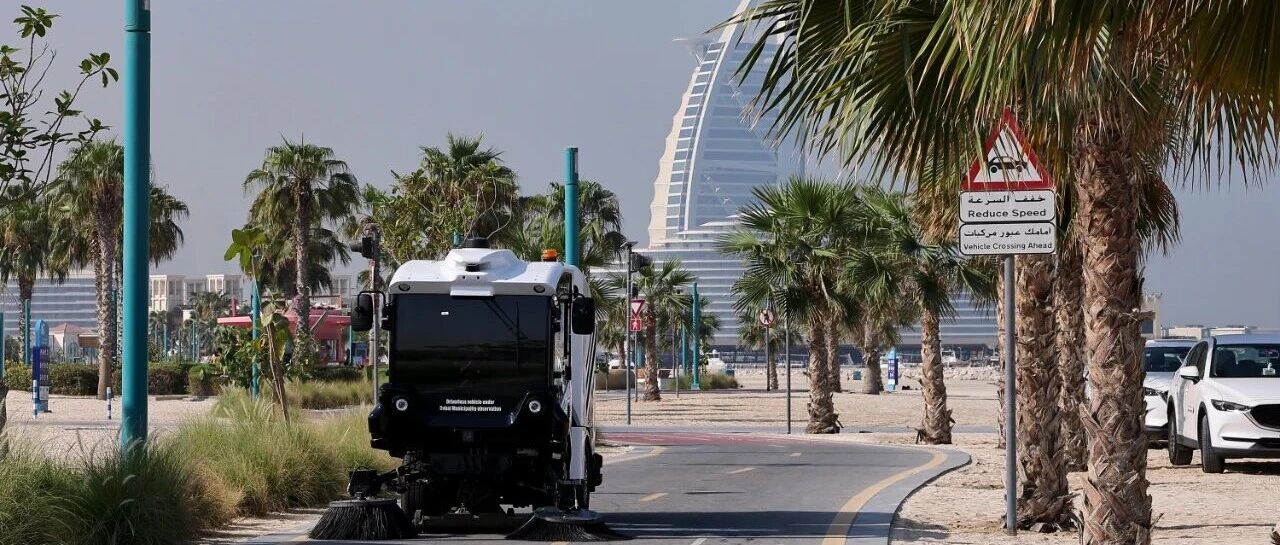
Core Viewpoint - The article highlights the innovative approach of Autowise.ai, a Chinese company that has successfully commercialized autonomous cleaning vehicles, positioning itself as a leader in the global market for unmanned sanitation equipment [1][24]. Group 1: Company Background and Transformation - Autowise.ai was founded by Huang Chao, who transitioned from a career in tech giants like Baidu and Didi to focus on autonomous driving technology, initially targeting passenger transport before pivoting to sanitation due to market saturation and high competition [3][4]. - The company identified significant challenges in the traditional sanitation industry, such as labor shortages and high operational costs, leading to the application of AI and autonomous driving technology in this sector [4][12]. Group 2: Product Development and Innovation - Autowise.ai developed a product matrix known as the "iron triangle," consisting of three core self-developed products: Autowise V3, Autowise V1, and the Roboard-X platform, which collectively support the widespread application of their technology [5][11]. - The Autowise V3, weighing under 3 tons, is designed for urban environments, offering high cleaning efficiency comparable to larger traditional models while being adaptable to narrow spaces [7][8]. - The Autowise V1 features a modular design that allows for multiple functionalities, significantly reducing costs for clients by enabling a single vehicle to perform various tasks [9][12]. Group 3: Business Model and Market Strategy - Autowise.ai has adopted a "light service" business model, allowing partners to pay for operational services rather than investing heavily in autonomous equipment, thus lowering the barriers for traditional sanitation companies to adopt smart technologies [12][13]. - The company has implemented its solutions in over 20 cities in China, establishing a comprehensive operational network that integrates traditional sanitation practices with autonomous technology [14]. Group 4: Global Expansion and Market Penetration - Autowise.ai has expanded its operations internationally, forming a joint venture in Saudi Arabia to deploy 1,000 autonomous vehicles, addressing local challenges such as extreme weather and labor costs [15][16]. - The company has also entered the European and American markets, providing services in complex environments like logistics centers, showcasing the adaptability and robustness of its technology [16][17]. Group 5: Vision and Future Outlook - The company aims to create new productivity and value in the sanitation industry, addressing labor shortages and safety concerns while enhancing operational efficiency [20][23]. - Autowise.ai's journey reflects a shift towards practical applications of advanced technology, demonstrating that innovation can thrive even in traditional sectors [18][24].
【投融资动态】来牟科技A+轮融资,融资额数千万人民币,投资方为九合创投、清波基金等
Sou Hu Cai Jing· 2025-11-27 11:33
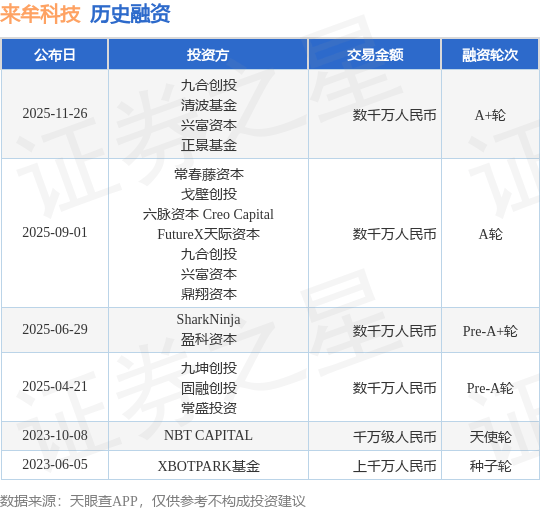
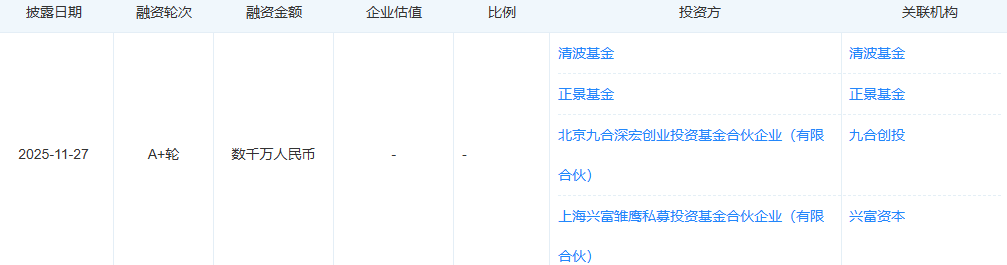
Core Insights - Changzhou Laimu Technology Co., Ltd. has completed an A+ round of financing, raising tens of millions of RMB, with investors including Jiuhe Venture Capital, Qingbo Fund, Xingfu Capital, and Zhengjing Fund [1][2]. Financing Details - The A+ round financing occurred on November 26, 2025, with participation from multiple investment firms [2]. - Previous financing rounds include: - A round on September 1, 2025, also raising tens of millions of RMB, with investors such as Ivy Capital, Gobi Partners, and others [2]. - Pre-A+ round on June 29, 2025, and Pre-A round on April 21, 2025, both raising tens of millions of RMB [2]. - Angel round on October 8, 2023, raising millions of RMB [2]. - Seed round on June 5, 2023, raising over ten million RMB [2]. Company Overview - Laimu Technology is a startup focused on courtyard robots, incubated by the XbotPark Robotics Base, primarily targeting the European and American markets [1][2]. - The founder previously served as the R&D director for SharkNinja, achieving a second-place market share for vacuum robots in North America [2]. - The team, established in early 2022, has extensive experience in product design, development, and sales, with members holding advanced degrees from prestigious universities and having worked at leading companies in the robotics and AI sectors [1][2].
李泽湘押注的割草机器人,又融了数千万!
Xin Lang Cai Jing· 2025-11-27 10:53
Core Insights - The article highlights that the emerging company, Laimu Technology, has successfully completed its fourth round of financing this year, raising tens of millions in an A+ round led by Jiuhe Venture Capital, with participation from Qingbo Fund, Xingfu Capital, and Zhengjing Capital [1][2] Company Overview - Laimu Technology, founded in 2022, focuses on the research and manufacturing of high-end robotic lawn mowers. The company has attracted significant investment from various prominent funds and institutions, accumulating over 100 million RMB in total financing since its inception [2][3] Product Innovation - Laimu Technology's core product, LymowOne, addresses traditional lawn mowing challenges with innovative features such as a new tracked design and an industry-first straight blade cutting system. This design enhances the device's climbing ability to 100% (i.e., 45 degrees) and increases its power output to 300W, significantly improving operational efficiency compared to competitors [4][6] Market Performance - Since its launch, LymowOne has performed exceptionally well, raising over $7.5 million on Kickstarter and achieving sales exceeding 100 million RMB by September. The product's average selling price is $2,499, indicating strong market recognition in the high-end segment. The company has stabilized its daily production capacity at 200 units, with total deliveries reaching several thousand units, aiming for over 100,000 units by 2026 [6][7] Industry Landscape - The global market for robotic lawn mowers is substantial, with approximately 250 million private lawns and gardens. North America and Europe are key markets, with countries like Germany and Switzerland showing over 40% penetration rates. IDC forecasts a significant increase in global shipments of robotic lawn mowers, with a year-on-year growth of 327.2% expected in the first half of 2025 [6][7] Trade Challenges - Despite the booming market, trade tensions are emerging, as the European Commission has initiated an anti-dumping investigation into Chinese exports of robotic lawn mowers following a complaint from a Swedish company. This company holds over 40% of the global market share for buried wire lawn mowers and claims that the influx of Chinese products negatively impacts the EU industry [7]

理想汽车-W(02015):3季度受召回拖累转亏,供应链瓶颈限制短期反弹,静待2026年新品
BOCOM International· 2025-11-27 10:30
Investment Rating - The investment rating for the company is Neutral [2][8]. Core Insights - The company experienced a loss in Q3 due to recall costs and supply chain bottlenecks, limiting short-term recovery, with expectations set for new products in 2026 [2][6]. - The stock price has adjusted approximately 40% from previous highs, reflecting most negative factors, and the recovery will depend on the resolution of supply chain issues and actual sales from new models [6][10]. Financial Overview - Revenue projections for the company are as follows: - 2023: 123,851 million RMB - 2024: 144,460 million RMB - 2025E: 123,190 million RMB - 2026E: 142,706 million RMB - 2027E: 151,853 million RMB - Year-on-year growth rates are projected to be 173.5% for 2023, 16.6% for 2024, -14.7% for 2025, 15.8% for 2026, and 6.4% for 2027 [5][10]. - Net profit estimates are as follows: - 2023: 11,704 million RMB - 2024: 8,032 million RMB - 2025E: 5,264 million RMB - 2026E: 6,056 million RMB - 2027E: 7,094 million RMB [5][12]. Market Performance - The company's stock closed at HKD 71.70 with a target price of HKD 80.84, indicating a potential upside of 12.7% [1][9]. - The market capitalization is approximately 237,697.31 million HKD, with a year-to-date change of -23.68% [4][10].

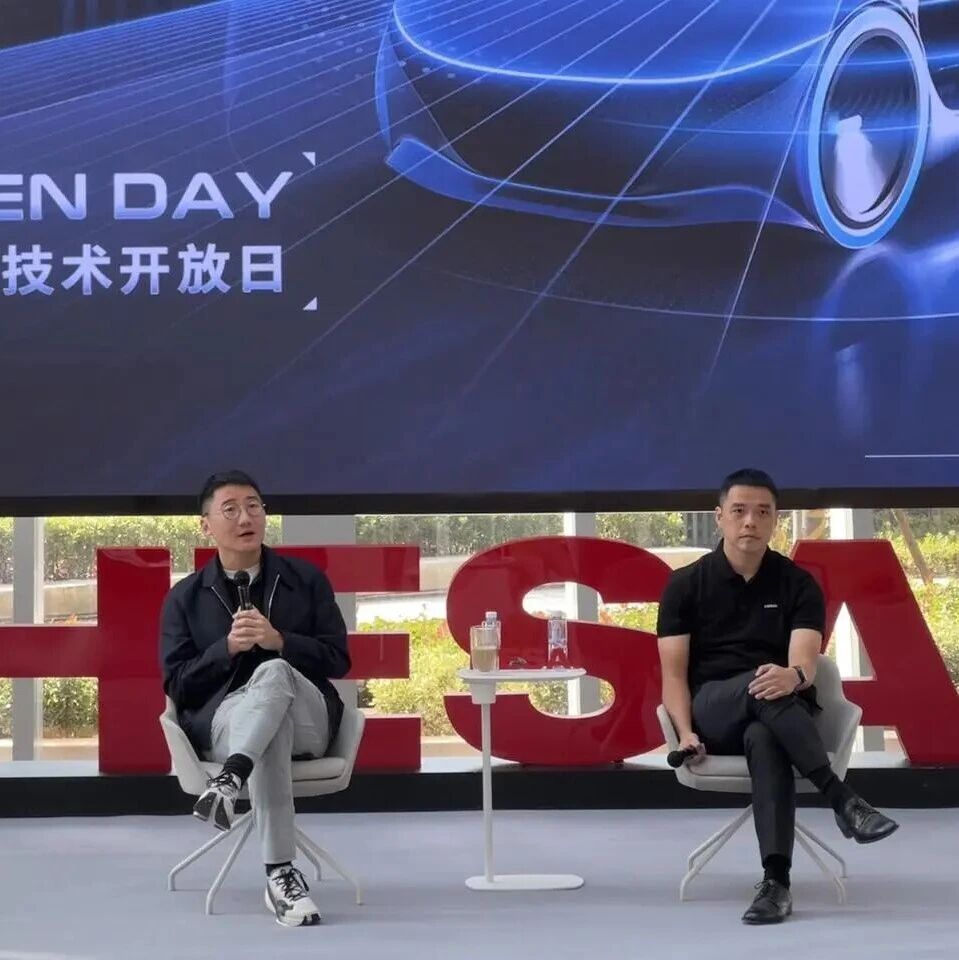
对话禾赛CEO李一帆:激光雷达行业,不能自嗨式地「造名词」
雷峰网· 2025-11-27 07:59
Core Viewpoint - The laser radar industry is expected to see a convergence of explicit indicators, but the number of players will decrease as safety and reliability become the primary focus [1][3][6]. Group 1: Industry Trends - The explicit indicators of laser radar products will converge, making them appear similar, akin to safety components like airbags [3][6]. - The industry is moving towards a more orderly state, which is essential for reasonable profit distribution [12][14]. - The average selling price (ASP) of laser radars has dropped significantly from tens of thousands of dollars to under $200, a decrease of 99.5%, yet the gross margin has remained stable due to innovative cost management [9][10]. Group 2: Company Strategy - The company focuses on bottom-layer technology and aims to produce standardized products for mass consumption rather than entering the automotive or robotics markets directly [3][21]. - The company has maintained stable gross margins by innovating and vertically integrating its supply chain, rather than relying on cost-cutting measures [9][10]. - The company is exploring overseas markets and non-automotive sectors to mitigate intense price competition in the Chinese automotive market [10][11]. Group 3: Safety and Reliability - Safety is a critical concern, and new players in the market may struggle to meet the high safety standards required for laser radar products [4][6]. - The future of robotics will likely involve integrating multiple small, high-frame-rate laser radars to ensure safety in human-robot interactions [19][20]. - The focus on safety will become increasingly important as robots become more prevalent in households, necessitating advanced safety measures [19][20]. Group 4: Market Outlook - The automotive market is expected to remain significantly larger than the robotics market in the coming years, as cars are essential consumer goods while robots are not yet widely adopted [23][24]. - The industry anticipates a period of reflection regarding the functionality and commercial value of robots, rather than merely their human-like appearance [25].

招商证券国际:维持速腾聚创目标价50港元及“增持”评级 看好公司感知龙头地位
Zhi Tong Cai Jing· 2025-11-27 07:08
Core Viewpoint - The report from China Merchants Securities International maintains a target price of HKD 50 for Suton Juchuang (02498) and an "Accumulate" rating, highlighting the significant growth potential in the ADAS and robotics sectors, with expectations of entering a profit cycle by 2026-2027 fiscal years [1] Group 1: Financial Performance and Projections - The company is expected to achieve profitability in Q4 of this year, with strong shipments in ADAS and robotics projected to exceed one million units [1] - Q4 laser radar shipments are anticipated to reach a record high, with October deliveries at 120,000 units and expected month-on-month growth in November and December [1] - ADAS shipments are projected to approach 600,000 units in 2025 and exceed one million units in 2026, with the digital EM platform already designated for 49 vehicle models [1] Group 2: Market Demand and Partnerships - There is a surge in demand for EM4 long-range radar for L3 autonomous driving, with capacity bottlenecks expected to be resolved by Q1 2026 [1] - The company has exclusive partnerships in the lawnmower robot sector, with expected shipments of 200,000 units by 2026 [1] - The overall shipment guidance for the robotics segment is nearly one million units for next year, and a new generation of Robotaxi models has been designated in collaboration with Didi Autonomous Driving, with an industry expectation of reaching a scale of 100,000 units in the next 3-5 years [1]

连续上行后,中国车市正步入十字路口,Robotaxi有望破局
Hua Er Jie Jian Wen· 2025-11-27 06:18
Core Viewpoint - The Chinese automotive industry is at a critical juncture after three years of growth, with investor sentiment shifting from optimism to caution as competition intensifies and potential subsidy reductions loom [1] Group 1: Market Sentiment and Policy Expectations - Investors are concerned that fierce market competition and subsidy cuts will continue to pressure industry sentiment and may impact the operational performance of OEMs and suppliers in Q1 2026 [1] - Most investors believe that national "trade-in" and local "replacement subsidies" will continue to be implemented in 2024 to mitigate the impact of a 5% increase in purchase tax and cyclical headwinds [2] - Investors expect that the implementation rules for local stimulus measures will become stricter, with per-vehicle subsidy amounts potentially decreasing by 30-50% year-on-year [3] Group 2: Traditional Automakers vs. New Players - There is a slight preference for traditional automakers, driven by low expectations and potential restructuring opportunities, alongside the influence of technology giants like Huawei [4] - Huawei's involvement in the automotive sector is reshaping the industry landscape, with its smart mobility alliance and collaborations with state-owned automakers [4] - Despite ongoing discussions around new players like BYD and NIO, investor opinions are divided, particularly regarding BYD's potential market share loss in 2024 [4] Group 3: Opportunities in Automation - The fields of autonomous driving and robotaxi are attracting significant market interest, with expectations for the removal of safety drivers becoming feasible due to technological advancements [5] - Regulatory breakthroughs for high-level autonomous driving are anticipated, with L3-level regulations expected to be released in the first half of 2026, potentially igniting renewed enthusiasm for autonomous driving clusters [5] - Suppliers with core technological advantages are expected to benefit from the increased penetration of L2+ and higher-level autonomous driving in China [5]
