人工智能(AI)

Search documents
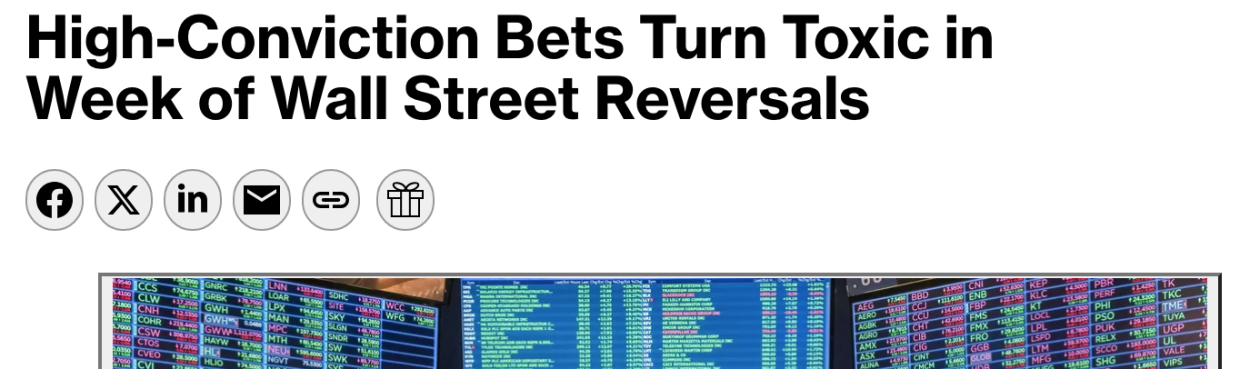
华尔街市场逆转 年初高共识交易集体失效
Huan Qiu Wang· 2026-02-15 01:06
Group 1 - In early 2026, Wall Street investors' risk appetite reached a high, with cash holdings at a historical low and a significant reduction in hedging positions [2] - The acceleration of AI technology applications has shifted market logic, leading to concerns about the replacement of light asset and white-collar industries such as software, wealth management, brokerage, and tax consulting [2] - The S&P 500 index experienced increased volatility, dropping to its lowest level since November of the previous year, with a rebound driven by moderate inflation data [2] Group 2 - A survey by Bank of America in January revealed that investor cash positions fell to a historical low of 3.2%, with nearly half of fund managers lacking downside protection, the lowest level since 2018 [2] - The correlation among various asset classes has increased, raising the risk of market-wide adjustments triggered by the sell-off of single assets [3] - Investment-grade bond ETFs performed strongly due to safe-haven demand, while U.S. Treasury prices rose, marking the largest weekly gain for long-term Treasury ETFs since April of the previous year [3]

釜山制造业低迷,行业分化加剧
Shang Wu Bu Wang Zhan· 2026-02-14 15:59
Core Viewpoint - The manufacturing sector in Busan is experiencing low economic sentiment at the beginning of the new year, with a Business Survey Index (BSI) of 79 for Q1 2026, indicating a slight recovery from the previous quarter's 64 but still significantly below the neutral line of 100 [1] Group 1: Economic Sentiment - The BSI for Busan's manufacturing sector shows a recovery of 15 points from the last quarter but remains weak overall [1] - The overall sentiment in the manufacturing sector is still below the neutral level, indicating ongoing economic challenges [1] Group 2: Sector Performance - There is a notable divergence among industries, with the electrical and electronic sector (121) and shipbuilding and related equipment (110) showing indices above 100, indicating a clear recovery [1] - Machinery and equipment (106) and assembly and metal (105) sectors also present relatively optimistic expectations [1] - In contrast, traditional manufacturing sectors such as clothing and fur (43), footwear (43), and textiles (53) are at historical lows due to rising raw material prices, increased labor costs, weak global demand, and intensified competition from Southeast Asian products [1] Group 3: Support Measures - The Busan Chamber of Commerce highlights the vulnerability of small and medium-sized manufacturing enterprises to external shocks and calls for the government to implement more precise and proactive support measures to alleviate uncertainties [1]
马斯克和黄仁勋的66条核心观点,你不能不看
Sou Hu Cai Jing· 2026-02-14 15:34
Group 1: Elon Musk's Perspectives on AI - The ultimate control of "digital superintelligence" cannot be achieved, similar to how chimpanzees cannot control humans, but the construction and values embedded in AI are crucial [4] - The key to AI safety is the "maximum pursuit of truth," avoiding the imposition of false beliefs on AI [5][6] - The danger of "thought viruses" being implanted in AI is not yet fully recognized by most [7] - AI will significantly transform the nature of work, with many current jobs being replaced by AI and robotics, leading to a future where work may become optional [10][11][12] - By 2026, true Artificial General Intelligence (AGI) is expected to emerge, with AI intelligence surpassing human intelligence by 2030 [17][21] - AI will revolutionize productivity, leading to unprecedented efficiency in the production of goods and services, potentially resulting in a significant drop in prices and an increase in purchasing power [24][32] Group 2: Jensen Huang's Insights on AI Infrastructure - The value of computer infrastructure accumulated over the past decade, approximately $10 trillion, is being modernized to adapt to the new computing methods of the AI era [26] - Open-source models are disrupting the AI industry, with explosive growth in downloads as various stakeholders seek to participate in the AI revolution [27] - The core of physical AI is to enable AI to understand the "rules of the real world," with a focus on creating data to train AI through simulation and synthetic data [29][30] - The AI revolution is not just about artificial intelligence but also about generative AI leading a new era, with Nvidia's AI generator producing tokens that can transform various industries [32][33] - The next generation of AI will be rooted in an understanding of physical laws, requiring the development of physics-based AI that can integrate into daily life [37][41]
“我们正在目睹一场AI创造性破坏席卷全球各行各业”!高盛合伙人:本质上,这是一次“护城河检查”
华尔街见闻· 2026-02-14 13:46
Core Viewpoint - A wave of "creative destruction" driven by artificial intelligence (AI) is testing the competitive advantages of companies across various industries, leading to a reassessment of their business models and resilience against technological disruptions [1][2]. Group 1: Market Dynamics - The sentiment of "sell first, ask questions later" is spreading in the market, with accelerated sell-offs primarily driven by AI concerns, lacking clear catalysts [2]. - High volatility in the software sector is observed, with valuations under pressure as AI raises questions about the terminal value of software and technology stocks [6][7]. - The current market environment is characterized by a potential growth shock, with a flattening yield curve and rising bond prices [18]. Group 2: Valuation Concerns - Valuation multiples for public companies have decreased from over 30 times earnings to just above 20 times, while private equity valuations remain significantly higher [7]. - The market is witnessing a chain reaction from public markets to private equity and private credit, particularly affecting the leveraged loan market [8]. Group 3: Investment Recommendations - Investors are advised to focus on companies with genuine competitive advantages and tangible assets, as these are likely to perform better in the current environment [13][22]. - The aerospace sector is highlighted as a promising area, with companies like Airbus being worth attention, while industrial stocks should be selected based on their benefits from the investment cycle rather than just short-term cyclicality [14]. - Real estate investment trusts (REITs) in Europe, particularly in German residential properties, are viewed positively, while office REITs are advised against due to potential risks [15]. Group 4: CTA Sell-off Signals - There is a need to be cautious of CTA (Commodity Trading Advisor) trigger points in major U.S. indices, with expectations of significant sell-offs, particularly in the Nasdaq 100 index [16][17]. - Goldman Sachs estimates that CTAs may sell off between $1.5 billion to $2 billion worth of U.S. stocks in the coming week, with the S&P 500 index remaining above critical thresholds for now [19].

OECD首席经济学家顾问:AI投资还未泡沫化,挑战在应用落地
2 1 Shi Ji Jing Ji Bao Dao· 2026-02-14 11:24
Tomasz Kozluk和团队预计,未来十年,AI有望为全球GDP或者生产率的提升贡献1个百分点,而且AI变 革前期可能会对经济进行一场结构性重塑,在后期才释放爆发性的增长。不过,他也指出,AI对不同 经济体的带动存在差异,在企业更广泛采用AI技术且在知识密集型服务领域发展更好的经济体中,收 益将最为显著;而那些在AI应用方面较为落后的国家,其收益预计会较小。 因而,在Tomasz Kozluk看来,现阶段AI的主要挑战不在于冲击各行各业,反而在于如何广泛应用落 地。技术的采纳需要建立信任,这需要企业和用户信任AI。同时也要尽量避免各种可能面临的瓶颈, 包括能源供应、劳动力技能落后以及未来可能出现的竞争不足等。 近期,外界都在等待Deepseek新一代V4模型的面世,Tomasz Kozluk认为,中美欧等大型经济体有能力 在通用大模型上不断迭代,但不一定所有发展中国家都要"手搓"出Deepseek这样的通用大模型,从经济 效益的角度看,各个新兴经济体发展垂类大模型会更有优势。 (文章来源:21世纪经济报道) 南方财经 21世纪经济报道记者赖镇桃报道 本周,AI恐慌在美股市场引发持续动荡,纳指周跌1.77% ...
视频丨AI帮忙挑年货、恐龙花灯与游客“聊天” 这个中国年满满“赛博味”
Sou Hu Cai Jing· 2026-02-14 04:31
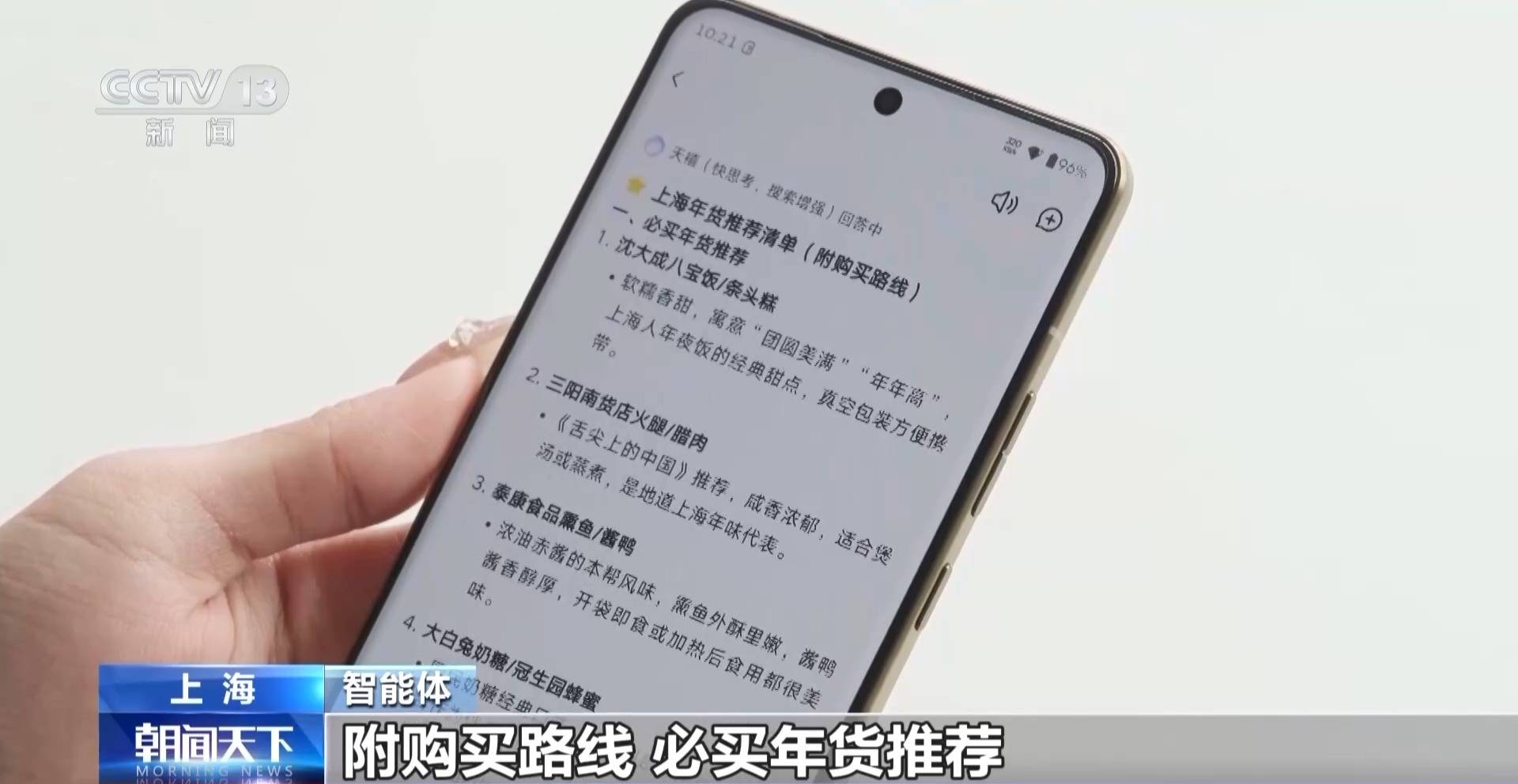
品中国年味,看消费新潮。马年春节脚步越来越近,过年的科技味儿也越来越浓,从AI智能体帮着挑年货、规划采购路线,到机器人当导购写福字,再到 传统景区用无人机点亮夜空,科技过大年真真切切地融入了我们每个人的生活。 AI智能体当年货参谋是个啥样的体验 向昕蕊是上海一所高校的大学生,春节返乡前,想为武汉的家人挑选一份地道的上海特产。作为外地来沪求学的学生,她对上海特产了解有限,而AI智能 体恰好解决了她的困扰。 不一会儿,AI智能体就完成了筛选与规划,不仅列出了方便携带、适合不同年龄段家人的经典老字号特产,还生成了一条高效的一站式采购路线图,明确 了出发地点、途经商铺、采购时长,甚至贴心提醒了避峰技巧和储存注意事项。 记者在采访中发现,像向昕蕊这样借助AI智能体采购年货的年轻人越来越多。如今的AI,早已不只是简单的"问答工具",而是深度参与人们生活决策的"好 帮手"。 相关大模型平台数据显示,春节相关热点问题中,咨询健康与作息类问题占比达29%,比如"春节饭菜隔夜还能吃吗""怎样更容易入睡";学习解题类问题占 比17%;生成新年文案、写真等内容类需求占比10%。 记者了解到,这批刚"上岗"的机器人,可不只是"书法达人 ...
韩国造船订单增8%,中国减35%
日经中文网· 2026-02-14 03:31
Group 1 - The core viewpoint of the article highlights the contrasting trends in shipbuilding orders among South Korea, China, and Japan for 2025, with South Korea experiencing an 8% increase in orders while China sees a significant 35% decrease [1][3][6] - South Korea's shipbuilding orders are projected to reach 11.59 million CGT, increasing its market share to 20.6%, while China's orders drop to 35.36 million CGT, reducing its market share to 62.7% [1][3] - The decline in China's orders is attributed to U.S. policies restricting Chinese shipbuilding, which has allowed South Korea to capture a larger share of the market [6][10] Group 2 - The global shipbuilding order volume is expected to decrease by 27% in 2025, falling to 56.42 million CGT, marking the first decline in two years [3][6] - Japan's shipbuilding orders have also decreased by 53%, resulting in a market share drop to 4.9%, indicating a significant decline in its shipbuilding capacity [1][3] - The South Korean government and companies are collaborating to revitalize the shipbuilding industry, leading to a fourfold increase in foreign workers in the sector over five years [7] Group 3 - Looking ahead, the global shipbuilding order volume is anticipated to expand in 2026, driven by strengthened environmental policies and a shift towards new fuel technologies [8] - HD Korean Shipbuilding & Marine Engineering has set a target of $23.3 billion in orders for 2026, reflecting a 26% increase from 2025, indicating strong demand for various types of vessels [8] - China is also making efforts to recover, with significant contracts signed to support its shipbuilding industry, while Japan aims to enhance its shipbuilding capacity to compete more effectively [10]

【招银研究|宏观专题】回归“小央行”:美联储“沃什时代”前瞻
2 1 Shi Ji Jing Ji Bao Dao· 2026-02-14 03:09
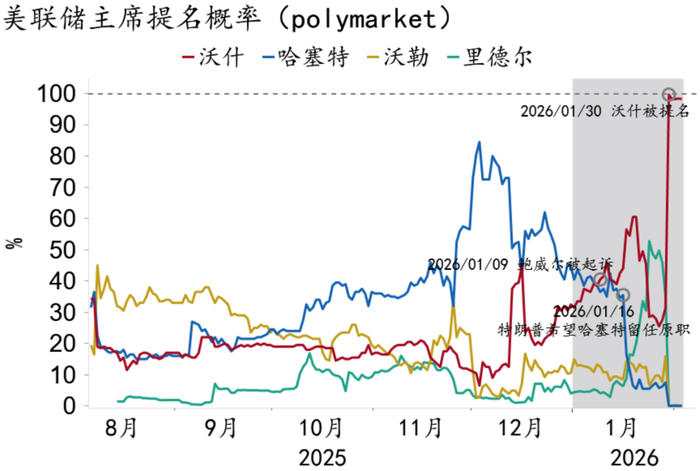
Core Viewpoint - Kevin Warsh has been nominated by Trump as the next Federal Reserve Chairman, aiming to balance various interests and potentially replace Jerome Powell on May 16, 2026 [1][3]. Group 1: Nomination Process - Warsh was chosen over other candidates due to his ability to unify different factions within the Republican Party and his strong connections with CEOs, financial giants, and politicians [1][7]. - Other candidates included Kevin Hassett, Rick Rieder, and Christopher Waller, each facing significant disadvantages compared to Warsh [4][8]. Group 2: Policy Philosophy - Warsh emphasizes that controlling inflation is the core mission of the Federal Reserve, advocating for balance sheet reduction and normalization of monetary policy [1][10]. - He believes that AI will drive the U.S. economy towards a "Goldilocks" scenario of high growth and low inflation, creating room for interest rate cuts [1][18]. - Warsh supports deregulation of U.S. commercial banks and aims to collaborate with regulatory vice-chair Bowman to advance this agenda [1][27]. Group 3: Long-term Policy Goals - Warsh's long-term strategy focuses on reviving monetarism, with deregulation and balance sheet reduction as core components [2][32]. - He may work with Treasury Secretary Bessent to implement "small central bank + small fiscal" reforms, aiming to achieve "growth with balance sheet reduction" [2][42]. Group 4: Market Implications - The global market may experience increased volatility, with U.S. stocks expected to trend upward but face a bumpy path [2][47]. - The U.S. Treasury yield is anticipated to decline moderately, with recommendations to focus on 2-5 year maturity bonds [2][56]. - The dollar is expected to initially weaken before strengthening, while the yuan is projected to appreciate moderately [2][62]. Group 5: Short-term Outlook - The Federal Reserve is likely to continue its interest rate cuts, with expectations of 2-3 cuts of 25 basis points each, potentially lowering the policy rate to 2.75-3.0% [1][36]. - Warsh's influence on short-term policy may be limited, but the dovish stance is expected to prevail [32][34].
因诺资产创始人徐书楠贺新春:十年AI积淀赋能投研 以“多策略”铸就长期稳健底色 祝投资者马到功成!
Xin Lang Cai Jing· 2026-02-14 01:16
专题:资本市场大咖2026新春献词:骏马踏春来 驭势稳行启新程 编者按:辞旧迎新,金马贺岁。值此新春佳节,新浪财经特邀公私募领域数十位领军人物,通过镜头与 文字,为投资者送来马年新春祝福。信心如磐,笃行致远。愿这一声声真挚寄语,伴您策马扬鞭,共赴 投资长路。 因诺(上海)资产管理有限公司创始人、投资总监徐书楠送来新春祝福。他表示,展望2026年,因诺将 继续坚持长期稳健的底色,依托十年AI积淀,推动大模型更深度地服务投研体系,将前沿能力沉淀为 更扎实的研究与实盘能力,持续打造多策略体系,力争为投资者带来更稳健、更可持续的长期体验与回 报。新的一年,愿大家行稳致远、马到功成。 专题:资本市场大咖2026新春献词:骏马踏春来 驭势稳行启新程 编者按:辞旧迎新,金马贺岁。值此新春佳节,新浪财经特邀公私募领域数十位领军人物,通过镜头与 文字,为投资者送来马年新春祝福。信心如磐,笃行致远。愿这一声声真挚寄语,伴您策马扬鞭,共赴 投资长路。 因诺(上海)资产管理有限公司创始人、投资总监徐书楠送来新春祝福。他表示,展望2026年,因诺将 继续坚持长期稳健的底色,依托十年AI积淀,推动大模型更深度地服务投研体系,将前沿能力沉 ...
美股三大指数周线齐跌
财联社· 2026-02-14 00:39
Market Overview - The three major indices showed mixed performance, with the Dow Jones up 0.10% to 49,500.93 points, the S&P 500 up 0.05% to 6,836.17 points, and the Nasdaq down 0.22% to 22,546.67 points [3] - All three indices recorded weekly declines, with the S&P 500 down 1.4%, the Dow down 1.2%, and the Nasdaq down 2.1% [3] Economic Indicators - The U.S. Bureau of Labor Statistics reported that the January CPI rose 2.4% year-over-year and 0.2% month-over-month, both below market expectations [3] - The core CPI, excluding volatile food and energy prices, increased by 2.5% year-over-year and 0.3% month-over-month, aligning with market expectations [3] - Phil Blancato, Chief Market Strategist at Osaic, indicated that this data could pave the way for interest rate cuts and inflation control if the trend continues [3] Sector Performance - Concerns over AI disruption led to market sell-offs, affecting various sectors including software, real estate, trucking, and financial services [6] - Financial stocks such as Charles Schwab and Morgan Stanley fell by 10.8% and 4.9%, respectively, while software company Workday dropped 11% and commercial real estate firm CBRE fell 16% [6] - The media sector was also impacted, with Disney down approximately 3% and Netflix down 6% [7] Technology Stocks - Major tech stocks mostly declined, with Nvidia down 2.21%, Apple down 2.27%, Microsoft down 0.13%, Google down 1.06%, and Amazon down 0.41% [7] - Tesla saw a slight increase of 0.09%, while Oracle rose by 2.34% and Netflix increased by 1.33% [7] Chinese Stocks - The Nasdaq Golden Dragon China Index fell by 0.10%, with Alibaba down 1.89%, JD.com down 1.38%, and Pinduoduo up 0.06% [7] - NIO remained flat, while Xpeng rose by 1.36% and Li Auto fell by 1.81% [7]