
逆周期和跨周期调节

Search documents
需求改善带动生产趋稳 11月制造业PMI回升
Shang Hai Zheng Quan Bao· 2025-11-30 18:29
需求改善带动生产趋稳 11月制造业PMI回升 ◎记者 陈芳 国家统计局服务业调查中心和中国物流与采购联合会11月30日发布的数据显示,11月,制造业采购经理 指数(PMI)为49.2%,比10月上升0.2个百分点。其中,新出口订单回升提振制造业,特别是拉动中小 企业景气度改善;受年底重点项目加快推进影响,建筑业景气度回升。 专家分析,11月,制造业景气度小幅回升,市场信心有所改善,但三大PMI指数仍位于荣枯线以下,应 加大宏观政策实施力度,推动全年经济平稳收官。 制造业出口趋稳 从制造业的分项指数看,出口需求回升,尤其是消费品制造业出口较10月好转。需求改善带动制造业生 产趋稳运行,企业销售加快。 11月,制造业新订单指数为49.2%,比10月上升0.4个百分点。其中,新出口订单指数从10月45.9%回升 至11月的47.7%,回升了1.7个百分点,明显改善。 中国物流信息中心分析师文韬表示,11月制造业出口是全面性地趋稳,制造业四大行业以及大中小企业 的新出口订单指数全部较10月上升。其中,消费品制造业新出口订单指数较10月上升超过2个百分点。 在需求端带动下,制造业生产活动也呈现企稳态势。11月,制造业生 ...
央行开展万亿元MLF操作
Zhong Guo Zheng Quan Bao· 2025-11-24 20:13
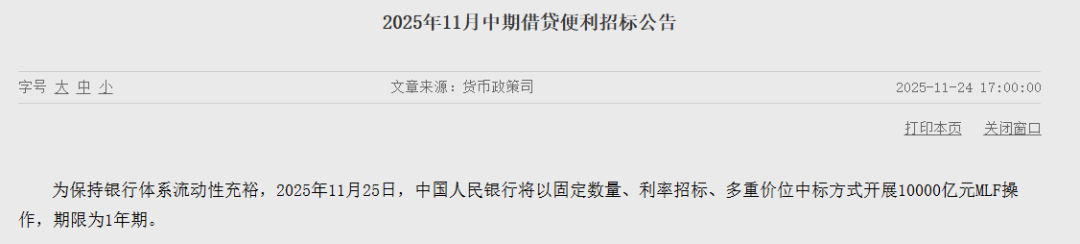
"在岁末年初之际,央行通过多种货币政策工具维持市场流动性充裕,进而引导金融机构加大信贷投 放,及时又必要。"招联首席研究员董希淼表示,目前,央行中短期流动性的投放方式已基本固定,即 每月5日前后开展3个月期买断式逆回购、15日前后开展6个月期买断式逆回购、25日开展MLF操作,为 保持市场流动性充裕提供有力支持。 ● 本报记者 彭扬 11月24日,据中国人民银行消息,11月25日,中国人民银行以固定数量、利率招标、多重价位中标方式 开展10000亿元MLF(中期借贷便利)操作,期限为1年期。 Wind数据显示,11月将有9000亿元MLF到期。这意味着11月MLF净投放为1000亿元,连续第九个月加 量续做,符合市场预期。 净投放处于较高水平 "考虑到11月央行还净投放5000亿元买断式逆回购,这意味着11月中期流动性净投放总额达6000亿元, 与上月相同,连续四个月处于年内较高水平。"东方金诚首席宏观分析师王青说。 王青分析,11月中期流动性净投放仍处于较高水平的原因有三方面:一是10月安排5000亿元地方政府债 务结存限额,用于化解存量债务及扩大有效投资,意味着年底前会加发5000亿元地方债,11月政府债 ...
10000亿元!央行预告
Zhong Guo Zheng Quan Bao· 2025-11-24 12:25
Core Viewpoint - The People's Bank of China (PBOC) is set to conduct a 1 trillion yuan MLF operation on November 25, indicating a net injection of 100 billion yuan in November, continuing a trend of increased liquidity support for the ninth consecutive month [1][3]. Group 1: Monetary Policy Actions - The PBOC will implement a fixed quantity, interest rate tender, and multi-price bidding method for the 1 trillion yuan MLF operation, with a one-year term [1]. - In November, there will be 900 billion yuan of MLF maturing, resulting in a net injection of 100 billion yuan [1]. - The central bank's net liquidity injection for November, including a 500 billion yuan reverse repo, totals 600 billion yuan, maintaining a high level of mid-term liquidity for four consecutive months [3]. Group 2: Factors Influencing Liquidity - Three main factors contribute to the high level of mid-term liquidity: the issuance of 500 billion yuan in local government bonds, the completion of 500 billion yuan in new policy financial tools, and an increase in the maturity of interbank certificates of deposit [3]. - The PBOC aims to support liquidity in the banking system to counteract potential tightening, ensuring a stable and ample funding environment [4]. Group 3: Future Expectations - Experts anticipate that the PBOC will continue to utilize both reverse repos and MLF as tools to inject mid-term liquidity into the market [5]. - The central bank's commitment to maintaining a supportive monetary policy stance is expected to help stabilize growth and expectations [4]. - The PBOC is likely to maintain a loose quantity operation model through the end of the year, fostering a relatively stable and accommodative funding environment [6].

国债密集发行 积极财政政策持续发力
Zhong Guo Zheng Quan Bao· 2025-11-23 20:46
Core Viewpoint - The recent intensive issuance of government bonds reflects the ongoing implementation of proactive fiscal policies aimed at supporting economic growth and ensuring effective use of funds [1][3]. Group 1: Government Bond Issuance - The Ministry of Finance has recently issued 970 billion yuan in coupon-bearing government bonds and 600 billion yuan in discount government bonds, with additional short-term bonds scheduled for issuance [1]. - The issuance of super long-term special government bonds has increased significantly this year, with a total of 1.3 trillion yuan issued, which is 300 billion yuan more than last year [2]. - The issuance schedule for super long-term special government bonds has been accelerated, with the first issuance occurring about a month earlier than last year, facilitating quicker fund deployment [2]. Group 2: Fiscal Policy and Economic Impact - Experts indicate that the ongoing issuance of government bonds is a key component of a more aggressive fiscal policy, which is expected to continue in the future [3]. - The issuance of 1.3 trillion yuan in super long-term special government bonds is projected to contribute 1.7% to 1.9% to GDP growth in 2025, providing crucial support for economic growth targets [2]. - The funds raised from government bond issuance in the fourth quarter are intended to support the implementation of the "14th Five-Year Plan" and enhance market liquidity [2]. Group 3: Fund Utilization and Oversight - The effectiveness of government bond fund utilization is critical for policy implementation, necessitating improved oversight and assessment to ensure funds are effectively allocated [3]. - Future fiscal policies are expected to focus on enhancing social confidence and expanding effective demand, particularly in areas such as modern industrial systems and infrastructure upgrades [3].
国债密集发行积极财政政策持续发力
Zhong Guo Zheng Quan Bao· 2025-11-23 20:06
● 本报记者 熊彦莎 专家表示,国债密集发行是积极财政政策持续发力的重要体现。后续积极财政政策取向料延续,应用好 用足特别国债、专项债等工具,加强国债资金监管考核,确保政策效能充分释放,护航稳增长。 发行节奏加快 国债密集发行彰显出积极财政政策持续发力。专家认为,后续财政政策将延续积极取向,通过扩大债券 工具使用、优化资金投向,进一步巩固经济稳中有进势头。(下转A02版) (上接A01版)财政部部长蓝佛安近日表示,要坚持积极取向,加强逆周期和跨周期调节,根据形势变 化,合理确定赤字率和举债规模,组合运用预算、税收、政府债券、转移支付等工具,用好政策空间, 保持支出强度,形成对经济社会发展的持续支撑。 作为"十五五"开局之年,2026年的财政政策备受关注。袁海霞认为,明年应用好用足特别国债、专项债 等工具,提振社会信心,扩大有效需求,进一步发挥财政政策稳增长、扩内需、惠民生的作用。 在资金投向上,袁海霞建议,提升财政发力的民生含量,同时聚焦现代化产业体系与基础设施升级,坚 持智能化、绿色化、融合化方向,继续加大支持经济转型发展中的新领域。 近段时间,国债发行较为密集。根据财政部2025年第四季度国债发行计划,今 ...
分析人士:预计明年LPR仍有下降空间
Qi Huo Ri Bao Wang· 2025-11-20 16:06
唐翠婷认为,今年我国前三季度实际GDP累计同比增长为5.2%,为实现全年5%的增长目标奠定了坚实 基础,显示出当前我国经济运行具备较强韧性。通胀层面,价格数据呈现边际回升迹象,其中PPI同比 降幅连续三个月收窄,核心CPI同比增速连续六个月回升,CPI同比增速连续两个月边际改善,"反内 卷"政策的积极效应逐步显现,LPR保持稳定的合理性进一步提升。 展望后市,唐翠婷预计,临近年末且我国经济韧性仍存,年内再次降息的概率较低,但随着国内增长动 能边际放缓、外部约束逐步减弱,2026年LPR仍有下降空间。后续,需重点关注11月宏观经济数据、12 月美联储议息会议及年末中央经济工作会议等关键节点。若经济稳增长压力持续,叠加外部约束放松, LPR下行概率将显著提升。 建信期货宏观研究员冯泽仁告诉记者,从政策背景来看,央行发布的三季度货币政策执行报告虽没改 变"稳健宽松"的总基调,但特别强调了"做好逆周期和跨周期调节"。这一表述暗示货币政策重心从单纯 的总量宽松转向结构性发力,兼顾短期稳增长与中长期防风险。因此,年底前的货币政策工作重心将是 加快5000亿元寄存限额等准财政政策的落地,托底年内经济。2026年是"十五五" ...
11月LPR不变,四季度降准降息预期减弱
2 1 Shi Ji Jing Ji Bao Dao· 2025-11-20 14:01
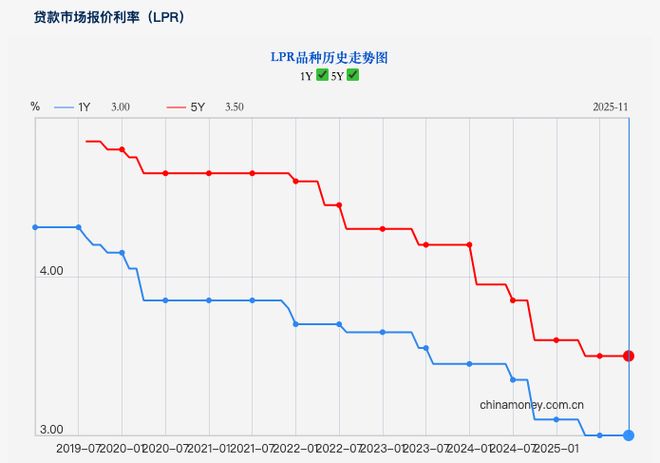
作者丨边万莉 唐婧 编辑丨包芳鸣 (图片来源:中国人民银行) LPR维持不变 2019年8月,央行推进贷款利率市场化改革。改革后的LPR由各报价行按照对最优质客户执行的贷款利 率,于每月20日(遇节假日顺延)以公开市场操作利率(主要指七天逆回购操作利率)加点形成的方式 报价。加点幅度则主要取决于各行自身资金成本、市场供求、风险溢价等因素。 目前,LPR已经成为银行贷款利率的定价基准,金融机构绝大部分贷款已参考LPR进行定价,直接影响 着各类经营主体融资成本。LPR 包含1年期与5年期以上两个品种,前者主要短期经营贷与消费贷,后 者则与房贷等长期限贷款密切相关。 11月20日,最新一期LPR报价出炉。中国人民银行授权全国银行间同业拆借中心公布,2025年10月20日 贷款市场报价利率(LPR)为:1年期LPR为3.0%,5年期以上LPR为3.5%。以上LPR在下一次发布LPR 之前有效。 值得关注的是,LPR报价已连续六个月保持不变。究其原因,一方面是作为LPR定价"锚"的7天期逆回 购利率连续多月保持稳定;另一方面,银行受净息差等因素影响,下调LPR报价加点的动力不足。 当前,市场对降准降息预期已有减弱。中国 ...
11月LPR不变,四季度降准降息预期减弱
21世纪经济报道· 2025-11-20 12:46
Core Viewpoint - The latest Loan Prime Rate (LPR) remains unchanged for six consecutive months, with the 1-year LPR at 3.0% and the 5-year LPR at 3.5%, reflecting stable market conditions and limited motivation for banks to lower rates [1][4][5]. Group 1: LPR Stability - The LPR has been stable due to the consistent 7-day reverse repurchase rate, which has remained at 1.40% since May [4][5]. - Market expectations for rate cuts have diminished, as liquidity is generally ample and banks need to maintain reasonable net interest margins to better serve the real economy [1][8]. Group 2: Economic Context - The macroeconomic environment has shown strength, with exports exceeding expectations and rapid development in new productive sectors, leading to reduced demand for counter-cyclical adjustments [4][8]. - The weighted average interest rate for new corporate loans in October was 3.1%, down approximately 40 basis points year-on-year, indicating a high level of credit resource supply [6]. Group 3: Future Monetary Policy - The central bank's recent report emphasizes the need for a moderately loose monetary policy while maintaining a focus on structural optimization and balancing short-term fluctuations with long-term goals [9][10]. - There is a shift towards more precise and coordinated monetary policy, with an emphasis on directing financial resources to key areas such as technological innovation and green development [10].

前10月财政“成绩单”:质效提升 支撑有力
Zhong Guo Jing Ying Bao· 2025-11-18 13:20
Core Insights - The article highlights the positive trends in China's fiscal operations from January to October, indicating a steady recovery in revenue and optimized expenditure structure, which supports high-quality economic development and modernization efforts [1][2]. Revenue Summary - From January to October, the national general public budget revenue reached 18.649 trillion yuan, a year-on-year increase of 0.8%, with a notable monthly growth trend [1]. - Tax revenue was particularly strong, amounting to 15.336 trillion yuan, reflecting a year-on-year growth of 1.7%, while non-tax revenue decreased by 3.1% to 331.26 billion yuan [1]. - Key tax categories showed growth, with domestic value-added tax at 588.58 billion yuan (up 4%) and corporate income tax at 391.82 billion yuan (up 1.9%) [1]. - The securities transaction stamp duty surged to 162.9 billion yuan, marking an 88.1% increase year-on-year, contributing to an overall stamp duty growth of 29.5% [1]. Expenditure Summary - National general public budget expenditure for the same period totaled 22.5825 trillion yuan, reflecting a year-on-year increase of 2% [2]. - Expenditure allocation favored social welfare and strategic sectors, with social security and employment spending at 377.42 billion yuan (up 9.3%), education spending at 341.17 billion yuan (up 4.7%), and health spending at 168.77 billion yuan (up 2.4%) [2]. - The focus on key areas such as technology, environmental protection, and social welfare demonstrates the government's commitment to stabilizing employment and improving living standards [2]. Policy Direction - The Ministry of Finance emphasizes the importance of proactive fiscal policies during the 14th Five-Year Plan period, aiming to support the realization of socialist modernization [3]. - Key strategies include maintaining a strong expenditure intensity, optimizing fiscal resource allocation towards high-quality development sectors, and ensuring policy coherence across fiscal, monetary, and industrial strategies [3].
财政收入稳步回升
Jing Ji Wang· 2025-11-18 00:24
Group 1 - The core viewpoint of the article highlights the steady recovery of national public budget revenue, with a year-on-year increase of 3.2% in October, indicating a positive economic trend [1] - In the first ten months, the total public budget revenue reached 18.65 trillion yuan, growing by 0.8%, with a 0.3 percentage point increase compared to the previous nine months [1] - Tax revenue in October was 2.07 trillion yuan, reflecting an 8.6% growth, which supports the notion of a resilient economy [1] Group 2 - The stamp duty revenue for the first ten months was 378.1 billion yuan, showing a significant year-on-year increase of 29.5%, with securities transaction stamp duty rising by 88.1%, indicating an active capital market [2] - Key industries such as equipment manufacturing and modern services showed strong tax revenue performance, with notable growth in sectors like computer communication equipment manufacturing (12.7%) and scientific research services (14.8%) [2] - Total public budget expenditure for the first ten months was 22.58 trillion yuan, up by 2%, with significant increases in social security and employment (9.3%) and education (4.7%) expenditures [2] Group 3 - Government fund budget revenue decreased by 2.8% to 3.45 trillion yuan, while expenditure increased by 15.4% to 8.09 trillion yuan, driven by accelerated use of bond funds [3] - The article emphasizes the need for continued active fiscal policies to support key expenditures and stimulate effective demand, contributing to economic recovery and sustainable fiscal health [3] - The Ministry of Finance plans to enhance fiscal support in line with major strategic goals, maintaining spending intensity and utilizing various fiscal tools to support economic and social development [3]