加息
Search documents
前日本央行货币政策主管:日元疲软提高12月加息可能性
智通财经网· 2025-11-26 00:28
Group 1 - The recent depreciation of the yen is increasing the likelihood of a rate hike by the Bank of Japan (BOJ) next month, with a high probability of a December rate increase if no major negative news arises [1][4] - The yen has depreciated approximately 5% over the past three months, reaching a 10-month low against the dollar, which has raised concerns about rising import costs and inflationary pressures [4][5] - The Japanese government has approved a comprehensive economic plan worth 21.3 trillion yen to support the economy and consumers affected by inflation, marking the largest stimulus measure since the pandemic [4] Group 2 - The BOJ's core inflation rate accelerated to 3% last month, remaining above the 2% target for three and a half years, prompting the central bank to closely monitor the yen's impact on potential inflation [5] - Market participants are speculating on the timing of the BOJ's rate hike, with a 40% probability for December and a 90% probability for January, as recent surveys indicate December as the most likely time for action [5][6] - The BOJ policy committee appears to be increasingly supportive of a rate hike in the coming months, with recent comments from committee members indicating a shift towards normalizing monetary policy [6]
国际银呈上涨趋势 美储戴利支持下月降息
Jin Tou Wang· 2025-11-25 04:51
据华尔街日报报道,美国旧金山联储主席、2027年FOMC票委戴利表示,她支持在下个月降息,因为她 认为就业市场突然恶化的可能性比通胀骤然上升更大,也更难以控制。 她在周一的采访中说:"在劳动力市场上,我没有信心我们能走在前面。现在劳动力市场已足够脆弱, 风险在于发生非线性变化。" 她表示,相比之下,通胀爆发的风险较低,因为关税推动的成本增长比今年早些时候的预期要温和得 多。戴利的观点值得关注,尽管她今年对货币政策没有投票权,但她很少在公开场合与美联储主席鲍威 尔持不同意见。 今日周二(11月25日)亚盘时段,国际白银目前交投于51.34一线上方,今日开盘于51.37美元/盎司,截至 发稿,国际白银暂报51.41美元/盎司,上涨0.13%,最高触及51.49美元/盎司,最低下探50.97美元/盎 司,目前来看,国际白银盘内短线偏向看涨走势。 【要闻速递】 在12月9日至10日的会议上,戴利可能会在解决利率制定委员会内部关于是降息还是暂停加息的分歧上 发挥关键作用。 【最新国际白银行情解析】 国际白银在趋势中走出上涨空间,目前最高在51.4,白银预计在48.5/52.5区间看待,坚持看到52.5附 近,如果在本周 ...
国泰海通 · 晨报1125|策略、固收
国泰海通证券研究· 2025-11-24 12:10
Group 1: Market Overview - The global risk appetite has decreased, with the VIX index and MOVE 5-day moving average rising significantly, leading to a synchronized decline in both stock and commodity markets [2] - Major global stock indices have generally retreated, with the technology sector experiencing notable declines, while gold, silver, copper, and oil also recorded drops [2][3] - The USD index has surpassed 100, and the Japanese yen has depreciated significantly, approaching the 160 mark against the dollar [2][5] Group 2: Equity Market Performance - The MSCI global index fell by 2.5%, with developed markets showing a pattern where declines in frontier markets were less severe than in developed and emerging markets [3] - In the U.S., major indices like the S&P 500 and Dow Jones dropped by 1.9%, while the Nasdaq fell by 2.7%, indicating increased scrutiny on the earnings quality of major tech firms [3] - Emerging markets saw significant declines in A-shares, with small-cap and tech boards dropping over 5.1%, while the Russian RTS index rose sharply by 9.1% [3] Group 3: Bond Market Dynamics - The Chinese bond market exhibited a "bear steepening" trend, with the yield curve shifting upward and the 10Y-2Y spread widening [4] - In contrast, U.S. Treasury yields showed a "bull steepening" pattern, with the yield curve moving downward, influenced by dovish comments from the New York Fed [4] - The Japanese government is expected to issue additional bonds to finance a fiscal stimulus plan, which may lead to increased long-term bond yields [4] Group 4: Commodity and Currency Trends - Commodity indices such as South China and CRB fell by 1.8% and 2.2%, respectively, with only three out of thirteen major commodity futures recording price increases [5] - The dollar index rose by 0.9%, while the yen depreciated by 1.2%, which may benefit Japanese exporters but also heighten inflationary pressures [5] - The Bank of Japan faces increased pressure to raise interest rates due to the combination of yen depreciation and inflation [5] Group 5: Fixed Income Issuance and Trading - Net financing in the bond market increased, with a total issuance of 3,846.4 billion yuan against 2,555.6 billion yuan maturing, resulting in a net increase of 1,290.8 billion yuan [9] - Secondary market trading volume decreased, with total transactions amounting to 7,783.28 billion yuan, down from 8,032.22 billion yuan the previous week [10] - The yield on 3-year AAA medium-term notes fell by 2.33 basis points to 1.86%, indicating a downward trend in short-term yields [10]
宏观金融类:文字早评2025/11/24星期一-20251124
Wu Kuang Qi Huo· 2025-11-24 02:26
1. Report Industry Investment Ratings There is no information provided regarding the report's industry investment ratings. 2. Core Views of the Report - The stock market has a certain degree of short - term uncertainty due to previous rises and overseas market adjustments, but the medium - to - long - term strategy is to go long on dips [4]. - The bond market is expected to oscillate and recover in the fourth quarter, with attention to the stock - bond seesaw effect and the increasing allocation power [8]. - For precious metals, it is recommended to hold a bottom position and wait and see, with the Fed's easing policy expected to further drive prices in December [10]. - Most non - ferrous metals are expected to be in a state of shock in the short term, with different support and pressure factors [13][15][18]. - The steel market is expected to be weakly volatile in the short term, but demand may improve with policy implementation [36]. - The energy and chemical market shows different trends, with some products recommended for long - term strategies and others for short - term caution [56][58][60]. - The agricultural product market also has various trends, such as short - term weak operation for some and shock - based operation for others [81][86]. 3. Summary by Related Catalogs Macro - financial Category Stock Index - **Market Information**: The US government may allow NVIDIA to sell H200 chips to China; the SASAC held a central enterprise specialization integration promotion meeting; Changxin Storage released new DDR5 products; a Goldman Sachs partner said the US stock market may continue to sell off [2]. - **Strategy View**: After previous rises and influenced by overseas market adjustments, the short - term index is uncertain, but the medium - to - long - term strategy is to go long on dips [4]. Treasury Bond - **Market Information**: The main contracts of TL, T, and TF decreased on Friday, while TS remained unchanged. The Bank of Japan may raise interest rates, and the US PMI data showed mixed results. The central bank conducted a net injection of 1622 billion yuan [5]. - **Strategy View**: The bond market is expected to oscillate and recover in the fourth quarter, with attention to the stock - bond seesaw effect and the increasing allocation power [8]. Precious Metals - **Market Information**: Gold prices rose slightly, and silver prices fell. The US 10 - year Treasury yield and the US dollar index were reported. Fed officials' "dovish" remarks supported precious metal prices [9]. - **Strategy View**: It is recommended to hold a bottom position and wait and see, with the Fed's easing policy expected to further drive prices in December [10]. Non - ferrous Metals Category Copper - **Market Information**: The copper price rebounded after a decline, with LME copper inventory decreasing and domestic spot premiums rising [12]. - **Strategy View**: The copper price is expected to be in a state of shock in the short term, with strong support at the bottom [13]. Aluminum - **Market Information**: The aluminum price rebounded after a decline, with domestic and overseas inventory changes and improved downstream procurement sentiment [14]. - **Strategy View**: The aluminum price is expected to strengthen after an oscillatory adjustment, with strong support [15]. Zinc - **Market Information**: The zinc price rose slightly, with changes in inventory and basis [16]. - **Strategy View**: The zinc price is expected to be weakly volatile in the short term, with the zinc industry still in an over - supply cycle [18]. Lead - **Market Information**: The lead price fell, with changes in inventory and basis [19]. - **Strategy View**: The lead price is expected to be weakly volatile in the short term, with relatively loose supply [19]. Nickel - **Market Information**: The nickel price continued to fall, with changes in spot premiums and cost [20]. - **Strategy View**: The nickel price is expected to be under pressure in the short term, and it is recommended to wait and see [21][22]. Tin - **Market Information**: The tin price fell slightly, with changes in supply, demand, and inventory. The safety situation in the DRC may affect tin mines [23]. - **Strategy View**: The tin price is expected to oscillate in the short term, and it is recommended to wait and see [24]. Carbonate Lithium - **Market Information**: The carbonate lithium price fell, with changes in spot and futures prices [25]. - **Strategy View**: It is recommended to pay attention to potential disturbances and the reference range of the main contract [26]. Alumina - **Market Information**: The alumina price fell, with changes in inventory and basis [28]. - **Strategy View**: It is recommended to wait and see in the short term, with attention to supply - side policies [29]. Stainless Steel - **Market Information**: The stainless steel price rose slightly, with changes in inventory and cost [30]. - **Strategy View**: The stainless steel price is expected to continue to decline weakly, with an over - supply situation [30]. Cast Aluminum Alloy - **Market Information**: The cast aluminum alloy price fell, with changes in inventory and basis [31]. - **Strategy View**: The price is expected to be in a state of shock in the short term [33]. Black Building Materials Category Steel - **Market Information**: The steel price rose slightly, with changes in inventory and basis [35]. - **Strategy View**: The steel price is expected to be weakly volatile in the short term, but demand may improve with policy implementation [36]. Iron Ore - **Market Information**: The iron ore price fell slightly, with changes in inventory and basis [37]. - **Strategy View**: The iron ore price is expected to oscillate within a range, with strong supply and stable demand [38][39]. Glass and Soda Ash - **Market Information**: The glass price fell, and the soda ash price fell. There were changes in inventory and basis [40][41]. - **Strategy View**: The glass price is expected to oscillate at the bottom, and the soda ash price is expected to be weakly volatile [40][41]. Manganese Silicon and Ferrosilicon - **Market Information**: The manganese silicon price fell, and the ferrosilicon price rose slightly. There were changes in inventory and basis [42]. - **Strategy View**: It is recommended to pay attention to the inflection point of market sentiment and price, and to look for opportunities to rebound [44][45]. Industrial Silicon and Polysilicon - **Market Information**: The industrial silicon price fell, and the polysilicon price rose slightly. There were changes in inventory and basis [46][49]. - **Strategy View**: The industrial silicon price is expected to oscillate, and the polysilicon price is expected to oscillate within a wide range [48][50]. Energy and Chemical Category Rubber - **Market Information**: The rubber price oscillated and adjusted, with changes in tire factory start - up rates and inventory [52][54]. - **Strategy View**: It is recommended to have a bullish strategy with stop - loss settings and partial hedging [56]. Crude Oil - **Market Information**: The crude oil price fell, and there were changes in refined oil prices and inventory [57]. - **Strategy View**: It is recommended to wait and see in the short term and test OPEC's export price - support willingness [58]. Methanol - **Market Information**: The methanol price fell, with changes in inventory and basis [59]. - **Strategy View**: The methanol price is expected to continue to decline weakly, with high inventory pressure [60]. Urea - **Market Information**: The urea price rose slightly, with changes in inventory and basis [61]. - **Strategy View**: The urea price is expected to oscillate at the bottom, and it is recommended to go long at low prices [61]. Pure Benzene and Styrene - **Market Information**: The pure benzene price was unchanged, and the styrene price rose. There were changes in inventory and basis [62]. - **Strategy View**: The styrene price may stop falling in stages, with cost and demand factors [63]. PVC - **Market Information**: The PVC price was unchanged, with changes in inventory and basis [64]. - **Strategy View**: The PVC price is expected to be weak, and it is recommended to go short in the medium term [66]. Ethylene Glycol - **Market Information**: The ethylene glycol price fell, with changes in inventory and basis [67]. - **Strategy View**: The ethylene glycol price is expected to be weak, and it is recommended to go short in the medium term [68]. PTA - **Market Information**: The PTA price fell, with changes in inventory and basis [69]. - **Strategy View**: The PTA price is expected to be affected by supply, demand, and valuation factors [71]. Para - Xylene - **Market Information**: The para - xylene price fell, with changes in inventory and basis [72]. - **Strategy View**: The para - xylene price is expected to have a risk of valuation correction, with high supply and low demand [73]. Polyethylene (PE) - **Market Information**: The PE price fell, with changes in inventory and basis [74]. - **Strategy View**: The PE price is expected to oscillate at a low level, with cost and demand factors [75]. Polypropylene (PP) - **Market Information**: The PP price fell, with changes in inventory and basis [77]. - **Strategy View**: The PP price is expected to be affected by cost and demand factors, and may be supported in the first quarter of next year [78]. Agricultural Products Category Pig - **Market Information**: The pig price fluctuated, with normal supply and limited demand [80]. - **Strategy View**: It is recommended to go short on the near - month contract or do reverse spreads [81]. Egg - **Market Information**: The egg price was stable with partial increases, with reduced inventory pressure and increased replenishment willingness [82]. - **Strategy View**: The egg price is expected to oscillate in the short term, and it is recommended to go short after a rebound in the medium term [83][84]. Soybean Meal and Rapeseed Meal - **Market Information**: The soybean meal price was stable, with changes in import cost, inventory, and demand [85]. - **Strategy View**: The soybean meal price is expected to oscillate, with cost support and pressure on crushing margins [86]. Edible Oils - **Market Information**: The edible oil price fell, with weak palm oil export data and high supply [87]. - **Strategy View**: The palm oil price is recommended to be viewed with an oscillatory perspective, and turn to a bullish strategy if production decreases [88][89]. Sugar - **Market Information**: The sugar price fell, with an expected global surplus in the 2025/26 season and increased imports [90][91]. - **Strategy View**: It is recommended to wait for a rebound and then go short [91]. Cotton - **Market Information**: The cotton price oscillated narrowly, with changes in production, inventory, and demand [92][93]. - **Strategy View**: The cotton price is expected to oscillate in the short term, with no strong driving force [94].
美联储政策失灵?K 型经济下,2026 年降息能否救美国?
Sou Hu Cai Jing· 2025-11-23 04:47
Core Economic Insights - The Federal Reserve's acknowledgment of a K-shaped economy highlights the disparity between low-income consumers, who are downgrading their consumption, and high-income individuals, who continue to spend lavishly [3][5] - The aggressive interest rate hikes initiated in 2022 have led to a significant divide in consumer spending, with low-income groups experiencing stagnation or decline in credit card spending, while high-income groups drive overall credit card consumption growth [5][7] Consumer Behavior - Research indicates that a 1% increase in the federal funds rate results in a 0.9% decrease in credit card spending, disproportionately affecting lower-income consumers who face a twofold reduction in spending compared to higher-income individuals [7] - As of November 2025, the 30-day delinquency rate on credit cards reached 4.8%, the highest since the 2008 financial crisis, while the bad debt rate for buy-now-pay-later services surged to 9.5% [7] Corporate Sector Dynamics - Capital expenditures in the AI sector are primarily concentrated among tech giants like Amazon, Microsoft, and Google, which possess substantial cash reserves, while small businesses struggle under high-interest rates [8][10] - The National Federation of Independent Business reported that small business confidence has remained below the 50-year average for 22 consecutive months, with credit access at its most challenging level since the European debt crisis in 2012 [10] Wealth Distribution and Policy Implications - The wealth concentration in the U.S. is stark, with the top 1% holding over 32% of the nation's wealth, while the bottom 50% possess only 2.5% [10][12] - The Federal Reserve's interest rate policies have inadvertently exacerbated wealth inequality, benefiting wealthy savers while placing a heavier burden on low-income borrowers [12][18] Future Outlook - A potential interest rate cut in the first half of 2026 is anticipated, but it is expected to be cautious and gradual rather than aggressive [14][16] - The impact of any rate cuts will likely be uneven, providing relief to lower-income consumers and small businesses while potentially inflating asset values for the wealthy [16][18] Structural Solutions - Long-term solutions to the K-shaped economy require fiscal policy changes, including a fairer tax system and targeted social transfers, which are currently hindered by political divisions [18][20]
新首相高市早苗“蜜月期”戛然而止?日本面临股债汇三杀,股市一周蒸发1270亿美元
智通财经网· 2025-11-22 02:41
Group 1 - The market enthusiasm for Japan's new Prime Minister, Sanae Takaichi, has faded, with Tokyo-listed companies losing approximately $127 billion in market value over the past week [1] - The Japanese yen and government bonds have also seen significant declines, raising concerns among investors about Japan's financial sustainability and the likelihood of the Bank of Japan raising interest rates to curb inflation [1][3] - The Nikkei 225 index, which includes many large exporters and tech companies, fell by 3.5% this week, while the broader TOPIX index dropped by 1.8% [3] Group 2 - Major investors have reduced net purchases of 10-year Japanese government bonds to the lowest level since October 2023, leading to increased bond yields and higher financing costs for the already indebted Japanese government [8] - Investors are shifting their focus from ultra-long-term bonds to potential opportunities in 5 to 10-year bonds, indicating a bearish sentiment in the Japanese bond market [6] - The spending plan proposed by Takaichi has raised concerns among investors, with some expressing increased anxiety about its implications for the economy [9]
日本通胀持续升温 日本央行陷两难境地
Jin Tou Wang· 2025-11-21 06:09
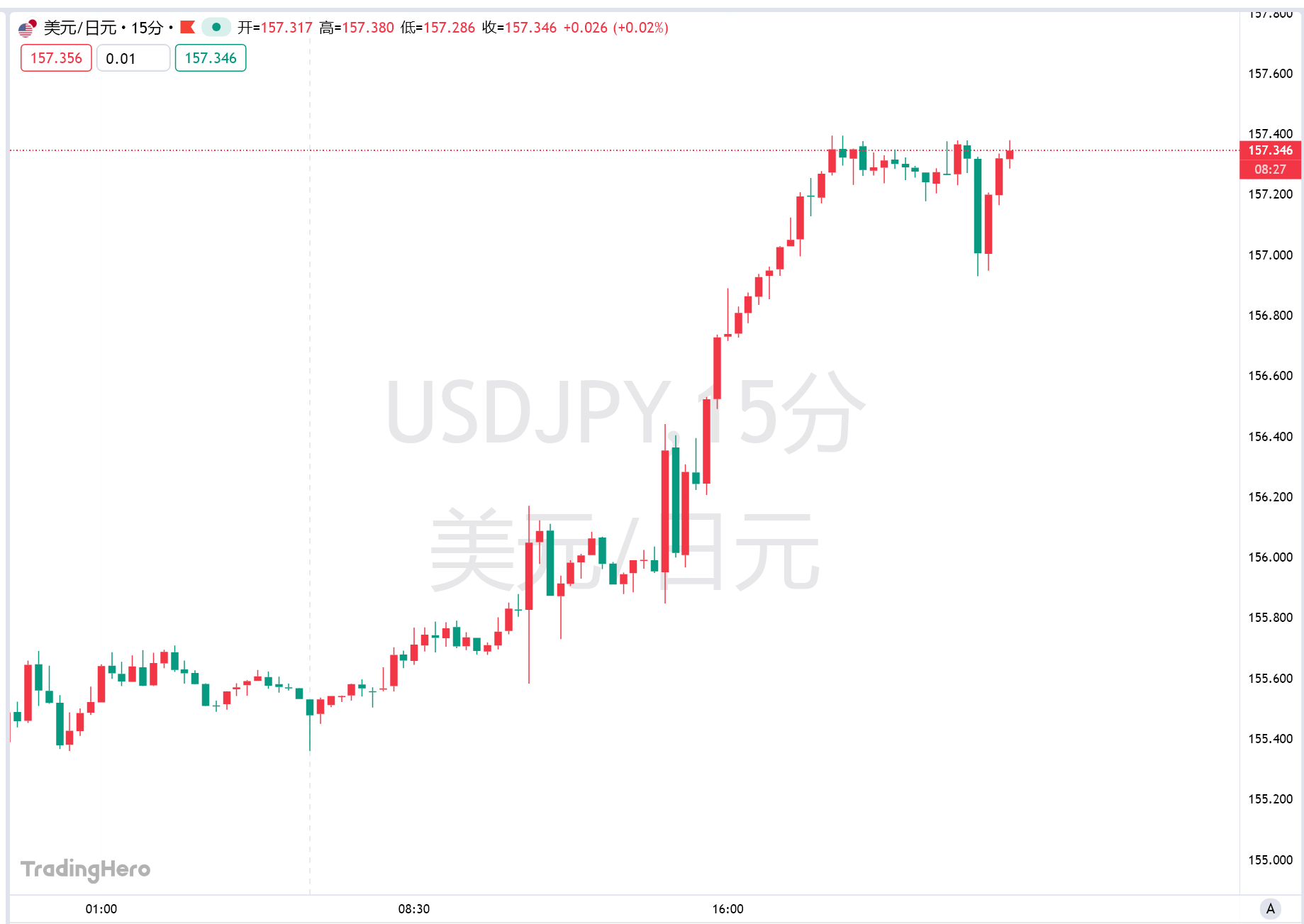
目前日本央行陷入两难境地:通胀持续高于政策目标,而受美国关税冲击,日本GDP增长数据正持续走 弱。截至9月的三个月内,日本GDP出现六个季度以来首次收缩,环比下降0.4%,年化降幅达1.8%。 美元/日元技术分析 日线相对强弱指数(RSI)显示出轻微超买信号,这抑制了交易员对美元/日元货币对建立新的看涨头寸 的意愿。因此,在为下一波上涨布局之前,谨慎的做法是等待短期内出现一定幅度的盘整或小幅回调。 与此同时,当前任何修正性下跌都可能在157.00关口略下方获得初步支撑,随后是156.65-156.60区域; 若跌破该区域,美元对日元汇率可能进一步跌向156.00关口。这一水平将成为关键支撑位,一旦失守, 将为更大幅度的下跌打开空间。 反之,若上行,158.00将构成首个阻力位,突破该水平后,美元兑日元有望进一步升向158.50附近的下 一个重要阻力区。届时多头动能可能继续扩大,推动汇价挑战1月初的高点,即接近159.00区域。 周五(11月21日)亚洲时段,美元/日元小幅回落,最新美元兑日元汇率徘徊在157.20附近,日本10月核 心通胀率以自7月以来最快速度攀升,这为日本央行加息提供了依据。由于市场担忧日本 ...
通胀升温、出口回升,日本10月经济数据令央行加息路径更明朗
Sou Hu Cai Jing· 2025-11-21 04:20
Core Viewpoint - Japan's inflation rate has slightly increased, and exports have rebounded, allowing the Bank of Japan to maintain its interest rate hike plans in the coming months. Prime Minister Fumio Kishida is preparing an economic plan to alleviate public discontent over rising living costs [1]. Inflation Data - The consumer price index, excluding fresh food, rose by 3% year-on-year, driven by increases in accommodation, car insurance premiums, and household durable goods. This aligns with economists' median expectations, with the previous month's increase at 2.9% [1]. - Consumer prices have remained at or above the Bank of Japan's 2% target for 43 consecutive months, marking the longest period since 1992. A more closely related price trend indicator (excluding energy) accelerated from 3% to 3.1% [2]. Export Performance - Japan's export value has increased for the second consecutive month, with a year-on-year growth of 3.6% in October, surpassing economists' expectations of 1.1%. However, exports to the U.S. have declined by 3.1% due to tariff policies [2]. - The depreciation of the yen has effectively boosted export values, although the volume of exports to the U.S. continues to show a downward trend [2]. Economic Stimulus Plan - Prime Minister Kishida is set to announce the largest fiscal spending plan since the COVID-19 pandemic, reinforcing his commitment to expansionary fiscal policy. This move signals to bond market investors that large-scale fiscal expansion will continue to exert pressure on debt financing costs [3]. - The announcement is expected to support market speculation that the Bank of Japan may raise borrowing costs in December or January [3]. Structural Inflation Dynamics - Accommodation costs increased by 8.5%, and car insurance premiums rose by 6.9%, contributing to the upward pressure on price indicators. In contrast, the price increases for processed food and energy have slowed down, exerting downward pressure on overall inflation [4]. - Electricity and natural gas subsidy policies have directly lowered the overall inflation rate by 0.26 percentage points, serving as a significant tool to curb inflation [4]. Trade and Manufacturing Insights - Japan's economy experienced its first contraction in six quarters during the summer, primarily due to weak export performance. Kishida's economic plan will include special support for businesses affected by U.S. tariff impacts [5]. - The latest trade data reveals structural differentiation in export growth, with semiconductors and other electronic components emerging as core growth drivers, showing a year-on-year increase of 15.8%, effectively offsetting declines in traditional industries [4].
日本央行内部鹰声四起 12月加息或提上议程
Xin Hua Cai Jing· 2025-11-21 02:42
Core Viewpoint - The Bank of Japan's Governor Ueda Kazuo indicated that the continued weakness of the yen may further increase inflation, as import prices rise due to the yen's depreciation, leading companies to be more willing to raise wages and product prices [1] Group 1: Monetary Policy Implications - Ueda emphasized that the impact of exchange rate fluctuations on prices is more significant than in the past, necessitating the central bank to remain highly vigilant [1] - There is a growing inclination towards supporting an interest rate hike in December, especially if Ueda votes in favor, aligning with two hawkish committee members who called for a rate increase in the October meeting [1] Group 2: Committee Dynamics - Committee member Koeda Junko expressed hawkish views, indicating rising concerns about inflation risks within the policy-making body [1] - Although Deputy Governor Iwata Noriyuki maintained the status quo in the last meeting, he is still viewed as leaning towards hawkish policies [1] - Currently, only Noguchi Akira holds a firm dovish stance, while the new member, who is seen as centrist, is expected to align with the mainstream opinion led by Ueda [1]