
资本配置

Search documents
Regions Financial(RF) - 2025 Q3 - Earnings Call Transcript
2025-10-17 15:00
Financial Data and Key Metrics Changes - The company reported strong quarterly earnings of $548 million, resulting in earnings per share of $0.61, with adjusted earnings of $561 million or $0.63 per share [4] - Adjusted pre-tax, pre-provision income increased by 4% year over year to $830 million, with a return on tangible common equity of 19% [4][6] - Net interest income was relatively stable, with a modest growth expected between 3% and 4% for the full year 2025 [11][13] Business Line Data and Key Metrics Changes - Average loans grew by 1%, while ending loans declined by 1%, with growth in financial services, government, and public sectors [9] - Wealth management generated record fee income, and capital markets income, excluding CBA, also reached a record high [6][15] - Non-interest income increased by 6% quarter over quarter, driven by higher service charges and capital markets activity [14][15] Market Data and Key Metrics Changes - The company achieved top quartile deposit growth and above peer median change in market share, maintaining the lowest deposit cost among peers [4] - Consumer deposits remained flat quarter over quarter, slightly ahead of typical seasonal trends, while commercial deposits showed strength [10] - The overall share of non-interest-bearing deposits to total deposits remained within the expected low 30% range [10] Company Strategy and Development Direction - The company is focused on modernizing core technology platforms, with plans to upgrade its commercial loan system to a new cloud platform in 2026 [7][8] - The strategic plan emphasizes organic growth through existing customer relationships and new client acquisitions, rather than pursuing M&A [37][38] - Investments in technology and talent are expected to enhance customer service and capitalize on growth opportunities [8][75] Management's Comments on Operating Environment and Future Outlook - Management expressed confidence in generating stronger loan growth moving into 2026, supported by improving macro conditions and increased line utilization [6][30] - The company anticipates continued positive trends in asset quality, with expectations for net charge-offs to be approximately 50 basis points for the full year [17][66] - Management remains vigilant regarding portfolios of interest, particularly in office and transportation sectors, while expressing optimism about overall credit quality [22][25] Other Important Information - The company executed $250 million in share repurchases and paid $235 million in common dividends during the quarter, with a common equity tier one ratio of 10.8% [18] - Adjusted non-interest expense increased by 4% compared to the prior quarter, with expectations for full-year adjusted non-interest expense to be up approximately 2% [15][16] Q&A Session Summary Question: Update on portfolios of interest and charge-offs - Management identified office and transportation as portfolios of interest, with expectations for continued elevated charge-offs but long-term guidance of 40 to 50 basis points [22][30] Question: Clarification on portfolio shaping and charge-offs - Portfolio shaping actions are a combination of addressing weaknesses in certain portfolios and proactive management of credit risk [34][54] Question: Strategic focus on M&A - The company remains focused on executing its strategic plan and does not currently see M&A as part of its strategy, despite market changes [37][38] Question: Loan growth expectations - The company expects to grow its loan portfolio consistent with GDP in its markets, with optimism for acceleration in 2026 [62] Question: Impact of CD rolls on NIM - The upcoming CD rolls are expected to significantly impact NIM, with a focus on managing deposit pricing effectively [100] Question: Salary and compensation outlook - The company does not anticipate significant changes in headcount or salary increases, maintaining a focus on efficiency through technology [104]

Webster Financial (WBS) - 2025 Q3 - Earnings Call Transcript
2025-10-17 14:00
Financial Data and Key Metrics Changes - The company reported a return on tangible common equity of 18% and a return on assets (ROA) of nearly 1.3% for Q3 2025, with overall revenue growth of 2.3% compared to the prior quarter [3][4] - Total assets reached $83 billion, with loans and deposits both increasing over 2% linked quarter [11] - Net income rose to $261 million from $259 million in the previous quarter, and earnings per share (EPS) increased to $1.54 from $1.52 [12] Business Line Data and Key Metrics Changes - Loan growth was driven by diverse categories, with total loans up $1.4 billion, or 2.6%, including a notable increase in commercial real estate [11][12] - Deposit growth was also diverse, with public funds up $1.2 billion seasonally, alongside growth in commercial and Healthcare Financial Services [11] - The private credit joint venture with Marathon Asset Management is fully operational, with positive early returns and a significant pipeline of lending opportunities [9][19] Market Data and Key Metrics Changes - The company noted that tariffs and labor market uncertainty are not significantly impacting the credit performance of its loan portfolio [6] - The addressable market for Health Savings Accounts (HSAs) is expected to increase by 7 million customers, potentially driving $1 billion to $2.5 billion in incremental deposit growth over the next five years [10] Company Strategy and Development Direction - The company aims to maintain a diverse balance sheet while focusing on organic earnings growth opportunities and capital generation [4] - There is a strategic focus on enhancing the HSA business through technology investments and expanding product offerings to capture a direct-to-consumer market [67] - The management remains cautious about M&A activities, emphasizing organic growth and smaller healthcare-related acquisitions instead [30][70] Management's Comments on Operating Environment and Future Outlook - Management expressed optimism about macroeconomic tailwinds for the banking industry, despite recent market volatility [5] - The outlook for Q4 includes expectations of flat net interest income, with potential seasonal outflows of deposits and higher debt costs [15] - The company is confident in its credit profile, with a focus on maintaining high-quality loan origination while managing risk [52] Other Important Information - The company celebrated its 90th anniversary, highlighting its long-standing commitment to serving clients and communities [16] - The tangible book value per share increased to $36.42 from $35.13, reflecting net income growth and improvements in accumulated other comprehensive income (AOCI) [14] Q&A Session Summary Question: Details on the Marathon Asset Management partnership - Management reported positive early success with a growing pipeline of business and the ability to offer expanded products to clients [19][20] Question: Trajectory of growth for Amitros and InterSync - The company is focused on growing attractive categories in HSA and Amitros, with a preference for InterSync balances over broker deposits [21][22] Question: Lending exposure to the private credit industry - The company has a significant NBFI exposure, primarily in fund banking and lender finance, with a strong track record of zero losses [26][27] Question: Outlook on loan growth for 2026 - Management anticipates steady loan growth in the mid-single digits for 2026, with a focus on high-quality assets [80] Question: Impact of recent rate cuts on loan and deposit pricing - The company is positioned neutrally regarding interest rates, with some downward repricing on variable rate portfolios [74] Question: Credit quality outlook - Management noted stable credit quality metrics, with a focus on resolving non-accrual and classified loans [49][52]

Honeywell Stock: $44 Billion Shareholder Returns
Forbes· 2025-10-17 13:55
Core Insights - Honeywell International has returned $44 billion to shareholders over the last decade through dividends and buybacks, despite facing challenges in 2025 with a year-to-date stock return of -6.20% [2] - The company approved a 5% dividend increase in September 2025, raising the quarterly dividend to $1.19 per share, marking the 16th consecutive year of dividend increases since 2010 [3] - Honeywell executed $1.646 billion in share buybacks during Q2 2025, with total dividend payments reaching $1.48 billion in the first half of the year, showcasing a strong commitment to returning cash to shareholders [4] Financial Performance - In Q2 2025, Honeywell reported earnings per share of $2.75, exceeding estimates of $2.64 by 4.17%, while maintaining revenue guidance as it prepares for a separation into three independent companies [5] - The company has demonstrated revenue growth of 7.1% over the last twelve months and a 5.1% average over the last three years, with a free cash flow margin of nearly 12.4% and an operating margin of 19.8% [14] Shareholder Returns - Honeywell's stock ranks 64th in history for total shareholder returns, emphasizing the importance of dividends and share repurchases as direct returns of capital to shareholders [7][8] - The total capital returned to shareholders as a percentage of current market cap appears inversely proportional to growth prospects for reinvestments, with Honeywell being a notable example [9][10]

巴菲特芒格盖茨难得的三人同台!充分体会到那句话:我几乎没见过哪个在认知上取得巨大成功的人是孤军奋战的
聪明投资者· 2025-10-15 07:04
Core Insights - The interview featuring Warren Buffett, Charlie Munger, and Bill Gates highlighted their perspectives on various topics including market valuations, corporate governance, and economic outlook, emphasizing a long-term optimistic view on the U.S. economy [3][4][12]. Group 1: Market and Economic Outlook - Buffett expressed confidence in the long-term performance of the U.S. economy, stating that decisions at Berkshire Hathaway are not influenced by short-term interest rate fluctuations [12][15]. - The trio agreed that stocks remain attractive in a low-interest-rate environment, with Buffett holding approximately $47 billion in cash, indicating a preference for equities over cash [4][5][46]. - Munger warned that future returns may be lower than historical averages but affirmed a commitment to long-term holdings [4]. Group 2: Corporate Governance and Shareholder Engagement - Buffett chose to abstain from voting against Coca-Cola's generous equity incentive plan, believing that constructive dialogue is more effective than confrontation [16][17]. - Munger criticized the disclosure of executive compensation as fostering jealousy and compared high-frequency trading to a societal curse [3][4]. - Buffett highlighted the importance of private discussions with management over public disputes, emphasizing the need for constructive engagement [16][19]. Group 3: Investment Strategies and Capital Allocation - Berkshire Hathaway's capital allocation strategy allows for efficient resource distribution across its diverse subsidiaries, with projected capital expenditures reaching $12 billion [78]. - Buffett indicated that the company would prioritize maintaining a cash reserve of $20 billion while having an additional $27 billion available for investments [46][78]. - The company is open to future collaborations with 3G Capital, recognizing their operational strengths and the potential for large transactions [42][43]. Group 4: Taxation and Corporate Strategy - Buffett discussed the impact of corporate tax structures on mergers and acquisitions, noting that tax considerations are increasingly driving corporate strategies [60][61]. - He emphasized that while tax reform is necessary, it is a complex issue that involves significant political challenges [64][65]. - The discussion highlighted the need for a balanced approach to corporate taxation, ensuring that reforms do not disproportionately benefit or harm specific companies [66][67].




J&J(JNJ) - 2025 Q3 - Earnings Call Transcript
2025-10-14 13:32
Financial Data and Key Metrics Changes - In Q3 2025, worldwide sales reached $24 billion, reflecting a 5.4% increase despite a 640 basis point headwind from Stelara [22][23] - Net earnings were $5.2 billion, with diluted earnings per share of $2.12, compared to $1.11 a year ago, marking a significant increase [22][23] - Adjusted net earnings for the quarter were $6.8 billion, with adjusted diluted earnings per share of $2.00, representing a 15.7% increase compared to Q3 2024 [22][23] Business Line Data and Key Metrics Changes - Innovative Medicine reported worldwide sales of $15.6 billion, increasing by 5.3% despite a 1,070 basis point headwind from Stelara [23][24] - In oncology, Darzalex sales grew by 19.9%, while Carvykti achieved sales of $524 million with an 81.4% growth [24] - Tremfya in Immunology delivered strong growth of 40.1%, while Spravato in neuroscience grew by 60.8% [25][15] - MedTech sales reached $8.4 billion, increasing by 5.6%, driven by strong performance in cardiovascular and vision segments [26][27] Market Data and Key Metrics Changes - U.S. sales growth was 6.2%, while international sales grew by 4.4% [22] - In cardiovascular, operational sales increased by approximately 12%, with Shockwave's technology supporting over 1 million patients [15][16] - Vision segment grew more than 6%, with TECNIS intraocular lenses being the fastest growing in the market [18] Company Strategy and Development Direction - The planned separation of the orthopedics business aims to sharpen focus on high-growth areas and enhance market leadership [19][20] - Johnson & Johnson is committed to investing in six core growth areas: oncology, immunology, neuroscience, cardiovascular surgery, and vision [21] - The company is focused on innovation and expanding its portfolio through strategic acquisitions, such as Intra-Cellular Therapies [19][20] Management's Comments on Operating Environment and Future Outlook - Management expressed confidence in the company's growth trajectory, emphasizing strong performance despite the loss of exclusivity for Stelara [33][34] - The company anticipates continued growth in Innovative Medicine and MedTech, with a focus on high-margin markets [34][40] - Future guidance for 2025 has been increased, projecting operational sales growth of 4.8% to 5.3% [40][41] Other Important Information - The effective tax rate for the quarter was 31.2%, up from 19.3% in the previous year, primarily due to a one-time remeasurement of deferred tax balances [30] - The company plans to invest $55 billion in U.S.-based innovation and manufacturing over the next four years [42][66] Q&A Session Summary Question: Why is the orthopedic spin-out happening now, and will there be similar separations for other divisions? - Management indicated that the orthopedic separation is a strategic move to prioritize breakthrough innovation and focus on high-growth markets [49][50] Question: What are the expectations for margins post-orthopedic spin-out? - Management acknowledged that while initial margin improvements may be modest, they expect stronger growth profiles and margin enhancements over time [56][57] Question: How will capital allocation priorities balance between Innovative Medicine and MedTech? - Management emphasized that capital allocation will focus on significant opportunities within the pipeline, with a strong commitment to both Innovative Medicine and MedTech growth [74][76]

J&J(JNJ) - 2025 Q3 - Earnings Call Transcript
2025-10-14 13:30
Financial Data and Key Metrics Changes - In Q3 2025, worldwide sales reached $24 billion, reflecting a 5.4% increase despite a 640 basis point headwind from Stelara [25][26] - Net earnings were $5.2 billion, with diluted earnings per share of $2.12, compared to $1.11 a year ago, representing a significant increase [25][26] - Adjusted net earnings for the quarter were $6.8 billion, with adjusted diluted earnings per share of $2.00, marking a 15.7% increase compared to Q3 2024 [25][26] Business Line Data and Key Metrics Changes - Innovative Medicine reported worldwide sales of $15.6 billion, increasing by 5.3% despite a 1,070 basis point headwind from Stelara [26][27] - In oncology, Darzalex sales grew by 19.9%, while Carvykti achieved sales of $524 million with an 81.4% growth [27][28] - Tremfya in Immunology saw a 40.1% growth, while Spravato in neuroscience grew by 60.8% [28][29] Market Data and Key Metrics Changes - U.S. sales growth was 6.2%, while international sales grew by 4.4% [25][26] - In MedTech, worldwide sales reached $8.4 billion, increasing by 5.6%, with cardiovascular operational sales increasing by approximately 12% [29][30] - Surgical Vision grew by 13.8%, driven by new product innovations [30] Company Strategy and Development Direction - The planned separation of the orthopedics business aims to sharpen focus on high-growth areas and enhance market leadership [12][23] - The company is committed to investing in six core growth areas: oncology, immunology, neuroscience, cardiovascular surgery, and vision [24][42] - Johnson & Johnson is focused on maintaining leadership in innovative medicine and MedTech while pursuing strategic acquisitions [41][42] Management's Comments on Operating Environment and Future Outlook - Management expressed confidence in the company's growth trajectory, emphasizing strong performance across key brands and new product launches [12][24] - The company anticipates continued growth in 2026, driven by innovative products and a strong pipeline [49][50] - Management highlighted the importance of maintaining a disciplined approach to capital allocation and investment in innovation [41][42] Other Important Information - The effective tax rate for the quarter was 31.2%, up from 19.3% in the previous year, primarily due to a one-time remeasurement of deferred tax balances [33] - The company plans to invest $55 billion in U.S.-based innovation and manufacturing over the next four years [45][92] Q&A Session Summary Question: Why is the orthopedic spin-out happening now, and will there be similar separations for other divisions? - Management explained that the orthopedic separation is part of a strategy to prioritize breakthrough innovation and focus on high-growth markets, with no immediate plans for further separations [57][60] Question: Can you elaborate on the expected margin improvements post-orthopedic spin-out? - Management indicated that while initial projections suggest a 75 basis point improvement, further analysis may reveal higher potential as the business evolves [62][64] Question: How is Johnson & Johnson approaching potential MFN tariffs and policy dynamics? - Management emphasized ongoing discussions with the administration to ensure American patients have access to innovation while maintaining leadership in life sciences [90][92]
What Makes Brady Corp. (BRC) a Fundamentally Strong Company?
Yahoo Finance· 2025-10-13 12:26
Core Insights - Heartland Advisors reported a strong performance for small-cap stocks in Q3 2025, with the Russell 2000® Index increasing by 12.39%, outperforming the S&P 500 Index's 8.12% rise [1] - The Heartland Value Plus Fund returned 8.51% in Q3 2025, lagging behind the Russell 2000® Value Index's 12.60% gain [1] Company Analysis: Brady Corporation (NYSE:BRC) - Brady Corporation specializes in manufacturing identification solutions and workplace safety products, with a one-month return of -10.15% and a 52-week decline of 3.35% [2] - As of October 10, 2025, Brady's stock closed at $72.51, with a market capitalization of $3.415 billion [2] - The company is actively engaging in stock buybacks, increasing dividends, and pursuing acquisitions while maintaining low leverage, indicating prudent capital allocation [3] - Brady's core business focuses on identification solutions for commercial products, particularly in rugged industrial markets, with recent growth noted in Aerospace and Data Center sectors [3] - The company has undergone restructuring and cost-cutting measures, with management projecting strong growth and guidance for 2026 that exceeds expectations [3] - Brady's stock is considered to have a reasonable valuation, with a price target reflecting 18 times the estimated EPS for 2026 [3] Hedge Fund Interest - Brady Corporation is not among the top 30 most popular stocks among hedge funds, with 18 hedge fund portfolios holding its shares at the end of Q2 2025, down from 21 in the previous quarter [4] - While Brady is recognized for its potential, certain AI stocks are viewed as having greater upside potential and lower downside risk [4]

今年涨最多的美股板块,不是AI不是加密概念股,是金矿
3 6 Ke· 2025-10-10 13:09
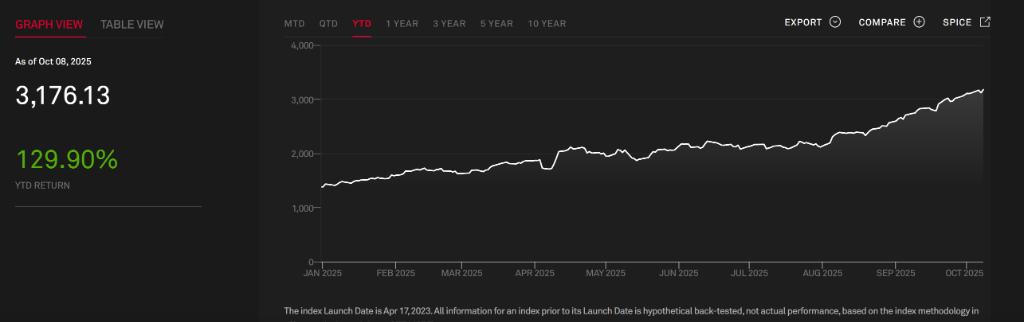
Core Viewpoint - The gold mining industry has emerged as a significant winner in the U.S. stock market this year, driven by a 52% increase in gold prices since January, surpassing $4,000 per ounce, and a 129% rise in the S&P Global Gold Mining Index, making it the best-performing sector among S&P industry indices [1][3]. Group 1: Performance and Profitability - Major gold mining companies like Agnico Eagle, Barrick Mining, and Newmont are poised for substantial profits due to rising gold prices, which convert additional revenue into pure profit due to fixed production costs [3][9]. - Year-to-date stock performance shows Newmont up 137%, Barrick up 118%, and Agnico Eagle up 116%, with Zijin Mining International's stock doubling since its IPO on September 30 [3][6]. Group 2: Comparison with Other Sectors - In contrast, leading tech companies like Nvidia, Oracle, Alphabet, and Microsoft have seen stock increases of 40%, 72%, 30%, and 25% respectively, while Bitcoin's price rose only 31%, highlighting the gold mining sector's resurgence [6]. Group 3: Historical Concerns - Despite current prosperity, seasoned investors recall the previous gold bull market peak in 2011, which led to excessive corporate mergers, soaring executive compensation, and rising production costs, ultimately resulting in a 79% decline in gold mining stocks over the following four years [7][8]. Group 4: Capital Allocation Challenges - Gold mining companies face challenges in capital allocation amidst expected cash inflows, with BMO Capital Markets predicting a $60 billion free cash flow for the sector next year [9]. - Recent CEO changes at Newmont and Barrick reflect pressure to improve returns, with expectations for increased dividends to benefit shareholders from rising gold prices [10]. Group 5: Concerns Over Executive Compensation - There are concerns regarding executive compensation in the gold mining sector, as CEO salaries have surpassed those in other mining companies, raising fears of excessive cash grabs similar to past behaviors [10][11].
大行评级丨花旗:汇丰控股私有化恒生银行是战略优先考量 维持“买入”评级
Ge Long Hui· 2025-10-10 05:40
Core Viewpoint - Citigroup's report indicates that HSBC Holdings announced plans to acquire a 37% minority stake in Hang Seng Bank at a price reflecting a 30% premium and a price-to-book ratio of 1.8 times [1] Group 1: Acquisition Details - The acquisition is expected to impact HSBC's capital by 125 basis points, with the funding coming from a suspension of stock buybacks for three quarters [1] - The acquisition premium is considered substantial, especially as Hang Seng Bank's stock price has risen by 24% over the past 12 months [1] Group 2: Strategic Implications - The move reflects the new management's strategic priorities under CEO Noel Quinn, focusing on restructuring HSBC according to a new business framework [1] - The strategy emphasizes a focus on Hong Kong and the UK, as well as Corporate and Investment Banking (CIB) and Individual Wealth Management (IWPB) [1] - The management is also advancing a cost-cutting plan and strategic asset disposals, which are progressing steadily [1]


东方创禾宋中华:投资人需穿透数据,在资本狂宴中保持清醒丨大咖荐书
Zheng Quan Shi Bao Wang· 2025-10-07 12:33
Core Insights - The essence of investment success lies in accurately assessing profitability, which is fundamentally tied to the depth of understanding [1] - Reading is emphasized as a crucial tool for enhancing cognitive abilities and recognizing enduring truths in a rapidly changing world [1] Group 1: Investment Philosophy - The book "Value Investing" by Howard Marks highlights that investment outcomes are primarily determined by the correctness of profitability judgments [1] - Charlie Munger's perspective suggests that achieving desired outcomes requires aligning understanding with value [1] Group 2: Recommended Reading - "Barbarians at the Gate" by Bryan Burrough and John Helyar is recommended as a classic account of the Wall Street battle during KKR's $25 billion leveraged buyout of RJR Nabisco in 1988 [2] - The book reveals the brutal nature of capital competition and the dual-edged sword of financial innovation, showcasing the consequences of viewing companies merely as assets rather than long-term entities [2] Group 3: Human Nature and Capital - The narrative serves as a parable about human nature, illustrating that capital amplifies inherent human traits rather than changing them [3] - Investors are urged to penetrate data and understand the underlying human behaviors that drive market dynamics [3]