
资产配置

Search documents
银行越来越重视FOF了
Xin Lang Cai Jing· 2025-07-31 10:40
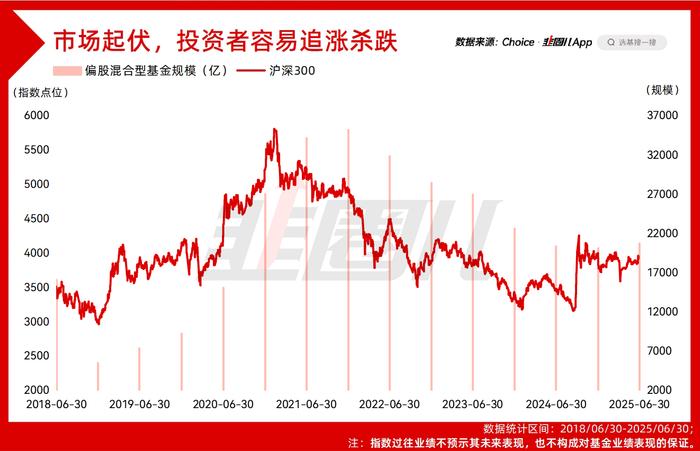
追涨杀跌是人性,我们对比偏股混合型基金的规模变化与沪深300的走势能很明显的看到这一点。 咱们更容易在高点大胆买入,而在低点小心谨慎,导致最终错失配置良机。 只能说,大家对资产配置还处于初学阶段,依然需要FOF等多元资产配置工具。 上半年,FOF规模较年初合计增长了356亿,(截至:2025/6/30;数据来源:万得)是连续3年规模萎缩 之后的首次回暖。 其中,偏债混合型FOF值得关注。 以万得偏债混合型FOF基金指数为例,从过往表现来看,相比沪深300和FOF基金指数波动较小、回撤 较低、夏普较高, 帮助抵御市场波动。 另一方面以债券基金打底,追求低波动的FOF基金,很适合银行渠道的客户群体。 以招行为例,从托管人视角看,截至2025/6/30招行FOF的保有规模已经达到了460亿。 | 基金托管人视角的 | | | --- | --- | | FOF规模保有量排行 | | | 托管行 | 规模(亿) | | 招商银行 | 460 | | 建设银行 | 174 | | 农业银行 | 159 | | 中国银行 | 148 | | 工商银行 | 117 | | : Choice · IFF LADD | 数据统 ...

3500点之后何去何从?
中国基金报· 2025-07-31 10:20
Core Insights - The article emphasizes the importance of asset allocation as a strategy to navigate market volatility and uncertainty, suggesting that relying solely on a single asset or market is insufficient for long-term stability [4][10]. Market Performance - A review of major asset classes over the past five years reveals that no asset experiences perpetual growth, with different assets undergoing varying degrees of volatility influenced by economic cycles [5][6]. - The performance of various asset classes in 2024 shows significant differences, with Chinese stocks returning 18.61%, global stocks at 17.45%, and gold leading with a return of 29.29% [6]. Asset Correlation - The article discusses the benefits of including low-correlation assets in a portfolio, highlighting that certain assets, like domestic bonds, often exhibit negative correlation with equities, which can help mitigate market risks [7][9]. Investment Strategy - The "fixed income enhancement" strategy is proposed as a straightforward and effective asset allocation framework, utilizing bonds as a stable foundation while allowing for some equity exposure to capture market upside [12]. - The strategy focuses on dividend and stable growth stocks, incorporating both A-shares and Hong Kong stocks to enhance the portfolio's adaptability to market fluctuations [13]. Performance Comparison - The "fixed income enhancement" strategy has reportedly outperformed its peers in terms of both returns and risk management over the past year, indicating its effectiveness in the current market environment [14][17].

3500点之后何去何从
Zhong Guo Ji Jin Bao· 2025-07-31 10:19
Core Insights - The article emphasizes the importance of asset allocation in navigating market volatility and achieving long-term investment stability [1][5][8] Group 1: Economic Cycle and Asset Performance - Over the past five years, various asset classes have experienced different levels of volatility, influenced by economic cycles, highlighting that no asset has a perpetual upward trend [2] - The annual returns of major asset classes for 2020-2024 show significant fluctuations, with Chinese stocks returning 18.61% in 2024, while global stocks returned 17.45% [4] Group 2: Low Correlation Asset Allocation - Allocating assets with low or negative correlation can effectively hedge market risks and reduce overall portfolio volatility [5][6] - The correlation coefficients among major financial indices indicate that certain assets, like domestic bonds, often exhibit negative correlation with equities, which can be beneficial for risk management [6] Group 3: Simplifying Asset Allocation - The article introduces a "fixed income enhancement" strategy as a straightforward framework for asset allocation, using bonds as a stable foundation while selectively adding equity assets to capture market upside [8][10] - The "Guofu Anyi Stable 6-Month Holding Mixed Fund" under Guohai Franklin Fund exemplifies this strategy, focusing on dividend and stable growth stocks, including both A-shares and Hong Kong stocks to enhance adaptability to market fluctuations [9][10] Group 4: Performance Metrics - The "Guofu Anyi Stable 6-Month Holding Mixed Fund" has outperformed its peers in both return and risk control over the past year, achieving a return of 6.16% compared to the peer average of 5.87% [11][12] - The fund's performance metrics indicate a solid strategy, with a clear focus on core assets and a straightforward approach to complex market conditions [13]
3500点之后何去何从?
Zhong Guo Ji Jin Bao· 2025-07-31 10:19
Core Insights - The article emphasizes the importance of asset allocation in navigating market volatility and achieving long-term investment success [1][2] Group 1: Market Trends and Asset Performance - Over the past five years, various asset classes have experienced different levels of volatility, influenced by economic cycles [2] - The performance of major asset classes from 2020 to 2024 shows significant fluctuations, with Chinese stocks returning 18.61% in 2024, while global stocks returned 17.45% [4] - Gold has shown strong performance with a return of 29.29% in 2024, contrasting with oil, which had a return of -1.42% [4] Group 2: Asset Correlation and Risk Management - Assets exhibit varying degrees of correlation, with the China Bond Index often negatively correlated with A-shares and Hong Kong stocks, suggesting that low or negatively correlated assets can effectively hedge market risks [4][5] - The article suggests that a "fixed income enhancement" strategy can simplify asset allocation by using bonds as a stable foundation while selectively adding equity assets to capture market upside [6] Group 3: Fund Performance and Strategy - The "Guofu Anyi Stable 6-Month Holding Mixed Fund" has outperformed its peers in both returns and risk management, achieving a return of 6.16% over the past year compared to the peer average of 5.87% [8] - The fund's maximum drawdown was -1.10%, significantly lower than the peer average of -3.61%, indicating better risk control [8] - The fund manager's strategy focuses on dividend and stable growth stocks, including allocations to Hong Kong stocks to enhance adaptability to market fluctuations [7][8]
控得住回撤攻得出收益,上银丰瑞、丰益两只固收+产品近一年超额业绩均居同类前10%
Zheng Quan Zhi Xing· 2025-07-31 08:53
Core Viewpoint - The increasing market volatility in 2023 has led to a significant structural differentiation in the A-share market, with investors seeking stability and yield flexibility in asset allocation, making "fixed income +" funds a focal point in the wealth management market [1] Group 1: Fund Performance - The Shangyin Fengrui One-Year Holding Mixed Fund A achieved a net value growth rate of 9.46% over the past year, significantly outperforming its benchmark return of 4.31% [2] - Since its inception in December 2023, the fund's net value growth rate reached 18.65%, compared to a benchmark return of 7.49%, indicating a clear excess return [2] - The fund ranks in the top 14% for one-year performance among its peers, with a maximum drawdown of -2.34%, well below the average of -4.78% for similar products [2] Group 2: Investment Strategy - The Shangyin Fengyi Mixed Fund A reported a net value growth rate of 6.34% over the past six months, with a one-year growth rate of 13.25%, far exceeding its benchmark of 4.94% [3] - The fund's stock allocation is 28.22% of total assets, leveraging the advantages of fixed income + products to enhance returns through selective stock picking [3] - The fund manager emphasizes a proactive investment strategy, focusing on sectors with growth potential such as gaming, semiconductors, and healthcare, while also incorporating convertible bonds to enhance yield flexibility [3][4] Group 3: Research and Market Outlook - Shangyin Fund has established a robust research framework, focusing on risk control and long-term stability, with a comprehensive investment research center [5] - The fund anticipates a stable macroeconomic environment, with a focus on sectors like big finance, military industry, innovative pharmaceuticals, and AI applications, as well as resource commodities like gold and copper [6]
黄金,等关税大棒落地!
Sou Hu Cai Jing· 2025-07-31 08:26
自香港,澳门活动结束后,时隔两个月又和大家见面了,一起探讨2025年下半年黄金投资机会与资产配 置。 8月1日,上海理财周刊在南宁举动活动,明年就要出发了。 转眼,从业超过15年了,一直以来我也积极参与各种活动,不少人疑问有出去的时间为什么不好好看 盘,好好做工作,去参加活动没什么用。 盯着眼下的事,只会原地踏步, 这一点我有不同的看法,一定要走出去,多和不同的从业人员交流,别人或许一句话,一个观点,就能 让自己少走弯路。 ...
投基金还不够,超级富豪都开始自己建电站了
3 6 Ke· 2025-07-31 08:08
Core Insights - The article highlights the increasing focus of ultra-high-net-worth individuals and family offices on renewable energy investments, marking a shift in capital allocation logic amidst the energy transition [1][2][4]. Investment Trends - The "Breakthrough Energy Alliance," founded by prominent figures like Bill Gates and Jack Ma, aims to promote the commercialization of clean energy technologies through investments [2][4]. - The "Breakthrough Energy Ventures fund" (BEV) has raised over $3.5 billion and invested in over 120 companies in cutting-edge fields such as nuclear fusion, lithium batteries, and hydrogen energy [4][5]. Family Office Strategies - Family offices are increasingly viewing renewable energy not just as a single investment avenue but as a strategic asset class for risk hedging and growth [6][14]. - A "core + satellite" investment strategy is commonly adopted, where core investments are in stable clean energy assets, while satellite investments target high-risk, high-growth energy tech companies [6][14]. Infrastructure Investment - A survey of 175 family offices revealed a strong optimism towards infrastructure investments, with 75% of respondents viewing this asset class favorably [12]. - Family offices are focusing on transitional infrastructure, such as data centers and solar panels, rather than traditional assets like toll roads [12][14]. Investment Participation Methods - Family offices engage in renewable energy investments through three primary methods: providing financing for projects, directly investing in clean tech startups, and building and operating renewable energy assets [15][18]. - Notable examples include Guzman Energy Group receiving $130 million in mezzanine debt from the Walton Family Office, and family offices like Treehouse Management developing their own renewable projects [16][19]. Active Family Offices in Renewable Energy - Several family offices are actively investing in renewable energy, including Capricorn Investment Group, Formica Capital, and Vulcan Capital, each with significant commitments to sustainable investments [20]. Conclusion - The article emphasizes that family capital is becoming a silent driver of the energy revolution, reflecting a unique patience and vision in long-term investment strategies [20].

上海证券上线“尚臻魔方” 助力投资者进行资产配置
Zhong Zheng Wang· 2025-07-31 06:13
Core Insights - Shanghai Securities is advancing its digital transformation by launching the "Shangzhen Magic Cube" project, which includes a "Fund Diagnosis and Optimization" module aimed at helping investors assess and optimize their fund holdings [1] Group 1: Project Overview - The "Shangzhen Magic Cube" emphasizes the alignment of investment strategies with investor needs and market conditions through a unique "4×3" strategy matrix based on macro quantitative analysis and asset allocation research [1] - The "Fund Diagnosis and Optimization" module breaks traditional fund analysis limitations by providing in-depth diagnostics focused on the actual experiences of fund holders, addressing issues like random entry and emphasizing risk and quality beyond returns [1] Group 2: Functionality and Features - The system introduces an innovative adjustment algorithm that considers deviation, offering personalized recommendations for increasing, decreasing, or replacing holdings based on specific issues such as industry imbalance and risk-return mismatches [1] - The adjustment process is designed to be practical, having been tested through extreme market conditions, thereby enhancing the professional service capabilities of Shanghai Securities in post-investment fund management [1] Group 3: Future Developments - Shanghai Securities plans to continuously iterate and optimize the project, with future phases aimed at creating a comprehensive wealth management solution that integrates intelligent fund diagnosis, precise asset allocation strategies, and full-cycle digital services [2]
政治局会议将如何影响债市?
Xin Lang Ji Jin· 2025-07-31 03:07
Core Viewpoint - The meeting of the Political Bureau of the Central Committee emphasized the need to boost demand and manage disorderly competition among enterprises, while showing a reduced focus on investment [1]. Economic Situation - The overall economic performance in the first half of the year showed steady progress, with high-quality development achieving new results [1]. - Macroeconomic policies are expected to remain stable, with limited changes in direction [1]. Bond Market Insights - The stable macroeconomic policy is likely to restore sentiment in the bond market, despite potential short-term fluctuations in commodities and stock markets [1]. - After an unusual fluctuation in the money market on July 24, the central bank increased liquidity, indicating a protective stance towards the funding environment [1]. - The yield on ten-year government bonds rose from 1.64% on July 9 to 1.75% on July 29, marking a 10 basis points increase, the highest since April [1]. Investment Strategies - Historical data shows that despite short-term market volatility, the long-term trend of the bond market remains upward, as evidenced by the performance of the Wind medium to long-term pure bond index since 2006 [1][4]. - The Wind short-term and medium to long-term pure bond indices have consistently achieved positive returns from 2010 to 2024, even during challenging years for both stocks and bonds [4][5]. Asset Allocation - There is a growing awareness among investors about the importance of diversified asset allocation, moving away from the notion of bonds being in opposition to stocks [7]. - The investment strategy proposed by Benjamin Graham, which involves balancing investments between equities and bonds, is increasingly relevant for investors [7]. - Bonds are viewed as an essential part of asset allocation due to their low correlation with equity assets, helping to balance risk and return [7].
7月美联储议息会议点评2025年第5期:资产配置快评为潜在通胀上行风险做准备
Huachuang Securities· 2025-07-31 02:44
Group 1: Federal Reserve's Monetary Policy - In July, the Federal Reserve maintained the federal funds rate in the range of 4.25%-4.5%, citing a "tight balance" in the labor market and potential inflation risks from high tariffs[3][6] - The Fed's assessment of economic uncertainty focuses on rising inflation impacting real GDP growth rather than nominal output or employment issues[3][6] - The threshold for rate cuts remains high, with no clear indication of a September rate cut despite market speculation[3][10] Group 2: Inflation and Economic Outlook - Inflation risks are primarily driven by tariffs, which are seen as a short-term shock, but the long-term impact on the economy requires further evaluation[3][9] - The Fed acknowledges that the current inflationary pressures may just be the beginning of the effects from tariffs on goods inflation[3][9] - The labor market remains solid, with no signs of weakness, but there are downside risks to economic growth[3][11] Group 3: Market Implications - Improved risk appetite and economic outlook may continue to support U.S. equities and long-term Treasury yields, with the dollar index potentially returning to the 100 mark[3][12] - Emerging market assets, excluding China, may face valuation risks due to high tariffs and external demand pressures, despite some trade agreements[3][12]