
两重

Search documents
贾康:以“两重”扩大政府有效投资:对应场景和投融资机制创新
Sou Hu Cai Jing· 2025-07-01 01:03
Core Viewpoint - The article emphasizes the strategic significance of expanding effective government investment in China through the "implementation of major national strategies and security capacity building in key areas," which supports the "new two-step" modernization agenda and combines supply-side structural reform with counter-cyclical regulation to stimulate domestic demand [1][4][37]. Group 1: Effective Investment and Economic Context - The current economic environment necessitates a focus on effective government investment, particularly during periods of economic downturn, to stimulate growth and enhance overall economic performance [1][8][21]. - The concept of "comprehensive performance" is introduced, which transcends traditional cost-benefit analysis by considering long-term benefits and positive externalities associated with government investments [4][12][38]. - The need for "appropriately ahead of schedule" investments is highlighted, suggesting that long-term infrastructure projects should be planned with foresight to maximize their impact [4][12][17]. Group 2: Investment Scenarios and Mechanisms - The article identifies various scenarios for effective government investment, including the construction of sponge cities, which are crucial for disaster prevention and urban resilience [2][26][27]. - It discusses the importance of innovative financing mechanisms, such as special bonds and public-private partnerships (PPP), to support these investments and ensure their sustainability [2][29][35]. - The necessity of a coordinated approach in government investment planning is emphasized, advocating for a unified strategy that aligns national and local investment efforts [25][39]. Group 3: Challenges and Recommendations - The article acknowledges challenges in measuring the effectiveness of government investments, particularly in terms of direct economic returns versus broader social benefits [12][13][15]. - Recommendations include enhancing the management of public debt and optimizing investment strategies to ensure that government spending translates into tangible economic benefits [31][34][36]. - The importance of addressing the needs of the private sector and improving the investment climate for private enterprises is also discussed, highlighting the role of government in fostering a supportive environment for economic growth [21][22].

商务部:将依法依规不断加快对稀土相关出口许可申请的审查……盘前重要消息还有这些
证券时报· 2025-06-19 23:23
Group 1 - The Ministry of Commerce of China is accelerating the review of export license applications related to rare earths, emphasizing the importance of maintaining global supply chain stability [2] - The Chinese government is willing to enhance communication and dialogue with relevant countries regarding export controls to facilitate compliant trade [2] Group 2 - The Chinese Ministry of Industry and Information Technology, along with other departments, held a video conference to strengthen safety management in the new energy vehicle sector, emphasizing the responsibility of manufacturers for product quality and safety [5] - Companies are urged to avoid exaggerated claims and ensure consumer safety while maintaining long-term commitments rather than engaging in short-term cost-cutting measures [5] Group 3 - The Shanghai Stock Exchange has developed a special action plan to enhance ESG ratings for listed companies, aiming to improve the quality of ESG information disclosure and promote long-term capital inflow [4] - The action plan includes six key initiatives: providing rating guidance, promoting communication, improving information disclosure, forming best practices, enhancing positive incentives, and improving management performance [4] Group 4 - Beijing's municipal government has issued interim support measures to promote the high-quality development of the gaming and esports industry, including financial rewards for successful game projects and support for cultural collaborations [6] - The measures aim to foster the creation of high-quality games that reflect cultural characteristics and enhance market competitiveness [6] Group 5 - Several companies have made significant announcements, including Zhaoyi Innovation submitting an H-share listing application and Sanhua Intelligent Controls setting its H-share issue price at HKD 22.53 [8] - Other notable developments include Ningde Times planning to use up to 4.5 billion yuan of idle fundraising for cash management and Long Spring High-tech receiving approval for a clinical trial of a flu vaccine [10]
中国经济靠什么“顶住了压力”?
Sou Hu Cai Jing· 2025-05-25 07:56
Core Viewpoint - The Chinese economy has demonstrated resilience and stability in the face of significant external and internal pressures, with key economic indicators showing positive growth despite challenges [1][3]. External Pressures - The international environment has changed dramatically in the first four months of the year, yet China's goods import and export maintained growth, with April showing a year-on-year increase of 5.6% and a 2.4% increase from January to April [3]. - The stability in foreign trade is attributed to diversification, timely responses from private foreign trade enterprises, and a solid industrial foundation that allows for flexibility and resilience in the global supply chain [3][4]. Domestic Demand - Insufficient domestic demand is also a pressure point, but it is being transformed into an opportunity to expand domestic demand [4]. - The government has implemented major strategic initiatives and safety capability projects, with nearly 500 billion yuan allocated in the first four months of the year to support 1,465 key projects, enhancing infrastructure and improving public welfare [5][6]. Consumer Engagement - The "old for new" consumption initiative has revitalized consumer activity, with over 300 million applications for vehicle trade-ins and significant sales in home appliances and digital products, indicating strong consumer participation [5][6]. Economic Dynamics - The Chinese economy is likened to a resilient spring, with increasing pressure leading to greater potential for growth, supported by favorable economic data related to new productive forces [8]. - The ability to withstand pressure is rooted in the leadership of the Communist Party, institutional advantages, a vast market, and the creativity of the population [8][9]. Continuous Adaptation - The approach to managing pressure is not passive but involves proactive innovation and the implementation of effective strategies [9][10].
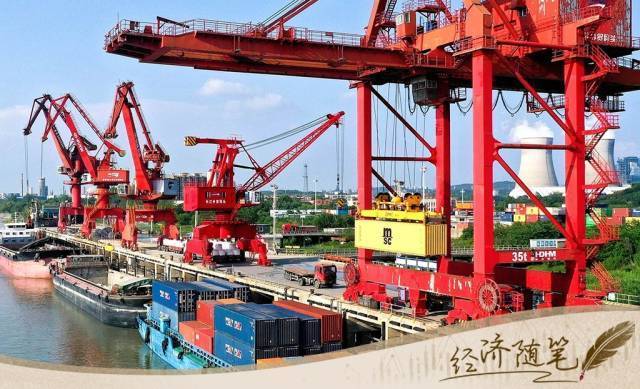
“两新”“两重”进展如何?国家发改委最新发声
Di Yi Cai Jing· 2025-05-20 06:49
Core Insights - The National Development and Reform Commission (NDRC) is establishing a mechanism for the direct and rapid enjoyment of funds from ultra-long-term special government bonds to support economic stability and growth amid external pressures [1][2] Group 1: Economic Stability and Growth - China's economy is demonstrating strong resilience and internal momentum, with key economic indicators such as industrial output, consumption, and investment showing stable growth despite external challenges [1] - As of May 5, sales in five major product categories, including automobiles and home appliances, contributed approximately 830 billion yuan to retail sales, indicating robust consumer activity [1][2] Group 2: Policy Implementation and Investment - The NDRC plans to accelerate the implementation of policies aimed at stabilizing employment and the economy, with most measures expected to be in place by the end of June [1] - In the first four months of the year, investment in equipment and tools increased by 18.2%, contributing 64.5% to overall investment growth [2] Group 3: "Two New" and "Two Heavy" Policies - The "Two New" policies are enhancing consumption and investment, with significant growth in retail sales of home appliances and office supplies, which increased by 38.8% and 33.5% year-on-year, respectively [2] - The "Two Heavy" projects focus on critical areas such as technological self-reliance and urban-rural integration, with plans to finalize the project list by the end of June [4][6] Group 4: Future Directions - The NDRC aims to improve the efficiency of fund utilization and streamline the subsidy application process to enhance consumer experience and reduce financial pressure on businesses [3] - Upcoming efforts will include a focus on both "hard investment" in infrastructure and "soft construction" to ensure effective project implementation and operation [5][6]
中美关税博弈的经济逻辑与中国关键抓手!中邮证券黄付生专业解读
Sou Hu Cai Jing· 2025-05-16 05:49
Core Viewpoint - The recent joint statement from the China-US Geneva economic talks on May 12 is seen as a potential turning point in easing tensions between the two nations, with significant tariff reductions announced [1][2]. Economic Rebalancing - The joint statement indicates a notable decrease in tariffs, with China reducing tariffs on US goods from 125% to 10% within the first 90 days, while the US will lower tariffs on Chinese goods to 30% [2][3]. - A 24% tariff will be suspended for 90 days, allowing for negotiations before July [3]. US Economic Context - The US has historically maintained high tariffs, averaging around 30%, which has been a part of its economic development strategy [3]. - The current economic situation suggests that the US cannot revert to pre-April 2 conditions, with markets anticipating fiscal easing from China and tax cuts from the US [3]. US Fiscal Pressure - As of March 2025, the US national debt is projected to reach approximately $36.6 trillion, with a significant portion of low-interest bonds maturing between 2025 and 2027, leading to increased interest payments [4]. - The US government is using tariff increases as a means to alleviate fiscal pressure, with potential tariff revenues significantly exceeding current levels [4][5]. Chinese Economic Strategy - China is focusing on boosting domestic consumption, particularly in the service sector, to counteract economic pressures [9]. - The first quarter of 2023 saw a GDP growth rate of 5.4%, driven by strong exports and a gradual recovery in consumption [9]. Key Economic Drivers for 2025 - The "Two New" and "Two Heavy" initiatives are identified as critical for China's economic development in 2025, focusing on equipment upgrades and major strategic projects [10][11]. - The expected policy support for these initiatives could reach around 3 trillion yuan, with investment multipliers anticipated to be higher than in 2024 [11]. Stimulus Measures - Six potential measures to stimulate the economy include expanding fertility subsidies, injecting capital into state-owned banks, increasing consumer subsidies, advancing supply-side reforms, issuing special government bonds, and raising rural pension levels [12][13][14][15][16]. Market Outlook - The equity market is expected to enter a "long-cycle, structural bull market," with monetary policy supporting the stock market while fiscal measures are necessary for economic recovery [16]. - The bond market may face risks in the second half of the year, with a potential upward trend in yields as economic conditions stabilize [16].
4月PMI数据点评:外部环境对制造企业生产意愿有所影响
Bank of China Securities· 2025-05-06 10:55
Manufacturing Sector Insights - In April 2025, the Manufacturing PMI index dropped to 49.0%, a decrease of 1.5 percentage points from March, indicating a contraction in manufacturing activity[2] - The new orders index fell to 49.2%, down 2.6 percentage points, while the new export orders index significantly declined by 4.3 percentage points to 44.7%, the lowest level since January 2023[2][6] - The production index decreased to 49.8%, down 2.8 percentage points, and the purchasing index fell to 46.3%, a drop of 5.5 percentage points, marking the lowest level since January 2023[2][7] Price and Demand Trends - The manufacturing price index continued to decline, with major raw material purchase prices and factory prices dropping by 2.8 and 3.1 percentage points, respectively[3][10] - The decline in factory prices was more pronounced than that of raw material purchase prices, suggesting a stronger impact of demand on manufacturing market prices[3][10] - In specific sectors, the export orders index for electrical machinery, general equipment, and specialized equipment saw declines exceeding 10%[3][10] Economic Policy and Future Outlook - The Politburo meeting on April 25 emphasized increasing investment to stimulate domestic demand, with a focus on major strategic projects expected to receive enhanced funding support[4][11] - The real estate investment sector is anticipated to stabilize gradually, supported by increased supply of high-quality housing[4][11] - The non-manufacturing PMI index fell to 50.4%, down 0.4 percentage points, but remained in the expansion zone, with new orders index at 44.9%, down 1.7 percentage points[5][13]