
两新

Search documents
国常会研究促投资,重点领域谋划一批重大项目
第一财经· 2026-02-07 04:11
Core Viewpoint - The article emphasizes the importance of effective investment policies to stabilize economic growth and enhance future development potential, highlighting the government's commitment to increasing investment in key sectors and projects [3][4]. Group 1: Investment Policies and Measures - The State Council meeting led by Premier Li Qiang discussed measures to promote effective investment, focusing on innovative policies and the utilization of various financial tools such as central budget investments and special bonds [3]. - In 2025, fixed asset investment (excluding rural households) decreased by 3.8% year-on-year, prompting the government to prioritize stabilizing investment and enhancing private sector participation [4]. - The first batch of 936 billion yuan in special long-term bonds for 2026 has been allocated to support approximately 4,500 projects in industrial and energy sectors, driving total investment exceeding 460 billion yuan [4]. Group 2: Focus Areas for Investment - The National Development and Reform Commission (NDRC) has organized a list of early-stage "two重" construction projects and central budget investment plans, amounting to about 295 billion yuan, targeting urban infrastructure and public service improvements [5]. - The NDRC aims to enhance investment efficiency by focusing on projects that directly benefit people, ensuring a balanced approach between hard and soft investments [5][6]. Group 3: Role of State-Owned Enterprises and Private Investment - The State-owned Assets Supervision and Administration Commission (SASAC) emphasized the role of central state-owned enterprises in expanding investment and supporting private sector development, particularly in infrastructure and emerging industries [7]. - Recent policies aimed at stimulating private investment include loan interest subsidies and risk-sharing mechanisms for private enterprises, addressing financing challenges faced by small and medium-sized enterprises [8].


——2026Q1政府债券供给展望及关注要点:国债发行进度真的快么?
Huachuang Securities· 2026-01-09 08:48
1. Report Industry Investment Rating No information about the industry investment rating is provided in the report. 2. Core Viewpoints of the Report - Based on various fiscal announcements, the report calculates the supply of government bonds and ultra - long bonds in Q1 2026 and interprets the key points of market - concerned supply [8]. - It analyzes the characteristics of government bond issuance in Q1 2026, including the situation of treasury bonds, local bonds, and makes supply forecasts [1][3][9]. 3. Summary According to the Directory 3.1 Treasury Bonds: In Q1, the number of issuances changes little, the single - issue scale rises and then falls, and there is room for acceleration in the future 3.1.1 Q1 Treasury Bond Plan: The number of issuances changes little, and 30y bonds use new codes - The number of treasury bond issuances in Q1 2026 is similar to that in the same period of 2025, with the number of coupon - bearing treasury bonds and savings bonds of each term remaining the same as in Q1 2025, and an additional 3M discount treasury bond issued in March 2026. The 50 - year treasury bond is postponed from February to March [9]. - 30y treasury bonds will use new codes. After the announcement, 250002 performed weakly, and 2500006 may continue to be the active bond in the short term. There is a risk of failure in the coupon - bond replacement of 30y ordinary treasury bonds [10]. 3.1.2 Single - issue Scale of Key - term Treasury Bonds: It rises first and then falls, and there may still be room for acceleration in the future - In January 2026, the single - issue scale of 2 - year and 10 - year coupon - bearing treasury bonds increased significantly compared with the same period in 2025, which may be due to high maturity pressure, the need to form physical workloads earlier, and to make way for the issuance of special treasury bonds [15][16]. - The single - issue scale of 1 - year treasury bonds later decreased to 135 billion. If the issuance speed of 135 billion continues, the monthly average may be around 150 billion, which is in line with the neutral issuance speed under a 4% deficit rate. To catch up with the net financing progress in 2025 in Q1, the quarterly average single - issue scale of key - term treasury bonds needs to reach 170 billion, indicating room for acceleration [18][19]. - Treasury bonds can use the remaining quota for issuance expansion before the Two Sessions. The remaining quota at the beginning of 2026 is expected to be around 580 billion, providing room for expansion [23]. 3.1.3 The quota of ultra - long special treasury bonds is pre - allocated but issued later - No special treasury bonds are scheduled for issuance in Q1. Ultra - long special treasury bonds show the characteristic of "quota pre - allocation but issuance postponement". The "Two - New" quota in 2026 is pre - allocated in a reduced scale but earlier, while the "Two - Important" quota is pre - allocated in a larger scale but later [25][29][30]. 3.2 Local Bonds: In Q1, the issuance scale is similar to that in the same period of 2025, the rhythm is earlier, and the terms vary across regions 3.2.1 Q1 Local Bond Plan: The issuance scale is basically the same as that in Q1 2025, and the supply is more concentrated in January - The planned issuance scale of the regions that have released plans is close to that in the same period of 2025. Affected by the Spring Festival shift, the issuance in January 2026 increased significantly compared with the same period in 2025 [31][32]. 3.2.2 Terms: Different regions show differentiation, and term shortening is not yet a general phenomenon - Regions with significantly shortened terms include Guangxi and Zhejiang, which do not arrange the issuance of 30y varieties and increase 10 - 20y varieties [32]. - Regions with little change in terms include Beijing and Shandong. Beijing's new special bonds still cover the full range of 1 - 30y terms, and Shandong's weighted average term is similar to that in Q1 2025 [33]. - Regions with significantly extended terms include Qingdao, which added 30y varieties that were not issued in 2025 [33]. 3.3 Q1 Supply Forecast: It is expected that the net financing of government bonds will be 3.6 trillion, and the issuance of ultra - long bonds will be 1.3 - 1.65 trillion 3.3.1 Government Bond Supply Forecast: The Q1 net financing is 3.6 trillion, including 2.15 trillion local bonds and 1.46 trillion treasury bonds - Local bonds: The net financing in Q1 may be around 2.15 trillion, with January and March being the supply peaks. The net financing in January, February, and March is expected to be 830 billion, 490 billion, and 840 billion respectively [38]. - Treasury bonds: The net financing in Q1 may be around 1.46 trillion. The single - issue scale of key - term treasury bonds is assumed to be 135 billion for the remaining 3 issues in January, rising to 175 billion in February, and around 190 billion in March due to high maturity pressure [39]. 3.3.2 Ultra - long Bond Supply Forecast: The issuance in Q1 is 1.4 - 1.77 trillion, including 11.6 billion treasury bonds and 1.3 - 1.65 trillion local bonds - Ultra - long treasury bonds: The issuance in Q1 may be around 11.6 billion, with 32 billion, 32 billion, and 52 billion issued in January, February, and March respectively [42]. - Ultra - long local bonds: The issuance in Q1 may be 1.3 - 1.65 trillion, with different issuance scales calculated according to different reference term structures [43].
【广发宏观吴棋滢】延续必要强度,优化发力路径:2026年财政政策展望
Xin Lang Cai Jing· 2025-12-25 01:33
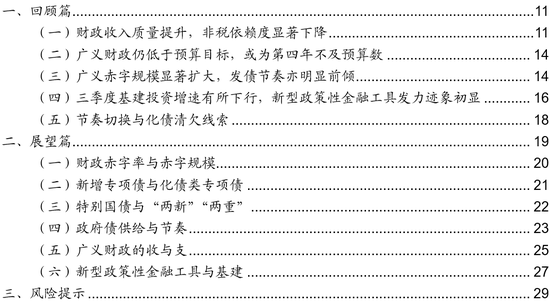
Group 1 - The core viewpoint of the report is that the fiscal policy for 2025 will be "more proactive," leading to significant increases in both narrow and broad fiscal deficits, with narrow deficit expected to rise by 39% and broad deficit by 27% [1][13][14] - The issuance of government bonds will be accelerated, with net supply expected to increase by 128% year-on-year in the first half of 2025, while broad fiscal expenditure is projected to show a "U"-shaped trend in 2024 and a "front high and back low" trend in 2025 [1][14] - The structure of fiscal revenue is improving, with a target growth rate for non-tax revenue set at -14.2%, indicating a reduced reliance on non-tax income [2][15][16] Group 2 - The expansion of debt resolution measures and diversification of debt resolution methods are highlighted, including the issuance of special bonds and policies targeting corporate arrears and PPP projects [2][16][17] - The expected slowdown in infrastructure investment growth in the second half of 2025 is attributed to several factors, including the completion of prior funding projects and the diversion of funds to debt resolution [3][18][19] - For 2026, the central economic work conference emphasizes the continuation of a more proactive fiscal policy, with expectations for a slight increase in fiscal strength compared to 2025 [4][20][21] Group 3 - The anticipated fiscal revenue growth for 2026 is projected to rebound to 3%-5%, driven by price increases and tax policy adjustments [5][26][27] - The introduction of new policy financial tools is expected to significantly impact fixed asset investment, with an estimated investment scale of 1.5-2 trillion yuan in 2026 [6][28][29] - The report indicates a structural shift in consumption patterns, with a focus on new types of consumption and service consumption, as traditional durable goods consumption is expected to slow down [8][32][33] Group 4 - The report discusses the expansion of debt resolution to include non-hidden debts, with measures to clear local government arrears to enterprises [9][34][35] - The importance of improving the local tax system is highlighted, with potential reforms in consumption tax expected to accelerate [10][36][37] - The overall impact on the asset side suggests that continued fiscal strength and proactive measures will support nominal growth and micro-activity in 2026 [11][37]
11月经济数据点评:中游供需矛盾进一步改善
Huachuang Securities· 2025-12-16 10:10
Group 1: Supply and Demand Analysis - The supply-demand gap for the midstream sector improved, with the demand-investment growth rate difference rising to 7.6% in November from 6.4% in October[1] - Midstream demand growth was 8.9% in November, down from 9.3% in October, while midstream investment growth fell to 1.3%[3] - The demand-investment growth rate difference for midstream has been increasing since May 2024 and turned positive in March 2025[3] Group 2: Future Projections - Historical data suggests that the midstream demand-investment growth rate difference is likely to remain positive, indicating potential price stabilization in the next two years[2] - The midstream PPI (Producer Price Index) is expected to stop declining and start rising, with a notable month-on-month increase of 0.04% in November, the first positive change since June 2024[4] - If the midstream PPI stabilizes, the year-on-year PPI is likely to continue rising, positively impacting midstream ROE (Return on Equity)[4] Group 3: Economic Data Overview - November's industrial value-added growth rate was 4.8%, with a slight month-on-month increase of 0.44%[20] - Retail sales growth in November was 1.3%, down from 2.9% in October, indicating weak consumer demand[22] - Real estate sales area decreased by 17.3% year-on-year in November, showing ongoing challenges in the property market[27]
中央经济工作会议前瞻
GOLDEN SUN SECURITIES· 2025-11-30 07:33
Group 1: Economic Outlook - The December Politburo meeting will set the policy direction for 2026, emphasizing the importance of the "14th Five-Year Plan" and a GDP target of around 5%[1][5] - Economic performance in 2023 is expected to show resilience, with positive factors accumulating, but risks and challenges remain[3][4] - The overall policy tone for 2026 is anticipated to be proactive, expansionary, and stimulative, continuing to emphasize the significance of economic work[4][5] Group 2: Policy Implementation - There will be a strong focus on implementing policies effectively and mobilizing all parties' enthusiasm, particularly in the context of the "14th Five-Year Plan"[6] - Key areas of focus include strengthening industries, expanding domestic demand, and leveraging central government support through monetary and fiscal policies[7][10] - The fiscal deficit for 2026 is projected to be around 4%, with special bonds expected to reach 5 trillion yuan, up from 4.4 trillion yuan in 2025[7][16] Group 3: Monetary and Fiscal Policies - Monetary policy is expected to remain accommodative, with potential interest rate cuts of 50-100 basis points and reserve requirement ratio reductions of 1-2 times in 2026[7][16] - Fiscal policy will prioritize "investment in people" alongside traditional infrastructure investments, with total fiscal expenditure projected to reach approximately 43 trillion yuan, an increase of about 1 trillion yuan from 2025[7][16] - Consumer spending is targeted to increase, with a focus on service consumption and a potential continuation of the "old-for-new" policy, maintaining a budget of at least 300 billion yuan for 2026[9][16]
股票私募最新仓位指数达78.41% 刷新今年以来最高纪录
Zheng Quan Shi Bao Wang· 2025-09-26 09:18
Group 1 - The A-share market remains active, with private equity firms showing positive signals as the stock private equity position index rises to 78.41%, the highest level this year, indicating a strong bullish sentiment among private equity institutions [1] - The stock private equity position index for different scales shows that the largest private equity firms (over 100 billion) have the highest increase in position, reflecting a clear intention to increase holdings [1] - The proportion of private equity firms with positions over 80% has increased to 60.01%, while those with lower positions have decreased, indicating a shift towards a more optimistic sentiment in the private equity sector [2] Group 2 - Pacific Securities notes that the technology sector remains strong, but there is a divergence in performance among leading stocks, suggesting a cautious approach for investors already holding technology stocks [2] - Xiangcai Securities expects the A-share market to continue a "slow bull" trend in the fourth quarter, with a focus on sectors like artificial intelligence and industries related to the "15th Five-Year Plan" [2] - HSBC Jintrust Fund highlights that the new round of interest rate cuts by the Federal Reserve and potential domestic policy support could enhance domestic demand and new growth momentum, particularly in the consumer sector during the upcoming festive season [3]
【广发宏观王丹】从EPMI数据看9月经济
郭磊宏观茶座· 2025-09-22 12:29
Core Viewpoint - The September EPMI (Emerging Industry Purchasing Managers Index) increased by 4.6 points to 52.4, indicating a seasonal recovery typical of autumn, although the absolute level remains historically low [1][6][24]. Group 1: EPMI and Industry Trends - The EPMI's increase aligns with the seasonal average of 4.5 points from 2014 to 2024, with the number of industries in the expansion zone rising from 2 to 4 [1][6][7]. - Despite the improvement, the absolute EPMI value of 52.4 is the second lowest for September in history, down 0.9 points from the previous year [6][24]. Group 2: Supply and Demand Indicators - Key supply and demand indicators showed improvement: production volume, product orders, and export orders increased by 7.8, 6.5, and 6.8 points respectively [2][9]. - The production-to-demand ratio turned positive, with an average of 0.7 for the first three quarters of 2025, indicating an improvement in supply-demand balance compared to previous years [9][10]. - Price indicators also improved, with purchase prices and sales prices rising by 0.8 and 0.2 points respectively, although the growth rate has slowed compared to July and August [9][12]. Group 3: Employment and Financing Environment - The EPMI loan difficulty index decreased by 0.9 points, suggesting a more favorable financing environment for emerging enterprises due to increased credit support and coordinated fiscal and monetary policies [15][16]. - Employment indicators have shown a two-month recovery, with a 2.6-point increase in September, indicating stronger demand for jobs in new industries during the graduation season [15][16]. Group 4: Sector Performance - In September, the highest absolute economic performance was observed in the new generation information technology and energy-saving environmental sectors, driven by demand growth related to AI computing power and domestic substitution [19][20]. - The new energy vehicle sector also saw a month-on-month increase in economic performance, with retail sales growing by 6% year-on-year and 10% month-on-month [19][20]. - The performance of traditional sectors varied, with some industries like petroleum asphalt and automotive tires showing increased operating rates, while others like high furnace and PVC saw declines [23][24]. Group 5: Economic Outlook - The third quarter has shown signs of continued economic slowdown, with September data being crucial for short-term economic assessment [24]. - The EPMI data suggests a neutral economic outlook, with seasonal recovery not extending the trends observed in July and August, indicating that achieving annual growth targets will require further policy support [24].

详解7月经济数据:工业增速维持高位,服务消费增势良好
第一财经· 2025-08-15 11:22
Core Viewpoint - The article discusses the performance of China's economy in July, highlighting a slowdown in key economic indicators due to external and domestic challenges, including extreme weather and trade tensions. The focus is on maintaining policy stability and promoting domestic demand to support economic growth [3][4][5]. Economic Performance - In July, China's industrial added value increased by 5.7% year-on-year, a decrease of 1.1 percentage points from June. The retail sales of consumer goods grew by 3.7%, also down by 1.1 percentage points from the previous month [3][4]. - Fixed asset investment from January to July rose by 1.6% year-on-year, with a decline of 1.2 percentage points compared to the first half of the year [3][4]. Industrial Production - The manufacturing sector showed a growth of 6.2% in July, while the mining industry grew by 5.0% and the electricity, heat, gas, and water production and supply sector increased by 3.3% [4]. - The article notes that the "two new" initiatives are positively impacting industrial production, with significant growth in shipbuilding and electric motor manufacturing [4][5]. Consumer Market - The consumer market showed a mixed performance, with retail sales growth slowing down in July but service sector sales remaining stable. The overall retail sales growth for services was 5.2% from January to July [10][11]. - The article emphasizes the impact of policies promoting the replacement of old consumer goods, which has led to substantial growth in categories like electric bicycles and 5G smartphones [10][11]. Investment Trends - Fixed asset investment reached 288,229 billion yuan from January to July, with a 1.6% year-on-year increase. Excluding real estate, investment grew by 5.3% [14]. - Infrastructure investment rose by 3.2%, while manufacturing investment increased by 6.2%. However, real estate development investment saw a decline of 12.0% [14][15]. - The article highlights that despite a nominal slowdown in investment growth, the actual physical workload remains robust, driven by innovation and equipment upgrades [14][16]. Future Outlook - The article suggests that while there are pressures on investment growth, the potential for future investment remains significant, particularly in new productive forces and urban-rural coordination [16]. - The need for continued policy support to enhance domestic demand and innovation is emphasized to ensure sustainable economic development [5][7].

方正中期期货新能源产业链日度策略-20250814
Fang Zheng Zhong Qi Qi Huo· 2025-08-14 03:03
Report Summary 1. Market Logic and Trading Strategies Carbonate Lithium - **Market Logic**: On Wednesday, the SMM battery - grade carbonate lithium index price was 80,946 yuan/ton, up 2,822 yuan/ton from the previous trading day. Most enterprises were in a wait - and - see mood, but due to some downstream enterprises' rigid procurement needs and the upstream and traders' reluctance to sell, the transaction price of carbonate lithium spot continued to rise significantly. Last week, the output of carbonate lithium was 19,556 tons, an increase of 2,288 tons from the previous week. Since mid - July, there have been news disturbances in lithium production, increasing concerns about the production stability of Yichun lithium mica mines. The total sample inventory last week was 142,418 tons, rising 692 tons from the previous week. In the long - term, the demand growth rate of new energy vehicles is gradually declining as the penetration rate exceeds 50% [3]. - **Trading Strategy**: The price fluctuates in the short - term. Upstream and downstream enterprises are advised to seize hedging opportunities according to their own risk management needs. The support for the main contract is 75,000 - 80,000 yuan, and the resistance is 88,000 - 90,000 yuan [4]. Industrial Silicon - **Market Logic**: Driven by profits, the main production areas resumed production last week, with the operating rate significantly increasing. Thanks to the synchronous resumption of downstream polysilicon production and rising procurement demand, the inventory of industrial silicon manufacturers decreased slowly. However, the market speculative sentiment is relatively cautious, and the acceptance of high - price goods is still low. It is expected that the spot price of industrial silicon will remain stable in the short - term, and the futures trend may be more guided by news [5]. - **Trading Strategy**: The short - term supply - demand contradiction is limited, but the high - level inventory still suppresses the price. Policy support exists, and the anti - involution sentiment may fluctuate. It is recommended to go long at low prices or sell slightly out - of - the - money put options on dips. The support interval is 8,200 - 8,300 yuan, and the resistance interval is 9,200 - 9,300 yuan [6]. Polysilicon - **Market Logic**: There are rumors that the industry may reach a consensus on joint production cuts to control the output in August and promote the return of the total inventory to a reasonable range. If true, it may lead to large - scale inventory reduction. However, the terminal demand is still weak, and the upside space for prices is limited. The futures price has a large premium over the spot price, and the increasing warehouse receipts also put pressure on the market. It is expected that the polysilicon market will fluctuate widely at a high level [7]. - **Trading Strategy**: Existing long positions can be partially liquidated at high prices, and short put options sold at low prices can be hedged at high prices. The support level for the main contract is 47,000 - 48,000 yuan, and the resistance level is 55,000 - 56,000 yuan [7]. 2. Plate Strategy Recommendation and Spot - Futures Price Changes Plate Strategy Recommendation | Variety | Market Logic | Support Level | Resistance Level | Market Judgment | Reference Strategy | | --- | --- | --- | --- | --- | --- | | Carbonate Lithium 09 | Driven by news | 65,000 - 66,000 yuan | 78,000 - 83,000 yuan | Oscillate strongly | Seize selling hedging opportunities, downstream cathode material enterprises focus on low - level stockpiling or buying hedging [13] | | Industrial Silicon 09 | Driven by news | 8,200 - 8,300 yuan | 9,200 - 9,300 yuan | Fluctuate widely | Sell put options on dips [13] | | Polysilicon 09 | Driven by news | 45,000 - 46,000 yuan | 55,000 - 56,000 yuan | Oscillate at a high level | Sell put options on dips [13] | Spot - Futures Price Changes | Variety | Closing Price | Change Rate | Trading Volume | Open Interest | Open Interest Change | Warehouse Receipts | | --- | --- | --- | --- | --- | --- | --- | | Carbonate Lithium | 85,100 yuan | 3.13% | 1,245,424 | 392,675 | 35,677 | 21,679 | | Industrial Silicon | 8,600 yuan | - 2.71% | 510,280 | 284,500 | 5,640 | 50,701 | | Polysilicon | 51,290 yuan | - 2.11% | 395,645 | 132,463 | - 3,592 | 5,150 | [13] | 3. Fundamental Data Carbonate Lithium - **Production and Inventory**: Last week, the output of carbonate lithium increased, and the inventory resumed its upward trend after a brief decline. The concentrated restocking on the demand side was remarkable, and the market's concern about supply stability is expected to support the lithium price [3]. - **Downstream**: Although the "two new" policies continue to support, the demand growth rate of new energy vehicles is gradually declining as the penetration rate exceeds 50% [3]. Industrial Silicon - **Production and Inventory**: The main production areas increased production last week, and the inventory of manufacturers decreased slowly due to the increase in downstream demand [5]. - **Downstream**: The downstream polysilicon industry resumed production, and the procurement demand increased [5]. Polysilicon - **Production and Inventory**: There are rumors of joint production cuts. If true, it may lead to inventory reduction. The terminal demand is weak, and the upside space for prices is limited [7]. - **Downstream**: The downstream demand has not weakened in the short - term, but the domestic demand may decline after the overseas policy window closes in the fourth quarter [7].
方正中期期货新能源产业链日度策略-20250813
Fang Zheng Zhong Qi Qi Huo· 2025-08-13 04:07
1. Report Industry Investment Rating No relevant content provided. 2. Core Views of the Report - For lithium carbonate, the supply side has been affected by the suspension of mining operations at Jiangxi Jianxiawo and the announced suspension of Zangge Mining, increasing concerns about the production stability of Yichun lithium mica mines. Although the short - term demand - side restocking supports lithium prices, the growth rate of new energy vehicle demand is gradually declining. In the medium - to - long - term, the supply - demand situation of lithium carbonate is likely to change from surplus to shortage, and prices may return above 100,000 yuan in the third and fourth quarters [5][6]. - For industrial silicon, profit drives the resumption of production in major producing areas, and downstream demand has recovered. The inventory of manufacturers is slowly decreasing, but the market's acceptance of high - price goods is low. The spot price is expected to remain stable in the short term, and the futures trend is more influenced by news, with a strong policy support but limited upside space [7]. - For polysilicon, if the industry's joint production - cut agreement is true, it may lead to large - scale inventory reduction. However, the terminal demand is weak, and the upside space for prices is limited. The futures price is expected to fluctuate widely at a high level [9]. 3. Summary by Relevant Catalogs 3.1 First Part: Spot Price 3.1.1 Plate Strategy Recommendation - **Lithium Carbonate 09**: The market is driven by news, with a support level of 75,000 - 80,000 yuan and a pressure level of 100,000 - 120,000 yuan. It is expected to fluctuate strongly. Downstream cathode material enterprises are advised to pay attention to low - level stocking or buying hedging opportunities [15]. - **Industrial Silicon 09**: Driven by news, with a support level of 8,200 - 8,300 yuan and a pressure level of 9,200 - 9,300 yuan. It is expected to have a wide - range fluctuation. It is recommended to go long on dips or sell slightly out - of - the - money put options [15]. - **Polysilicon 09**: Driven by news, with a support level of 47,000 - 48,000 yuan and a pressure level of 55,000 - 56,000 yuan. It is expected to fluctuate at a high level. It is recommended to take partial profits or exit long positions on rallies and hedge short put options on rallies [15]. 3.1.2 Futures and Spot Price Changes - The closing price of lithium carbonate is 82,520 yuan, with a daily increase of 1.88%, a trading volume of 1,417,704 lots, an open interest of 356,998 lots, an increase of 39,322 lots in open interest, and 20,829 lots of warehouse receipts [16]. - The closing price of industrial silicon is 8,840 yuan, with a daily decrease of 1.78%, a trading volume of 520,504 lots, an open interest of 278,860 lots, an increase of 6,917 lots in open interest, and 50,658 lots of warehouse receipts [16]. - The closing price of polysilicon is 51,800 yuan, with a daily increase of 0.69%, a trading volume of 481,809 lots, an open interest of 136,055 lots, a decrease of 3,684 lots in open interest, and 4,940 lots of warehouse receipts [16]. 3.2 Second Part: Fundamental Situation 3.2.1 Lithium Carbonate Fundamental Data - **Production and Inventory**: Last week, the production of lithium carbonate was 19,556 tons, an increase of 2,288 tons from the previous week. The total sample inventory was 142,418 tons, an increase of 692 tons from the previous week. The short - term concern about supply stability supports lithium prices, but the growth rate of new energy vehicle demand is declining [5]. - **Downstream Situation**: No specific data provided, but graphs related to downstream products such as lithium iron phosphate and ternary materials are mentioned [26]. 3.2.2 Industrial Silicon Fundamental Data - **Production and Inventory**: Profit drives the resumption of production in Xinjiang, Yunnan, and Sichuan, and the downstream demand has recovered, resulting in a slow reduction of manufacturers' inventory. However, the market's acceptance of high - price goods is low, and the spot price is expected to remain stable in the short term [7]. - **Downstream Situation**: Graphs related to downstream products such as organic silicon DMC and aluminum alloy are mentioned [37]. 3.2.3 Polysilicon Fundamental Data - **Production and Inventory**: If the joint production - cut agreement is true, it may lead to large - scale inventory reduction. However, the terminal demand is weak, and the upside space for prices is limited [9]. - **Downstream Situation**: Graphs related to downstream products such as silicon wafers and photovoltaic modules are mentioned [43].
