中国版平准基金

Search documents
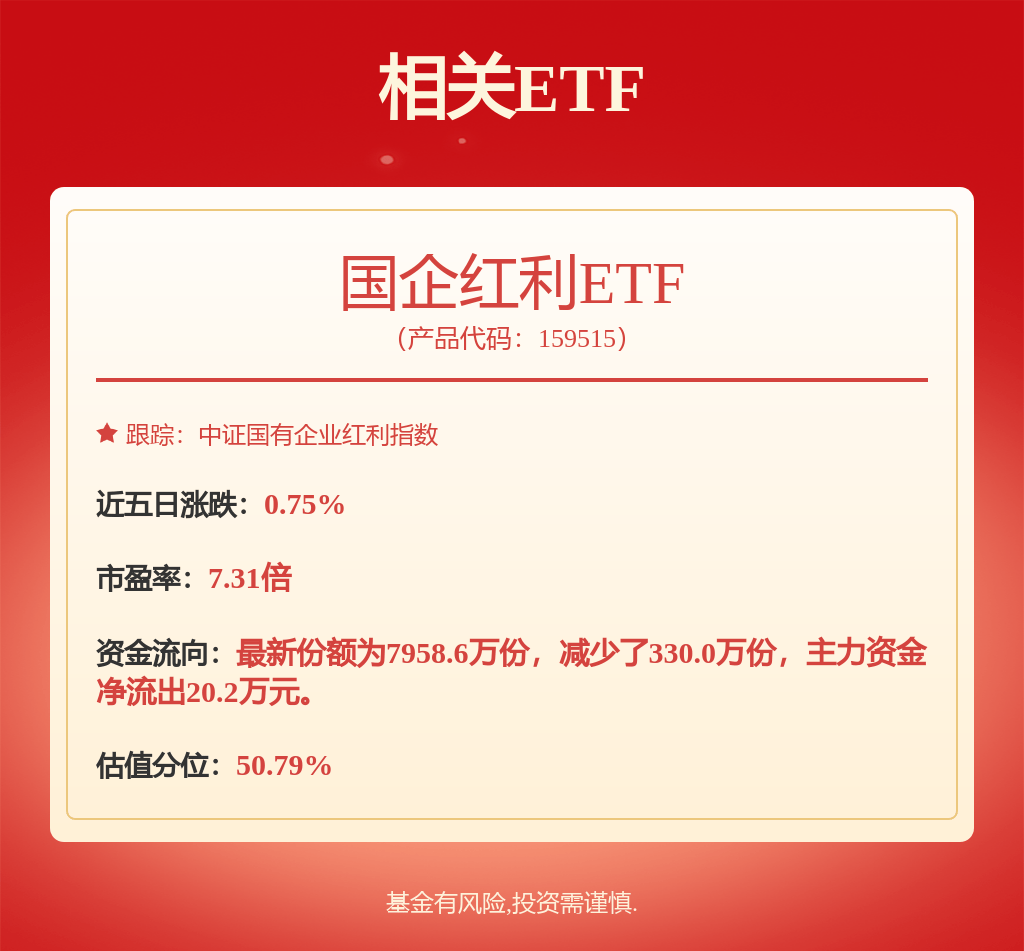
一季度国民经济起步平稳开局良好,国企红利ETF(159515)涨0.66%
Sou Hu Cai Jing· 2025-04-22 02:39
Group 1 - The core viewpoint of the articles highlights the positive performance of the state-owned enterprise dividend sector amid a stable economic recovery in China, with the National Bureau of Statistics reporting a GDP of 318,758 billion yuan for Q1, reflecting a year-on-year growth of 5.4% and a quarter-on-quarter increase of 1.2% [1] - The establishment of the Chinese version of the stabilization fund is expected to bolster market confidence and accelerate the entry of medium to long-term capital into the A-share market, laying a solid foundation for its long-term stable operation [1] - The performance of the state-owned enterprise dividend index (000824) is driven by the dual themes of state-owned enterprises and dividend strategies, enhancing the effectiveness of the investment strategy [2] Group 2 - The state-owned enterprise dividend ETF (159515) tracks the CSI State-Owned Enterprise Dividend Index (000824), which is designed to select high-quality state-owned enterprises with strong profitability and low valuations [2] - As state-owned enterprise reforms deepen, there is potential for further improvement in profitability and operational efficiency, leading to a dual recovery in earnings and valuations [2] - The defensive attributes of the dividend sector are expected to become more prominent due to the concentration of annual and quarterly report disclosures, alongside tariff-related disruptions [1]

股票型ETF资金流入显著
Wind万得· 2025-04-19 22:18
Core Viewpoint - The A-share market exhibited a volatile pattern during the week of April 14 to April 18, with the national team focusing on ETF interventions to stabilize the market [1][5]. Group 1: ETF Inflows - A total net inflow of approximately 34.73 billion was recorded for stock ETFs in the two markets, with 8 ETFs seeing inflows exceeding 1 billion [3][4]. - The ETFs with significant inflows included the CSI 300 ETF, SSE 50 ETF, CSI 500 ETF, CSI 1000 ETF, and the STAR Market Composite Index ETF [3][4]. Group 2: National Team's Intervention Strategy - The national team's intervention strategy has shown a new characteristic of being more refined, with a focus on key moments during trading sessions [1][7]. - The national team has adopted a "bottom-line thinking" approach, indicating a strong belief in the long-term prospects of the Chinese capital market and a commitment to maintaining market stability [7]. - Analysts agree that the national team's actions have positively impacted market stability and investor confidence, particularly in the context of external disturbances [7]. Group 3: Market Dynamics - The national team's balanced buying across various ETFs supports liquidity across different market capitalizations, preventing structural distortions in the market [4]. - The intervention is seen as a signal to attract passive investment flows, creating a positive feedback loop for market stability [4][7]. - Despite the supportive measures, there are indications of increased caution among investors, suggesting that the market may require time to consolidate [7].

野村东方国际证券资产管理部总经理兼投资总监肖令君:关税对中国资产影响有限 积极看多大方向不会改变
野村东方国际证券· 2025-04-18 09:25
特朗普关税政策对全球金融市场影响持续,全球经济的运行规则陷入罕见的不确定性中。当 下如何剖析A股核心资产的长期价值,如何剖析中国资产的核心吸引力,是为市场热烈讨论的 焦点。为此,野村东方国际证券资产管理部总经理兼投资总监肖令君接受第一财经电视《财 经夜行线》栏目采访,就内外部环境剧烈变化下中国资产的长期价值分享观点。 对于高关税对中国上市企业盈利能力和市值影响,肖令君团队统计了 2023 年A股年报数据:经 历 2018 年贸易战后, A 股公司披露年报中包含美国区域业务的上市公司数目占比已经有所下降, 从 2018 年的 2.38% 下降至 2023 年的 1.68% 。而有披露的公司有主动区分收入国别来源的数据 中,来自于境外的收入占 A 股总收入比约 12% 。以 2023 年我国对美国出口占全部出口大约 15% 去拟算,那么 A 股上市公司对美出口业务创收大约 1.3 万亿。美国业务对 A 股利润贡献约为 1500 亿元左右,占全部 A 股盈利约为 3% 。这些数据说明中国上市公司市场日趋多元化,关税对其盈利 能力和市值影响有限。 本文转自第一财经,请点击"阅读原文"查看原文。 本文转载自: 第一财经 ...
关键时刻!重磅研判
Sou Hu Cai Jing· 2025-04-13 12:36
Core Viewpoint - The establishment of the "Chinese version of the stabilization fund" signifies a strategic response to external tariff pressures, showcasing China's commitment to maintaining market stability and investor confidence [1][11][20]. Group 1: Strategic Significance of the "Chinese Version of the Stabilization Fund" - The mechanism serves to isolate internal and external risks, effectively countering the impact of external tariffs on the capital market through coordinated actions by central financial institutions [4][11]. - It aims to reshape market pricing logic and investment ecology by guiding funds towards long-term value investments through the continuous purchase of strategic ETFs [11][12]. - The initiative promotes alignment between capital markets and national strategies, accelerating the valuation reconstruction of core assets in emerging industries [12][13]. Group 2: Policy Coordination and Market Response - Multi-departmental collaboration in response to tariff challenges reflects a strong policy determination and confidence, with potential future actions including support for export enterprises and increased consumer spending [19][20]. - The coordinated response sends multiple positive signals, including a commitment to safeguarding national interests and stabilizing market expectations [19][20]. - The combination of monetary, fiscal, and industrial policy tools demonstrates a comprehensive approach to managing market sentiment and reducing irrational decision-making risks [20]. Group 3: Long-term Investment Value in Capital Markets - The current economic resilience and low valuation levels provide a solid foundation for long-term investment in Chinese assets, with expectations of GDP growth exceeding 5% in the first quarter [22][24]. - The shift towards institutional investors and the emphasis on value investment principles are expected to enhance market stability and attract more patient capital [17][22]. - The ongoing structural transformation of the economy, moving from real estate-driven growth to innovation-led development, is anticipated to further enhance the investment value of the capital market [24][33]. Group 4: Global Economic Positioning - China's competitive advantages in the global economy include a vast domestic market, comprehensive industrial capabilities, and a strong emphasis on innovation in key sectors [27][28][30]. - The government's proactive policies and the robust performance of emerging industries are expected to sustain economic growth and attract foreign investment [29][30]. - The focus on high-quality development and the transition to new productive forces will play a crucial role in shaping the future landscape of the capital market [24][33].

媒体视点 | 各路资金持续流入 资本市场内在稳定性增强
证监会发布· 2025-04-12 05:52
Core Viewpoint - The article emphasizes the strong influx of funds into the A-share market, signaling a commitment to stabilize the stock market, supported by various policies and institutional actions [1][3]. Group 1: Fund Inflows and Market Stability - On April 7 and 8, ETF products saw a net inflow of over 190 billion yuan, enhancing the stability of the A-share market [1]. - Multiple funding sources have entered the market, conveying a strong message of "stabilizing the stock market" to all market participants [1]. - The support for capital market stability is expected to continue, with policies encouraging further fund inflows into A-shares [1]. Group 2: Institutional Actions - The "national team," represented by the Central Huijin Investment, has actively participated in stabilizing the capital market, functioning similarly to a "stabilization fund" [3]. - Central Huijin has a significant amount of available funds and can receive liquidity support from the People's Bank of China, ensuring ample backing for future market stabilization efforts [3]. - Public funds are also taking action, with firms like Bosera Fund and China Merchants Fund committing to invest substantial amounts into their equity funds [3]. Group 3: Insurance Capital Involvement - Insurance companies are increasing their investments in the market, with Sunshine Insurance and Zhongrong Asset both announcing recent increases in domestic equity assets [6]. - Regulatory support for insurance capital entering the market has been strengthened, with new guidelines allowing for a higher proportion of equity investments [7]. - The insurance sector's investment capacity is projected to reach 33.26 trillion yuan by 2024, with the new regulations potentially providing over 1 trillion yuan in additional market funds [7]. Group 4: Company Buybacks and Confidence - Over 300 listed companies have announced buyback and increase plans from April 7 to 9, using real capital to convey confidence in the market [9]. - Central enterprises have responded quickly, with several announcing buybacks or mergers to maintain shareholder value and bolster investor confidence [9]. - The combination of policies and corporate actions is expected to create a positive feedback loop, enhancing market stability [9].
媒体视点 | 中国版平准基金横空出世 稳市打出组合拳
证监会发布· 2025-04-12 05:52
Core Viewpoint - The central bank and Central Huijin Investment Co., Ltd. are committed to supporting the stock market by increasing investments in index funds and providing sufficient re-lending support when necessary [1][2]. Group 1: Central Huijin's Role and Strategy - Central Huijin is recognized as a key stabilizing force in the capital market, acting as a "national team" and "China's version of a stabilizing fund" [2][3]. - The company has a strong asset base, stable cash flow, and efficient financing channels, which provide it with the confidence to support the market [2]. - Central Huijin has a history of intervening in the market to maintain stability, having participated in such efforts multiple times since 2008 [2]. Group 2: Market Impact and Future Outlook - The recent actions by Central Huijin have helped alleviate pessimistic market expectations and triggered a rebound in the A-share market around the 2024 Spring Festival [3]. - Analysts believe that Central Huijin's commitment to maintaining market stability will encourage investors to focus on long-term value rather than short-term fluctuations [3]. - There is an expectation of further policy support to stabilize the capital market, which will provide liquidity and enhance risk appetite among investors [3].
面对新机遇,中长期资金入市规划图来了!深交所副总经理唐瑞明确三大路线
2 1 Shi Ji Jing Ji Bao Dao· 2025-04-11 05:20
Core Viewpoint - The establishment of the "Chinese version of the stabilization fund" has led to a continuous rise in the A-share market, with regulatory guidance encouraging more medium- and long-term funds to enter the market [1][2]. Group 1: Policy Developments - The central government and various ministries are emphasizing the importance of medium- and long-term funds entering the market, with multiple policies introduced to stabilize the market [5]. - The new "National Nine Articles" and the 2025 government work report reiterate the need for healthy capital market development [5]. - A joint action plan by six ministries aims to steadily increase the scale and proportion of equity funds [5]. Group 2: Economic and Industrial Context - Domestic economic recovery is showing positive trends, with investment and consumption growth exceeding expectations [6]. - Technological innovation is driving industrial transformation, particularly in sectors like integrated circuits and artificial intelligence [6]. Group 3: International Practices - Mature markets have established long-term investment mechanisms that provide replicable pathways for "long money and long investment" [7][8]. - The U.S. 401(k) plan has allocated over $30 trillion in pension assets to equity markets, creating a virtuous cycle of savings, investment, and value appreciation [7]. Group 4: Strategies for Attracting Long-term Funds - The Shenzhen Stock Exchange is developing a work plan to attract medium- and long-term funds, focusing on product supply, optimizing the environment, and service integration [9][10]. - The plan includes enhancing the quality of listed companies, supporting innovative bond products, and improving index compilation methods [11][12][13]. - Regulatory mechanisms will be optimized to facilitate participation in new stock issuances and enhance liquidity for ETFs [14]. - Various initiatives will be implemented to better serve existing medium- and long-term funds and promote diversified investment strategies [15].
A股近5000股上涨!专家估计“中国版平准基金”规模1.5万亿以上 关税战拉响“特朗普衰退”预警
21世纪经济报道· 2025-04-10 04:28
Market Overview - A-shares experienced a collective rebound on April 10, with the Shanghai Composite Index rising by 0.93% and the ChiNext Index increasing by 2.4% [1][2] - The market saw active performance in sectors such as consumer electronics, robotics, AI applications, and precious metals, with nearly 5,000 stocks rising [1] Precious Metals Sector - The precious metals sector showed significant movement, with Sichuan Gold hitting the daily limit [5] - As of 11:26 AM, spot gold prices broke above $1,310 per ounce, gaining nearly $50, a rise of 1.6% [6] - London gold prices increased by 1.55% year-to-date, while COMEX gold rose by 1.99% [7] Company Responses to Tariff Policies - Several companies, including Cambrian and Tengda Technology, reported that the recent U.S. tariff policies would have limited impact on their operations, with overseas revenue constituting less than 1% of total income [12][14] - Companies like Far East Holdings emphasized their focus on domestic supply chains, indicating minimal effects from the tariffs [15] Economic Outlook and Tariff Impact - The U.S. economic growth forecast has been downgraded, with expectations of growth significantly below 2% for the year [18] - The imposition of tariffs has led to increased volatility in the U.S. stock market, with major indices experiencing substantial gains on April 9, including a 12.16% rise in the Nasdaq Composite [20] - Despite the market rebound, concerns about ongoing tariff negotiations and potential recession risks remain prevalent, with a 79% probability of recession indicated by JPMorgan's metrics [22]



A股港股联袂大涨!
证券时报· 2025-04-10 02:12
Market Overview - Both A-shares and Hong Kong stocks opened higher today, with the Hong Kong market showing stronger performance, particularly the Hang Seng Technology Index which rose over 6% [1][12] - The A-share market opened with the Shanghai Composite Index up 1.29%, the Shenzhen Component Index up 2.29%, and the ChiNext Index up 3.35% [4] Capital Inflow - The stability of the A-share market is supported by significant capital inflows, with nearly 200 billion yuan net inflow into stock ETFs over the past three trading days as of April 9 [2][7] - Central enterprises, including Huijin Investment and China Chengtong, have announced increased purchases of ETFs to stabilize the capital market, indicating a commitment to long-term capital support [8] Sector Performance - In terms of sector performance, consumer electronics, components, communication equipment, and automotive sectors showed significant gains [5] - The Apple concept stocks experienced a strong rebound, with intraday gains exceeding 6% [6] Hong Kong Stock Performance - The Hang Seng Index opened up 2.69% and saw intraday gains exceeding 4%, with major stocks like BYD Electronics and Sunny Optical Technology rising over 10% [12][13] - Electronic stocks led the gains in Hong Kong, with companies like GoerTek and TCL Electronics seeing intraday increases of over 70% and 40%, respectively [15] Economic Indicators - The National Bureau of Statistics reported a 0.1% year-on-year decline in consumer prices for March, with food prices down 1.4% and non-food prices up 0.2% [8] - The Producer Price Index (PPI) for March showed a 2.5% year-on-year decline, indicating a broader trend of decreasing industrial prices [9][10]

中国版平准基金横空出世 稳市打出组合拳
中泰证券资管· 2025-04-09 10:57
Core Viewpoint - The article emphasizes the role of the Central Huijin Investment Ltd. as a stabilizing force in the capital market, asserting its commitment to maintaining market stability through strategic investments in ETFs and supporting the long-term development of the Chinese economy [1][2][3]. Group 1: Central Huijin's Role and Actions - Central Huijin is recognized as a key player in stabilizing the capital market, often referred to as the "Chinese version of a stabilizing fund" [3]. - The company has publicly stated its intention to increase its holdings in various market-style ETFs, demonstrating confidence in the capital market's future [1][2]. - Since the implementation of a series of incremental policies on September 26, 2024, the capital market has shown positive changes, reinforcing Central Huijin's belief in the market's potential [1][3]. Group 2: Financial Strength and Support - Central Huijin possesses strong financial backing, characterized by a healthy balance sheet and substantial cash flow from stable dividends, allowing for significant self-funding [2]. - The company has established efficient financing channels and can receive liquidity support from the People's Bank of China, enhancing its capacity to stabilize the market [2]. - The central bank has expressed its support for Central Huijin's efforts to increase its holdings in stock market index funds, ensuring adequate liquidity to maintain market stability [2]. Group 3: Market Impact and Future Outlook - Central Huijin's actions have historically contributed to the stabilization of the A-share market, particularly noted during periods of market volatility [3]. - Analysts suggest that the recent statements and actions by Central Huijin will help shift investor focus from short-term fluctuations to long-term value, fostering a more stable investment environment [4]. - Future policy measures are anticipated to further support market liquidity and risk appetite, reinforcing the intention to stabilize the capital market [4].