
中国资本市场

Search documents
财经纪录片|潮涌东方——中国资本市场35周年特别报道
Xin Hua She· 2025-12-25 15:11
Core Insights - The establishment of the Shanghai Stock Exchange on December 19, 1990, marked the beginning of China's capital market journey, evolving from a few listed companies to over 5,400 today [2] - The capital market has expanded significantly, now encompassing various industries and contributing to the national economy, showcasing a blend of traditional giants and innovative tech leaders [2][3] - Over 35 years, the capital market has transformed from a small stream into a vast ocean, providing essential support for innovation and industry, and driving global economic trends [3] Industry Development - The capital market has grown in both breadth and depth, playing a crucial role in sustaining the momentum of China's economic growth [3] - The interaction between capital and industry has become increasingly significant, fostering a dynamic environment for economic development [2][3] - The future of the capital market is poised for further expansion, with new opportunities awaiting exploration [4]
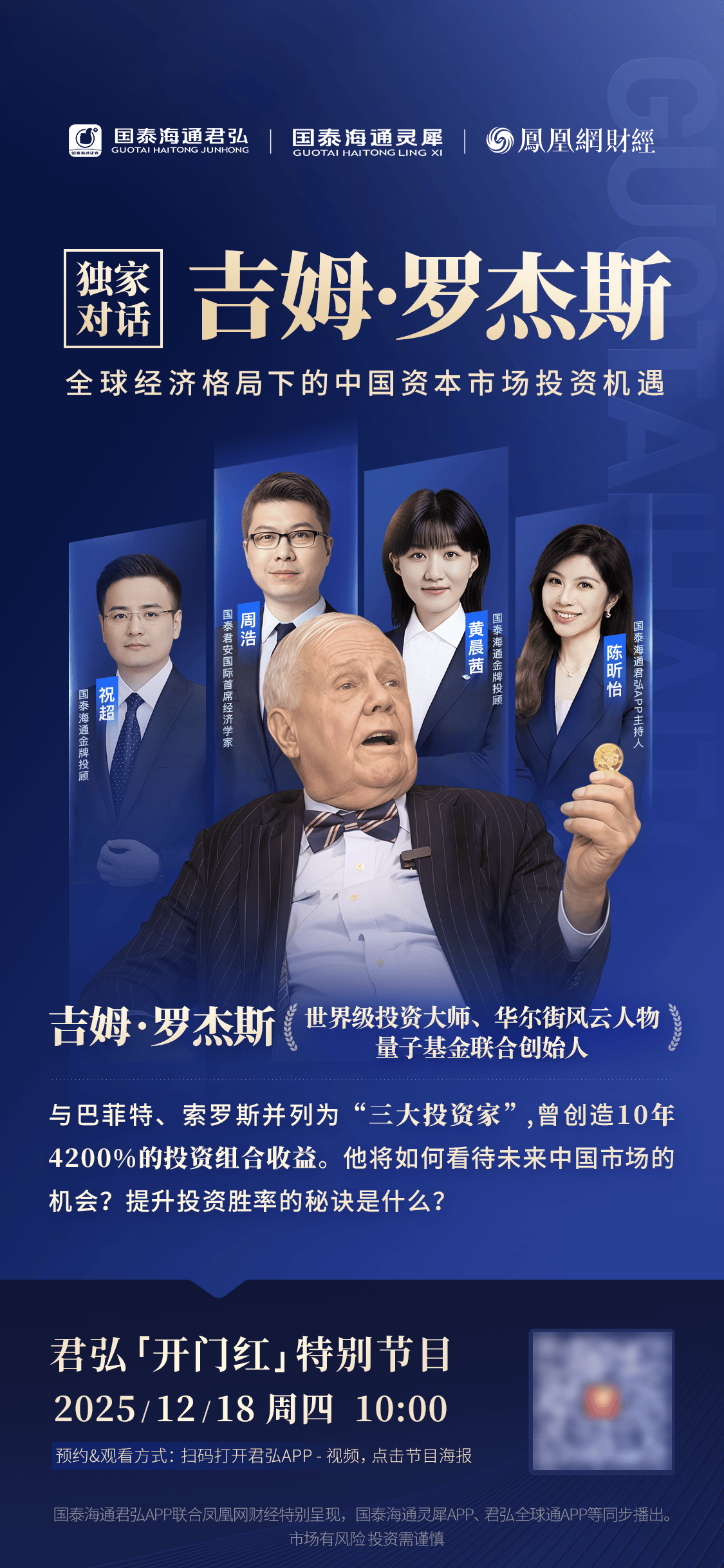
国泰海通君弘独家对话国际投资大师吉姆·罗杰斯
Zhong Guo Jin Rong Xin Xi Wang· 2025-12-18 13:54
Core Insights - The article discusses the insights shared by international investment master Jim Rogers during a special live broadcast hosted by Guotai Junan, focusing on investment opportunities in China and the global economic landscape [1][2]. Investment Opportunities - Jim Rogers expresses a long-term optimistic view on the Chinese capital market, stating that he holds many Chinese stocks and believes China will become the world's most important economy in the next decade and century, presenting numerous opportunities [2]. - Specific sectors highlighted by Rogers include tourism, transportation, aviation, and undervalued agriculture, which are expected to benefit from China's development [2]. Market Resilience - Rogers emphasizes the resilience of the Chinese market, noting that while many global markets have faced downturns, China has remained stable. He expresses a desire to increase his holdings in Chinese assets during future market declines, anticipating a rebound [2]. Global Market Trends - The article notes that since 2009, most global markets have experienced a prolonged period of growth, which is historically rare. Rogers warns that when everyone is making money easily, it is essential to be cautious of potential risks [2]. AI Industry Perspective - Regarding the AI industry, Rogers acknowledges that new developments often lead to bubbles, but he believes that AI has not yet formed a bubble and that there is no immediate cause for concern [3]. Precious Metals Investment - Rogers maintains a long-term positive stance on precious metals, currently holding gold and silver. He indicates that while he will not increase his holdings at current high prices, he sees long-term value and plans to buy more if prices decline [3]. Investment Strategy Advice - Rogers advises investors to stick to areas they understand, avoid following popular trends, and not be swayed by media noise. He encourages young investors to focus on their strengths for long-term wealth accumulation [3]. Digital Investment Tools - Guotai Junan is enhancing its digital investment tools, such as the Guotai Junan Lingxi App, to provide intelligent investment strategies and support for investors, aiming to help them seize opportunities in the Chinese capital market by 2026 [4][5]. Service Innovation - The Guotai Junan Lingxi App has been upgraded to improve service efficiency, integrating professional capabilities with digital technology to become a comprehensive AI investment partner for users [5][9]. Comprehensive Service Approach - Guotai Junan is committed to providing a full-cycle investment service, utilizing a professional live broadcast matrix and various content offerings to enhance investor engagement and support [4].



看好中国!国泰海通君弘独家对话国际投资大师吉姆・罗杰斯,解码全球视野下的投资新机遇
Sou Hu Cai Jing· 2025-12-18 07:40
Core Viewpoint - The article emphasizes the importance of the end of the year and the beginning of the new year as a critical juncture for investors to identify investment directions amidst global economic changes and market opportunities [1][6]. Group 1: Event Overview - Guotai Junan launched a special live broadcast titled "Opening Red" on December 18, featuring international investment master Jim Rogers, who has a long-term bullish outlook on the Chinese capital market [1][5]. - The live broadcast was available on multiple platforms, including Guotai Junan Junhong App and Phoenix Finance, aiming to provide insights into Chinese asset opportunities and global economic conditions [5]. Group 2: Jim Rogers' Insights - Jim Rogers, a co-founder of the Quantum Fund, highlighted his optimistic view on China's future, stating that he holds many Chinese stocks and believes China will become the world's most important economy in the next decade [6]. - He identified sectors such as tourism, transportation, and agriculture as promising investment areas benefiting from China's development [6]. - Rogers expressed confidence in the resilience of the Chinese market, noting its stability compared to other markets that have faced downturns [6]. Group 3: Investment Strategies - Rogers advised investors to focus on areas they understand and to avoid being swayed by popular opinions or market noise [7]. - The Guotai Junan Junhong App aims to provide tailored investment strategies based on the insights shared during the broadcast, helping investors seize opportunities in the Chinese capital market by 2026 [7]. Group 4: Service Innovations - Guotai Junan is committed to enhancing investor services through a professional live broadcast matrix and various content offerings, such as "Chief is Here" and "Watch the Market" [8]. - The company is leveraging AI technology to upgrade its Guotai Junan Lingxi App, aiming to provide a more interactive and personalized investment experience for users [9][13]. - The app focuses on four core scenarios: market monitoring, trading, dialogue, and live broadcasting, enhancing service capabilities and decision-making processes for investors [13].
看好中国!国泰海通君弘独家对话罗杰斯,解码全球视野下的投资新机遇
券商中国· 2025-12-18 06:39
Core Viewpoint - The article emphasizes the importance of global economic changes and market opportunities as a critical point for investors to anchor their investment directions, highlighting the role of Guotai Junan in promoting inclusive finance and enhancing long-term investment success for investors [1]. Group 1: Event Highlights - On December 18, Guotai Junan launched a special live broadcast featuring international investment master Jim Rogers, who has a long-term bullish outlook on the Chinese capital market, discussing key topics such as opportunities in Chinese assets and global economic conditions [2]. - Jim Rogers, a co-founder of the Quantum Fund, is recognized as one of the "three great investors" alongside Warren Buffett and George Soros, having achieved a remarkable 4200% investment portfolio return over ten years [7]. Group 2: Investment Insights - Rogers expressed optimism about China's future, stating that he holds many Chinese stocks and believes China will become the world's most important economy in the next decade, presenting numerous opportunities [8]. - He highlighted sectors such as tourism, transportation, and agriculture as areas of investment interest, particularly those benefiting from China's development [8]. - Rogers noted the resilience of the Chinese market, stating that while many markets have collapsed, China has remained stable, and he plans to increase his holdings in Chinese assets during future market downturns [8]. Group 3: Investment Strategy and Tools - Rogers advised investors to focus on areas they understand and to avoid being swayed by popular advice or market noise, encouraging young investors to concentrate on their strengths for long-term wealth accumulation [9]. - Guotai Junan's app aims to provide Chinese investors with tailored investment strategies based on the insights shared during the live broadcast, helping them seize investment opportunities in the Chinese capital market by 2026 [9]. Group 4: Service Innovations - The special live broadcast reflects Guotai Junan's commitment to enhancing investor services and building a professional live broadcast matrix, showcasing their expertise in macroeconomic and asset allocation discussions [11]. - The Guotai Junan Lingxi App has been upgraded to integrate professional capabilities with smart technology, aiming to become a comprehensive AI investment partner for investors [13]. - The app focuses on four core scenarios: market monitoring, trading, dialogue, and live broadcasting, enhancing service capabilities and providing a seamless experience for users [16].

中国式“长期主义”是资本市场的压舱石——专访东方证券研究所所长黄燕铭
Guo Ji Jin Rong Bao· 2025-12-15 09:05
Group 1 - The core viewpoint is that China's capital market has emerged from a downturn and is on a path to high-quality development, driven by the recognition of "Chinese-style long-termism" by global investors [2][8] - The stability and continuity of Chinese policies are fundamental to creating a healthy and sustainable capital market ecosystem, contrasting with the short-term focus of Western political dynamics [2][4] - The "long-termism" is reflected in the continuity of goals across five-year plans, with each plan building on the previous one, leading to a coherent strategy towards the grand vision of a modern socialist country by 2049 [3][8] Group 2 - The governance capability of China is demonstrated through the adaptability and operability of policies that align with current stage characteristics, addressing core contradictions and enhancing national governance [4][5] - China's early recognition of potential global economic challenges, as indicated in previous five-year plans, has allowed for proactive policy responses, showcasing resilience in the face of external shocks [6][7] - "Long-termism" is identified as the fundamental reason behind the sustainability of the "China miracle," emphasizing the importance of policy continuity and consensus in achieving long-term goals [8]

中信保诚资管王达:2025年中国资本市场关键词是“枢纽化”
Jing Ji Guan Cha Wang· 2025-11-26 08:17
Core Viewpoint - The key term to describe the Chinese capital market in 2025 is "hubification," indicating its role as a central point for financial resources and the real economy, as well as for the wealth of residents and the high-quality development of the national economy [1] Group 1 - The capital market in 2025 will exhibit resilience, exploration, confidence, and rebalancing characteristics [1] - The capital market serves as a hub for financial resources and the real economy [1] - It also acts as a bridge between domestic and international economic cycles [1]
中信证券:资本市场积极动能正不断积累
Shang Hai Zheng Quan Bao· 2025-11-11 16:57
Group 1 - The theme of the 2026 Capital Market Annual Conference held by CITIC Securities is "Striving for a New Journey," focusing on the global macro landscape and market investment strategies [1] - CITIC Securities General Manager Zou Yingguang highlighted the increasing international discourse power of China and the rising position of Chinese enterprises in the global value chain, indicating a positive accumulation of momentum in the capital market [1] - The "14th Five-Year Plan" period will see new characteristics in the global context, technological trends, and institutional environment affecting China's capital market [1] Group 2 - CITIC Securities Chief A-share Strategy Analyst Qiu Xiang stated that A-share companies are transitioning from local enterprises to global multinational corporations, marking a shift from emerging to mature market status [2] - Qiu Xiang noted that the overall volatility of the A-share market is expected to enter a long-term downward trend due to various mechanisms, including increased participation of retail investors seeking stable returns [2] - The influence of social media and diverse public opinion is expected to mitigate the effects of collective investor behavior, reducing the likelihood of one-sided market movements [2] Group 3 - Three key themes for industry allocation in 2026 include: upgrading traditional manufacturing and resource industries to enhance profit margins, the globalization of Chinese enterprises opening new profit growth opportunities, and a new round of systematic trends in the technology sector driven by application changes [3] - CITIC Securities Chief Economist Ming Ming anticipates a "front low, back high" growth pattern for China's economy in 2026, with moderate fiscal expansion and improved local government finances [3] Group 4 - The economic structure in 2026 is expected to be primarily production-driven, with external and internal demand becoming more balanced [4] - Fiscal policy is projected to moderately expand, with an increase in special bond quotas for project construction, while monetary policy may see further easing with potential rate cuts [4] - The focus of industrial policy during the "14th Five-Year Plan" period will shift towards balancing supply and demand, enhancing service consumption and investment in emerging industries to boost domestic demand's contribution to GDP [4]

“十五五”时期中国资本市场面临重大机遇|宏观经济
清华金融评论· 2025-11-11 09:13
Core Viewpoint - The article emphasizes the significant opportunities for the Chinese capital market during the "14th Five-Year Plan" period, driven by comprehensive reforms, economic transformation, institutional improvements, and value reassessment of assets [1][9][15]. Group 1: Economic Context and Historical Comparison - The Chinese stock market has experienced a prolonged period of platform consolidation, similar to historical patterns observed in the U.S. stock market, which also underwent extended phases of stagnation before significant upward movements [3][4][6]. - The Shanghai Composite Index has been fluctuating around the 3000-point mark for 17.5 years, indicating a long-term consolidation phase before recent upward trends [3]. Group 2: Opportunities for Capital Market Development - The "14th Five-Year Plan" outlines three major certainties that could lead to significant opportunities for the capital market: high-quality economic development, macro policy expectations, and the recovery of asset valuations [9][10]. - Comprehensive reforms are expected to release dividends, addressing long-standing issues of unbalanced and insufficient development, which have been exacerbated by the pandemic and global changes [10]. - Economic transformation is anticipated to create new opportunities, with a focus on building a strong domestic market and enhancing technological self-reliance [11]. Group 3: Institutional Improvements - The article highlights the importance of improving the capital market's institutional framework, which has been lacking in the past, leading to a disparity in asset price movements compared to real estate [12][13]. - Recent policies aimed at enhancing the quality of listed companies and encouraging long-term investments are expected to provide a solid foundation for the capital market's operation [12]. Group 4: Value Reassessment and Market Dynamics - Despite recent highs in the Shanghai Composite Index and Shenzhen Component Index, the overall valuation of A-shares remains low, indicating potential for future value reassessment [14]. - The article identifies three driving forces for the value reassessment of Chinese assets: economic transformation, increased diversification of household assets, and the global shift of capital away from U.S. dollar assets [14]. Group 5: Conclusion and Future Outlook - The combination of economic recovery, technological innovation, ongoing institutional improvements, and asset value reassessment suggests a positive outlook for the Chinese capital market [15]. - However, the article cautions that investors should adopt a long-term value investment approach, as uncertainties and risks remain prevalent in the market [15].

把握资本市场新机遇——专访中金公司董事总经理、全球股票业务执行负责人张一鸣
Zheng Quan Ri Bao Wang· 2025-10-30 12:04
Core Insights - The article discusses the opportunities and challenges facing China's capital market as outlined in the "15th Five-Year Plan" and emphasizes the need for a more inclusive and adaptive capital market system [1][4]. Group 1: Capital Market Development - The capital market in China is expected to play a crucial role in achieving high-quality economic development during the "15th Five-Year" period and by 2035 [4]. - The valuation advantage of Chinese assets is becoming more prominent, with foreign capital increasingly focusing on China's innovation-driven industries [2][3]. - The recent optimization of the Qualified Foreign Institutional Investor (QFII) system is seen as a significant step towards enhancing the openness of China's capital market, which is expected to attract more long-term foreign capital [3]. Group 2: Financial Support for Innovation - The article highlights the importance of long-term capital in supporting disruptive technologies and new industries, which require substantial investment and a flexible financing environment [6]. - Investment banks are positioned as a bridge between real enterprises and capital markets, providing stable long-term capital for quality companies and facilitating policy improvements for technological innovation [5][6]. - The capital market must provide precise and inclusive financial services to support new industries and technologies throughout their lifecycle [6]. Group 3: Policy Recommendations - The capital market should prioritize serving the real economy by directing financial resources towards key areas such as technological innovation, green economy, and digital economy [7]. - Recommendations include enhancing the quality of listed companies, improving dividend stability, and deepening delisting reforms to create a more efficient market [7]. - There is a call for the continuous improvement of risk management tools to provide diverse hedging options for various market participants [7].

体验了一把激烈的过山车
Sou Hu Cai Jing· 2025-10-15 14:53
Group 1 - The A-share market is expected to show only a slight decline despite the announcement of a potential 100% tariff increase, indicating a lack of significant concern among investors [1][2] - The Shanghai Composite Index experienced a minor fluctuation, with a decrease of 0.19% on Monday, 0.62% on Tuesday, and a recovery of 1.22% on Wednesday, closing at 3912 points, which is a 0.38% increase from the previous Friday [2] - The long-term outlook for the Chinese capital market remains positive, drawing parallels to the real estate market over the past 20 years, suggesting a prolonged upward trend [3] Group 2 - The Federal Reserve has signaled potential interest rate cuts, which is expected to positively influence global markets and provide more room for domestic rate adjustments [4] - A recent portfolio adjustment resulted in mixed performance, with profits fluctuating from a peak of 3.1% down to 0.5%, but the outlook for the favored sector remains optimistic for long-term holding [4]