
以量补价

Search documents
华鲁恒升(600426):三季度业绩同比小幅下降,以量补价降低业绩压力
CMS· 2025-10-30 10:38
Investment Rating - The report maintains a "Strong Buy" investment rating for the company [3]. Core Views - The company experienced a slight decline in third-quarter performance, with revenue of 23.55 billion yuan, down 6.46% year-on-year, and a net profit of 2.37 billion yuan, down 22.14% year-on-year [1][7]. - Despite the decrease in product prices, the company managed to mitigate performance pressure through increased sales volume, particularly in new energy materials and chemical fertilizers [7]. - The company is actively advancing project launches and has several new projects in the pipeline, which are expected to enhance future growth potential [7]. Financial Data and Valuation - The company reported total revenue of 27.26 billion yuan for 2023, with a projected decline of 10% year-on-year, followed by a recovery of 26% in 2024 [2][14]. - The projected net profit for 2025 is 3.24 billion yuan, reflecting a 17% decrease from the previous year, with earnings per share (EPS) expected to be 1.53 yuan [2][14]. - The current price-to-earnings (PE) ratio is 15.0 for 2023, expected to decrease to 12.2 by 2027, indicating a potential undervaluation [2][14]. Sales and Production Insights - The average selling prices of core products have decreased year-on-year, with significant drops in new energy materials and chemical fertilizers, but sales volumes have increased, helping to offset revenue declines [7]. - The company’s gross margin improved to 19.1% in the third quarter, up 1.6 percentage points year-on-year, despite a slight decline from the previous quarter [7]. Project Development - The company is efficiently advancing project launches, with several new projects already in the preparatory stages, including a 20,000-ton BDO project and a 30.39 billion yuan investment in a gasification platform upgrade [7].

江瀚新材(603281):主营产品价格下行拖累业绩,硅烷价格或已触底:——江瀚新材(603281):2025年三季报点评
Guohai Securities· 2025-10-29 08:10
Investment Rating - The report maintains a "Buy" rating for Jianghan New Materials [1][10][13] Core Views - The decline in silane prices has negatively impacted the company's performance, but there are signs that prices may have bottomed out, which could benefit the company in the long term [5][9][10] Summary by Sections Financial Performance - For the first three quarters of 2025, the company achieved revenue of 1.425 billion yuan, a year-on-year decrease of 16.38%, and a net profit attributable to shareholders of 322 million yuan, down 29.50% year-on-year [5][6] - In Q3 2025, the company reported revenue of 480 million yuan, a year-on-year decline of 9.40%, but a quarter-on-quarter increase of 5.89%. The net profit for the same period was 112 million yuan, down 22.85% year-on-year and down 1.63% quarter-on-quarter [5][6] Sales and Margins - The average selling price of functional silane in Q3 2025 was 15,229 yuan per ton, a decrease of 2,255 yuan per ton year-on-year and a decrease of 658 yuan per ton quarter-on-quarter. The sales volume increased to 31,200 tons, up 2,080 tons year-on-year and up 3,125 tons quarter-on-quarter [7][9] - The gross margin for Q3 2025 was 29.29%, down 5.46 percentage points year-on-year and down 1.14 percentage points quarter-on-quarter [8][10] Future Outlook - The report forecasts the company's revenue for 2025-2027 to be 1.95 billion, 2.564 billion, and 3.184 billion yuan, respectively, with net profits of 418 million, 571 million, and 719 million yuan, respectively. The corresponding P/E ratios are projected to be 23, 17, and 13 times [10][12] - The report suggests that the functional silane industry may be recovering, as prices have recently increased from their lows, which could benefit Jianghan New Materials as a leading player in the sector [9][10]

农商行龙头“交卷”!这项指标下滑,北向资金转向,什么情况?
券商中国· 2025-10-28 15:27
Core Viewpoint - Chongqing Rural Commercial Bank (Yunong Bank) reported a slight increase in revenue and net profit for the first three quarters of 2025, but faced significant declines in non-interest income, which negatively impacted overall revenue growth [1][4]. Financial Performance - For the first nine months of 2025, the bank achieved operating income of 21.658 billion yuan, a year-on-year increase of 0.67%, and a net profit attributable to shareholders of 10.694 billion yuan, up 3.74% year-on-year [1]. - Non-interest income saw a significant decline of 20.9% year-on-year, with the drop accelerating each quarter [1][4]. - The bank's total assets reached approximately 1.66 trillion yuan by the end of September, marking a 9.3% increase from the beginning of the year, the highest growth rate for the same period in nearly four years [2]. Loan Growth and Strategy - Customer loans and advances totaled nearly 778 billion yuan, reflecting an 8.92% increase year-to-date, also the highest growth in four years, primarily driven by corporate loans [2]. - The bank aims to achieve an average annual asset growth of 100 billion yuan over the next three years, focusing on agricultural loans and inclusive small and micro loans [2][3]. Non-Interest Income Challenges - The bank's non-interest income accounted for about 20% of total income, but the decline in this area has been a drag on overall revenue growth [4]. - The bank's fee and commission income decreased by 2.12 billion yuan, while investment income and fair value changes dropped by 6.3 billion yuan year-on-year [5]. Management Changes - In April 2023, Liu Xiaojun was appointed as the new chairman, marking a significant leadership change for the bank [6]. - A series of executive changes occurred, including the retirement and resignation of several vice presidents, leading to a new executive structure [6][7].



广汇物流20251024
2025-10-27 00:31
Summary of Guanghui Logistics Conference Call Company Overview - **Company**: Guanghui Logistics - **Period**: First three quarters of 2025 Financial Performance - **Total Revenue**: 20.51 billion CNY, a decrease of 20% year-on-year [2][3] - **Net Profit**: 3.18 billion CNY, a decrease of 24.55% year-on-year [2][3] - **Q3 Revenue**: 6.3 billion CNY, a decrease of 18% year-on-year [2][3] - **Q3 Net Profit**: 53.84 million CNY, a decrease of 63% year-on-year [2][3] - **Operating Cash Flow**: 9.04 billion CNY, a decrease of 18% year-on-year [3] Energy Logistics Segment - **Revenue**: 16.59 billion CNY, accounting for 82% of total revenue, a decrease of 7% year-on-year [2][4] - **Net Profit**: 2.5 billion CNY, a decrease of approximately 47% year-on-year [2][4] - **Average Gross Margin**: 35% [4] - **Net Profit Margin**: 15% [4] - **Total Volume**: 21.08 million tons, an increase of 38% year-on-year, accounting for 30% of Xinjiang coal exports [2][4] - **Initiation Volume**: 9.2 million tons, stable compared to last year [4] Pricing Strategy - **Recovery of Freight Rates**: Gradual restoration of initiation and transshipment freight rates, with a planned increase of 10.7 CNY per ton for transshipment, adding 9.1 CNY to net profit [2][6] - **Initiation Rate**: Planned increase to 0.25 CNY per ton-kilometer [6] Real Estate Segment - **Revenue**: 3.8 billion CNY, a decrease of 50% year-on-year [2][7] - **Net Profit**: 11.46 billion CNY [2][7] - **Unsold Inventory Cost**: Approximately 2 billion CNY, primarily located in Chengdu Tianfu New Area, Guilin, and Urumqi [2][7] - **Inventory Breakdown**: 1.3 billion CNY in commercial inventory and 700 million CNY in residential and apartment inventory [7] Future Outlook - **Q4 Energy Logistics Volume**: Expected to reach around 10 million tons, with an increase of approximately 50 million CNY in net profit from transshipment [2][8] - **Real Estate Performance**: Uncertainty remains, but no significant impairment losses are expected [9] Competitive Advantage - **Market Position**: Company maintains a significant advantage through a phased pricing strategy, achieving stable growth despite adjustments [11] - **Customer Discounts**: Freight discount of 40 CNY per ton directly benefits customers by reducing transportation costs [12] Debt Management - **Asset-Liability Ratio**: Decreased to 63.75%, down from 65.7% at the beginning of the year [3][14] - **Debt Composition**: Includes contract liabilities from real estate projects, which will decrease as projects progress and revenue is recognized [14] Additional Notes - **Delisting Application**: Submitted on October 14, expected to be completed by the end of October [10]

猪肉“旺季不旺”陷入困境 期现价格齐跌养殖端全面亏损
Di Yi Cai Jing· 2025-10-13 11:25
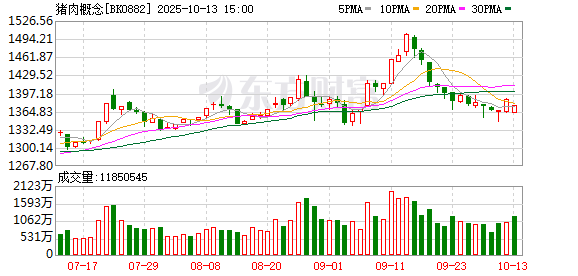
Core Viewpoint - The domestic pork market is experiencing a "peak season not booming" situation, with both futures and spot prices falling unexpectedly, indicating a significant supply-demand imbalance in the industry [2][3][4]. Supply and Demand Dynamics - As of October 13, the spot price of pork has dropped to 10.92 yuan/kg, down 1.26 yuan/kg from before the National Day holiday, reflecting a year-on-year decline of 39.43% [3][4]. - The number of breeding sows remains high, with a total of 40.62 million as of the end of September, which is 104.2% of the normal holding capacity, contributing to the oversupply of pigs [3][4]. - The industry is in a phase of "capacity reduction," but the progress is slower than expected, leading to continued price declines [4][5]. Company Performance - Major listed pig companies are facing operational challenges, with sales prices and revenues declining significantly in September. For instance, Wens Foodstuff Group sold 3.33 million pigs in September, a year-on-year increase of 32.46%, but at a lower average price of 13.18 yuan/kg, reflecting a 30.81% drop [5][6]. - Muyuan Foods reported a sales revenue of 9.066 billion yuan in September, down 22.46% year-on-year, with a notable decrease in the number of pigs sold [6][7]. - Smaller companies like Zhengbang Technology have seen significant increases in output, with a year-on-year growth of 107.64% in September, but overall revenue remains under pressure due to falling prices [7][8]. Future Outlook - The outlook for pork prices remains pessimistic, with expectations of continued downward pressure due to persistent supply and weak demand [7][8]. - The industry is closely monitoring the effectiveness of capacity reduction policies, which aim to lower the number of breeding sows to around 39.5 million to potentially stabilize prices [5][6].



多家养殖上市公司公布9月份简报 行业延续以量补价趋势
Zheng Quan Ri Bao Wang· 2025-10-12 13:20
Core Viewpoint - The A-share pig farming sector is experiencing a trend of increasing sales volume but decreasing prices, with leading companies expanding their output to mitigate the downward pressure on pig prices [1][2][3]. Group 1: Sales Performance - Major listed companies in pig farming reported significant year-on-year increases in sales volume for September 2023, with Muyuan Foods selling 5.573 million pigs (up 11.05%), Wens Foodstuffs selling 3.3253 million pigs (up 32.46%), and Zhengbang Technology's sales surging by 107.64% to 790,700 pigs [2]. - Other companies like New Hope and Tangrenshen also reported notable increases in sales volume, with growth rates of 16.92% and 28.33% respectively [2]. Group 2: Price Trends - The average selling price of pigs decreased significantly in September 2023, leading to a "volume increase, price decrease" effect. Muyuan Foods' average price was 12.88 yuan/kg (down 30.94%), while Wens Foods' average price was 13.18 yuan/kg (down 30.81%) [3]. - The sales revenue for these companies also declined, with Muyuan Foods experiencing a 22.46% drop in revenue [3]. Group 3: Strategic Responses - Companies are adopting varied strategies to cope with industry pressures. Muyuan Foods has raised its 2025 piglet output forecast to between 12 million and 14.5 million, while Wens Foods is leveraging its diversified operations [3]. - New Hope is focusing on cost control and efficiency improvements to counter price risks [3]. Group 4: Market Outlook - The supply-demand dynamics in the pig farming industry are expected to remain challenging in Q4 2023, with supply pressures likely to dominate the market. The Ministry of Agriculture reported a higher-than-normal number of breeding sows, indicating increased pig supply in the coming months [4]. - Demand may show seasonal improvement but is expected to remain weak year-on-year, with potential price increases limited by the availability of frozen products [4]. Group 5: Recommendations for Companies - Companies are advised to control production capacity, reduce costs, and ensure cash flow by implementing strategies such as slowing down output and enhancing breeding efficiency [4]. - Additionally, extending the industrial chain and developing deep processing of pigs can help increase product value and reduce reliance on single sales channels [5].
猪价加速下跌 上市猪企多“以量补价” 悲观情绪蔓延短期猪价弱势难改
Xin Hua Cai Jing· 2025-10-09 21:33
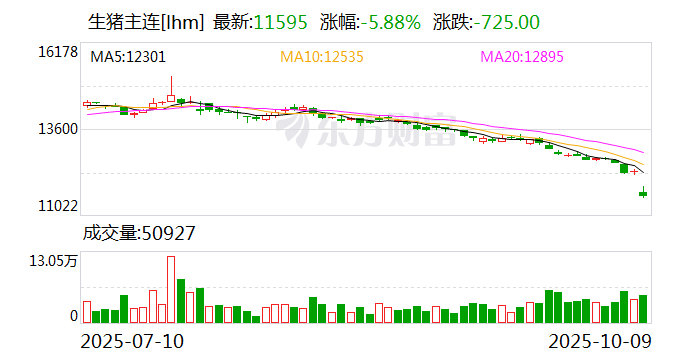
Core Viewpoint - The domestic pig prices have sharply declined, with futures contracts dropping nearly 6% to below 12,000 yuan per ton, attributed to a combination of reduced demand and increased supply pressure [2][3]. Group 1: Price Trends - The weighted price of October pig futures has already seen a monthly decline of 7.9%, following an 8.4% drop in September, marking the largest monthly decline since January [3]. - The sales data from listed pig companies indicate a significant increase in sales volume despite the drop in average selling prices, with companies like Wens Foodstuffs reporting a 32.46% year-on-year increase in sales [4]. Group 2: Supply and Demand Dynamics - There is a notable increase in the planned slaughter volume for October, with a 5.48% rise compared to September, indicating ongoing supply pressure [5][6]. - The market consensus suggests a phase of demand inertia decline post-holiday, with expectations of reduced consumer demand and limited new orders from major slaughterhouses [7]. Group 3: Market Sentiment - The overall market sentiment is pessimistic, with many institutions expressing a bearish outlook for pig prices over the next three months due to high levels of breeding sows and slow capacity reduction [8][9]. - The industry is experiencing a phase of losses, with companies focusing on cost-cutting and cash flow management, leading to a challenging environment for price recovery [8].



生猪:十年复盘
2025-09-28 14:57
Summary of the Pig Farming Industry Conference Call Industry Overview - The pig farming industry has undergone three significant phases over the past decade: the embryonic phase (2012-2016), the growth phase (2014-2016), and the maturity phase (2016 to present) [2][4][16] - Market understanding, corporate strategies, and stock performance have varied significantly across these phases [2] Key Insights and Arguments - Early stock prices were directly influenced by pig prices, but later investors began to anticipate price changes, as seen in late 2018 to early 2019 when expectations of reduced capacity drove stock prices up [2][9] - The ability to grasp cyclical trends is crucial for corporate growth; companies like Muyuan Foods focus on key variables such as the number of breeding sows to enhance predictive capabilities [2][10] - African swine fever has led to reduced supply, altering the supply-demand relationship and prompting investors to adopt data-driven analysis and cyclical judgment for investment decisions [11] - Muyuan Foods' low-cost expansion strategy allows it to remain profitable during periods of declining pig prices by increasing output to offset lower per-head profits [2][13][14] Investment Logic - The investment logic in the pig farming sector can be summarized by two core elements: cycles and growth [3] - The sector has experienced increasing competition, leading to a more aggressive trading environment and a focus on replicating successful business models [3][18] Industry Phases 1. **Embryonic Phase (2012-2016)**: Limited market understanding and low research value; characterized by passive acceptance [4][7] 2. **Growth Phase (2014-2016)**: Emergence of more pure breeding companies and a complete industry chain; stock prices showed high correlation with pig prices [7][16] 3. **Maturity Phase (2016-present)**: The industry reached its peak with leading companies like Muyuan and Wens showing strong performance; stock prices closely tied to market conditions [7][16] Stock Price Trends - Stock prices in the pig farming sector have shown distinct phases, initially driven by new stock effects and later influenced by market transparency and predictive capabilities [9] - For instance, stock prices rose in anticipation of future price increases despite current low prices due to expected capacity reductions [9] Factors Influencing Corporate Growth - Key factors for corporate growth include the ability to understand cyclical factors and optimize production efficiency, especially in light of strict environmental policies [10][12] Environmental Policy Impact - Strict environmental policies have accelerated industry consolidation and improved overall production efficiency, benefiting larger companies that can adapt [12] Muyuan Foods' Profitability - Muyuan Foods maintained profitability during price declines due to its low-cost strategy, allowing it to offset reduced profits per head by increasing overall output [13] Growth Logic of Muyuan Foods - Muyuan's growth logic is centered on low costs and output volume, which directly impacts its return on equity (ROE) and overall profitability [14] Recommendations for Investment - The recommendation to invest in the pig farming sector in September 2021 was based on anticipated capacity reductions and a subsequent price increase, highlighting a contrarian investment strategy [15] Future Trends for Leading Companies - Leading companies are transitioning from low-cost expansion to focusing on cyclical value creation, indicating a shift towards long-term sustainable growth strategies [21]
上市券商利息净收入同比增超30%
Zheng Quan Ri Bao· 2025-09-04 23:37
Core Viewpoint - The margin financing and securities lending business (referred to as "margin business") is a core pillar of brokerage credit operations, significantly impacting brokerage performance. The demand for margin financing has surged due to a recovery in the A-share market and improved investor risk appetite, leading to a more than 30% year-on-year growth in net interest income for listed brokerages in the first half of the year [1][2]. Group 1: Business Performance - In the first half of the year, the margin balance remained high at 1.8 trillion yuan, laying a foundation for the growth of interest income for brokerages. Listed brokerages adopted strategies to expand margin business scale, achieving a net interest income of 19.657 billion yuan, a year-on-year increase of 30.66% [1][2]. - Leading brokerages dominated the margin business, with Guotai Junan achieving the highest net interest income of 3.187 billion yuan, followed by Huatai Securities with 2.037 billion yuan. Other brokerages like China Galaxy Securities, Everbright Securities, and others also reported net interest income exceeding 1 billion yuan [1][2]. Group 2: Growth Rates - Top brokerages such as Guotai Junan, Huatai Securities, and Zhongyuan Securities reported year-on-year growth rates in net interest income exceeding 100%, with increases of 205.43%, 186.62%, and 122.44% respectively. Additionally, seven other brokerages saw growth rates above 30% [2]. - There is a noticeable divergence among listed brokerages, with some like Shenwan Hongyuan and Northeast Securities turning losses into profits, while four brokerages still reported negative net interest income [2]. Group 3: Business Strategies - Guotai Junan focused on customer demand, optimizing business scenarios and strategies, resulting in a net increase of 26,400 new margin clients, a 61% year-on-year increase. The margin balance reached 180.996 billion yuan, with a market share of 9.78% [3]. - Huatai Securities implemented a dual-track strategy focusing on financing and compliance, while Zhongyuan Securities concentrated on activating existing clients and risk control for steady growth [3]. Group 4: Market Trends - As of September 1, the total margin balance reached 2.296991 trillion yuan, surpassing the historical peak of 2.27 trillion yuan in June 2015. Although it slightly decreased to 2.289861 trillion yuan by September 3, it remained at a high level [4]. - The number of individual investors in the margin market increased to 7.6222 million, with active trading participants rising to 492,096, indicating heightened investor enthusiasm [4]. Group 5: Future Outlook - Despite a 10% year-on-year decline in margin financing rates, the margin scale is expected to accelerate in the second half of the year, with a potential for "volume compensating for price." Some institutions are responding to liquidity risks by lowering financing ratios, which may highlight the capital strength of leading firms [4][5].

上市券商利息净收入同比增超30% 两融业务“以量补价”策略显成效
Zheng Quan Ri Bao· 2025-09-04 16:49
Core Viewpoint - The margin financing and securities lending business (referred to as "margin business") is a core pillar of brokerage credit operations, significantly impacting brokerage performance due to its scale changes [1] Group 1: Business Performance - In the first half of the year, the margin balance remained high at 1.8 trillion yuan, laying a foundation for the growth of interest income for brokerages [2] - A total of 42 listed brokerages achieved net interest income of 19.657 billion yuan, a year-on-year increase of 30.66% [2] - Leading brokerages dominate the margin business, with Guotai Junan leading with 3.187 billion yuan in net interest income, followed by Huatai Securities with 2.037 billion yuan [2][3] Group 2: Growth Trends - The top brokerages and some regional firms showed remarkable performance, with Guotai Junan, Huatai Securities, and Zhongyuan Securities experiencing net interest income growth rates exceeding 100% [2] - The margin business of Guotai Junan focused on customer needs, achieving a net increase of 26,400 new margin clients, a 61% year-on-year increase [3] Group 3: Market Dynamics - As of September 1, the total margin balance reached 2.296991 trillion yuan, surpassing the historical peak of 2.27 trillion yuan in June 2015 [4] - The number of individual investors in the margin market increased to 7.6222 million, with active trading participants rising to 492,096 [4] Group 4: Strategic Focus - Leading brokerages have clarified their business priorities for the second half of the year, focusing on steady development of the margin business to support overall performance growth [5] - Guotai Junan plans to enhance customer acquisition efforts, while Huatai Securities aims to improve differentiated marketing policies and tools [5]

