价值因子

Search documents
量化资产配置月报:信用指标修正,价值因子得分提高-20251103
Shenwan Hongyuan Securities· 2025-11-03 09:46
Group 1 - The value factor score has improved, indicating a recovery in the economy, with liquidity slightly loose and credit indicators showing slight improvement. The macro direction suggests economic recovery, weak liquidity, and credit contraction [3][6][8] - The economic outlook indicator is maintained at an upward trend, with expectations of a slight increase over the next three months, reaching a peak in March 2026 [14][15] - The liquidity environment is characterized by interest rates above the average, but overall remains slightly loose, with monetary supply still positive [23][24][26] Group 2 - The credit indicators are weak, with credit volume and structure remaining low. The total credit indicators continue to decline, while the credit structure shows slight recovery [28] - The allocation view for major asset classes indicates a decrease in gold allocation to 10%, while A-shares allocation is increased [29] - Market focus has shifted towards economic indicators, with PPI attention rising above economic concerns recently [30] Group 3 - Industry selection is inclined towards sectors sensitive to economic changes but insensitive to credit fluctuations, with a general preference for value-oriented industries [32] - The top scoring industries based on economic sensitivity include utilities, coal, and construction decoration, while the highest credit scoring industries include retail and banking [33]
一位谦逊的投资者分享:把“承认无知”,变为你的最大优势
雪球· 2025-10-15 13:30
Core Insights - The article emphasizes that most investors lack the ability to predict market movements and should instead focus on identifying patterns and understanding market errors to gain a probabilistic advantage [4][6][12]. Group 1: Investment Principles - Principle 1: Most individuals do not possess predictive abilities; instead, they should identify patterns and study market errors to gain a probabilistic advantage [6]. - Principle 2: The spread between high-yield bonds and government bonds serves as an effective signal for identifying market cycles [6][15]. - Principle 3: The traditional 60/40 portfolio has flaws, particularly during high inflation periods when both stocks and bonds may decline simultaneously [25][26]. - Principle 4: Valuation changes reward cheap stocks and penalize expensive ones, which is a significant recurring feature in global equity markets [30]. - Principle 5: Crises often present opportunities, while opportunities can be accompanied by bubbles [31]. - Principle 6: High-quality small-cap stocks, especially those with low valuations and net cash, present excellent investment opportunities [7][41]. Group 2: Market Nature and Cycle Positioning - Market Nature: The market is inherently unpredictable, and human cognitive limitations hinder accurate forecasting [12][13]. - Cycle Positioning: The relationship between high-yield spreads and inflation is crucial for understanding market cycles [14][15]. - High-yield spreads indicate when to allocate to defensive assets or small-cap value stocks and commodities [16][19]. - Inflation impacts the performance of stocks and bonds, particularly during periods of high inflation where both may decline [26][28]. Group 3: Asset Selection - Asset Selection: The principle of mean reversion suggests that valuation changes favor cheap stocks and penalize expensive ones [30]. - Value and Profitability Factors: Long-term performance indicates that value and profitability factors can outperform the market [34][38]. - High-quality small-cap stocks are identified as having significant investment potential due to their growth sensitivity and market mispricing [41][44]. Group 4: Commodity Insights - Long-term correlation exists between copper and oil prices, reflecting economic conditions [46]. - The copper-oil ratio serves as an economic cycle indicator, guiding asset allocation decisions [47][48]. Group 5: Gold as an Asset - Gold is viewed as a strategic asset that cannot be manipulated by governments or central banks, making it a preferred choice during extreme inflation or deflation [51][52]. - The demand for gold is supported by central bank purchases, which stabilize its long-term value [55]. Group 6: Portfolio Construction - The article advocates for an all-weather portfolio that includes currencies and commodities to reduce volatility and maximize returns [58][59]. - The traditional 60/40 portfolio is deemed insufficient for managing stock risk exposure, suggesting a need for a more diversified approach [58].


港股四季度策略展望:寻找港股新路标
Huaxin Securities· 2025-10-09 07:03
Group 1: Southbound Capital - Southbound capital has significantly flowed into the Hong Kong stock market in 2025, with a cumulative net purchase of 979 billion HKD from January to August, surpassing the total of 807.9 billion HKD for the entire year of 2024 [2][24]. - Despite the increasing transaction share of southbound capital, its net purchases have shown little predictive power for the future movements of the Hang Seng Index, with a negative correlation observed between daily net purchases and index fluctuations [2][24]. - The top 10% of stocks by net purchase amount from southbound capital yielded an annualized return of 12.08%, significantly higher than the average of 2.61% and the bottom 10% group which saw a return of -2.94% [3][29]. Group 2: Industry Rotation - The analysis of industry rotation indicates that the southbound net purchase amount has a poor monotonicity across industries, but after adjusting for transaction amounts, the excess returns for bullish positions significantly improve, with the top three industries showing an annualized return of 11.64% [4][32]. - The retail sector, particularly represented by Alibaba, has been the most favored by southbound capital, with a net purchase scale significantly outperforming other sectors [4][32]. - The report highlights the effectiveness of style factors in guiding industry allocation, with growth and long-term momentum factors showing particularly strong performance in the Hong Kong market [6][65]. Group 3: IPO Trends - The Hong Kong stock market has experienced a surge in IPO activity in 2025, with 43 companies listed by June 30, raising a total of 106.71 billion HKD, which is significantly higher than the 88.15 billion HKD raised in 2024 [7][38]. - Notable IPOs include Heng Rui Pharmaceutical and Ningde Times, which raised 11.3 billion HKD and 41 billion HKD respectively, indicating a strong market interest and improved liquidity [7][38]. - The new IPO regulations implemented in August 2025 aim to enhance the attractiveness of the Hong Kong market by reducing public shareholding requirements and shortening the listing review process [7][38]. Group 4: Real Estate Market - The Hong Kong real estate market is showing signs of stabilization following the government's removal of property control measures, which has significantly reduced transaction costs for residential properties [11][12]. - High-frequency data indicates a rebound in private residential price indices since March 2025, suggesting a recovery in market sentiment and price stabilization [12][11]. - The low-interest environment and financial wealth effects are contributing to the improved outlook for the real estate sector, with transaction volumes increasing significantly [11][12].
多策略配置(一):增强价值风格的逻辑
Changjiang Securities· 2025-07-23 09:24
Group 1: Value Factors - The report identifies four key value factors: Dividend Yield (DP), Book-to-Price Ratio (BP), Cash Flow-to-Price Ratio (CFP), and Earnings-to-Price Ratio (EP) as essential metrics for evaluating stock value [10][12][13] - The value factor scores are calculated using standardized Z-scores of the aforementioned metrics, with the final value factor score being the average of these Z-scores [12][13] - Different indices exhibit varying performances based on these value factors, with EP and DP being significant indicators in the CSI 300 and CSI 500 indices, while BP and SALES2EV show better performance in the CSI 1000 index [17][19] Group 2: Value Index - The report constructs three types of indices based on value metrics, including a high-value index, a high-value industry-neutral index, and an adjusted value index that considers different sector characteristics [33][34] - The high-value index is created by selecting stocks based on equal weighting of BP, EP, DP, and CFP, while the industry-neutral index adjusts these metrics to account for sector differences [33][34] - The performance of these indices indicates that value indices can outperform benchmark indices over the long term, although they may experience cyclical downturns [37]
瑞银六月投资提醒:市场看似盘整,这些因子轮换机会别错过!黄金七月会起飞!
Sou Hu Cai Jing· 2025-06-18 09:31
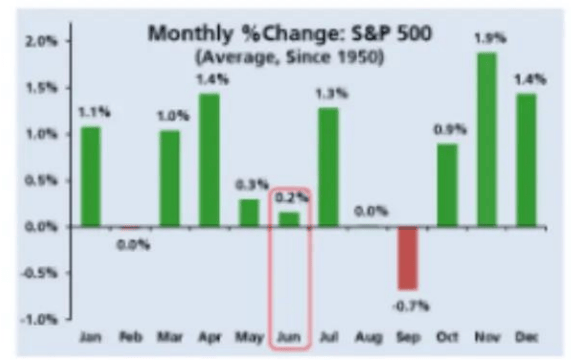
Group 1 - June is typically a month of consolidation across various asset classes, including currencies, commodities, and stocks [1] - Historically, the S&P 500 index shows a slight increase of 0.2% in June since 1950 [2] - The first week of June tends to perform strongly, stabilizing in the middle of the month, and then declining towards the end [4] Group 2 - June has been identified as a month with significant factor rotation, with quality, momentum, and size factors performing well, while value factors lag [8] - If seasonal patterns hold, June is expected to favor high-quality large-cap growth stocks, which are positioned at the intersection of all factor tilts [10] Group 3 - The European quality factor may rebound in June, as seasonal factors support long/short quality factor strategies [11] - The healthcare sector has historically performed well in June, with an average increase of 0.8% relative to the S&P 500 index [13] Group 4 - The biotechnology sector is particularly strong seasonally, suggesting that going long on the biotechnology index (XBI) may be the best strategy for the healthcare sector in June [15] - Historically, gold performs poorly in June but marks the end of a seasonal downturn, with significant improvement expected in July [15][17]

金融工程周报
SINOLINK SECURITIES· 2025-05-16 01:50
- The report discusses the performance of major market indices in China over the past week, highlighting that the SSE 50, CSI 300, CSI 500, and CSI 1000 indices all experienced gains, with respective increases of 1.93%, 2%, 1.6%, and 2.22%[2][12] - The report mentions the release of April inflation data in China, noting that the PPI was -0.27% year-on-year, down 0.2% from the previous month, and the CPI was -0.1% year-on-year, unchanged from the previous month[3][20] - The People's Bank of China announced ten specific measures, including a 0.5% reserve requirement ratio cut and a 0.1% interest rate cut, which positively impacted the banking sector[3][20] - The report highlights the implementation of the "Action Plan to Promote High-Quality Development of Public Funds" by the China Securities Regulatory Commission, which aims to ensure that fund managers' performance compensation is significantly reduced if their products underperform the benchmark by more than 10% over three years[3][20] - The report suggests that fund managers will focus more on closely tracking performance benchmarks and allocating funds to large-cap stocks to reduce market volatility and avoid significant style deviations[3][20] - The report recommends maintaining core positions in large-cap value stocks and tactically switching to financial and domestic consumption sectors for the upcoming week[4][21] - The report discusses the micro-cap stock index timing and rotation indicators, noting that the micro-cap stock index relative net value crossed above the annual line on October 14, 2024, and the trend has continued since then[5][30] - The micro-cap timing model uses two mid-term risk warning indicators: the ten-year government bond yield year-on-year indicator and the volatility congestion degree year-on-year indicator. As of October 15, 2024, the volatility congestion degree indicator fell below the threshold, and the ten-year government bond yield indicator was -20.45%, not triggering the risk control threshold of 0.3[5][30] - The report tracks the performance of eight major stock selection factors across different stock pools (all A-shares, CSI 300, CSI 500, and CSI 1000). The market capitalization factor performed best in the CSI 300 stock pool, while the reversal factor performed well in the CSI 500 and CSI 1000 stock pools[39][40] - The report notes that due to continued market volatility, volume-price factors maintained good performance, and small-cap stocks performed well, driving the market capitalization factor upward. The value factor also performed well due to the positive impact of the reserve requirement ratio cut on low-valuation sectors like banking[40] - The report provides the IC mean and long-short returns for the major factors, showing that the volatility factor achieved positive returns in the all A-shares stock pool, indicating some stability[41] - The report discusses the construction of quantitative bond selection factors for convertible bonds, tracking the performance of five bond selection factors. The equity growth factor achieved positive long-short returns last week[45][46] - The report includes detailed definitions and classifications of major factors, such as market capitalization, value, growth, quality, consensus expectations, technical, volatility, and reversal factors[51]
机构:价值、低波、红利等因子有效性或提升,300红利低波ETF(515300)最新规模创近1年新高!
Sou Hu Cai Jing· 2025-05-15 03:03
Group 1 - The CSI 300 Dividend Low Volatility Index decreased by 0.07% as of May 15, 2025, with mixed performance among constituent stocks [1] - China Shenhua led the gains with an increase of 1.48%, followed by China Life Insurance at 1.21% and Hangzhou Bank at 0.85%, while GF Securities experienced the largest decline [1] - The CSI 300 Dividend Low Volatility ETF (515300) saw a trading volume of 32.31 million yuan during the session, with an average daily trading volume of 114 million yuan over the past week [1] Group 2 - The latest size of the CSI 300 Dividend Low Volatility ETF reached 5.631 billion yuan, marking a one-year high [1] - Over the past five trading days, there were net inflows on four days, totaling 66.32 million yuan [1] - As of April 30, 2025, the top ten weighted stocks in the index accounted for 37.43% of the total, including China Shenhua, Gree Electric, and China Petroleum [1] Group 3 - Huatai Securities anticipates that a series of policies aimed at stabilizing the market and expectations will support risk appetite, with resilient inflation and export data for April [2] - The recent issuance of the "Action Plan for Promoting High-Quality Development of Public Funds" by the CSRC is expected to reshape the A-share market ecosystem [2] - Sectors such as large-cap stocks, financials, public utilities, and oil & petrochemicals are likely to benefit from the guidance towards long-term capital inflow and asset allocation [2]






价值、低波、红利等因子有效性或提升,红利低波ETF(512890)值得关注
Xin Lang Ji Jin· 2025-05-12 06:43
Group 1 - The core viewpoint of the articles highlights the active trading of the Dividend Low Volatility ETF (512890) and the supportive policies from the China Securities Regulatory Commission (CSRC) aimed at enhancing market stability and investor confidence [1][2] - The CSRC's new action plan includes 25 measures to shift the focus of the public fund industry from "scale" to "returns," which is expected to have a medium to long-term impact on the A-share market ecosystem [2] - The recent economic data, including resilient inflation and export figures, suggests a short-term favorable outlook, although the risk-reward ratio may decline, leading to a more structural market trend [1] Group 2 - The new regulations are expected to accelerate the trend towards indexation of public fund products and emphasize the performance benchmark constraints for fund products, potentially increasing allocations to low-risk equity funds and dividend assets [2] - Investment firms recommend maintaining current positions in the market while adjusting the portfolio structure, favoring sectors like large financials and dividend stocks over previously high-performing technology and growth sectors [1] - The MACD golden cross signal indicates positive momentum in certain stocks, suggesting potential investment opportunities [4]
因子投资凭什么赚钱?
雪球· 2025-05-08 07:44
Core Viewpoint - The article emphasizes the two fundamental logic of investment: taking on risk to earn risk premiums and capturing market mispricing, with a focus on factor investing as a primary strategy for the "Tianxingjian" fund portfolio [2]. Factor Investment Summary 1. Size Factor: The "Comeback" of Small Companies - The size factor focuses on smaller companies, which may offer excess returns due to their higher risk profile and potential undervaluation by larger institutions [4]. 2. Value Factor: The Wisdom of Buying "Cheap Goods" - The value factor targets companies with low valuations, where the risk premium arises from potential financial troubles and market overreactions to bad news, leading to mispricing [5][6]. 3. Quality Factor: The "Reward" for Good Companies - The quality factor emphasizes financially healthy companies, where excess returns may stem from investor short-sightedness and the undervaluation of stable firms [7]. 4. Dividend Factor: The "Charm" of Cash Cows - The dividend factor focuses on companies with stable and high dividend payouts, where the risk premium may relate to growth uncertainties or interest rate sensitivities, leading to systematic undervaluation [8]. 5. Low Volatility Factor: Steady Happiness - The low volatility factor targets companies with lower stock price fluctuations, where excess returns may arise from market biases favoring high-risk stocks, resulting in undervaluation of low-volatility stocks [9]. Conclusion - Each factor that consistently outperforms the market is influenced by both risk premiums and market mispricing, with understanding these dynamics aiding in the effectiveness of factor investing [10].

上证全指相对成长指数下跌0.45%,前十大权重包含京沪高铁等
Jin Rong Jie· 2025-04-15 08:51
Group 1 - The A-share market showed mixed performance with the Shanghai Composite Index relative to the growth index declining by 0.45%, closing at 2675.86 points and a trading volume of 171.84 billion [1] - The Shanghai Composite Index relative to the growth index has decreased by 5.59% over the past month, increased by 0.79% over the past three months, and has declined by 1.15% year-to-date [1] - The Shanghai Composite Index style index series is based on the Shanghai Composite Index, calculating style scores based on growth and value factors, selecting the top 150 listed companies for the growth and value indices [1] Group 2 - The top ten holdings of the Shanghai Composite Index relative to the growth index include Kweichow Moutai (12.65%), Zijin Mining (3.77%), and others, with the Shanghai Stock Exchange accounting for 100% of the holdings [2] - The industry composition of the holdings in the Shanghai Composite Index relative to the growth index includes Information Technology (19.80%), Industrials (19.31%), Consumer Staples (18.67%), and others [2] Group 3 - The index sample is adjusted every six months, with adjustments occurring on the next trading day after the second Friday of June and December, with a sample adjustment ratio generally not exceeding 20% [3] - In special circumstances, the index may undergo temporary adjustments, and companies that are delisted will be removed from the index sample [3]