
价格治理

Search documents
中医优势病种按病种付费试点工作即将开启
Xiangcai Securities· 2025-10-19 13:45
Investment Rating - The industry maintains an "Overweight" rating [8] Core Insights - The Chinese medicine sector outperformed other pharmaceutical sub-sectors last week, with a 0.38% increase, while the overall pharmaceutical sector declined by 2.48% [2] - The current PE (ttm) for the Chinese medicine sector is 27.9X, which is at the 30.45% percentile since 2013, while the PB (lf) is 2.36X, at the 6.85% percentile since 2013 [3] - The price index for Chinese medicinal materials remained stable due to the National Day holiday, with a total index of 232.77 points [4] - A pilot program for disease-based payment for traditional Chinese medicine (TCM) is set to begin, which may enhance reimbursement for TCM services [5] Summary by Sections Market Performance - The Chinese medicine sector recorded a 0.38% increase, while the overall pharmaceutical sector saw a decline of 2.48% [2] - Top-performing companies in the sector include Guizhou BaiLing, Wanbangde, and Darentang, while underperformers include Tianmu Pharmaceutical and Tailong Pharmaceutical [2] Valuation - The PE (ttm) for the Chinese medicine sector is 27.9X, up 0.1X week-on-week, with a one-year maximum of 30.26X and a minimum of 24.72X [3] - The PB (lf) is 2.36X, unchanged from the previous week, with a one-year maximum of 2.59X and a minimum of 2.17X [3] Policy Developments - The pilot program for TCM payment will select around 15 provinces or cities to test the new payment model over 2-3 years, potentially improving the compatibility of TCM services with existing insurance payment methods [5] Investment Recommendations - The report suggests focusing on three main investment themes: price governance, consumption recovery, and state-owned enterprise reform [6][11][12] - Specific recommendations include companies with strong R&D capabilities and unique products, as well as those less affected by price reductions from centralized procurement [12]
华夏时评:价格治理不是“终点”,需求扩张才是“起点”
Hua Xia Shi Bao· 2025-10-10 10:53
Core Viewpoint - The 2025 Golden Week saw a significant increase in domestic travel and spending, indicating a stable growth in total consumption, but further efforts are needed to stimulate consumer confidence and market order [2][3]. Group 1: Economic Performance - During the 8-day holiday, there were 888 million domestic trips, an increase of 123 million compared to the 2024 National Day holiday [2]. - Total domestic spending reached 809 billion yuan, up by 108.19 billion yuan from the previous year [2]. Group 2: Market Regulation - The National Development and Reform Commission and the State Administration for Market Regulation issued an announcement to combat price disorder and maintain a fair market price order [2][3]. - The announcement includes a three-step approach: industry average cost investigation, warning reminders, and law enforcement inspections to address issues like below-cost pricing [2]. Group 3: Demand Management - Price governance is seen as a starting point for demand expansion, emphasizing the need for both short-term stimulus and long-term structural reforms [4]. - Short-term measures should focus on fiscal expansion and monetary policy coordination to meet economic development goals [4]. Group 4: Long-term Strategies - Strategies to stimulate domestic demand should include promoting consumption upgrades and addressing livelihood shortcomings to support the next growth cycle [4][5]. - Emphasis on income distribution reform is crucial to enhance consumer spending power and address insufficient domestic demand [5].


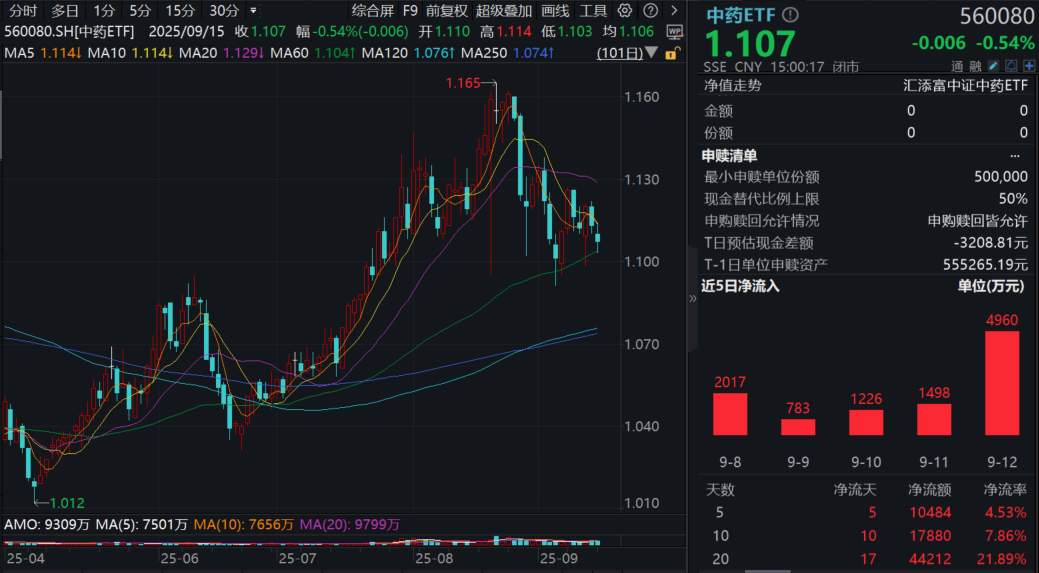
资金坚定“高切低”!中药ETF(560080)收跌0.54%两连阴,全天溢价高企,基金份额创上市以来新高,连续10日“吸金”超1.78亿
Xin Lang Cai Jing· 2025-09-15 09:40
Core Viewpoint - The market is experiencing fluctuations, with strong interest in relatively stable performance and high valuation products, particularly in the traditional Chinese medicine (TCM) sector, as evidenced by the recent performance of the Chinese Medicine ETF (560080) [1][2]. Market Performance - The Chinese Medicine ETF (560080) closed down 0.54% with a trading volume of nearly 100 million yuan, while maintaining a premium rate of 0.24% at the close [1]. - The ETF has seen a net inflow of over 178 million yuan over the past 10 days, reaching a record high in fund shares since its listing [1][2]. - The financing balance for the Chinese Medicine ETF has exceeded 70 million yuan, indicating strong investor interest [1]. Valuation Metrics - The dynamic price-to-earnings (P/E) ratio of the TCM sector is at a low since 2021, with the CSI Traditional Chinese Medicine Index TTM P/E ratio at 25.76x as of September 12, 2025 [3]. Stock Performance - Most major components of the Chinese Medicine ETF saw declines, with notable drops including Da Ren Tang down over 2% and Dong E E Jiao down over 1% [5]. - Conversely, Zhongheng Group increased nearly 4%, while Yunnan Baiyao and Zhongsheng Pharmaceutical saw slight increases [5]. Policy Developments - A recent government plan aims to accelerate the promotion of TCM at the grassroots level, with a goal for every county-level TCM hospital to establish at least two specialty departments and one TCM technology promotion center by 2030 [7]. - The National Health Commission is working on revising the National Essential Medicines List, which could further promote the application of TCM in grassroots markets [7]. Investment Opportunities - Three main investment themes in the TCM sector are identified: 1. Price governance, focusing on competitive advantages and the ability to exchange price for volume [8]. 2. Consumption recovery driven by macroeconomic improvement and aging population trends [8]. 3. State-owned enterprise reform, which is expected to enhance performance and create investment opportunities [9]. Recommendations - Investors are advised to focus on companies with strong R&D capabilities, those less affected by centralized procurement, and those with strong brand power and product offerings [9].
中药行业周报:中医药在基层使用推广有望加速-20250914
Xiangcai Securities· 2025-09-14 11:49
Investment Rating - The industry rating is maintained at "Overweight" [7] Core Views - The market performance of the traditional Chinese medicine (TCM) sector showed a slight increase of 0.03% last week, while the overall pharmaceutical sector experienced a minor decline of 0.36% [2] - The TCM sector's PE (ttm) is at 28.52X, with a PB (lf) of 2.42X, indicating a stable valuation compared to historical data [3] - The demand for TCM materials is expected to rise as the traditional medication peak season approaches, leading to a rebound in market conditions [4] - The promotion of TCM at the grassroots level is anticipated to accelerate, supported by government initiatives to enhance TCM services in community health centers and county hospitals [5][6] Market Performance - The TCM sector's index closed at 6720.55 points, reflecting a 0.03% increase, while the pharmaceutical sector index was at 9157.77 points, down 0.36% [2][18] - The performance of individual companies within the TCM sector varied, with leading companies including Yiling Pharmaceutical and Wanbangde, while companies like Kangyuan Pharmaceutical and Zhendong Pharmaceutical lagged [2][15][17] Valuation - The TCM sector's PE (ttm) is at 28.52X, unchanged from the previous week, with a one-year maximum of 30.26X and a minimum of 22.58X [3] - The PB (lf) stands at 2.42X, also stable, with a one-year maximum of 2.65X and a minimum of 1.99X [3] Policy and Regulatory Environment - The State Council's recent approval of the "Healthcare Strengthening Foundation Project" aims to enhance the use of TCM in grassroots healthcare settings, which is expected to significantly impact the sector [5] - The National Health Commission's response regarding the basic drug directory management indicates potential adjustments that could favor TCM applications in grassroots markets [6] Investment Recommendations - The report suggests focusing on three main investment themes: price governance, consumption recovery, and state-owned enterprise reform [10][11] - Specific investment targets include companies with strong R&D capabilities, those less affected by centralized procurement, and leading TCM brands [10][11]


7月份国内市场钢材价格止跌回升
Zhong Guo Chan Ye Jing Ji Xin Xi Wang· 2025-09-05 01:12
Core Viewpoint - In July, the domestic steel market showed an upward trend due to favorable macro policies, increased cost support, and enhanced expectations for crude steel production regulation. However, in August, the market began to return to fundamentals, with prices experiencing slight fluctuations amid weak demand and continuous inventory accumulation [1][6]. Price Index Summary - The China Steel Price Index (CSPI) averaged 92.79 points in July, an increase of 2.69 points (2.98%) month-on-month, but a decrease of 7.67 points (7.64%) year-on-year. The long product index averaged 94.82 points, up 2.90 points (3.16%) month-on-month, and the plate index averaged 91.10 points, up 2.78 points (3.14%) month-on-month [2]. - As of the end of July, the CSPI was 95.87 points, up 6.36 points (7.11%) month-on-month, but down 1.60 points (1.64%) year-to-date [2]. Price Trends of Major Steel Products - In July, the average prices of major steel products increased across the board, with hot-rolled coil prices rising by 133 CNY/ton (4.07%) and seamless pipe prices increasing by 15 CNY/ton (0.36%) [5]. Regional Price Index Analysis - In July, the average steel price index across six major regions in China showed a general upward trend, with the East China region experiencing the largest increase of 3.37% [7]. Investment and Economic Indicators - From January to July, fixed asset investment (excluding rural households) totaled 288,229 billion CNY, a year-on-year increase of 1.6%, with infrastructure investment growing by 3.2% [8]. - The manufacturing sector faced challenges, with the Purchasing Managers' Index (PMI) dropping to 49.3% in July, indicating a contraction in manufacturing activity [9]. Steel Production and Consumption - From January to July, crude steel production was 59,447 million tons, a decrease of 3.1% year-on-year, while apparent crude steel consumption fell by 6% [11]. - In July, the daily crude steel production was 256.9 thousand tons, down 7.4% month-on-month [11]. International Market Trends - The CRU international steel price index was 186.2 points in July, down 1.0% month-on-month and 2.1% year-on-year [13]. - The North American steel price index increased by 2.1% in July, while European and Asian markets continued to see price declines [17][19]. Future Price Trends and Policy Implications - The steel industry is expected to face challenges in exports due to ongoing trade investigations and tariffs, which may impact future pricing and demand [24]. - The industry is advised to focus on price governance mechanisms and self-regulation in production to adapt to changing market conditions [25][26].
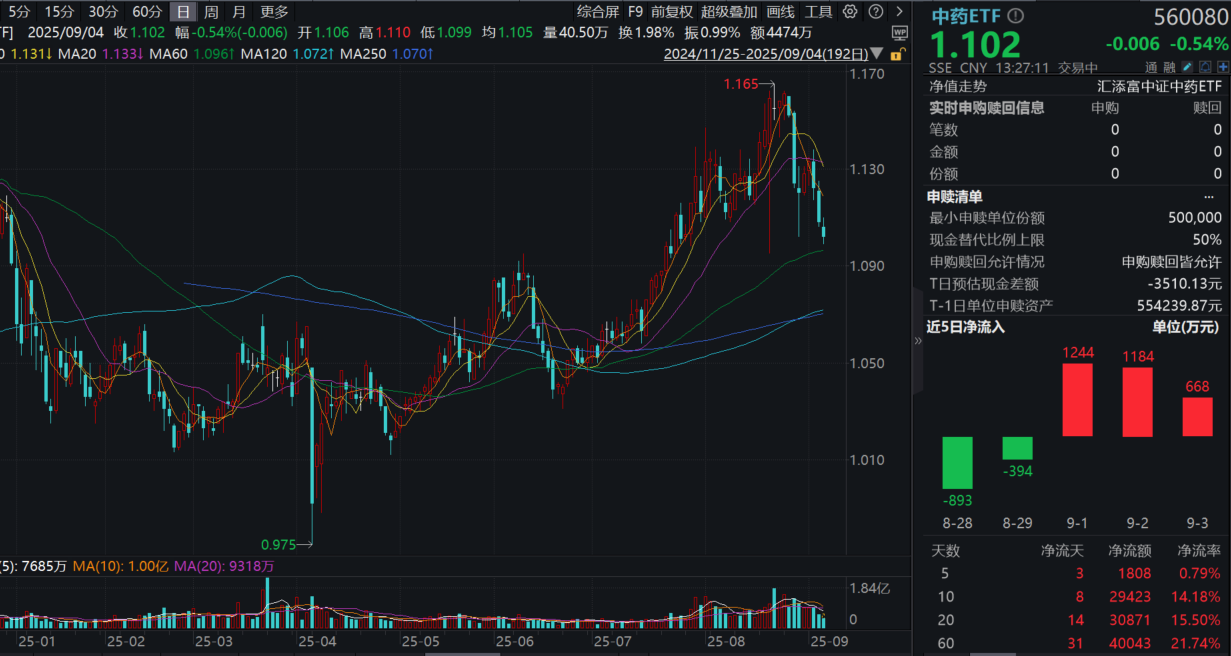
A股震荡,云南白药、华润三九跌超1%,中药ETF(560080)缩量回调,溢价大幅走阔!资金逢跌涌入!机构:静待需求回暖
Xin Lang Cai Jing· 2025-09-04 06:21
Core Viewpoint - The Chinese medicine sector is experiencing a phase of performance pressure, but there are signs of potential recovery in demand and profitability in the second half of 2025, with a focus on companies with strong fundamentals and innovative pipelines [7][10][11]. Market Performance - On September 4, the Shanghai Composite Index fell over 1%, and the Sci-Tech Innovation 50 Index dropped more than 5%, indicating a volatile market environment [1]. - The Chinese medicine ETF (560080) saw a slight decline of 0.54%, with a trading volume exceeding 44 million yuan, reflecting strong demand for buying on dips despite recent losses [1]. Valuation Metrics - As of September 3, 2025, the TTM price-to-earnings ratio of the CSI Traditional Chinese Medicine Index is 25.75x, which is at a low level since 2021 [3]. Company Performance - In the first half of 2025, the total revenue of 64 Chinese medicine companies was 172.9 billion yuan, a year-on-year decrease of 4.95%, while the net profit attributable to shareholders decreased by 9.31% to 19.1 billion yuan [7]. - The gross margin for the sector was 42.05%, down 1.01 percentage points year-on-year, while the net profit margin was 11.04%, down 0.56 percentage points [7]. Cash Flow and Expenses - The median expense ratio for the Chinese medicine sector in the first half of 2025 was 44.5%, up 1.5 percentage points from the same period in 2024, indicating stable expense management [9]. - Operating cash flow improved by 30.77% year-on-year, suggesting better collection of receivables [7][9]. Market Trends - Despite weak OTC demand, the consolidation of retail pharmacies is expected to enhance market concentration for leading OTC products, with market shares for key products increasing [10]. - The Chinese medicine industry is expected to benefit from three main themes: price governance, consumption recovery, and state-owned enterprise reform, which could lead to improved performance for competitive companies [11][12].


中药行业周报:关注中报业绩超预期标的-20250824
Xiangcai Securities· 2025-08-24 13:49
Investment Rating - The industry maintains an "Overweight" rating, suggesting a positive outlook for investment opportunities in the sector [6]. Core Insights - The Chinese herbal medicine sector has shown strong performance, with the sub-sector index rising by 2.86%, outperforming other pharmaceutical sub-sectors [2]. - The price governance policies are expected to create a more pronounced differentiation within the industry, favoring companies with competitive advantages [6]. - The upcoming disclosure period for mid-year reports from herbal medicine companies is anticipated to provide insights into their performance, with 43 companies set to report [5]. Market Performance - The Chinese herbal medicine index closed at 6973.18 points, reflecting a 2.86% increase over the past week, while the overall pharmaceutical index rose by 1.05% [2][12]. - The performance of individual companies varied, with ST Xiangxue and Renhe Pharmaceutical leading, while Weikang Pharmaceutical and Xinguang Pharmaceutical lagged [2][17][19]. Valuation Metrics - The price-to-earnings (PE) ratio for the herbal medicine sector is currently at 30.11X, up by 0.85X week-on-week, indicating a relatively high valuation compared to historical levels [3]. - The price-to-book (PB) ratio stands at 2.5X, also reflecting an increase, suggesting that the sector is trading at a premium compared to its historical averages [3]. Supply Chain Insights - The herbal medicine raw material market is experiencing significant inventory pressure, with a slight decline in prices due to weak demand [4]. - The price index for herbal materials has decreased by 0.8% week-on-week, indicating a potential ongoing downward trend in pricing [4]. Investment Recommendations - The report suggests focusing on three main investment themes: price governance, consumption recovery, and state-owned enterprise reform [6][9]. - Specific investment targets include companies with strong R&D capabilities, those less affected by price collection policies, and leading brand herbal medicine firms [10].
创新价格治理方式护航平台经济
Jing Ji Ri Bao· 2025-08-23 22:16
Core Viewpoint - The platform economy is increasingly significant in China's economic landscape, providing new opportunities for domestic demand and employment while also requiring regulatory measures to ensure fair pricing practices and protect consumer rights [1][2]. Group 1: Importance of Regulating Platform Pricing Behavior - Regulating pricing behavior is crucial for the high-quality development of the platform economy, transitioning from "scale expansion" to "quality improvement" [1]. - The pricing behavior of internet platforms is characterized by "bilateral market" features and "technology empowerment," necessitating a regulatory framework to protect both operators and consumers [1][2]. Group 2: Overview of the Pricing Behavior Rules - The "Behavior Rules" consist of 30 articles focusing on aspects such as operator pricing autonomy, price marking, competitive pricing behavior, consumer price rights protection, and supervision mechanisms [2]. - The rules prioritize the autonomy of platform operators in pricing, encouraging innovation and quality improvement while prohibiting practices that manipulate transaction prices through technical means [2]. Group 3: Consumer Rights Protection and Transparency - The rules establish clear pricing display requirements to address information asymmetry, including mandates for transparent pricing mechanisms and disclosure of differential pricing practices [3]. - Consumer rights are reinforced by requiring platforms to clearly present options for automatic payments and renewals, along with easy cancellation methods [3]. Group 4: Implementation and Collaboration - The implementation of the "Behavior Rules" will require collaboration among various stakeholders, including government, platform operators, and industry associations, to ensure effective governance [5][6]. - A multi-faceted approach is recommended for the rules' enforcement, including institutional innovation, technological support, and credit building to create a comprehensive governance ecosystem [6].
“反内卷”:三重目标下如何去产能、提物价
Soochow Securities· 2025-07-28 06:02
Group 1: Capacity Reduction Strategy - The "anti-involution" price governance aims for three goals: short-term regulation of price wars, medium-term capacity reduction, and long-term price recovery, particularly PPI[1] - Capacity reduction can be categorized into two types: shutdown and production limitation, and policy-guided capacity reduction[1] - The current trend favors policy-guided capacity reduction over shutdowns, as the demand side lacks strong stimulus policies[1] Group 2: Price Recovery Expectations - PPI is expected to take 11-12 months to turn positive, potentially reaching around 1.9% by September 2026 under neutral assumptions[1] - Three scenarios for PPI recovery are outlined: optimistic (3.86%), neutral (1.92%), and pessimistic (0.9%) by September 2026, depending on the strength of supply-side capacity reduction[3] - The GDP deflator's recovery is more challenging than PPI due to the service sector's larger weight, with the second industry experiencing a -3.06% deflation in Q2 2024[3] Group 3: Market Clearing Mechanism - The market clearing mechanism is essential for addressing capacity surplus, requiring timely price adjustments and responsive supply behavior[22] - Current obstacles include government subsidies allowing firms to sell below cost, leading to persistent losses and market inefficiencies[24] - Previous efforts to clear "zombie enterprises" in coal and steel sectors have shown significant results, with 115 million tons of capacity addressed[24]
中药行业周报:多地对中成药价格提出治理要求-20250727
Xiangcai Securities· 2025-07-27 10:12
Investment Rating - The industry investment rating is maintained at "Overweight" [4] Core Views - The market performance shows that the Chinese medicine sector has increased by 1.39% last week, while the overall pharmaceutical sector continues its upward trend, with Chinese medicine lagging behind [3][6] - The price governance of traditional Chinese medicine (TCM) is being implemented across multiple regions, with various local health insurance bureaus issuing notifications regarding price risk management for certain TCM products [9] - The valuation metrics for the Chinese medicine sector indicate a PE (ttm) of 28.69X, which has increased by 0.41X week-on-week, and a PB (lf) of 2.37X, which has also risen by 0.03X week-on-week [7] Summary by Sections Market Performance - The Chinese medicine sector reported a closing index of 6638.77 points, reflecting a 1.39% increase, while the overall pharmaceutical index closed at 8580.75 points, up by 1.9% [6][22] - The performance of individual companies within the sector varied, with notable gainers including Zhendong Pharmaceutical and Yabao Pharmaceutical, while Wanbangde and Weikang Pharmaceutical showed declines [6][22] Valuation - The current PE (ttm) for the Chinese medicine sector is 28.69X, with a one-year maximum of 30.13X and a minimum of 22.58X, placing it at the 32.65% percentile since 2013 [7] - The PB (lf) stands at 2.37X, with a one-year maximum of 2.65X and a minimum of 1.99X, positioning it at the 7.04% percentile since 2013 [7] Price Governance - Recent notifications from various local health insurance bureaus indicate a focus on price governance for TCM, with specific measures being taken in regions such as Ningxia and Jilin [9] - The governance aims to address price risks associated with TCM products, particularly those that exceed local minimum treatment costs [9] Investment Recommendations - The report suggests focusing on three main investment themes: price governance, consumption recovery, and state-owned enterprise reform [11][12] - Specific recommendations include companies with strong R&D capabilities and unique products, as well as those less affected by centralized procurement [12]