信用评级下调

Search documents
S&P downgrades Statkraft’s credit rating from A to A-, in line with the company’s long-standing rating target
Globenewswire· 2025-11-12 16:51
Group 1 - S&P downgraded Statkraft AS's long-term issuer credit rating from A to A- due to weakening performance and financial metrics, with a stable outlook [1] - Statkraft has consistently targeted an A- rating from S&P and a BBB+ from Fitch, and remains committed to these targets [1] - On June 18, Statkraft announced a new strategy aimed at strengthening core activities and competitiveness [2] Group 2 - For updates on strategy execution, stakeholders can refer to the Q3 2025 presentation available on Statkraft's website [2] - The rating report can also be accessed through Statkraft's investor relations section [2]


Muni Market Rebounds After Early-Year Selloff
Youtube· 2025-10-30 19:36
Core Viewpoint - The underperformance in the market is primarily attributed to technical factors rather than fundamental issues, with uncertainty around tax exemptions leading to increased supply that was not matched by buyer demand [1][2]. Market Dynamics - The market is currently experiencing a record supply of bonds, which has not been sufficiently absorbed by buyers due to concerns over tariffs and federal spending [2][3]. - The ongoing government shutdown is impacting federal funding, particularly Medicaid, which constitutes about 60% of state revenues, leading to potential budget cuts at the state level [3][4]. State-Level Financial Health - States have a limited timeframe to address budgetary challenges, with options including cutting coverage or making difficult budgetary decisions [5]. - California is highlighted as a state with high revenues (over 50% higher than pre-COVID levels) but facing potential downgrades due to excessive spending [6][7]. Credit Ratings and Investment Strategy - A downgrade for California would still leave its bonds in a strong position, but it reflects undesirable fiscal behavior [8]. - Anticipation of a potential downgrade could occur as early as summer, prompting a shift in investment focus towards more reliable revenue sources such as local geos and public schools [9]. Year-End Market Outlook - The supply of municipal bonds is expected to decrease in the fourth quarter, which is a positive indicator for yields, aligning with forecasts for the year [11].

跟随惠誉步伐,标普下调法国信用评级至A+
智通财经网· 2025-10-18 03:21
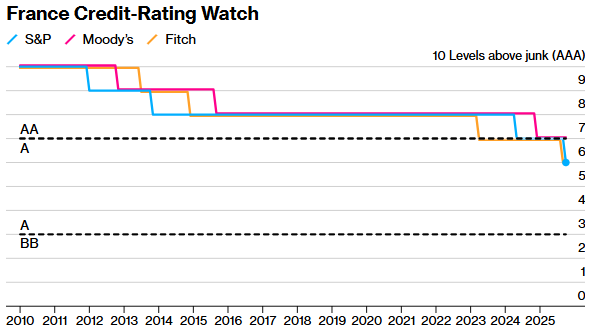
Core Viewpoint - Standard & Poor's (S&P) downgraded France's credit rating from AA- to A+, marking a significant blow to the country's credibility amid rising debt burdens and political instability [1][4]. Group 1: Credit Rating Downgrade - France has lost two "AA" ratings from major credit rating agencies within a month, which may compel strict investment funds to sell French bonds [1]. - The downgrade places France at the same level as Spain and Portugal, six levels above junk status, with a stable outlook [1]. Group 2: Political and Fiscal Challenges - France's minority government is struggling to pass legislation to address its growing debt, with high budget uncertainty despite the submission of the 2025 budget draft [1][4]. - Recent political instability, including the dismissal of two prime ministers over budget issues, has raised concerns about a potential public finance crisis [4]. - The current Prime Minister, Sébastien Lecornu, has made compromises to maintain his position, including agreeing to increase fiscal deficit spending and suspending pension reform plans [4][5]. Group 3: Fiscal Targets and Economic Outlook - Lecornu aims to reduce the budget deficit from 5.4% of GDP this year to 4.7% next year, while maintaining a target of below 3% by 2029 [4][5]. - The spread between French and German 10-year government bond yields has increased by over 85 basis points recently, indicating rising borrowing costs for France [5][6]. - S&P warned that further deterioration in France's fiscal situation or economic growth prospects could lead to additional rating downgrades [6].

Global market reaction to two years of war in Gaza
Yahoo Finance· 2025-10-09 13:55
Group 1: Market Response - Israeli stocks and major global defense manufacturers have seen significant increases since the October 7, 2023 attacks, with defense stocks rising over 120% [2] - The MSCI Israel stocks index has increased by more than 80%, outperforming main global stock benchmarks by approximately 30 percentage points [3] Group 2: Credit Ratings - Israel experienced its first-ever credit rating downgrades in 2024, initiated by Moody's, followed by S&P and Fitch [4] - Concerns about Israel's credit status peaked during the conflict, with credit default swap markets indicating a potential downgrade to 'junk' status, although these fears have since diminished [5] Group 3: Economic Impact - The war has severely impacted Israel's economy, which is valued at $580 billion, with initial costs estimated at around 14 billion shekels ($3.75 billion) [6] - Economic growth nearly halted last year, but is projected to be 2.5% this year, with potential for over 5% growth next year if a "peace dividend" occurs [6] Group 4: Commodity Prices - Oil prices surged above $90 per barrel following the Hamas attacks, but quickly fell back to $75 by the end of 2023 [7] - Tensions with Iran caused another spike in oil prices in early 2024, which also subsided after initial escalations [8] Group 5: Safe-Haven Assets - Gold prices increased nearly 3% after the Hamas attacks, marking the largest weekly rise in six months, and have continued to rise since then [9]
Schlosstein Doesn't Expect Shutdown to Cause Recession
Youtube· 2025-10-06 18:04
Group 1: Government Shutdown Implications - The current government shutdown appears to be more prolonged due to a lack of communication between the parties involved, differing from historical instances where resolutions were typically reached quickly [2][3] - The president's potential aim to reduce the size of government could have a more significant impact on GDP than usual, as past shutdowns often resulted in backpay that mitigated economic effects [3][5] - The upcoming military payday on October 15th is a critical date, as both parties may want to avoid being blamed for not paying troops, which could prompt negotiations [4] Group 2: Economic and Credit Rating Concerns - The risk of a recession stemming from the shutdown is considered minor, as shutdowns are generally short-lived and spending delays are usually compensated later [5][6] - Credit rating agencies have already downgraded U.S. debt, citing shutdowns and political dysfunction, which raises concerns about U.S. fiscal governance [6][7] - Persistent dysfunction in Washington may lead rating agencies to question whether the U.S. can effectively utilize its resources to maintain credit ratings [7][8] Group 3: Fiscal Sustainability - The U.S. is currently on an unsustainable fiscal path, with uncertainty about what will trigger a necessary change, but a significant adjustment is anticipated when it occurs [8][9]
特朗普政府停摆再度升级,两党补助问题互不相让,美多重风险叠加
Sou Hu Cai Jing· 2025-09-30 10:10
Core Viewpoint - The potential government shutdown in the U.S. is expected to be unprecedented, with more significant unpredictability and potential damage compared to previous shutdowns [1] Group 1: Historical Context - Since 1976, the U.S. federal government has experienced 21 shutdowns, with most employees receiving back pay afterward [3] - The longest shutdown lasted 35 days, affecting approximately 800,000 federal employees, with 40% on unpaid leave and 60% required to work without pay [3] Group 2: Legislative Framework - The Government Employee Fair Treatment Act of 2019 ensures that all employees, regardless of their position, receive full back pay after a shutdown [5] - This act has not been previously challenged, providing a safety net for federal employees [5] Group 3: Current Developments - Trump's threat of "permanent layoffs" targets non-essential employees, leading to legal challenges regarding the compliance of the Office of Management and Budget's (OMB) layoff directives [6][8] - Approximately 25,000 probationary employees are currently affected, with the legality of their potential layoffs becoming a focal point of litigation [8] Group 4: Operational Impact - The Federal Aviation Administration (FAA) and Transportation Security Administration (TSA) are essential services, but past shutdowns have shown significant operational disruptions, such as a 10% absentee rate among TSA agents during the 2019 shutdown [9] - If 44,000 TSA employees face unpaid work again, there is a risk of airport shutdowns across the U.S. [10] Group 5: Economic Consequences - The shutdown could delay critical economic reports, including the September employment report and mid-month inflation data, affecting data quality for several months [12][14] - The 2019 shutdown lowered GDP by 0.2%, resulting in a loss of $11 billion, and a similar impact is anticipated if the current shutdown persists [14] Group 6: Broader Implications - The Federal Reserve's independence may be compromised due to recent political tensions, raising concerns about potential administrative interference in monetary policy [15] - The Consumer Financial Protection Bureau, reliant on Federal Reserve funding, may face operational paralysis during the shutdown [17] - The ongoing political standoff has led to a downgrade in the U.S. credit rating by both S&P and Fitch, reflecting the severity of the situation [17]

法国评级下调,政治失衡是主因
Sou Hu Cai Jing· 2025-09-16 00:50
Core Viewpoint - Fitch Ratings downgraded France's credit rating from "AA-" to "A+", indicating a shift from "very low" to "low" default risk, which has raised concerns among political figures but is seen as a manageable situation by economists [1][2]. Group 1: Rating Downgrade Implications - The downgrade is viewed as a negative signal but does not imply an economic crisis; rather, it highlights a political crisis in France [2]. - Despite the downgrade, France's credit status remains relatively stable compared to countries like Spain and Italy, suggesting that the impact on the economy will not be severe [1][2]. Group 2: Political Context - The political landscape in France is described as structurally paralyzed, with a fragmented parliament leading to instability and challenges in passing fiscal policies [2]. - The resignation of former Prime Minister François Bayrou due to a failed confidence vote reflects the ongoing political turmoil, with the new Prime Minister facing significant challenges from far-right forces [2]. Group 3: Economic Risks - The real risk for France is likened to an "Italian-style dilemma," where rising debt financing costs could gradually limit the country's investment capacity, posing a long-term threat [2]. - An increase in interest rates by one percentage point could lead to an additional €3 billion in annual spending, accumulating to €30 billion over ten years, which is comparable to France's annual investment needs for emission reduction goals [2]. Group 4: Government Strategy - The new Prime Minister's primary task is to ensure the budget passes smoothly to restore market confidence, balancing efficiency and compromise among various political interests [3]. - The government may need to adjust its €44 billion fiscal target to facilitate budget approval and stabilize the political situation, which is crucial for regaining investor trust and maintaining lower financing costs [3].
法国总理政治豪赌引发“多事之秋”!总统马克龙也被拉下水?
Jin Shi Shu Ju· 2025-08-28 03:38
Group 1 - The French Prime Minister François Bayrou's decision to hold a confidence vote has plunged the Eurozone's second-largest economy back into crisis, raising significant economic risks and concerns about a potential recession [2] - Business leaders in France express that the uncertainty surrounding the political situation is likely to lead consumers to delay spending decisions, which could severely impact the economy [2][3] - France's economy grew by 0.3% in the second quarter, primarily supported by a rebound in household spending, but this reliance on consumption raises concerns about recession risks [2][3] Group 2 - Bayrou's proposed budget tightening plan of €44 billion includes measures such as canceling two public holidays and freezing most public spending, amidst rising debt and deficit levels [3] - Polls indicate that a significant majority of the French public prefers new national elections, with support for this approach ranging from 56% to 69% [3][4] - The political landscape shows that 41% of respondents favor the far-right National Rally leading the next government, although 59% oppose this party's leadership [4] Group 3 - The decision to hold a confidence vote has triggered significant market sell-offs, narrowing the yield spread between French and Italian 10-year bonds, while the French 30-year bond yield reached a 14-year high of 4.45% [5] - Analysts suggest that whether a new Prime Minister is appointed or early elections are called, both scenarios could lead to prolonged uncertainty in the market [5] - Upcoming credit rating assessments could act as catalysts for the bond market, with Fitch planning to evaluate France shortly after the confidence vote [5]
常德农商行上半年净利378万元同比降逾45% 此前主体信用评级遭下调
Xin Lang Cai Jing· 2025-08-01 07:40
Group 1 - The core viewpoint of the news is that Changde Rural Commercial Bank has experienced a significant decline in revenue and net profit in the first half of 2025, alongside a further drop in capital adequacy ratio, leading to a downgrade in its credit rating [1][2] - In the first half of 2025, Changde Rural Commercial Bank reported operating income of 370 million yuan, a year-on-year decrease of 9.71%, with net interest income at 250 million yuan, down 21.77% [1] - The net profit for the same period was 3.7845 million yuan, reflecting a substantial year-on-year decline of 45.8% [1] Group 2 - As of June 30, 2025, the total assets of Changde Rural Commercial Bank amounted to 38.43 billion yuan, with total liabilities of 36.496 billion yuan [1] - The capital adequacy ratio, tier 1 capital adequacy ratio, and core tier 1 capital adequacy ratio were reported at 8.07%, 6.73%, and 6.73% respectively, all below regulatory requirements [1][2] - The bank's credit rating was downgraded from AA- to A+ on July 17, 2025, primarily due to a significant increase in non-performing loan ratio and a substantial decline in profitability [2]
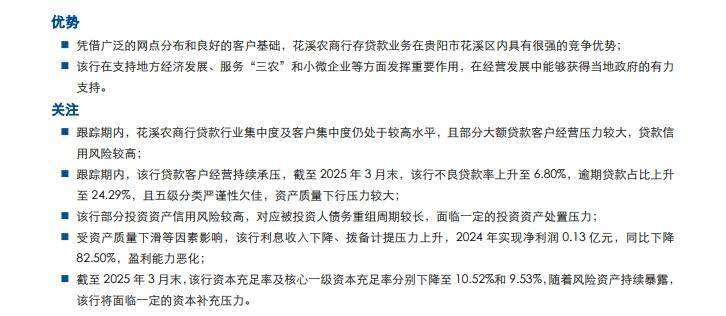
贵州花溪农商银行评级遭下调:一季度末不良率6.80%,2024年净利润同比下降超80%
Sou Hu Cai Jing· 2025-07-31 10:52
Core Viewpoint - The credit rating of Guizhou Huaxi Rural Commercial Bank Co., Ltd. has been downgraded from A+ to A, with a stable outlook, primarily due to declining asset quality, deteriorating profitability, and pressure on capital adequacy [1] Asset Quality - The bank's non-performing loan (NPL) ratio has risen to 6.80% as of March 2025, with overdue loans accounting for 24.29% of total loans, indicating significant downward pressure on asset quality [3] - The bank's loan concentration is high, with the top five industries (wholesale and retail, agriculture, leasing and commercial services, real estate, and accommodation and catering) accounting for 86.09% of total loans as of March 2025 [3] - Customer concentration is also elevated, with single customer loan concentration at 9.68% and top ten customer concentration at 94.92%, both increasing significantly compared to the end of 2023 [3] Profitability - The bank's net profit for 2024 plummeted by 82.50% to 0.13 billion, with a return on equity (ROE) dropping to 0.47% [3] - Despite a 16.77% increase in operating income to 0.687 billion in 2024, the surge in credit impairment losses (up 109.47% year-on-year) severely impacted profitability [3] Capital Adequacy - As of March 2025, the capital adequacy ratio stands at 10.52%, down 1.08 percentage points from the end of 2024, indicating reduced capital buffer [4] - The core tier one capital adequacy ratio is at 9.53%, also showing a decline, suggesting pressure for capital replenishment [4]