
债务负担

Search documents
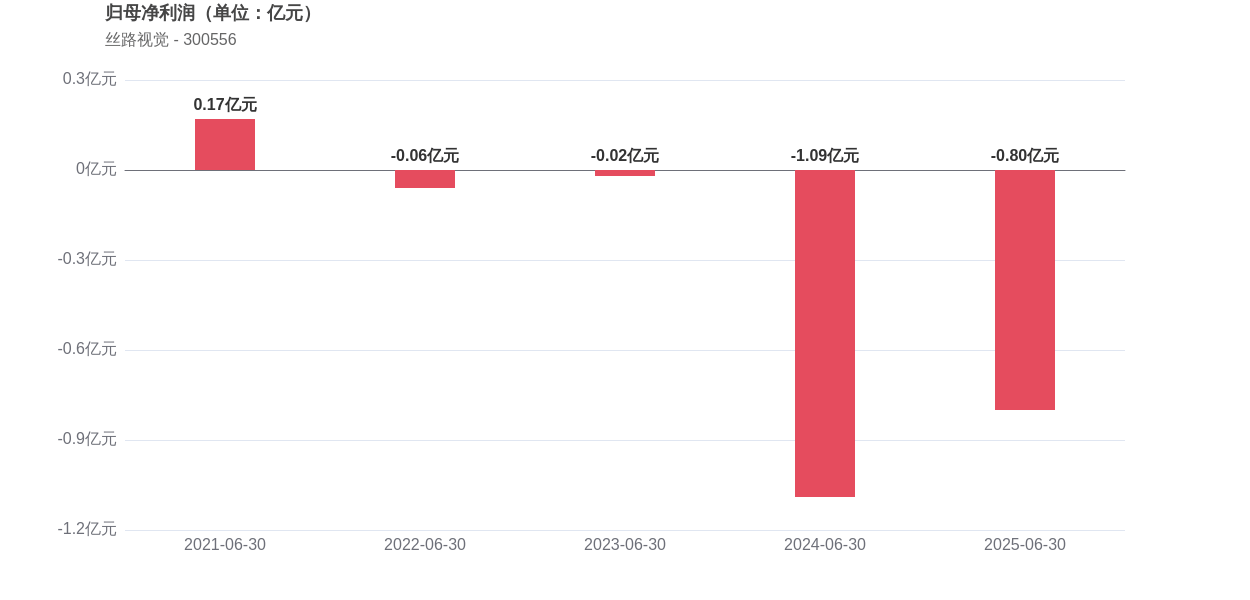
丝路视觉2025上半年连续4年中报亏损:资产负债率升至67.91%
Sou Hu Cai Jing· 2025-08-20 06:24
Core Viewpoint - Silk Road Vision reported a decline in revenue but a narrowing of losses in the first half of 2025, continuing a trend of losses for four consecutive years, indicating ongoing profitability pressure [1]. Financial Performance - The net profit margin improved from -37.48% in the first half of 2024 to -29.47% in 2025, while the gross profit margin increased from 2.80% to 12.00%. However, the return on equity decreased to -14.61%, down 2.47 percentage points year-on-year [3]. Operational Stability - The company faced challenges with inventory turnover efficiency, with inventory turnover days increasing by 19.29% to 53.63 days compared to the first half of 2024. The net cash flow from operating activities improved to -0.27 billion from -1.87 billion in the same period last year. The debt-to-asset ratio rose to 67.91%, an increase of 11.15 percentage points year-on-year, indicating a heavier debt burden [5]. Institutional Holdings - As of the first half of 2025, the number of institutions holding Silk Road Vision's stock decreased to 2 from 28 in the same period of 2024, reflecting a decline in investor confidence. The company's market capitalization peaked at 96.20 billion in December 2016, and the current market cap of 26.50 billion would require a 262.99% increase in stock price to reach that historical high, while still being in a loss position [7].


“大而美”法案获通过 纳指、标普500指数再创新高
Zhi Tong Cai Jing· 2025-07-03 22:25
Market Performance - The three major U.S. indices rose, with the Nasdaq and S&P 500 reaching new highs [1] - The Dow Jones increased by 344.11 points (0.77%) to 44828.53 points, the Nasdaq rose by 207.97 points (1.02%) to 20601.10 points, and the S&P 500 gained 51.93 points (0.83%) to 6279.35 points [1] Economic Indicators - U.S. non-farm payrolls increased by 147,000 in June, surpassing the expected 106,000, while the unemployment rate fell to 4.1%, below the expected 4.3% [6] - Average hourly earnings rose by 0.2% month-over-month and 3.7% year-over-year, indicating reduced inflationary pressure [6] - The ISM services index rose to 50.8 in June, indicating a return to expansion after a contraction in May [7] Tax Legislation Impact - The U.S. House of Representatives passed President Trump's large-scale tax and spending bill, which is expected to be signed into law [1] - The International Monetary Fund (IMF) warned that the tax bill could complicate efforts to reduce fiscal deficits and debt burdens in the coming years, potentially increasing the deficit by $3.3 trillion [8][9] Trade Deficit - The U.S. trade deficit widened in May to $71.5 billion, a 19% increase from April, driven by a larger decline in exports compared to imports [10] Company News - Lucid Motors reported a record delivery of 3,309 vehicles in Q2, a 38% year-over-year increase, with total deliveries for the first half of the year reaching 6,418, up nearly 50% from the previous year [11] - The growth in Lucid's deliveries is attributed to the rapid expansion of the global electric vehicle market and successful brand positioning [11]

研究所晨会观点精萃-20250702
Dong Hai Qi Huo· 2025-07-02 01:03
Report Industry Investment Ratings No relevant content provided. Core Views of the Report - Overseas, Powell's slightly dovish stance on interest - rate cuts and the uncertainty of US trade agreements have affected the global risk appetite; domestically, the increase in the manufacturing PMI in June and consumption - stimulating policies have improved the domestic market sentiment. Different asset classes have different short - term trends and corresponding investment suggestions [2]. - The domestic stock market is rising, driven by factors such as the improvement of economic data and policy stimulus. The short - term macro - upward drive has increased, and short - term cautious buying is recommended [3]. - Gold prices are supported by factors such as the US tax and spending bill and Powell's dovish stance. The market expects two interest rate cuts this year starting from September. Gold is expected to be strong in the short term [4]. - Due to the weakening of the US dollar, non - ferrous metals are showing a strong - oscillating trend. Different non - ferrous metals have different supply - demand situations and price trends [5]. - The oil price will continue to oscillate due to the game between summer demand and OPEC+ production increase prospects. Different energy - chemical products have different price trends based on their own supply - demand and cost factors [9]. - International crude oil premium and US biodiesel policy利好 are exhausted, and domestic oils and fats are under short - term pressure. Different agricultural products have different price trends based on their own supply - demand situations [14]. Summary by Related Catalogs Macro Finance - Overseas: Powell's statement is slightly dovish, but the labor market demand is better than expected. The US trade agreement is uncertain, and the global risk preference has cooled down. - Domestic: The manufacturing PMI in June is 49.7%, up 0.2 percentage points from the previous month. Consumption - stimulating policies have improved the domestic market sentiment. - Asset Suggestions: Stocks are expected to rebound in the short - term with cautious buying; bonds are at a high level and should be observed carefully; commodities in different sectors have different trends and corresponding investment suggestions [2]. Stock Index - The domestic stock market continues to rise, supported by sectors such as CSSC, biomedicine, and semiconductors. - Fundamental factors include the improvement of economic data and policy stimulus. The short - term macro - upward drive has increased, and short - term cautious buying is recommended [3]. Precious Metals - Gold prices rose on Tuesday. The US tax and spending bill and Powell's dovish stance support the gold price. The market expects two interest rate cuts this year starting from September. Gold is expected to be strong in the short term, and subsequent employment data should be focused on [4]. Non - Ferrous Metals and New Energy - Copper: US officials are seeking to reach a trade agreement by July 9. The supply is high, demand may weaken, and the inventory growth has slowed down. The price may fall in the future, and the negotiation results and tariff policies should be focused on. - Aluminum: The aluminum price rose due to the increase in copper prices. The LME inventory is increasing, and the domestic inventory has reached the inflection point of destocking. The warehouse receipts are decreasing. - Aluminum Alloy: It is in the off - season of demand, but the tight supply of scrap aluminum supports the price. The price is expected to be strong in the short term with limited upside. - Tin: The supply of tin ore is tight, and the demand is in the off - season. The price is expected to be strong in the short term but will be restricted in the medium term. - Carbonate Lithium: The supply is relatively loose, and one should wait for the opportunity after the rebound meets resistance. - Industrial Silicon: The price fell sharply, and the supply is unstable. It is expected to be in a weak - oscillating state, and one should observe. - Polysilicon: The fundamentals are loose, and it is recommended to short on rallies [5][6][7]. Energy and Chemicals - Crude Oil: The short - term oil price will continue to oscillate due to the game between summer demand and OPEC+ production increase prospects. - Asphalt: The price is oscillating strongly, following the oil price. The inventory is being destocked, and the situation in the peak - demand season should be focused on. - PX: The cost support is strong, but the downstream demand feedback is negative. It will follow the oil price and oscillate strongly. - PTA: The short - term basis has fallen, the demand is low, and the price may fall slightly later. - Ethylene Glycol: The price center has fallen, and the inventory at the port has decreased. The price will oscillate. - Short - Fiber: The inventory is being destocked slowly, and the price will oscillate weakly following the cost. - Methanol: The price is oscillating, affected by factors such as inventory and supply. The operation of Iranian devices should be focused on. - PP: The price is expected to oscillate weakly due to the increase in production and weak demand. - LLDPE: The price is expected to oscillate weakly due to the increase in production and weak demand in the off - season [9][10][12]. Agricultural Products - US Soybeans: The short - term CBOT soybeans may have weather - related premium support due to less rainfall and higher temperatures in the main production areas in the next two weeks. - Bean and Rapeseed Meal: The supply of soybean meal is loose, and the basis is expected to be weak. The stable price of US soybeans provides some support. - Bean and Rapeseed Oil: The supply of soybean oil is loose, and it may be under pressure following related oils and fats. The supply of rapeseed oil is expected to improve, and the high inventory at the port is being digested. - Palm Oil: The domestic inventory is increasing, and the price is expected to continue to weaken due to the exhaustion of利好 factors. - Corn: The spot price is strong, while the futures price is weak. After the seasonal substitution of wheat for feed consumption, the corn price is likely to rise. - Pig: The spot price has rebounded due to the reduction of group - farm slaughter at the end of the month. The supply is expected to increase in July, and the price has some resilience. Attention should be paid to the epidemic risk in North China [14][15][16].
特朗普减税大招引发担忧,IMF高官呼吁美国削减财政赤字!
Jin Shi Shu Ju· 2025-05-21 08:59
Group 1 - The IMF calls for the U.S. to reduce its fiscal deficit in light of rising debt burdens, emphasizing that the current deficit is too large [1][2] - Moody's has downgraded the U.S. credit rating due to concerns over increasing debt, with projections indicating that the deficit-to-GDP ratio could rise from 6.4% last year to nearly 9% by 2035 if proposed tax cuts are implemented [1][2] - The U.S. Treasury Secretary attributes the downgrade to the previous administration's policies and expresses a commitment to reducing the deficit-to-GDP ratio to 3% before the end of the Trump administration [1][2] Group 2 - The U.S. debt-to-GDP ratio is projected to reach 98% in the fiscal year 2024, up from 73% a decade ago, indicating a continuous rise in debt levels [2] - Despite expectations of a decrease in the fiscal deficit due to rising tariff revenues, these forecasts do not account for the potential impacts of Trump's tax cut proposals currently under congressional review [2][4] - Concerns over the deficit and Moody's downgrade have led to a weakening of the dollar and a rise in U.S. Treasury yields, with the 10-year Treasury yield reaching 5.04%, the highest level in 2023 [3][4] Group 3 - The expansion of the deficit implies that the government will need to issue more bonds, raising questions about the stability of the U.S. market among domestic and international investors [4] - The IMF has revised down its economic growth forecast for the U.S. in 2025 to 1.8% and for global growth to 2.8%, factoring in the effects of Trump's tariffs [4] - Recent announcements of significant tariff reductions between the U.S. and China are seen as positive developments, although the actual tariff rates remain higher than last year, and uncertainties persist regarding the implementation of new tax rates [5]
IMF呼吁美国削减财政赤字,解决债务负担。(英国《金融时报》)
news flash· 2025-05-21 04:05
Core Viewpoint - The IMF urges the United States to reduce its fiscal deficit and address its debt burden [1] Group 1 - The IMF highlights the importance of fiscal consolidation to ensure long-term economic stability [1] - The call for action comes amid rising concerns over the sustainability of U.S. debt levels [1] - The organization emphasizes that failure to address these issues could lead to negative consequences for both the U.S. economy and the global financial system [1]
穆迪下调美国主权信用评级,债务高企与利息负担侵蚀美国信用体系
Xin Jing Bao· 2025-05-17 13:55
Group 1 - Moody's downgraded the U.S. government's long-term issuer and senior unsecured rating from Aaa to Aa1, marking all three major credit rating agencies have rated U.S. sovereign credit below AAA [1] - The primary reasons for the downgrade include the continuous expansion of U.S. government debt and increasing interest payment ratios, which are significantly higher than those of similarly rated sovereign nations [2][3] - Moody's expects the U.S. federal deficit to widen, reaching nearly 9% of GDP by 2035, up from 6.4% in 2024, primarily due to rising debt interest payments and low revenue [3] Group 2 - The aggressive tariff policies implemented by the U.S. have negatively impacted the country's sovereign credit level, increasing the risk of economic downturn and debt repayment [4] - The combination of high debt levels and rising interest payments is projected to lead to cumulative interest expenditures on U.S. debt reaching $13.8 trillion over the next decade, nearly double the inflation-adjusted total of the past 20 years [5] - The failure of U.S. government policies is accelerating the collapse of U.S. debt credit, with market skepticism about the sustainability of dollar hegemony reaching historical peaks [6]