关税谈判

Search documents
永安期货有色早报-20251105
Yong An Qi Huo· 2025-11-05 01:28
Group 1: Report Industry Investment Ratings - No industry investment ratings are provided in the report. Group 2: Report Core Views - Overall, in the context of continued tightness in the mining end and the growth of infrastructure and power demand in Southeast Asia and the Middle East, maintain a strategy of buying on dips for copper; for aluminum, hold on dips in the long - term due to good domestic apparent demand and potential overseas supply disruptions; for zinc, with poor domestic fundamentals but potential supply reduction at the end of the year, suggest a wait - and - see approach for single - side trading, focus on reverse arbitrage opportunities, and pay attention to the positive spread arbitrage opportunity between December and February; for nickel and stainless steel, due to weak fundamentals and potential policy support in Indonesia, look for short - selling opportunities; for lead, expect narrow - range oscillations in lead prices and suggest cautious operation; for tin, follow the macro - sentiment in the short - term and hold on dips in the medium - to - long - term; for industrial silicon, expect price oscillations in the short - term and cycle - bottom oscillations in the medium - to - long - term; for lithium carbonate, the price may change in the medium - to - long - term if certain demand conditions are met [1][2][3][7][8][10][11] Group 3: Summary by Metal Copper - Market行情受关税谈判进展主导,中美谈判后铜价回落测试10日均线支撑 [1] - 下游开工回落,高价下维持刚需接货,库存小幅去化略超预期,关注废铜政策对精废替代的影响 [1] - 听闻部分矿山在1.1w美金价位入场保值,伦铜近期可能有中等量级交仓到货,短期情绪或转冷静 [1] - 维持回调买入思路,关注伦铜1.03w美金附近支撑,可考虑卖1.03w以下看跌期权或逐步建立虚拟库存 [1] Aluminum - 国内表需好,铝水比例高,铝锭与铝材去库,海外供给有停产扰动推动价格上行 [1] - 中美经贸关系好转,美联储降息后停止缩表,需求边际好转 [1] - 低库存下长期以逢低持有为主 [1] Zinc - 本周锌价震荡上行,供应端国产和进口TC加速下滑,四季度至明年一季度国产矿边际走紧,11月火烧云锌锭投产但增量兑现待考察 [2] - 需求端内需季节性疲软,海外欧洲需求一般,部分炼厂生产有阻力,国内社库震荡,海外LME库存去化,出口窗口打开 [2] - 国内基本面现实较差,但年底供应端有阶段性减量,价格重心难深跌,短期单边建议观望,关注反套和12 - 02月差正套机会 [2] Nickel - 供应端纯镍产量高位维持,需求端整体偏弱,升水平稳,库存端国内外持续累库,短期基本面偏弱 [3] - 印尼矿端扰动持续,政策端有挺价动机,关注逢高空配机会 [3] Stainless Steel - 供应端钢厂10月排产环比小幅增加,需求端以刚需为主,成本方面镍铁、铬铁价格维持,库存高位维持 [7] - 印尼政策端有挺价动机,关注逢高空配机会 [7] Lead - 本周铅下游减产致铅价下跌,供应侧报废量同比偏弱,再生利润恢复激励复产但进度慢,精矿开工增加但供应紧张 [8] - 需求侧电池开工率下滑,成品库存高,需求有走弱预期,精废价差变化,再生复产出料 [8] - 预计下周内外铅价在17200 - 17500区间窄幅震荡,建议观望再生复产和仓单增加情况谨慎操作 [8] Tin - 本周锡价震荡,供应端矿端加工费低位,云锡检修结束,海外佤邦产出有分歧,印尼短期部分停产 [10] - 需求端高价下由刚性支撑,下游接单心理价位提高,海外LME库存低位震荡恢复 [10] - 国内基本面短期供需双弱,短期跟随宏观情绪,若宏观有系统性风险锡价下行空间大,中长期贴近成本线逢低持有 [10] Industrial Silicon - 本周新疆头部企业开工稳定,后续川滇开工数量将减少,枯水期供给环比下滑,但Q4供需处于平衡偏宽松状态,月度累库约3万吨 [11] - 短期价格预计震荡运行,中长期价格走势预计以季节性边际成本为锚的周期底部震荡为主 [11] Lithium Carbonate - 本周五受江西矿山复产传闻影响价格快速回落,原料端海外矿端挺价,市场可流通精矿现货偏紧 [11] - 锂盐端企业惜售,市场低价货源少,期现商难补库,下游在价格上行时观望,回调后买盘增强 [11] - 基差调整有限,成交集中在01 - 400至01 + 0元区间,若储能需求高景气且动力需求稳定,中长期格局转变时点可能在未来1 - 2年出现 [11]
永安期货有色早报-20251104
Yong An Qi Huo· 2025-11-04 01:31
Group 1: Report Industry Investment Ratings - No information provided Group 2: Core Views of the Report - For copper, maintain a strategy of buying on dips considering the continuous tightness in the mining end and the growth of infrastructure and power demand in Southeast Asia and the Middle East. Pay attention to the support around $10,300 for LME copper [1]. - For aluminum, with good domestic apparent demand, high proportion of molten aluminum, de - stocking of aluminum ingots and various aluminum products, and supply disruptions overseas, hold long - term on dips due to the low inventory [1]. - For zinc, the domestic fundamentals are poor, but there may be a phased reduction in supply at the end of the year. In the short - term, it is recommended to wait and see for single - side trading, pay attention to reverse arbitrage opportunities between domestic and overseas markets, and positive arbitrage opportunities for the spread between December and February contracts [2]. - For nickel, the short - term fundamentals are weak, but there are continuous disturbances at the Indonesian mining end and the policy side has the motivation to support prices. Pay attention to short - selling opportunities [3]. - For lead, it is expected that the domestic and overseas lead prices will maintain a narrow - range oscillation next week, in the range of 17,200 - 17,500. It is recommended to wait and see the resumption of secondary lead production and the increase of warehouse receipts [6]. - For tin, in the short - term, follow the macro sentiment and wait and see. If there is a systematic macro risk, the tin price has a large downward space; in the long - term, hold on dips near the cost line [7]. - For industrial silicon, in the short - term, the supply and demand are in a balanced and slightly loose state, and the price is expected to oscillate. In the long - term, the price is expected to oscillate at the bottom of the cycle with the seasonal marginal cost as the anchor [8]. - For lithium carbonate, in the context of "anti - involution", the price elasticity is high after supply - side disturbances are realized, and there is strong downward support before that. If the energy storage demand remains high and the power demand is stable, the long - term pattern may change in the next 1 - 2 years [8]. - For stainless steel, the fundamentals are generally weak, and the Indonesian policy side has a certain motivation to support prices. Pay attention to short - selling opportunities [11]. Group 3: Summaries by Metals Copper - Market sentiment was dominated by tariff negotiation progress this week. After the China - US negotiation, the bullish news was digested, and the copper price tested the support of the 10 - day moving average. The downstream copper开工 rate decreased, but the inventory showed a slight de - stocking pattern [1]. - Some mines were reported to enter the market for hedging at the price of $11,000. There may be medium - sized deliveries of LME copper in the near future [1]. Aluminum - Domestic apparent demand was good, the proportion of molten aluminum was at a high level, and both aluminum ingots and various aluminum products were de - stocking. Overseas supply was affected by potential production stoppages [1]. - The improvement of China - US economic and trade relations and the Fed's decision to stop balance - sheet reduction led to a marginal improvement in demand [1]. Zinc - The zinc price oscillated upward this week. The treatment charges (TC) for domestic and imported zinc concentrates accelerated their decline. The domestic zinc concentrate supply will be tight from the fourth quarter to the first quarter of next year [2]. - The Huoshaoyun zinc ingot officially started production in November, with an expected monthly output of 8,000 - 10,000 tons. The total supply is expected to increase by about 8,000 tons month - on - month, but the market acceptance needs further observation [2]. - Domestic demand was seasonally weak, and overseas demand in Europe was average. Some overseas smelters faced production difficulties due to processing fees. The domestic social inventory oscillated, and the overseas LME inventory decreased [2]. Nickel - The supply of pure nickel remained at a high level, the demand was weak, and the premiums were stable recently. Both domestic and overseas inventories continued to accumulate [3]. - There were continuous disturbances at the Indonesian mining end, and the policy side had the motivation to support prices [3]. Lead - The lead price declined this week due to the production cut of downstream lead users. The supply of scrap lead was weak year - on - year, and the recovery of secondary lead production was slow [6]. - The demand for lead batteries decreased, and the finished - product inventory was high. The supply - demand mismatch was serious, and the spot premium in Hunan continued to rise [6]. - The refined - scrap lead price difference was - 75, and the five - region social inventory was at a historical low of 29,800 tons. The spot tightness was not significantly relieved [6]. Tin - The tin price oscillated this week. The processing fees at the mining end were at a low level, and the supply improved marginally after the maintenance of Yunnan Tin ended [6][7]. - There were differences in the output of the Wa State in Myanmar, and the Indonesian tin exports may recover to normal in 2026, but there were short - term production stoppages due to anti - smuggling efforts [7]. - The demand was mainly supported by rigidity at high prices, and the overseas LME inventory oscillated at a low level and recovered [7]. Industrial Silicon - The operation of leading enterprises in Xinjiang was stable, and the number of operating furnaces in Sichuan and Yunnan will decrease significantly in the dry season. The supply - demand of industrial silicon in Q4 is in a balanced and slightly loose state, with a monthly inventory accumulation of about 30,000 tons [8]. Lithium Carbonate - The lithium carbonate price dropped rapidly on Friday due to the rumor of the resumption of production of Jiangxi mines. The overseas mines firmly supported the price, and the market supply of concentrated ore was tight [8]. - Lithium salt producers were reluctant to sell due to inventory reduction and high downstream开工 rates. The downstream was mainly in a wait - and - see attitude, and the trading volume above 80,000 yuan was small [8]. Stainless Steel - The steel mills' production plan in October increased slightly month - on - month. The demand was mainly for rigid needs, and the prices of nickel iron and chrome iron remained stable [11]. - The inventory was at a high level, and the warehouse receipts remained unchanged. The fundamentals were generally weak [11].
永安期货有色早报-20251103
Yong An Qi Huo· 2025-11-03 03:14
Report Industry Investment Ratings No relevant content provided. Core Views of the Report - For copper, maintain a strategy of buying on dips considering the ongoing tightness in the mining end and the growth in infrastructure and power demand in Southeast Asia and the Middle East. Pay attention to the support around $10,300 for LME copper and consider selling put options below $10,300 or gradually building virtual inventories [1]. - For aluminum, with good domestic apparent demand, high proportion of molten aluminum, de - stocking of aluminum ingots and various aluminum products, and supply disruptions overseas, hold long - term on dips [1]. - For zinc, due to the poor domestic fundamentals but potential short - term supply reduction at the end of the year, the price may not fall deeply. In the short term, it is recommended to wait and see for single - side trading, pay attention to reverse arbitrage opportunities between domestic and overseas markets, and consider positive arbitrage opportunities for the 12 - 02 spread [2]. - For nickel, with a weak short - term fundamental situation and continuous disturbances in the Indonesian mining end, look for opportunities to short on rallies [3]. - For lead, expect the domestic and overseas lead prices to maintain a narrow - range oscillation next week. It is recommended to operate cautiously while observing the resumption of secondary lead production and the increase in warehouse receipts [7]. - For tin, in the short term, follow the macro sentiment and wait and see. If there is a systemic risk in the macro - environment, the tin price may decline significantly. In the long - term, buy on dips near the cost line [8]. - For industrial silicon, in the short term, the supply and demand are in a balanced and slightly loose state, and the price is expected to oscillate. In the long - term, the price is expected to oscillate at the bottom of the cycle based on the seasonal marginal cost [9]. - For lithium carbonate, in the context of "anti - involution", the price has high elasticity after supply - side disturbances are realized, and strong downward support before the disturbances. If the energy storage demand remains high and the power demand is stable, the long - term pattern of lithium carbonate may change in the next 1 - 2 years [9]. - For stainless steel, with a generally weak fundamental situation and potential price - supporting motivation from Indonesian policies, look for opportunities to short on rallies [13]. Summary by Metal Copper - **Market Data**: From October 27 to 31, 2025, the spot premium of SHFE copper changed from - 35 to 0, the scrap - refined copper spread decreased by 82, and the LME inventory decreased by 325 [1]. - **Market Analysis**: The market is dominated by tariff negotiation progress. The overall copper price has declined, and the downstream copper开工 has further decreased. The de - stocking of inventory is slightly better than expected. Consider the impact of the tightening of scrap copper policies on scrap - refined substitution. There may be medium - scale deliveries of LME copper in the near future, and the short - term sentiment may turn calm [1]. Aluminum - **Market Data**: From October 27 to 31, 2025, the Shanghai aluminum ingot price increased by 80, the domestic alumina price decreased by 1, and the SHFE aluminum social inventory decreased by 4,594 [1]. - **Market Analysis**: The domestic apparent demand is good, the proportion of molten aluminum is high, and there is de - stocking. Overseas supply is facing disruptions. The improvement of Sino - US economic and trade relations and the Fed's policy adjustment have led to a marginal improvement in demand [1]. Zinc - **Market Data**: From October 27 to 31, 2025, the spot premium of zinc remained at - 40, the SHFE zinc social inventory remained unchanged, and the LME zinc inventory increased by 400 [2]. - **Market Analysis**: The zinc price has oscillated upward. The supply of domestic and imported TC is accelerating downward, and the domestic mining supply will be tight from the fourth quarter to the first quarter of next year. The demand is seasonally weak domestically and generally average overseas. The export window has opened, and there has been some delivery overseas [2]. Nickel - **Market Data**: From October 27 to 31, 2025, the price of 1.5% Philippine nickel ore remained unchanged, the SHFE nickel spot price decreased by 350, and the LME inventory remained unchanged [3]. - **Market Analysis**: The supply of pure nickel remains at a high level, the demand is weak, and the inventories at home and abroad are continuously increasing. There are continuous disturbances in the Indonesian mining end [3]. Lead - **Market Data**: From October 27 to 31, 2025, the spot premium of lead remained at - 210, the social inventory decreased by 334, and the LME inventory decreased by 3,875 [7]. - **Market Analysis**: The lead price has declined due to downstream production cuts. The supply of secondary lead is recovering slowly, and the demand for batteries is weakening. The supply - demand mismatch is serious, and the spot is still in short supply [7]. Tin - **Market Data**: From October 27 to 31, 2025, the LME C - 3M of tin changed from 100 to 40, and the LME inventory increased from 2,725 to 2,875 [7][8]. - **Market Analysis**: The tin price has oscillated. The processing fee at the mining end is at a low level, and the supply has marginally recovered. Overseas production is still uncertain, and the demand is mainly supported by rigidity [8]. Industrial Silicon - **Market Data**: From October 27 to 31, 2025, the 421 Yunnan basis increased by 55, the 421 Sichuan basis increased by 55, and the number of warehouse receipts decreased by 157 [9]. - **Market Analysis**: The production of leading enterprises in Xinjiang is stable, and the production in Sichuan and Yunnan will decrease significantly in the dry season. In the fourth quarter, the supply and demand are in a balanced and slightly loose state, and the price is expected to oscillate [9]. Lithium Carbonate - **Market Data**: From October 27 to 31, 2025, the SMM electric - grade lithium carbonate price increased by 550, the SMM industrial - grade lithium carbonate price increased by 550, and the number of warehouse receipts decreased by 20 [9]. - **Market Analysis**: The overseas mining end is firm in price - holding, the market supply of concentrated ore is tight, and the lithium salt producers are reluctant to sell. The downstream is mostly on the sidelines, and the buying is strong after the price correction on Friday [9]. Stainless Steel - **Market Data**: From October 27 to 31, 2025, the price of 304 cold - rolled coil remained unchanged, the price of 304 hot - rolled coil remained unchanged, and the price of scrap stainless steel decreased by 50 [13]. - **Market Analysis**: The steel mills' production in October increased slightly month - on - month, the demand is mainly for rigid needs, and the inventory is at a high level. The Indonesian policies may support the price [13].
永安期货有色早报-20251031
Yong An Qi Huo· 2025-10-31 01:56
1. Report Industry Investment Rating - No industry investment rating is provided in the report. 2. Core Viewpoints - For copper, maintain a buy - on - pullback strategy due to continued tightness in the ore end and growing infrastructure and power demand in Southeast Asia and the Middle East. Consider selling put options below $10,300 on LME copper or gradually building virtual inventories [1]. - For aluminum, the short - term fundamentals are acceptable, and long - term holding on dips is recommended while keeping an eye on terminal demand [1]. - For zinc, in the face of increased macro uncertainty, it is advisable to stay on the sidelines for single - side trading. For internal - external spreads, gradually take profits on internal - external positive spreads and watch for far - month reverse spreads. For monthly spreads, focus on the positive spread opportunity between December and February contracts [2]. - For nickel, due to short - term weak fundamentals and increased macro uncertainty, it is recommended to wait and see [3]. - For stainless steel, the fundamentals remain weak, with increased short - term macro uncertainty and some price - support motivation from Indonesian policies [3]. - For lead, it is expected that the lead price will fluctuate narrowly between 17,300 and 17,700 next week. It is recommended to wait and see the resumption of recycled production and the increase in warehouse receipts before operating cautiously [6]. - For tin, in the short term, follow the macro sentiment and wait and see. If there is a systematic macro risk, the tin price may have a large downside. In the long - term, buy on dips near the cost line [10]. - For industrial silicon, in the short term, the price is expected to fluctuate weakly. In the long - term, the price is expected to oscillate at the cycle bottom anchored by the seasonal marginal cost [13][15]. - For lithium carbonate, no specific investment strategy is given in the report. 3. Summary by Metal Copper - Market sentiment is dominated by tariff negotiation progress and the release of the 15th Five - Year Plan. There are still supply disturbances in scrap copper in Anhui and other places, and the uncertainty of scrap copper supply will continue to increase in the fourth quarter and next year [1]. - Overseas, the export window has opened, but no inventory delivery has been observed. The divergence between the start - up rates of copper and aluminum cables is obvious, and attention should be paid to whether the start - up rate stabilizes [1]. Aluminum - The operating capacity remains flat. The production schedule of photovoltaic modules has stabilized, and the proportion of molten aluminum has increased significantly in September. There is seasonal inventory accumulation of aluminum ingots and bars, but the post - holiday inventory reduction is considerable, and the apparent demand is rising [1]. - The global economic recovery is showing signs, and the Fed's interest - rate cut expectation is strengthening. However, the uncertainty of Sino - US economic and trade relations has deepened, and some European electrolytic aluminum plants have reduced production due to equipment failures [1]. Zinc - Supply: Domestic and imported TC are showing a downward trend. Domestic mines will be marginally tighter from the fourth quarter to the first quarter of next year, while overseas mines had an unexpected increase in the second quarter. In October, smelting has slightly recovered, and attention should be paid to the impact of sulfuric acid and silver prices on total profits [2]. - Demand: Domestic demand is seasonally weak, and European demand is average. Some overseas smelters face production resistance due to processing fees [2]. - Inventory: Domestic social inventory is oscillating, and overseas LME inventory is decreasing. The export window has opened, and some smelters and traders are preparing for exports [2]. Nickel - Supply: The production of pure nickel remains at a high level. - Demand: Overall demand is weak, and the premium has been stable recently. - Inventory: Both domestic and overseas inventories are accumulating [3]. Stainless Steel - Supply: Steel mills' production schedules in October have increased slightly compared to the previous month. - Demand: Demand is mainly driven by rigid needs. - Cost: The prices of nickel iron and chrome iron remain stable. - Inventory: Inventory remains at a high level, and warehouse receipts are stable [3]. Lead - Supply: The scrap volume is weak year - on - year. The recovery of recycled lead profits has encouraged resumption of production, but the progress is slow. There is a serious supply - demand mismatch, and the spot premium in Hunan has been rising [6]. - Demand: The battery start - up rate has increased this week, and the expectation of weakening demand has been reversed. The refined - scrap spread is - 75, and the lead ingot spot premium is 15 [6]. - Inventory: The five - region social inventory is at a historical low of 31,900 tons, and the spot tightness has not eased [6]. Tin - Supply: The processing fee at the mine end is at a low level. The output of overseas Wa State is still controversial, and some mines and smelters in Indonesia have shut down [10]. - Demand: Demand is mainly supported by rigidity at high prices, and the downstream's psychological price for orders has increased [10]. - Inventory: Overseas LME inventory is oscillating and recovering at a low level [10]. Industrial Silicon - Supply: The operation of leading enterprises in Xinjiang is stable. The number of start - ups in Sichuan and Yunnan will decrease significantly in the dry season, and the overall supply of industrial silicon will decline month - on - month [13][15]. - Demand: Considering the maintenance of leading polysilicon enterprises, the supply - demand in Q4 is in a balanced and slightly loose state, with a monthly inventory accumulation of 40,000 - 50,000 tons [13][15]. Lithium Carbonate - The prices of SMM electric and industrial lithium carbonate have both increased by 850 yuan. The basis of the main and near - month contracts has changed, and the number of warehouse receipts has increased by 116 [15].
永安期货有色早报-20251030
Yong An Qi Huo· 2025-10-30 01:54
Group 1: Investment Ratings - There is no specific investment rating for the entire industry provided in the report. Group 2: Core Views - The market is influenced by tariff negotiation progress and the 15th Five - Year Plan. For copper, maintain a callback - buying strategy considering the tight supply at the mine end and increasing demand in Southeast Asia and the Middle East. For aluminum, the short - term fundamentals are okay, and hold at low prices in the long - term. For zinc, with export opportunities but poor domestic fundamentals, it's advisable to wait and see for unilateral trading, and pay attention to different arbitrage opportunities. For nickel, due to weak fundamentals and uncertain policies, it's better to wait and see. For stainless steel, the fundamentals are weak with uncertain macro and policy support. For lead, prices are expected to oscillate narrowly, and it's necessary to observe the resumption of production and increase in warehouse receipts. For tin, follow the macro sentiment in the short - term and hold at low prices close to the cost line in the long - term. For industrial silicon, prices are expected to oscillate weakly in the short - term and at the cycle bottom in the long - term. For lithium carbonate, the analysis of industrial silicon also applies as the relevant supply and demand situation is similar [1][2][3][6][10][13][16]. Group 3: Summary by Metals Copper - Market influenced by tariff negotiation and 15th Five - Year Plan. Anhui's scrap copper supply has disturbances, and the uncertainty will increase in Q4 and next year. Overseas, there is no sign of warehouse delivery despite the opened export. Copper cable and aluminum cable have different starts. Maintain a callback - buying strategy, pay attention to the support around $10,300 for LME copper, and consider selling put options below $10,300 or building virtual inventory gradually [1]. Aluminum - Operating capacity is flat. PV module production is stable, and the proportion of molten aluminum has increased. There is seasonal inventory accumulation during holidays and significant destocking after holidays. The global economy shows signs of recovery, but Sino - US economic and trade relations are uncertain, and a European electrolytic aluminum plant has reduced production. Short - term fundamentals are okay, and hold at low prices in the long - term [1]. Zinc - Zinc prices oscillated upward this week. Domestic and imported TC are declining. Domestic mines will be tighter from Q4 to Q1 next year, while overseas mines had an unexpected increase in Q2. The smelting end has a slight recovery in October. Domestic demand is seasonally weak, while overseas LME inventory is decreasing. The export window is open. It's advisable to wait and see for unilateral trading, gradually take profit on long - short arbitrage, and pay attention to far - month reverse arbitrage and 12 - 02 positive arbitrage opportunities [2]. Nickel - The supply of pure nickel remains at a high level, demand is weak, and both domestic and overseas inventories are increasing. There are continuous disturbances in Indonesia's mines, and the policy has a motivation to support prices. It's better to wait and see [3]. Stainless Steel - Steel mills' production in October increased slightly. Demand is mainly for rigid needs. The prices of ferronickel and ferrochrome are stable. Inventory remains at a high level, and the fundamentals are weak with uncertain macro and policy support [3]. Lead - Lead prices increased due to spot shortages. Supply from scrap is weak, and the resumption of production of recycled lead is slow. The demand for batteries has increased, and the expected weakening of demand has reversed. The tight supply situation continues due to the lower - than - expected resumption of recycled lead production. Prices are expected to oscillate narrowly between 17,300 - 17,700, and it's necessary to observe the resumption of production and increase in warehouse receipts [6]. Tin - Tin prices oscillated this week. The processing fee at the mine end is low, and the supply has marginally recovered after the end of Yunnan Tin's maintenance. Overseas production has uncertainties. Demand is mainly rigid at high prices. The domestic fundamentals are in a state of weak supply and demand. Follow the macro sentiment in the short - term and hold at low prices close to the cost line in the long - term [10]. Industrial Silicon - The production of leading enterprises in Xinjiang is stable, and the production in Sichuan and Yunnan will decrease. In Q4, the supply - demand is in a balanced and slightly loose state with a monthly inventory accumulation of 4 - 5 million tons. Prices are expected to oscillate weakly in the short - term and at the cycle bottom in the long - term [13]. Lithium Carbonate - The situation is similar to industrial silicon. The supply - demand in Q4 is in a balanced and slightly loose state, and prices are expected to oscillate weakly in the short - term and at the cycle bottom in the long - term [16].
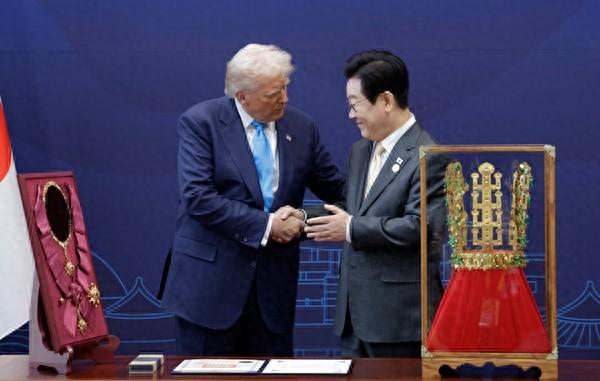
抵韩第一天获赠“金王冠”、无穷花大勋章,特朗普:我现在就想戴上
Guan Cha Zhe Wang· 2025-10-29 11:39
Core Points - The meeting between U.S. President Trump and South Korean President Lee Jae-myung aimed to ease trade and defense tensions between the two countries, highlighted by the presentation of significant gifts [1][3] - Trump became the first U.S. president to receive South Korea's highest honor, the "Mugunghwa Grand Order," recognizing his role as a "peace builder" on the Korean Peninsula [1][3] - The gifts included a replica of the "Golden Crown of Silla," symbolizing leadership and the historical pursuit of peace on the Korean Peninsula [3][4] Group 1: Diplomatic Relations - South Korea's efforts to impress Trump included a lavish welcome and gifts, reflecting a desire to secure concessions in ongoing tariff negotiations [5] - The U.S. and South Korea are currently at an impasse regarding a $350 billion investment plan, with disagreements over investment methods and responsibilities [5] - Trump's visit to South Korea follows his previous stops in Japan and Malaysia, indicating a strategic approach to strengthen alliances in the region [4] Group 2: North Korea Relations - Speculation surrounds the possibility of Trump meeting North Korean leader Kim Jong-un during his visit, although North Korea has shown little interest in such a meeting [6] - Trump's comments suggest a willingness to ease sanctions on North Korea in exchange for negotiations, despite North Korea's firm stance on retaining its nuclear capabilities [6] - Recent missile tests by North Korea have raised concerns, but Trump downplayed the significance of these actions during his visit [6] Group 3: Domestic Reactions - Protests against Trump's visit occurred in South Korea, with local groups criticizing his approach to the U.S.-South Korea alliance [6] - South Korean officials are concerned about potential demands from Trump regarding increased military spending and defense responsibilities [5][6] - Lee Jae-myung indicated that discussions on visa regulations and worker treatment are ongoing, highlighting the complexities of U.S.-South Korea relations [7]

韩媒:特朗普今日访韩将会晤李在明 或主谈关税问题
Zhong Guo Xin Wen Wang· 2025-10-29 03:29
Core Points - The bilateral meeting between South Korean President Lee Jae-myung and U.S. President Trump is scheduled for October 29, focusing on tariff issues [1] - This meeting marks the shortest interval between visits of South Korean and U.S. leaders in history, occurring nearly two months after their last meeting in Washington [1] - The discussions will take place at the National Gyeongju Museum, including a welcome ceremony and a working lunch [1] Tariff Negotiations - The two leaders are expected to discuss tariff negotiations and the South Korea-U.S. alliance, with particular emphasis on the $350 billion investment project from South Korea to the U.S. [1] - There are existing disagreements regarding the investment methods and revenue distribution related to this project, leading to a prolonged stalemate in negotiations [1] - The likelihood of narrowing differences during this meeting is considered low by the South Korean presidential office due to significant gaps in opinions [1]
永安期货有色早报-20251029
Yong An Qi Huo· 2025-10-29 01:49
Group 1: Report Industry Investment Rating - No industry investment rating is provided in the report. Group 2: Report's Core View - The overall market is influenced by tariff negotiation progress and the 15th Five - Year Plan communique. Different metals have different fundamentals and investment strategies. For copper, maintain a callback - buying idea; for aluminum, hold at low prices in the long - term; for zinc, be cautious in trading; for nickel, observe; for stainless steel, the fundamentals are weak; for lead, observe the regeneration and warehouse receipts; for tin, follow the macro - mood in the short - term and hold at low prices in the long - term; for industrial silicon, prices are expected to be weak in the short - term and cycle at the bottom in the long - term; for lithium carbonate, the information about industrial silicon is repeated, and there is no specific core view for lithium carbonate presented separately [1][2][3][6][10][13][16] Group 3: Summary by Metal Copper - **Market Data**: From Oct 22 - 28, the Shanghai copper spot price decreased by 15, the waste - refined copper price difference decreased by 203, and LME inventory decreased by 1400 [1] - **Fundamentals**: Market sentiment is affected by tariff negotiations and the 15th Five - Year Plan. There are supply disturbances in waste copper, and the copper cable and aluminum cable start - up rates diverge [1] - **Strategy**: Maintain a callback - buying idea, pay attention to the support around $10,300 for LME copper, and consider selling put options below $10,300 or gradually establishing virtual inventory [1] Aluminum - **Market Data**: From Oct 22 - 28, the Shanghai aluminum ingot price remained unchanged, the domestic alumina price decreased by 4, and LME inventory decreased by 3625 [1] - **Fundamentals**: Operating capacity is flat, photovoltaic component production is stable, there is seasonal inventory accumulation, and the European electrolytic aluminum plant has a 200,000 - ton production reduction [1] - **Strategy**: Keep an eye on terminal demand in the short - term and hold at low prices in the long - term [1] Zinc - **Market Data**: From Oct 22 - 28, the zinc price oscillated upwards, the spot premium decreased by 10, and LME inventory decreased by 1800 [2] - **Fundamentals**: Supply - side TC is declining, demand is seasonally weak domestically and has some resistance overseas, and the export window has opened [2] - **Strategy**: Observe in the short - term, gradually take profit on domestic - foreign positive spreads, look for far - month reverse spreads, and pay attention to the 12 - 02 positive spread opportunity [2] Nickel - **Market Data**: From Oct 22 - 28, the Shanghai nickel spot price decreased by 950, and LME inventory increased by 156 [3] - **Fundamentals**: Supply is at a high level, demand is weak, and inventories are increasing both at home and abroad [3] - **Strategy**: Observe due to short - term weak fundamentals and increased macro - uncertainty [3] Stainless Steel - **Market Data**: From Oct 22 - 28, the 304 cold - rolled coil price remained unchanged, and the waste stainless steel price decreased by 50 [3] - **Fundamentals**: Supply is slightly increasing, demand is mainly for rigid needs, costs are stable, and inventories are at a high level [3] - **Strategy**: No specific strategy is provided, but the fundamentals are overall weak [3] Lead - **Market Data**: From Oct 22 - 28, the lead price increased due to spot tightness, the spot premium increased by 10, and LME inventory decreased by 2700 [6] - **Fundamentals**: Supply - side regeneration is slow, demand has reversed the weakening expectation, and the spot is in short supply [6] - **Strategy**: Expect the price to oscillate narrowly between 17,300 - 17,700, and observe the regeneration and warehouse receipt increase [6] Tin - **Market Data**: From Oct 22 - 28, the tin price oscillated, the position decreased by 5024, and LME inventory decreased by 25 [10] - **Fundamentals**: Supply - side processing fees are low, and demand is mainly rigid. Overseas production has uncertainties [10] - **Strategy**: Follow the macro - mood in the short - term and hold at low prices close to the cost line in the long - term [10] Industrial Silicon - **Market Data**: From Oct 22 - 28, the basis of different grades changed, and the number of warehouse receipts decreased by 141 [11] - **Fundamentals**: Supply will decline in the dry season, but considering polysilicon plant maintenance, Q4 supply - demand is in a balanced and slightly loose state with a monthly inventory accumulation of 400,000 - 500,000 tons [13][16] - **Strategy**: Prices are expected to be weak in the short - term and cycle at the bottom in the long - term [13][16] Lithium Carbonate - **Market Data**: From Oct 22 - 28, the SMM electric carbon price increased by 1950, the SMM industrial carbon price increased by 2000, and the number of warehouse receipts decreased by 404 [16] - **Fundamentals**: No specific fundamentals for lithium carbonate are presented separately, and the information about industrial silicon is repeated [16] - **Strategy**: No specific strategy for lithium carbonate is provided [16]
对抗态度发生转变,加征关税有望取消,美国推动对巴西贸易新战略
Huan Qiu Shi Bao· 2025-10-28 22:32
Core Points - The meeting between Brazil and the U.S. representatives in Malaysia focused on the issue of tariffs imposed by the U.S. on Brazilian products, following a meeting between Presidents Lula and Trump [1][2] - The U.S. has recently imposed a 40% tariff on Brazilian imports, with many products facing a total tariff rate of 50% [1] - Both leaders expressed optimism about reaching a new trade agreement, with discussions on various sectors and key minerals [2][4] Summary by Sections Tariff Discussions - The U.S. has implemented a 40% tariff on Brazilian imports, with a significant portion facing a 50% tariff rate [1] - Trump and Lula's meeting has led to speculation about a potential reduction or elimination of these tariffs [1][2] Political Context - Trump's previous demands for Lula to halt judicial investigations into former President Bolsonaro were seen as a factor in the tariff imposition [1] - Lula has maintained that Brazil's judicial independence is non-negotiable [1] Future Negotiations - Brazilian Foreign Minister Vieira expressed hope for completing bilateral negotiations within weeks, discussing all sectors and key minerals [2] - Lula's priority includes negotiating the lifting of U.S. sanctions on Brazilian officials [2] Economic Interests - The U.S. is particularly interested in Brazil's mineral resources, especially in light of recent supply chain disruptions from China [3][4] - The high prices of Brazilian meat and coffee due to tariffs have influenced Trump's shift in attitude towards Brazil [3]
特朗普赚大了,中美刚谈完,巴西、印度传来大消息,有望达成协议
Sou Hu Cai Jing· 2025-10-28 09:39
Core Insights - The latest round of US-China trade talks in Kuala Lumpur concluded early with a "substantial framework agreement," and the US announced it would no longer consider imposing a 100% tariff on Chinese goods [1][3][20] Group 1: US-China Trade Negotiations - The negotiations, initially planned for three days, wrapped up in two, indicating a significant breakthrough in discussions [1] - Key topics included rare earth exports, agricultural tariffs, and fentanyl control, with China maintaining a firm stance during the talks [3][5] - The US Treasury Secretary's announcement to abandon the 100% tariff plan reflects a retreat in response to China's strong position [3][16] Group 2: Impact on Commodities - Rare earth elements and soybeans emerged as critical issues, with China controlling over 90% of global rare earth processing capabilities, leading to soaring prices for US metals [5][6] - The US soybean market faced severe disruptions, with imports from China plummeting by 97% in a week, causing protests among American farmers [6][12] Group 3: Broader Geopolitical Implications - Following the US-China talks, India announced it would cease purchasing oil from sanctioned Russian companies, signaling a shift towards the US [8] - Brazil's President Lula met with Trump to initiate tariff negotiations, aiming to resolve trade tensions that have cost Brazil over $1 billion annually due to high tariffs on key exports [10][12] - The interconnected nature of these negotiations suggests a ripple effect, with each country's actions influencing the others, highlighting the complexity of global trade dynamics [20]