创新药出海

Search documents
生物医药成为新兴支柱产业,半导体维持高景气
Tebon Securities· 2026-03-10 11:49
Group 1: Consumer Sector - The average lifespan of restaurant stores in China has decreased from 2.1 years in 2015 to 16.9 months in 2023[4] - As of December 2025, the number of restaurant stores in China exceeded 7.7 million, with a year-on-year growth of 3.1%[7] - The chain rate of the restaurant industry in China increased from 15% in 2020 to 23% in 2024, but remains below the global average[11] Group 2: Health Sector - The Chinese government has elevated the biopharmaceutical industry to a pillar industry, with a focus on innovative drugs for three consecutive years in government work reports[21] - The potential total amount for BD transactions of Chinese innovative drugs reached approximately $34.6 billion in January 2026, a 55% increase from $22.3 billion in January 2025[22] Group 3: Hard Technology Sector - In January 2026, global semiconductor sales reached $82.54 billion, a year-on-year increase of 46.1%[31] - The sales of semiconductor equipment in Q3 2025 reached $33.66 billion, with a year-on-year growth of 10.8%[30] - Global smartphone shipments in Q4 2025 reached 336 million units, with a year-on-year growth of 2.3%[36]
医药行业跟踪报告:生物医药首次被列为国家“新兴支柱产业”,战略定位进一步提升
Shanghai Aijian Securities· 2026-03-10 08:15
Investment Rating - The report assigns an "Outperform" rating for the pharmaceutical sector, indicating a positive outlook compared to the broader market [4][11]. Core Insights - The pharmaceutical sector is experiencing a significant transformation, with the government designating biopharmaceuticals as a "new pillar industry," signaling a strategic elevation in its importance [5]. - The report highlights the successful approval of the world's first photodynamic therapy product for cervical precancerous lesions in China, showcasing innovation in non-invasive treatments [5]. - Despite recent market volatility due to geopolitical tensions, the long-term trend of innovation in China's pharmaceutical industry remains strong, with expectations for continued growth in overseas markets for innovative drugs [5][4]. Summary by Sections Industry Performance - The SW Pharmaceutical Bio Index decreased by 2.78% during the week of March 2 to March 8, underperforming the CSI 300 Index, which fell by 1.07% [4]. - Among sub-sectors, only in vitro diagnostics showed a slight gain of 0.18%, while CXO and medical devices experienced declines of 4.99% and 4.62%, respectively [4]. Government Policy and Market Trends - The Chinese government has consistently included "innovative drugs" in its work reports for three consecutive years, emphasizing support for the development of innovative pharmaceuticals and medical devices [5]. - In 2025, the total number of License-out transactions for Chinese innovative drugs reached 157, with a total value of approximately $135.7 billion, indicating a doubling in upfront payments compared to 2024 [5]. Investment Opportunities - The report suggests focusing on investment opportunities in ADCs, bispecific antibodies, small nucleic acids, and weight-loss drugs, as well as high-growth areas like CXO, medical device exports, brain-computer interfaces, and AI in healthcare [5].
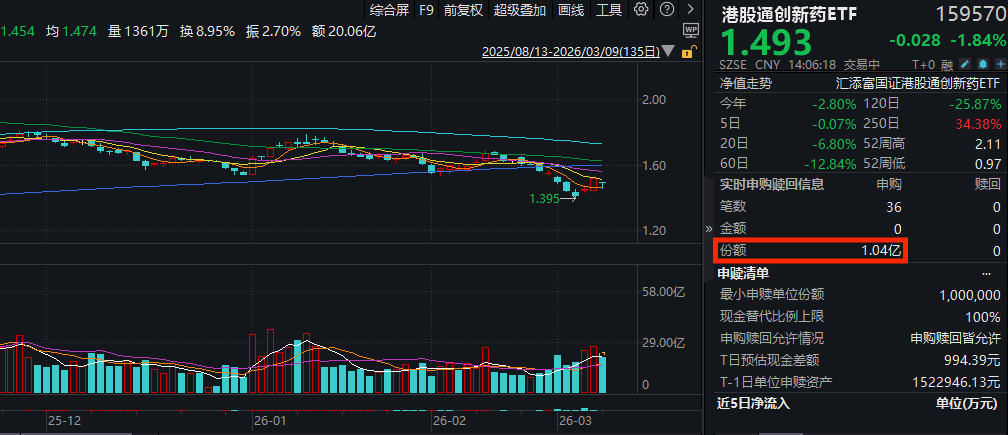
翰森制药核心产品新适应症获批,中国生物制药罗伐昔替尼出海落地!港股通创新药ETF(159570)回调近2%,超2亿元资金狂涌!
Xin Lang Cai Jing· 2026-03-09 06:45
Group 1 - The core viewpoint of the news highlights the recent downturn in the Asia-Pacific market, particularly in the Hong Kong pharmaceutical sector, with the Hong Kong Stock Connect Innovation Drug ETF (159570) experiencing a nearly 2% decline, despite a significant net subscription of 210 million yuan and a total scale exceeding 23.1 billion yuan [1][3] - The high-level meeting has officially categorized innovative drugs as an "emerging pillar industry," emphasizing the acceleration of commercial health insurance development and the promotion of high-quality development in innovative drugs [3] - The approval of Hansoh Pharmaceutical's application for the listing of Amivantamab tablets marks a significant milestone, as it is the first domestically developed third-generation EGFR-TKI in China, with five approved indications since its initial approval in March 2020 [3] Group 2 - In business development news, China Biologic Products announced an exclusive licensing agreement with Sanofi for Rovafatinib, a novel oral small molecule JAK/ROCK inhibitor, with potential payments totaling up to 1.53 billion USD, including an upfront payment of 135 million USD [4] - The Hong Kong Stock Connect Innovation Drug ETF (159570) saw most of its index's popular stocks decline, with notable drops including 5% for 3SBio and over 4% for CanSino Biologics, while Hansoh Pharmaceutical saw a slight increase due to new drug news [4] - The innovative drug sector is experiencing short-term volatility, but the long-term growth potential remains intact, with a focus on the globalization of Chinese pharmaceutical companies and the advancement of innovative technologies [6][9] Group 3 - The focus of the market has shifted from the ability to enter overseas markets to the progress of products in overseas clinical deployments, with key data readouts and milestone achievements becoming critical for future evaluations [7] - Chinese companies are making breakthroughs in frontier technologies such as small nucleic acids and cell therapies, positioning themselves as core assets in global transactions [8] - Leading innovative drug companies are entering a positive cycle of product commercialization and reinvestment in research and development, with expectations for significant performance improvements in the upcoming earnings period [9]



对话全国政协委员梁颖宇:中国创新药如何真正打入国际市场
经济观察报· 2026-03-09 03:17
Core Viewpoint - The article emphasizes the need for Chinese biopharmaceutical companies to pursue high-quality international expansion and the application of AI in the healthcare sector, highlighting the challenges and opportunities in these areas [2][4]. Group 1: High-Quality International Expansion of Biopharmaceuticals - Chinese biopharmaceutical companies have accelerated their international expansion, with China supplying 30% of the global raw material drug capacity and holding about 30% of the global new drug pipeline [5]. - By 2025, the total value of China's innovative drug licensing transactions is expected to reach $135.6 billion, surpassing the U.S. and making China the largest market for innovative drug licensing [5]. - Challenges include limitations in the current international expansion models, risks of industry chain outflow, and increased international competition, which could threaten the sustainability of domestic innovation [5][6]. - The reliance on licensing deals may lead to premature outflow of core assets and hinder the establishment of a self-sustaining commercialization system [6]. - The outflow of talent and capital poses risks to the integrity of the industry chain, as international firms increasingly attract Chinese talent and companies to establish R&D centers abroad [6]. Group 2: Recommendations for High-Quality International Expansion - Strengthening the domestic market is crucial to create a dual-circulation ecosystem for innovative drugs, enhancing payment systems, and improving the accessibility of innovative drugs [7]. - A national-level strategic safety system for pharmaceutical globalization should be established, coordinating overseas registration, global clinical trials, and intellectual property protection [8]. - The industry should build a globally competitive innovation ecosystem, including international clinical trial platforms and a database for geopolitical and compliance risks [8]. - Companies need to shift from merely selling products to building capabilities, enhancing their global R&D, registration, and commercialization systems [8]. Group 3: Application of AI in Healthcare - AI has permeated various aspects of healthcare, including clinical management, hospital operations, and drug development, but it also faces challenges such as data privacy and algorithm bias [14]. - Recommendations include establishing cross-institutional data-sharing mechanisms, enhancing algorithm transparency, and creating a regulatory framework for AI in healthcare [15][16]. - The importance of maintaining the physician's role in the decision-making process is emphasized, with AI serving as a decision support system rather than a replacement for doctors [18]. Group 4: Future Trends in AI Healthcare - The potential for AI to significantly reduce the time required for drug development and approval processes is highlighted, with expectations for AI to play a major role in the pharmaceutical industry [19].

医药生物行业跟踪周报:两会将创新药列为新兴支柱产业,26年BD出海再提速-20260308
Soochow Securities· 2026-03-08 12:39
Investment Rating - The report maintains an "Overweight" rating for the pharmaceutical and biotechnology industry [1]. Core Insights - The National People's Congress has designated innovative drugs as a "new emerging pillar industry," indicating a strategic shift for the biopharmaceutical sector from a nurturing phase to a key driver of economic growth [16][17]. - As of March 6, 2026, the total contract value for Chinese innovative drug outbound business development (BD) has reached USD 56.8 billion, with an upfront payment of USD 3.3 billion, representing 41% of the total for 2025 and exceeding the total for 2024 [17][21]. - Despite significant stock price corrections from 2025 highs, the fundamental outlook for quality companies remains strong, with ongoing clinical development and internationalization efforts [21]. Summary by Sections Industry Trends - The A-share pharmaceutical index has seen a year-to-date decline of 2.42%, underperforming the CSI 300 by 1.02% [9]. - The Hang Seng Healthcare Index has outperformed the Hang Seng Technology Index by 0.97% year-to-date [9]. R&D Progress and Company Dynamics - Recent approvals include HSK31679 for non-alcoholic fatty liver disease and the GLP-1 receptor agonist Enogratide, marking significant advancements in innovative drug development [17]. - The report highlights specific companies to watch, including: - PD1 PLUS: Sangamo Therapeutics, CanSino Biologics, Innovent Biologics, and Zai Lab [12]. - ADC: I-Mab Biopharma, Kelun-Biotech, and Baillie Gifford [12]. - Small nucleic acids: Frontier Biotechnologies, Fuyuan Pharmaceutical, and Yuyuan Pharmaceutical [12]. Market Performance - The report notes that the pharmaceutical index's price-to-earnings ratio is currently at 36.18, which is 2.24 times lower than the historical average [9]. - The report identifies high-performing stocks such as Yahu Pharmaceutical (+40.65%) and Duoyi Pharmaceutical (+30.81%) for the week, while stocks like Haixiang Pharmaceutical (-15.06%) and Furu Medical (-13.07%) faced significant declines [9].




医药生物行业跟踪周报:两会将创新药列为新兴支柱产业,26年BD出海再提速
Soochow Securities· 2026-03-08 12:34
Investment Rating - The report maintains an "Overweight" rating for the pharmaceutical and biotechnology industry [1]. Core Insights - The National People's Congress has designated innovative drugs as a "new emerging pillar industry," indicating a strategic shift for the biopharmaceutical sector from a nurturing phase to a core engine of economic growth [16][17]. - As of March 6, 2026, the total value of business development (BD) contracts for Chinese innovative drugs has reached $56.8 billion, with an upfront payment of $3.3 billion, representing 41% of the total for 2025 and exceeding the total for 2024 [17][21]. - Despite significant stock price corrections from 2025 highs, the fundamentals of quality companies remain solid, and the long-term growth logic for innovative drug exports is still intact [21]. Summary by Sections Industry Trends - The A-share pharmaceutical index has seen a year-to-date decline of 2.42%, underperforming the CSI 300 by 1.02% [9]. - The Hang Seng Healthcare Index has outperformed the Hang Seng Technology Index by 0.97% year-to-date [9]. R&D Progress and Company Dynamics - Recent approvals include HSK31679 for non-alcoholic fatty liver disease and the GLP-1 receptor agonist Enogratide, marking significant advancements in innovative drug development [17]. - The report highlights specific companies to watch, including: - PD1 PLUS: Sangamo Therapeutics, CanSino Biologics, Innovent Biologics, and Zai Lab [12]. - ADC: I-Mab Biopharma, Kelun-Biotech, and Baiyue Tianheng [12]. - Small nucleic acids: Frontier Biotechnologies, Fuyuan Pharmaceutical, and Yuyuan Pharmaceutical [12]. Market Performance - The report notes that the pharmaceutical index's price-to-earnings ratio is currently at 36.18, which is 2.24 times lower than the historical average [9]. - The report identifies top-performing stocks for the week, including Yahu Pharmaceutical (+40.65%) and Duoyi Pharmaceutical (+30.81%), while highlighting significant declines in stocks like Haixiang Pharmaceutical (-15.06%) and Furu Medical (-13.07%) [9].



全国政协委员、汇珩资本梁颖宇:建议明确AI医疗事故责任认定机制,建立多方共担模式
证券时报· 2026-03-06 15:15
Core Viewpoint - The rapid development of AI in healthcare brings new challenges such as data privacy, algorithm bias, and legal regulation, necessitating a clear responsibility framework for AI-related medical errors [1][5]. Group 1: AI in Healthcare Challenges - AI has penetrated various healthcare sectors including clinical health management, hospital operations, drug development, and insurance payments, but it faces issues like data incompleteness and bias, especially when training data is limited to specific populations [5]. - The lack of interoperability between institutions creates data silos, hindering the transferability of AI models [5]. - Ethical concerns arise from the sensitivity of medical data, complicating cross-institutional data flow and necessitating improvements in patient consent and risk communication regarding AI diagnostics [5]. Group 2: Recommendations for AI Implementation - Establish a cross-institutional data sharing mechanism to enhance data flow and interoperability, and implement privacy-preserving technologies to ensure data is usable yet not visible [7]. - Create a clear framework for AI medical error responsibility, including a multi-party accountability model and a tiered regulatory system based on risk levels [7]. - Develop a national AI medical data infrastructure to support AI applications and reduce urban-rural disparities in healthcare access [8]. Group 3: Biopharmaceutical Industry Trends - China's biopharmaceutical companies are increasingly expanding overseas, with the country being the largest exporter of active pharmaceutical ingredients, accounting for 30% of global capacity [10]. - The trend of "selling seedlings" (early-stage licensing) poses risks of losing core assets and long-term value, which could hinder the establishment of independent commercialization systems [11]. - To strengthen the domestic market, it is essential to enhance the value of innovative drugs and improve the payment system involving government, insurance, and charitable funds [11]. Group 4: Investment Sentiment in Biopharmaceuticals - Investment confidence in the biopharmaceutical sector is gradually recovering, with several innovative drug companies successfully listing on the Hong Kong stock market [14]. - The focus remains on late-stage investments, but early-stage capital is crucial for the industry's growth, emphasizing the need for patience from investors [14]. - The AI healthcare sector is viewed as one of the most promising applications of AI, with potential for significant growth, although caution is advised regarding market saturation and resource allocation [14].
医药生物行业创新药板块观点(2026年第1期):短期波动,不改远期成长
Orient Securities· 2026-03-06 08:24
Investment Rating - The report maintains a "Positive" outlook for the pharmaceutical and biotechnology industry [5] Core Viewpoints - Short-term fluctuations do not change the long-term growth trajectory of the innovative drug sector. Despite recent market volatility, the underlying logic for medium to long-term growth remains intact, driven by globalization, technological breakthroughs, and industry upgrades [8][12] - The focus has shifted from "can we go global" to "what progress has been made after going global," emphasizing the importance of overseas clinical deployment and milestone achievements for innovative drugs [13][14] - Breakthroughs in frontier technologies, particularly in small nucleic acids and CAR-T therapies, position Chinese companies to become core global assets [18][20] - The commercialization of innovative drugs is expected to lead to a profitability inflection point, with key companies entering a positive cycle of product volume growth and reinvestment in R&D [22] Summary by Sections 1. Short-term Fluctuations, Long-term Growth - The innovative drug sector has experienced significant volatility due to concentrated expectations and emotions, but the long-term growth trend remains unchanged [8][12] - The valuation of leading companies has reached reasonable levels, suggesting potential investment opportunities as market sentiment stabilizes [12] 1.1 Focus on Globalization Progress - The emphasis has shifted to the progress of products in overseas clinical trials, with a focus on key data readouts and milestone achievements [13][14] - Domestic bispecific antibodies are accelerating their global clinical trials, becoming core trading assets in the context of expiring patents for PD-(L)1 products [13] 1.2 Breakthroughs in Frontier Technologies - Chinese companies are leading in small nucleic acids and CAR-T therapies, with significant advancements in delivery technologies expanding treatment options beyond rare diseases [18] - In vivo CAR-T therapies have shown preliminary clinical effectiveness, with a growing number of transactions indicating a shift towards mainstream adoption [20] 1.3 Commercialization Driving Profitability - Leading innovative drug companies are entering a cycle of product volume growth that supports R&D reinvestment, with expectations for exceeding market performance in 2023 [22] - The upcoming earnings period in March-April 2026 is seen as a critical validation point for the sector [22] 2. Global New Drugs: Highlights in Autoimmunity and Oncology - The report highlights the approval of the world's first PD-L1/TGF-β bispecific antibody, showcasing the R&D capabilities of domestic companies [26][27] - The successful launch of innovative drugs in critical therapeutic areas reflects the growing strength of domestic pharmaceutical companies in addressing unmet medical needs [26][27]

创新药板块观点(2026年第1期):短期波动,不改远期成长-20260306
Orient Securities· 2026-03-06 06:13
Investment Rating - The report maintains a "Positive" outlook for the innovative pharmaceutical sector in China [5]. Core Viewpoints - Short-term fluctuations do not alter long-term growth prospects. The innovative drug sector has experienced increased volatility due to external factors, but the underlying logic for medium to long-term growth remains intact. The report suggests focusing on investment opportunities once market volatility stabilizes [8][12]. - Key investment themes include "outbound execution," "breakthroughs in cutting-edge technologies," and "profitability inflection points" [3][8]. Summary by Sections 1. Short-term Fluctuations, Long-term Growth - The innovative drug sector has been experiencing significant fluctuations since the beginning of the year, driven by investor sentiment and market adjustments. However, the long-term trends of globalization, technological breakthroughs, and industrial upgrades remain unchanged [12]. - The focus has shifted from "can we go abroad" to "what progress is made after going abroad," emphasizing the importance of clinical deployment and milestone achievements in overseas markets [13][14]. 1.1 Outbound Execution Becomes Key - The report highlights that the focus on outbound strategies has transitioned to the progress of products in overseas clinical trials. The performance of domestic dual antibodies in global clinical trials is becoming a focal point for the industry [13][14]. 1.2 Breakthroughs in Cutting-edge Technologies - Chinese companies are making significant advancements in small nucleic acids and cell therapies, positioning themselves as core assets in global transactions. The report notes that small nucleic acids are expanding beyond rare diseases and metabolic disorders, with breakthroughs in delivery technologies [18][19]. - In vivo CAR-T therapies are showing promising initial clinical results, with a growing number of transactions in this area, indicating a shift towards more mainstream applications [20][21]. 1.3 Commercialization Drives Profitability Inflection Points - Leading innovative pharmaceutical companies are entering a positive cycle of product commercialization and reinvestment in R&D. The report anticipates that 2026 will be a critical year for profitability, with key performance periods in March and April serving as important validation points [22][23]. 2. Global New Drugs: Highlights in Autoimmunity and Oncology - The report discusses the approval of the world's first PD-L1/TGF-β dual antibody, highlighting the strength of domestic R&D capabilities. This drug, approved for advanced gastric cancer, showcases the potential for domestic companies to achieve significant milestones in drug development [26][27].
四大证券报精华摘要:2月27日
Zhong Guo Jin Rong Xin Xi Wang· 2026-02-27 01:22
Group 1 - In February, nearly 240 listed companies were surveyed by various institutions, with over half achieving positive returns during the same period, and some stocks seeing cumulative gains exceeding 80% [1] - The mechanical equipment and electronics sectors were the primary focus of institutional surveys, with significant attention also given to cyclical sectors like basic chemicals [1] - Institutions are optimistic about investment opportunities in humanoid robots, upstream AI infrastructure, and certain chemical sector stocks that offer high elasticity and dividends [1] Group 2 - In January 2026, domestic automobile sales reached 2.346 million units, with the top ten companies accounting for 1.962 million units, representing 83.6% of total sales, indicating a high concentration in the market [2] - The automotive market is characterized by "steady start and structural differentiation," with increased competition among top manufacturers as they launch new products and technologies [2] - The pharmaceutical and biotechnology sectors saw 80 companies receive institutional surveys, with a focus on brain-computer interface stocks and the trend of innovative drugs going global [2] Group 3 - Several securities firms have held spring strategy meetings earlier than usual, reflecting changes in the competitive landscape of the industry [3] - The shift from "commission for research" to "service for income" is becoming more pronounced among brokerage firms [3] - The AI industry is entering a more pragmatic phase, focusing on revenue and profit, with significant investment opportunities in AI inference computing and domestic AI chips [3] Group 4 - Lithium carbonate futures surged by 11.83% to a high of 187,700 yuan/ton, driven by Zimbabwe's adjustments to lithium export policies, which may tighten global supply in the short term [4] - UBS predicts a potential third price cycle for lithium, raising the average price expectation for 2026 to around 180,000 yuan/ton [4] Group 5 - The A-share merger and acquisition market remains vibrant, with over 500 transactions disclosed since the beginning of the year, totaling over 100 billion yuan [5] - More than 50% of these transactions are driven by industrial synergy, highlighting a core market trend [5] - The hard technology sector is a primary battleground for mergers and acquisitions, with increased participation from the Sci-Tech Innovation Board and the Growth Enterprise Market [5] Group 6 - The Hong Kong Stock Exchange reported record highs in trading volume and revenue for 2025, reaffirming its position as a global leader in new stock financing [6] - The exchange aims to enhance market convenience and competitiveness while continuing to invest strategically in emerging business areas [6] - Export-oriented companies are actively implementing measures to hedge against currency risks amid fluctuations in the renminbi exchange rate [6] Group 7 - Regions like Guangdong, Anhui, and Hubei are strategically positioning themselves in advanced fields such as AI, quantum technology, and high-end manufacturing [7] - The development of future industries relies heavily on original innovation and disruptive technologies, which are still in early stages [7] - Policies are increasingly systematic and comprehensive, supporting innovation from inception to market application [7] Group 8 - NIO's chip subsidiary, Anhui Shenji Technology Co., completed its first round of equity financing, raising 2.257 billion yuan, with a post-investment valuation nearing 10 billion yuan [8] - The financing attracted diverse capital participation, including state-owned capital and semiconductor industry funds, indicating market confidence in the company's technology and production capabilities [8] - The involvement of local state capital aligns with Hefei's ongoing investment in the integrated circuit industry [8]