
地方债务化解

Search documents
从“攻坚化解”到“系统治理”,2025是地方债化债大年
Hua Xia Shi Bao· 2025-12-25 00:13
Core Viewpoint - China's local debt resolution efforts have deepened this year, with significant progress in reducing hidden debt and lowering financing costs, marking a shift from aggressive measures to systematic governance in debt management [3][4]. Group 1: Debt Reduction Progress - Since the introduction of a comprehensive debt resolution plan in July 2023, local debt resolution has advanced significantly, with hidden debt expected to decrease to approximately 6.5 to 7 trillion yuan by the end of this year [4]. - After the completion of a 2 trillion yuan debt replacement quota next year, the hidden debt that local governments need to resolve independently is projected to drop to around 4.5 trillion yuan, significantly alleviating pressure and maintaining overall risk at manageable levels [4]. - As of June 2023, the debt structure of financing platforms has improved, with bank loans accounting for 56.59% of interest-bearing liabilities, bonds at 24.19%, and non-standard financing at 19.22%, reflecting a shift in financing sources [4]. Group 2: Systematic Governance and Policy Shifts - The debt resolution strategy has transitioned to a systematic governance approach, characterized by fiscal debt resolution, financial collaboration, and institutional regulatory frameworks [4][5]. - The Ministry of Finance's establishment of a debt management department signifies the implementation of long-term mechanisms for monitoring, borrowing, and accountability in debt management [5]. - The focus of debt resolution policies has shifted from "developing through debt resolution" to "resolving debt through development," indicating a more integrated approach to managing local government debt [3][5]. Group 3: Future Directions and Challenges - In 2026, the debt resolution strategy is expected to continue emphasizing development while addressing operational debt and overdue payments, with a focus on reducing high-cost non-standard debts [8][9]. - There may be supplementary policies to support the transition of financing platforms, which are required to exit by June 2027, as achieving sufficient self-sustainability within this timeframe is challenging [9]. - The government is likely to prioritize clearing overdue payments to enterprises, with 2026 anticipated to be a critical year for addressing these debts, although some regions may struggle to meet their obligations without additional bond issuance [10].


从“攻坚化解”到“系统治理”,2025是地方债化债大年| 2025中国经济年报
Sou Hu Cai Jing· 2025-12-24 13:43
Group 1 - The core viewpoint of the article highlights the significant progress in China's local debt resolution efforts, transitioning from a focus on tackling debt to a more systematic governance approach [1][2][3] - The special refinancing bonds aimed at replacing hidden debts have effectively reduced the scale of hidden debts and lowered financing costs, with local financing platforms accelerating their market-oriented transformation and exit [1][2] - As of the end of this year, the scale of local hidden debts is expected to decrease to approximately 6.5 to 7 trillion yuan, with further reductions anticipated in the following year [2][3] Group 2 - The debt structure of financing platforms has improved, with a notable decline in financing costs; as of June, bank loans accounted for 56.59% of the total interest-bearing liabilities of urban investment platforms, while bond financing decreased to 24.19% [2] - The central economic work conference emphasized the need to actively and steadily resolve local government debt risks, optimizing debt restructuring and replacement methods [5][7] - The article discusses the potential for new policies to support the transition of financing platforms, including the issuance of special bonds to alleviate funding pressures faced by banks involved in debt resolution [6]
贵州省地方债务化解观察与展望:山重水复疑无路,柳暗花明又一村
Lian He Zi Xin· 2025-12-16 11:38
1. Report Industry Investment Rating No relevant content provided. 2. Core Viewpoints of the Report - In recent years, Guizhou Province's local debt has shown characteristics such as continuous growth in scale, heavy regional debt burden, differentiated debt pressure among cities, liquidity pressure on some urban investment enterprises, concentrated redemption of urban investment bonds, and persistent negative public opinions. Despite relatively weak debt - resolution resources, with strong policy support from the central government and increasingly diverse debt - resolution means, certain achievements have been made in debt resolution. However, issues such as high credit spreads of urban investment bonds and continuous short - term liquidity pressure on urban investment enterprises still need attention. - In the short term, with the continuous implementation of a package of debt - resolution and incremental debt - resolution policies, Guizhou, as a key province, will continue to benefit, and the liquidity risk is generally controllable within the policy protection period, but the principal and interest repayment pressure on urban investment enterprises remains high. - In the long run, debt resolution depends on the self - development of local governments and urban investment enterprises. Guizhou has obvious advantages in industries such as liquor, mineral deep - processing, digital economy, new energy, characteristic agriculture, and cultural tourism. With the construction of a modern industrial system and the improvement of high - quality development levels, Guizhou is expected to resolve its debt during development [4]. 3. Summary by Relevant Catalogs 3.1 Introduction - Guizhou is an important area in China's regional coordinated development, but due to factors such as terrain, transportation, and industrial structure, its economic aggregate ranks in the middle and lower reaches nationwide, with weak fiscal strength, heavy dependence on central subsidies, and a heavy local government debt burden. Since 2018, negative public opinions in Guizhou have attracted market attention. Under the support of policies such as the "package of debt - resolution", Guizhou has actively explored debt resolution [5]. 3.2 Debt Characteristics - **Continuous growth in local debt scale and heavy regional debt burden**: As of the end of 2024, Guizhou's local government debt balance was 1753.709 billion yuan, and the debt scale of urban investment enterprises was about 900 billion yuan. Its government debt ratio and broad - based government debt ratio rank in the upper - middle level nationwide, indicating a heavy regional debt burden [7]. - **Differentiated regional debt burden, with heavier debt burdens in Guiyang and Zunyi**: As of the end of 2024, the provincial - level government debt and urban investment enterprise debt in Guizhou accounted for less than 15% and about 11% respectively, while the debt of city (prefecture) - level, district - county - level, and park - level urban investment enterprises accounted for about 48%, 22%, and 18% respectively. The urban investment enterprise debt is mainly concentrated in Guiyang and Zunyi. Guiyang, Zunyi, and Liupanshui rely more on urban investment enterprise financing, and their broad - based government debt ratios are relatively high [9]. - **Large liquidity pressure on urban investment enterprises in some cities (prefectures)**: Although the debt structure of Guizhou's urban investment enterprises is relatively reasonable, urban investment enterprises in some areas such as Qiannan, Qiandongnan, and Tongren have small cash - like assets and large short - term debt repayment pressure [12]. - **Concentrated redemption of urban investment bonds**: The issuance of urban investment bonds in Guizhou is concentrated in Guiyang and Zunyi. The redemption scale of urban investment bonds in Guizhou increased year by year from 2021 to 2023 and then decreased significantly. However, the redemption scale of due bonds in Guiyang and Zunyi is still large [14]. - **Persistent negative public opinions**: Since 2018, non - standard negative events in Guizhou's urban investment enterprises have been the highest in the country, mainly concentrated in Zunyi and Qiannan. The number of urban investment enterprises with bill overdue in Guizhou ranked third in the country from 2022 - 2024, and as of the end of October 2025, there were still 16 enterprises in the continuous overdue list, mainly concentrated in Zunyi, Guiyang, and Liupanshui [16]. 3.3 Debt - Resolution Achievements 3.3.1 Debt - Resolution Resources - **Fiscal resources**: In 2024, Guizhou's comprehensive financial resources ranked 14th in the country, with general public budget revenue of 217 billion yuan (ranked 21st) and government - funded revenue of 231.528 billion yuan (ranked 8th). Its fiscal self - sufficiency rate is less than 35%. Although the scale of state - owned land transfer income has declined since 2021, the government - funded revenue has continued to grow. The coverage of government - funded revenue for government debt interest is at a medium - upper level in the country. As of the end of 2024, Guizhou's debt space exceeded 280 billion yuan, ranking first among key provinces [22][25]. - **Financial resources**: Since 2020, the balance of local financial institutions' deposits and loans in Guizhou has continued to grow rapidly. As of the end of 2024, the balance of local financial institutions' loans and deposits ranked 19th and 25th in the country respectively, and the loan - to - deposit ratio was the highest in the country. As of November 16, 2025, the total credit line of banks for bond - issuing enterprises in Guizhou exceeded 1 trillion yuan, and the credit lines of Guizhou Bank and Guiyang Bank accounted for more than 90% of the total. The total assets and deposits of Guizhou's city commercial banks rank 16th in the country, and their coverage of urban investment enterprise debt is at a medium level in the country [27][29]. - **Local state - owned enterprise resources**: Although the number of listed companies in Guizhou ranks relatively low in the country, the total market value is at a medium level. As of the end of September 2025, the total market value of Kweichow Moutai exceeded 1.8 trillion yuan, accounting for nearly 85% of the total market value of listed companies in Guizhou. The market value of listed companies held by local state - owned enterprises in Guizhou has a relatively high coverage of urban investment enterprise debt, but the reduction of Kweichow Moutai's equity is restricted [33]. 3.3.2 Debt - Resolution Measures - **Financial support for debt resolution**: It mainly includes debt restructuring, non - standard discounted repayment, and "unified borrowing and repayment". For example, in 2022, Zunyi Road and Bridge Construction (Group) Co., Ltd. carried out loan extension and interest - rate reduction restructuring; since 2023, there have been cases of non - standard discounted repayment in many cities in Guizhou; in February 2024, Guizhou first practiced "unified borrowing and repayment" nationwide, involving a bond amount of about 3.6 billion yuan [37][38]. - **Special refinancing bonds and special new special bonds**: In 2024, Guizhou was allocated a quota of 352.8 billion yuan for special refinancing bonds, and 800 billion yuan was arranged from new local government special bonds for five consecutive years starting from 2024 for debt resolution. Since 2024, the cumulative issuance amount of special refinancing bonds and special new special bonds in Guizhou ranks among the top in key provinces, and the early redemption amount of urban investment bonds exceeds 30 billion yuan [39]. - **Activating state - owned enterprise resources for debt resolution**: "Moutai debt resolution" is a typical case, which includes equity transfer and reduction of Kweichow Moutai, bond issuance by Moutai Group to acquire the equity of Guizhou Expressway, and financing and capital operation by the finance company to relieve the liquidity pressure of state - owned platforms [41]. - **Other methods**: These include setting up emergency funds, arranging various fiscal funds, transferring the right to state - owned asset income, and using operating income. Provincial state - owned platforms also provide support such as emergency loan transfer, credit support, and credit enhancement for urban investment enterprises [42]. 3.3.3 Debt - Resolution Performance - **Significant reduction in the debt scale of bond - issuing urban investment enterprises and improvement in the financing structure**: Since the end of 2022, the debt scale of bond - issuing urban investment enterprises in Guizhou has continued to decline. The scale of bank loans and bond financing has decreased, and the proportion of bank loans and other financing has increased to about 67% and 14% respectively, while the proportion of bond financing has decreased to about 19% [44]. - **Continuous net repayment of urban investment bonds and reduced concentrated redemption pressure**: Since 2021, urban investment bonds in Guizhou and most of its cities (prefectures) have been in a state of net repayment, with an annual net repayment scale of over 35 billion yuan from 2023 - 2024. As of the end of September 2025, the scale of outstanding urban investment bonds in Guizhou was about 138 billion yuan, and the maturity scale in the next four years is relatively balanced [47]. - **Significant narrowing of the credit spread of urban investment bonds**: Since the implementation of the package of debt - resolution plans, the credit spread of urban investment bonds in Guizhou has narrowed significantly since the end of 2023, but it is still at the highest level among key debt - resolution provinces. As of the end of October 2025, the credit spread has decreased by more than 300BP compared with the beginning of 2021. However, the cash - like assets' coverage of short - term debt has decreased, and the short - term liquidity of bond - issuing urban investment enterprises is still under pressure [49][51]. 3.4 Debt - Resolution Outlook - **Short - term outlook**: With the continuous implementation of the package of debt - resolution and incremental debt - resolution policies, Guizhou will continue to benefit, and the liquidity risk is generally controllable within the policy protection period. However, the principal and interest repayment pressure on urban investment enterprises is still large due to factors such as the contradiction between debt resolution and development, restrictions on new financing, and insufficient coverage of interest by current debt - resolution policies [55][56]. - **Long - term outlook**: Debt resolution depends on the self - development of local governments and urban investment enterprises. Guizhou has obvious advantages in industries such as liquor, mineral deep - processing, digital economy, new energy, characteristic agriculture, and cultural tourism. By building a modern industrial system and promoting high - quality development, Guizhou is expected to resolve its debt during development [57].
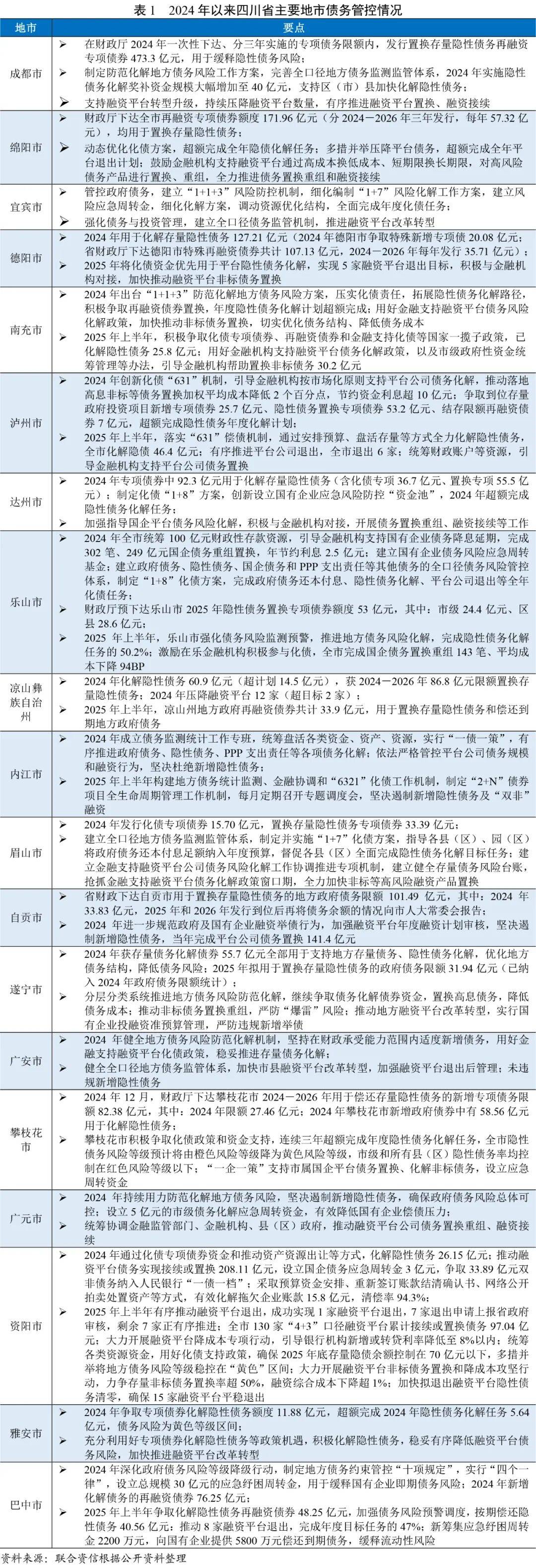
四川省发债城投企业财务表现观察:投融资结构优化,局部流动性压力仍存
Lian He Zi Xin· 2025-12-04 11:06
Report's Industry Investment Rating - Not provided in the content Core Viewpoints of the Report - Since 2024, with the rapid implementation of debt - resolution policies, Sichuan Province has achieved orderly resolution of implicit debts, a continuous decrease in the number of financing platforms, and optimization of the debt structure of urban investment companies. However, there are still some pressures on debt repayment and liquidity in some regions. The financial fundamentals of urban investment companies are difficult to improve significantly. In the future, the resolution of operating debts depends on the substantial transformation of urban investment companies and the enhancement of their self - hematopoietic ability to achieve a new balance between economic development and debt resolution [3][5]. Summary of Each Section I. Sichuan Province's Debt Management Situation - **Overall situation**: Since 2024, with the rapid implementation of debt - resolution policies, the number of local government financing platforms in Sichuan has been significantly reduced. The province has taken various measures to resolve implicit debts, and the debt - repayment pressure has been relieved to some extent. For example, in 2024, Sichuan issued 5079.2 billion yuan of local government bonds, of which 1982 billion yuan was used to replace existing debts [5][6]. - **City - level situation**: Different cities in Sichuan have different debt management measures and effects. For example, Chengdu issued 473.3 billion yuan of refinancing special bonds to replace existing implicit debts; Mianyang used 171.96 billion yuan of refinancing special bonds (issued in three years from 2024 - 2026) to replace existing implicit debts; Yibin established a risk - prevention and control mechanism and completed the annual debt - resolution task [6]. II. Changes in Financial Indicators of Urban Investment Companies Investment - **Overall in Sichuan**: From 2022 to June 2025, the scale of the three types of investments (urban - construction assets, self - operated assets, equity, and fund - investment assets) of urban investment companies in Sichuan increased year by year, but the growth rates declined. The proportion of urban - construction assets decreased, while the proportion of equity and fund - investment assets increased. In 2024, the growth rate of urban - construction assets, equity and fund - investment assets, and self - operated assets decreased to 5.56%, 18.23%, and 3.53% respectively from 15.32%, 26.00%, and 13.30% in 2022 [10][11]. - **Regional differences**: In 2024, the total asset scale of enterprises in Chengdu was much larger than that in other cities. The growth rates of the three types of investments in Yibin, Nanchong, Ya'an, and Leshan were relatively high, while the investment scale in Dazhou and Panzhihua decreased [12][13]. Receivables - **Overall in Sichuan**: From 2022 to the end of 2024, the accounts - receivable scale of urban investment companies in Sichuan continued to expand, but the growth rate slowed down. The cash - income ratio remained at a relatively high level [14]. - **Regional differences**: At the end of 2024, the accounts - receivable scale of urban investment companies in Chengdu accounted for more than half of the province, and the collection pressure needed to be relieved. The growth rates of accounts - receivable in Meishan, Bazhong, and Yibin were relatively fast, while those in Dazhou, Luzhou, Panzhihua, and Ya'an decreased. The cash - income ratios in Nanchong and Panzhihua were high, while those in Guang'an, Chengdu, and Yibin were relatively low [15][17]. Fundraising - **Overall in Sichuan**: From 2022 to 2024, the net cash inflow from fundraising activities of urban investment companies in Sichuan decreased year by year. In 2024, except for Ya'an, Dazhou, and Luzhou, the fundraising activities of urban investment companies in other cities had net cash inflows, and the net inflow scale of most cities decreased year - on - year [18]. - **Regional differences**: In 2024, the cash inflow and outflow of fundraising activities of urban investment companies in Chengdu accounted for more than 60% of the province. The fundraising activities of different cities varied significantly. The net cash inflow of fundraising activities in Yibin was relatively large [18]. Interest - bearing Debt - **Overall in Sichuan**: From 2022 to June 2025, the debt scale of urban investment companies in Sichuan continued to grow, but the growth rate slowed down. The debt - term structure was mainly long - term debt. After the implementation of the "package debt - resolution plan", bank - loan financing increased, and the proportion of bond and other financing decreased [20][21]. - **Regional differences**: At the end of 2024, the debt scale of Chengdu accounted for nearly 70% of the province. The debt - growth rates in Meishan, Zigong, Ziyang, and Yibin were relatively fast. The proportion of short - term debt in some regions was relatively high. The bank - financing growth rates in Yibin, Guang'an, and Zigong were relatively high in 2024, and most cities' bond financing showed a net outflow [20][23]. Debt - repayment Ability - **Overall in Sichuan**: From 2022 to June 2025, the asset - liability ratio and total - debt capitalization ratio of urban investment companies in Sichuan increased year by year. The cash - to - short - term - debt ratio decreased from 2022 to the end of 2024 and rebounded significantly at the end of June 2025 [25][26]. - **Regional differences**: The debt burdens of urban investment companies in Mianyang, Chengdu, Guangyuan, and Yibin were relatively heavy, while those in Ya'an, Guang'an, and Liangshan were relatively light. The short - term debt - repayment pressures in Zigong, Suining, Leshan, and Yibin were relatively large, while those in Chengdu and Guang'an were relatively small [26]. III. Summary - Since 2024, through debt monetization and market - oriented transformation, the investment growth rate of urban investment companies in Sichuan has gradually slowed down, and the investment structure has been continuously adjusted. The debt scale has continued to grow, but the growth rate has slowed down. The proportion of bank financing has increased year by year. However, the overall debt burden of urban investment companies in Sichuan has continued to increase, and regional differences are obvious. In the context of large fiscal revenue and expenditure pressures, it is still difficult to significantly improve the financial fundamentals of urban investment companies [28].
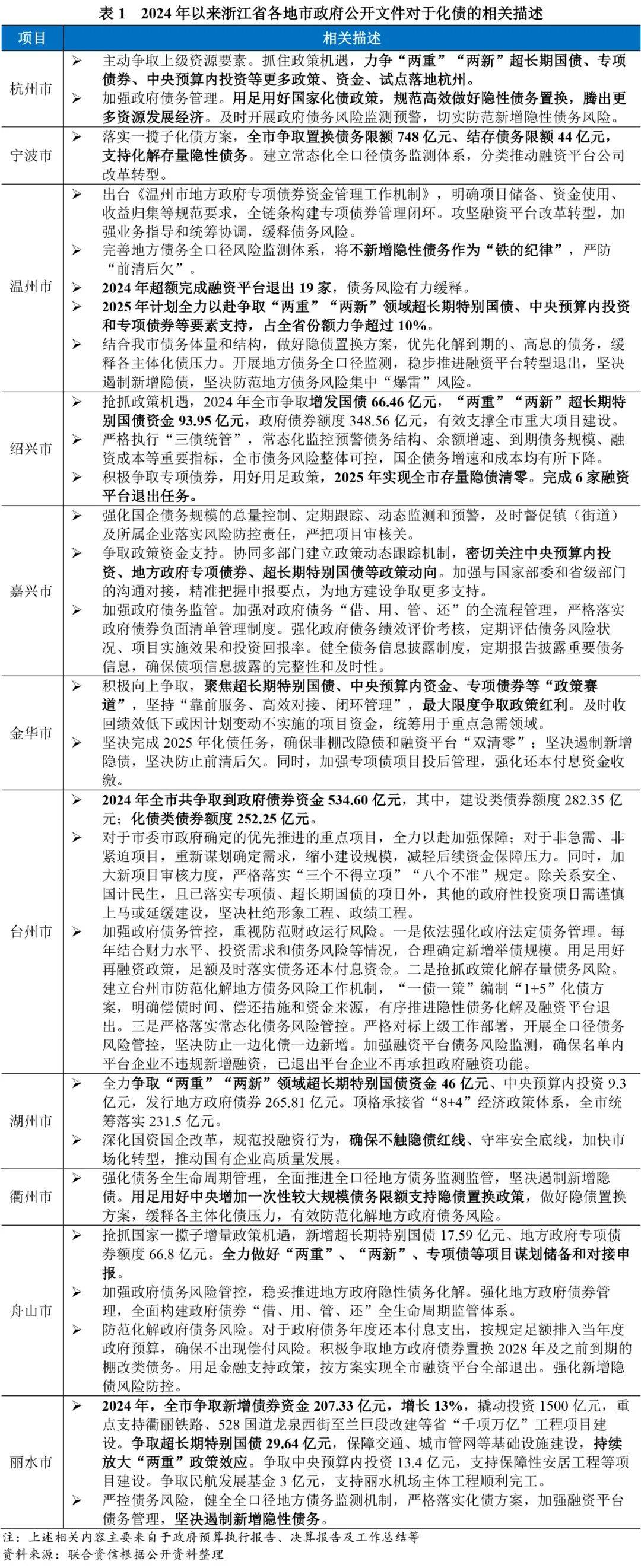
浙江省发债城投企业财务表现观察:化债与发展并举,再融资能力强劲
Lian He Zi Xin· 2025-12-04 11:01
1. Report Industry Investment Rating No relevant content provided. 2. Core Viewpoints of the Report - Zhejiang Province has made phased achievements in debt resolution through multiple measures such as seeking superior funds, issuing special refinancing bonds, and controlling project investments. The province's 11 prefecture - level cities have formed a pattern of "full - scale promotion and gradient clearance" around debt reduction goals, with some regions achieving zero implicit debt and "dual zero" goals. At the same time, Zhejiang's urban investment enterprises' debt scale continues to grow but at a slower pace, with an optimized financing structure, and the short - term debt ratio has slightly increased. However, challenges remain, including regional differentiation, continued growth in accounts receivable in some areas, slowdown in investment growth, and insufficient self - hematopoietic ability in some urban investment enterprises. Therefore, it's necessary to plan for debt resolution and market - oriented transformation of urban investment enterprises simultaneously to improve their operational efficiency and risk - resistance ability [3][9][34]. 3. Summary by Relevant Catalogs 3.1 Zhejiang Province's Debt Control Situation - **Seeking Superior Funds**: In 2024, Zhejiang obtained 69.764 billion yuan in ultra - long - term special treasury bonds and 327.9 billion yuan in new special bonds, with 290.1 billion yuan used for project construction, accounting for 9.1% of the national total, and 37.8 billion yuan for the completion of existing government investment projects [5]. - **Implicit Debt Replacement**: In 2024, the Ministry of Finance allocated a local government debt limit of 244.2 billion yuan to Zhejiang in three - year installments (81.4 billion yuan per year from 2024 - 2026). In 2024 and 2025, Zhejiang (including Ningbo) fully used the "special bonds for implicit debt replacement" quota of 81.4 billion yuan each year. The issuance of special refinancing bonds in 2025 was faster than the national average, which lowered the average financing cost of urban investment enterprises [5]. - **Controlling Project Investment**: Cities like Jiaxing and Taizhou proposed to control project investment to prevent new debt. They sorted out and reviewed existing government investment projects, strengthened support for key projects, and carefully considered or postponed non - urgent projects. They also tightened the review of new projects and coordinated the connection between the fiscal budget and the government investment plan [6]. - **Regional Achievements**: As of the end of September 2025, some regions in Zhejiang, such as Lin'an District and Chun'an County in Hangzhou, Zhoushan City, etc., achieved zero implicit debt, and some areas completed the "dual zero" goals of implicit debt resolution and platform exit. More than 600 urban investment platforms in Zhejiang have exited, accounting for half of the national total during the same period [9]. 3.2 Changes in Financial Indicators of Zhejiang's Urban Investment Enterprises 3.2.1 Investment - **Overall Situation in Zhejiang**: From 2022 to June 2025, the investment scale of urban - construction assets, self - operated assets, and equity and fund investments of Zhejiang's urban investment enterprises continued to grow, but the growth rate of urban - construction assets and equity and fund investments slowed down. By the end of June 2025, the growth rates of these three types of assets further decreased. The proportion of urban - construction assets decreased to 69.90% but remained the main asset component [13]. - **Regional Differences**: Most cities' total investment and urban - construction asset investment increased. The growth rates of Wenzhou, Shaoxing, Huzhou, and Zhoushan were below 10%, while the other seven cities exceeded 10%. In 2024, the growth rate of urban - construction assets in all cities slowed down, and the growth rates of self - operated assets in most cities increased. The growth rate of equity and fund investments decreased in half of the regions [14]. 3.2.2 Receivables - **Overall Situation in Zhejiang**: From 2022 to June 2025, the accounts receivable of Zhejiang's urban investment enterprises continued to grow, but the growth rate decreased in 2024 and June 2025. In 2024, the cash income ratio was relatively good, which may be affected by multiple factors such as the slowdown of project settlement and the change in the business structure [16]. - **Regional Differences**: At the end of 2024, the accounts receivable of urban investment enterprises in Hangzhou, Ningbo, and Huzhou exceeded 50 billion yuan, while those in Quzhou, Lishui, and Zhoushan were below 20 billion yuan. Except for Jinhua, the growth rate of accounts receivable in other cities exceeded 10% [18]. 3.2.3 Financing - **Overall Situation in Zhejiang**: From 2022 to 2024, the cash inflow and outflow of financing activities of Zhejiang's urban investment enterprises increased year by year, with a net inflow that fluctuated and decreased, mainly due to policy restrictions on new financing in 2024. The financing structure was optimized, with bank borrowing as the main channel and an increasing proportion of bank financing [20][25]. - **Regional Differences**: In 2024, the cash inflow of financing activities in Hangzhou, Shaoxing, Ningbo, and Huzhou exceeded 500 billion yuan. The net inflow of financing activities was positive in all cities, with significant regional differences. The net inflow in Zhoushan was only 6 billion yuan, while those in Hangzhou, Ningbo, and Jiaxing exceeded 100 billion yuan [20][23]. 3.2.4 Interest - Bearing Debt - **Overall Situation in Zhejiang**: By the end of June 2025, the debt scale of Zhejiang's urban investment enterprises continued to grow, but the growth rate slowed down from 22.55% in 2023 to 8.53%. The debt was mainly long - term, with a slightly increased proportion of short - term debt. The financing structure was optimized, with bank borrowing accounting for nearly 70% [25][26]. - **Regional Differences**: The debt scale of urban investment enterprises in Hangzhou, Shaoxing, Ningbo, and Huzhou ranked among the top, exceeding 1 trillion yuan in total. In 2024, the debt growth rates of urban investment enterprises in Jiaxing, Quzhou, Taizhou, and Lishui exceeded 15%. The proportion of short - term debt in some regions increased [26]. 3.2.5 Debt - Servicing Ability - **Overall Situation in Zhejiang**: From 2022 to June 2025, the overall debt burden of Zhejiang's urban investment enterprises continued to rise, and the cash - to - short - term - debt ratio fluctuated and decreased. Since 2025, with increased debt resolution efforts and support from financial institutions, the short - term debt - servicing ability has improved [29][33]. - **Regional Differences**: The debt burdens of urban investment enterprises in Shaoxing, Taizhou, Jinhua, Hangzhou, and Jiaxing were relatively heavy. The cash - to - short - term - debt ratio of cities in Zhejiang ranged from 0.3 to 0.5 times, with Lishui having the highest ratio. In 2025, the short - term debt - servicing ability of all cities improved to some extent [33].
【债市研究】化债与发展并举,再融资能力强劲——浙江省发债城投企业财务表现观察
Sou Hu Cai Jing· 2025-12-04 10:29
Core Viewpoint - Zhejiang Province is actively advancing local debt resolution through various methods, achieving phased results, including a significant reduction in platform numbers and some regions reaching dual clearance of debts [1][5]. Group 1: Debt Management in Zhejiang Province - Zhejiang Province is utilizing strategies such as securing higher-level funding, issuing special refinancing bonds, and controlling project investments to enhance debt management and has seen initial success [2]. - In 2024, Zhejiang secured 69.764 billion yuan in special long-term bonds and 327.9 billion yuan in new special bonds, with 290.1 billion yuan allocated for project construction, accounting for 9.1% of the national total [2]. - The provincial government is gradually implementing plans for replacing hidden debts, with a total debt limit of 244.2 billion yuan set for 2024, distributed over three years [2]. Group 2: Investment Control Measures - Several cities in Zhejiang, including Jiaxing and Taizhou, have publicly committed to controlling project investments to manage new debt risks [3]. - The focus is on prioritizing essential projects while re-evaluating non-urgent projects to reduce future funding pressures [3]. - New project approvals are being scrutinized, with a strong emphasis on avoiding non-essential projects and ensuring alignment with fiscal budgets [3]. Group 3: Financial Indicators of Urban Investment Enterprises - The debt scale of urban investment enterprises in Zhejiang continues to grow, but the growth rate has slowed, with long-term debt remaining predominant [23]. - As of June 2025, the debt growth rate decreased from 22.55% in 2023 to 8.53% [23]. - The financing structure has improved, with bank loans becoming the primary source of financing, accounting for nearly 70% of total financing by June 2025 [26]. Group 4: Cash Flow and Receivables - Urban investment enterprises in Zhejiang have maintained a net inflow of cash from financing activities, with significant inflows reported in cities like Hangzhou, Ningbo, and Jiaxing [16][20]. - However, the growth rate of accounts receivable has been increasing, indicating ongoing challenges in cash collection [12][15]. - The cash income ratio for urban investment enterprises has shown positive performance, reflecting better cash collection from certain business segments despite overall project settlement delays [14]. Group 5: Challenges and Future Outlook - Zhejiang Province faces significant regional disparities in debt management, with some areas continuing to experience increased accounts receivable and cash flow pressures [5][34]. - The investment growth rate is slowing, particularly in infrastructure projects, which, combined with cash collection challenges, indicates that the internal debt repayment capacity of urban investment enterprises has not improved substantially [34]. - As a major economic province, Zhejiang must balance the hard task of debt resolution with the new requirements for high-quality development, necessitating a comprehensive approach to enhance operational efficiency and risk resilience in urban investment enterprises [34].
【债市研究】投融资结构优化,局部流动性压力仍存——四川省发债城投企业财务表现观察
Sou Hu Cai Jing· 2025-12-04 10:23
Core Viewpoint - Since 2024, Sichuan Province has implemented debt reduction policies, leading to the orderly resolution of hidden debts and a reduction in the number of financing platforms, optimizing the debt structure of urban investment companies [1][2][3]. Debt Management Situation in Sichuan Province - The rapid implementation of debt reduction policies has resulted in a significant decrease in the number of local government financing platforms, with a projected reduction of 71% in the number of platforms and 62% in the scale of operating financial debt by September 2025 compared to March 2023 [2]. - The Sichuan government has issued local government bonds totaling 507.92 billion yuan in 2024, with 1,982 billion yuan allocated for replacing existing debts, alleviating some repayment pressure [3]. Financial Indicators of Urban Investment Companies - Investment in urban construction, self-operated assets, and equity and fund investments has been increasing, but the growth rate is declining. By the end of 2024, the proportion of urban construction assets is decreasing, while the share of equity and fund investments is rising [8][9][10]. - By the end of 2024, the total debt scale of urban investment companies in Sichuan Province continues to grow, with a year-on-year growth rate of 9.28%. Chengdu accounts for nearly 70% of the total debt scale [21][25]. Cash Flow and Collection - The scale of accounts receivable for urban investment companies has been expanding, but the growth rate is slowing down. By the end of 2024, the cash income ratio remains high, indicating good cash collection performance [13][14]. - Chengdu's accounts receivable scale exceeds half of the province's total, with a growth rate of 10% in 2024, indicating a need for improved cash collection [14]. Financing Activities - The cash inflow from financing activities for urban investment companies has been shrinking, with most cities experiencing a decline in net inflow. Chengdu's financing activities account for over 60% of the province's total [15][21]. - The financing structure is primarily reliant on bank loans, which account for over 68% of total financing, while bond financing is decreasing [22][27]. Debt Structure and Repayment Capacity - The overall debt structure remains dominated by long-term debt, with a reasonable maturity structure. However, the asset-liability ratio and total debt capitalization ratio have been rising, indicating increasing debt burdens [24][25]. - Different regions exhibit varying refinancing capabilities, with some areas facing significant short-term repayment pressures [25][27].
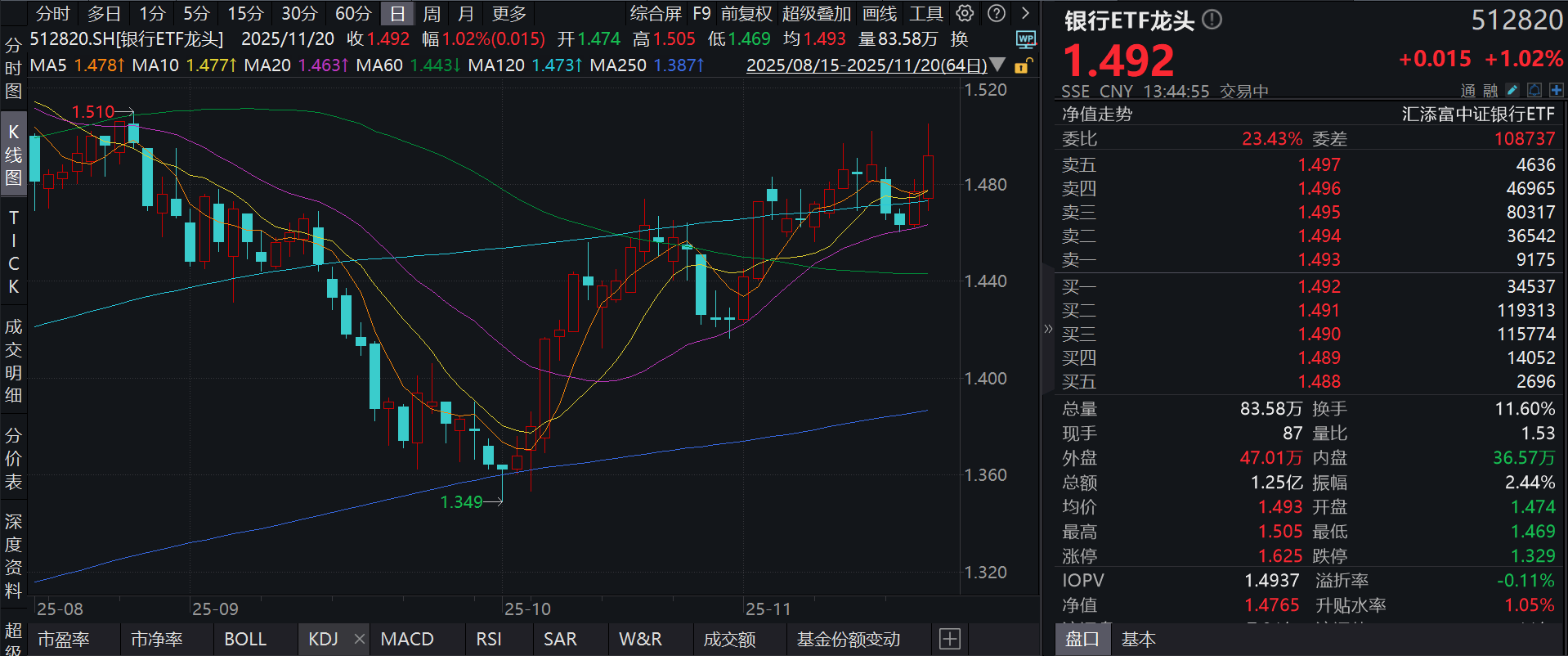
银行板块坚定向上,中国银行、工商银行双双创新高!银行ETF龙头(512820)大幅放量,一度涨近2%!机构:基本面边际企稳,Q3业绩延续改善
Sou Hu Cai Jing· 2025-11-20 06:01
Core Viewpoint - The banking sector in China is experiencing a strong performance, with significant increases in stock prices and market activity, indicating a positive outlook for the industry moving forward [1][3]. Group 1: Market Performance - The China Securities Bank Index rose by 1.07% as of November 20, 2025, with major banks like Bank of China and China Construction Bank seeing increases of 4.33% and 3.36% respectively [1]. - The leading bank ETF (512820) saw a near 2% increase at one point, currently up by 1.02%, with a latest price of 1.49 yuan [1]. - Over the past month, the leading bank ETF has accumulated a rise of 2.71% [1]. Group 2: Financing and Investment Trends - Leveraged funds are increasingly investing in the banking sector, with the latest financing buy amount reaching 6.7961 million yuan and a financing balance of 34.9936 million yuan [3]. - As of November 20, 2025, A-share bank stocks continued to strengthen, with Bank of China surpassing a market capitalization of 2 trillion yuan [3]. Group 3: Industry Transformation - The President of China Merchants Bank stated that the banking industry has transitioned from a phase of scale expansion to one focused on transformation and value creation, emphasizing the need for banks to align with national strategies and market trends [3]. - The continuation of a moderately loose monetary policy and the emphasis on maintaining reasonable interest rate relationships are expected to enhance banks' operational stability and their ability to support high-quality economic development [3]. Group 4: Future Outlook - The core viewpoints for 2026 include a focus on low interest rates and asset scarcity, regulatory cycles, economic transformation, and an investment logic that prioritizes high dividend and defensive assets while also considering banks' growth potential and long-term value [4]. - The banking sector is expected to benefit from a re-evaluation of its "stability anchor," with a focus on stable earnings, dividend attractiveness, and improved asset quality [4]. - There is an anticipated shift in insurance capital preferences towards bank equity, with a target dividend yield of 3.5%-4% seen as a reasonable baseline [4].


化债攻坚迈向系统治理新阶段
Shang Hai Zheng Quan Bao· 2025-11-16 17:55
Group 1 - The core viewpoint of the article highlights the progress and transformation in China's local debt management, moving from "crisis resolution" to "systematic governance" with the establishment of the Debt Management Department by the Ministry of Finance [2][5] - Since the implementation of the debt resolution plan, significant reductions in local hidden debt have been achieved, with hidden debt decreasing to 10.5 trillion yuan, a reduction of nearly 4 trillion yuan from 2023 [3][4] - The average interest cost of local government debt has decreased by over 2.5 percentage points, saving more than 450 billion yuan in interest expenses [3] Group 2 - The growth rate of urban investment bonds has been effectively controlled, dropping to 5.5% in 2024 and further to 4.9% in the first half of 2025 [4] - The establishment of the Debt Management Department signifies a shift to a centralized and systematic approach to debt management, integrating responsibilities across various levels of government [5][6] - The "6+4+2" debt resolution strategy is being implemented, with the next two years seen as a critical window for achieving debt resolution goals [6] Group 3 - To consolidate the results of debt resolution, local governments need to enhance their fiscal self-sufficiency and establish a long-term risk monitoring mechanism [7] - The shift from land finance to industry-driven growth is essential for sustainable debt resolution, with a focus on developing regional industries to boost tax revenue [7][8] - Optimizing the debt structure between central and local governments is necessary, including increasing the proportion of general bonds and balancing new and refinancing debts [9]

山东路桥20251104
2025-11-05 01:29
Summary of Shandong Road and Bridge's Conference Call Company Overview - Shandong Road and Bridge is a comprehensive enterprise with qualifications in highway engineering and municipal engineering construction and design, holding top-level construction qualifications [3][4] - The company has a strong bidding and project undertaking capability, covering the entire industry chain including research, design, construction, maintenance, and investment [3] Financial Performance - For the first three quarters of 2025, Shandong Road and Bridge reported revenue of 41.354 billion RMB, a year-on-year decrease of 3.11% [2][5] - Net profit was 1.729 billion RMB, down 3.52% year-on-year, while net profit attributable to shareholders was 1.410 billion RMB, a decrease of 3.27% [2][5] - Operating cash flow was negative at 1.389 billion RMB, but showed a year-on-year increase of 76.98% [2][5] - Total assets reached 173.929 billion RMB, up 6.47% from the beginning of the year, while liabilities increased by 3.67% to 132.676 billion RMB [5] Order Situation - The company secured new contracts worth 65.6 billion RMB in the first three quarters, with the highest proportion in housing construction [2][6] - The order structure includes municipal engineering, maintenance, and industrial park projects, with a significant increase in municipal engineering and industrial park business [6][7] - Domestic contracts accounted for 35.93% from outside Shandong, 42.42% from within Shandong, and approximately 21% from overseas [6] Market Dynamics - The third quarter saw accelerated performance decline due to increased industry pressure, cyclical factors causing delayed payments, and unmet expectations for new project progress [11][12] - The company is optimistic about future growth, particularly in the context of the upcoming "15th Five-Year Plan," which emphasizes infrastructure and renewable energy [10] Strategic Focus - The company prioritizes projects based on the creditworthiness and cash flow of owners, focusing on regions with good fiscal health [4][14] - Plans to increase dividend payouts to enhance company valuation and encourage conversion of convertible bonds [4][20] - The target is to ensure a price-to-book ratio (PB) greater than 1 in the long term [23] Overseas Expansion - Shandong Road and Bridge has seen significant growth in overseas orders, with a focus on markets in Africa, Southeast Asia, and Central Asia [24][25] - The company has successfully entered the Eastern European market through acquisitions and has ongoing projects in various regions [24][25] - The profitability and cash flow of overseas projects vary by project type, with aid projects providing stable cash flow despite lower profits [26] Conclusion - Shandong Road and Bridge is navigating a challenging domestic market while strategically expanding its overseas presence and focusing on improving financial health and project management practices [2][24][25]
