
增税

Search documents
三季度GDP仅增长0.1%!英国经济在预算案前“骤然失速”
智通财经网· 2025-11-13 09:01
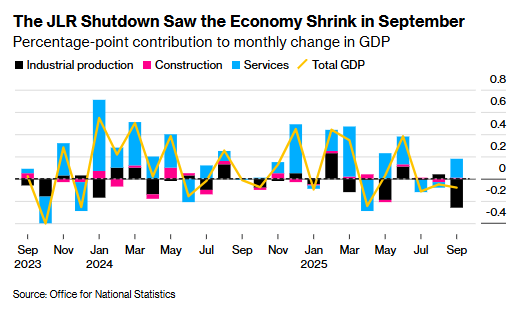
Economic Growth - The UK economy experienced minimal growth in Q3, with GDP increasing by only 0.1%, down from 0.3% in Q2 and below the forecasted 0.2% [1][3] - In September alone, the economy contracted by 0.1%, as weak growth in the services sector was offset by a sharp decline in manufacturing [1] Jaguar Land Rover Incident - A significant factor impacting September's economic performance was a cyberattack on Jaguar Land Rover, leading to a production halt of over five weeks and a nearly 30% drop in automotive manufacturing output [7] - This incident directly contributed to a 0.17 percentage point decline in GDP for September [7] Consumer and Business Sentiment - Consumer and business spending has been sluggish due to concerns over potential tax increases in the upcoming budget announcement by Chancellor Rachel Reeves [3][5] - The economic outlook is further dampened by expectations of significant tax hikes, which could reduce GDP by approximately 0.2% by 2026 [3] Trade Performance - UK exports to the US fell by 11.4% (approximately £500 million), reaching the lowest level since January 2022, largely due to tariffs imposed by the US [8][9] - Overall, UK exports decreased by 0.1% in Q3, while imports declined by 0.3% [11]

增税与降息预期压顶,英镑看跌情绪创今年1月以来之最
Zhi Tong Cai Jing· 2025-11-06 08:56
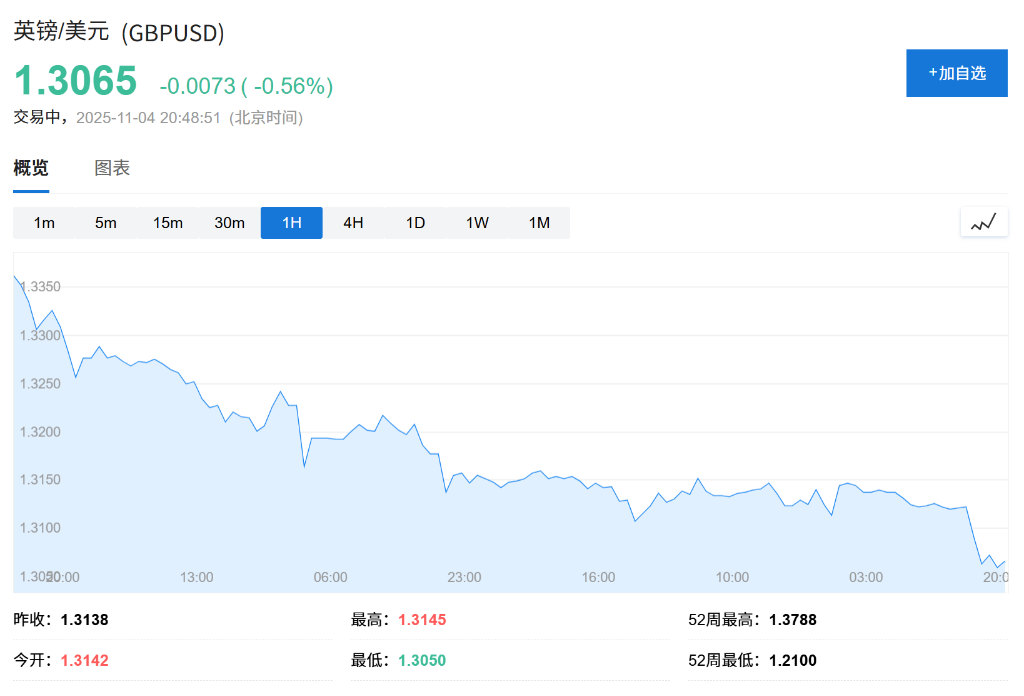
Core Viewpoint - The market sentiment towards the British pound has turned increasingly negative, with expectations of tax increases and interest rate cuts contributing to this outlook [1][2]. Group 1: Market Sentiment and Currency Performance - The British pound has fallen to its lowest point in months, with traders concerned about the upcoming budget's limited positive impact on economic growth [1]. - The options market indicates that bearish sentiment towards the pound has reached its highest level since January, reflecting uncertainty in fiscal and monetary policies [1]. - The likelihood of the Bank of England cutting interest rates this month is estimated at around 33%, a significant increase from nearly zero just weeks ago [1]. - The pound has depreciated against the US dollar, reaching approximately 1.305, and has also hit its lowest level against the euro in 2023 [1]. Group 2: Economic Implications and Forecasts - UK Chancellor of the Exchequer, Reeves, has laid the groundwork for tax increases, indicating the need for "difficult choices" to maintain fiscal stability [1]. - Analysts express concerns that fiscal tightening could negatively impact economic growth and confidence, with predictions that the euro may rise to 0.9 pounds in the coming weeks [2]. - The one-month options risk reversal indicator for the pound has dropped to -1.21 percentage points, the lowest since January, indicating increased costs for put options compared to call options [2]. Group 3: Volatility and Future Outlook - Despite the low market sentiment, implied volatility for options remains subdued, with a recent peak of 7.2%, significantly lower than levels seen during previous market crises [3]. - Analysts suggest that the gradual announcement of budget plans by UK officials may reduce market volatility, leading to cautious investor behavior [3]. - If the budget's austerity measures are less severe than expected, there could be potential for the pound to strengthen in the long term, contingent on the credibility of the proposed tax measures [3].
英镑跌至七个月低点!英国财政大臣里夫斯承诺削减债务,为加税铺路
Hua Er Jie Jian Wen· 2025-11-04 13:07
Core Viewpoint - The UK Chancellor of the Exchequer, Rachel Reeves, is paving the way for a significant policy shift, indicating that the Labour government may abandon its core campaign promise of not raising taxes to address increasing fiscal challenges [1][4]. Group 1: Fiscal Challenges - The UK government faces a fiscal gap estimated at £35 billion, driven by high borrowing costs, costly policy reversals, and a significant downgrade in economic growth forecasts by the Office for Budget Responsibility (OBR) [5]. - Reeves reiterated her commitment to the UK's "ironclad" fiscal rules, countering calls within her party to relax these rules for increased public spending [5]. - The core issue lies in the Labour Party's flagship tax promise during the campaign, which was to avoid raising personal income tax, National Insurance (NI), or Value Added Tax (VAT), collectively contributing to about two-thirds of government tax revenue [5]. Group 2: Political Strategy - Reeves' speech broke traditional norms, as Chancellors typically remain silent before formally presenting the budget, indicating a strategic move to garner support for a politically contentious fiscal plan [4][7]. - The speech aimed to prepare the public for potential widespread tax increases in the upcoming budget, with Reeves emphasizing the need for everyone to contribute to the country's future [6][8]. - Opposition parties criticized Reeves' address, with the Liberal Democrats and Conservatives dismissing it as ineffective and accusing the Labour Party of abandoning its commitments [6].
英财政大臣定调秋季预算案:抑制通胀为核心 为降息铺路
Xin Hua Cai Jing· 2025-11-04 10:02
Core Viewpoint - The UK Chancellor of the Exchequer, Rachel Reeves, announced that the upcoming autumn budget on November 26 will focus on controlling inflation and creating conditions for the Bank of England to lower key interest rates [1][2] Group 1: Budget and Economic Policy - The autumn budget aims to control government debt while ensuring public service spending [1] - Reeves emphasized that her decisions will focus on reducing inflation to support economic growth and improve living costs for the public [1] - There is a possibility of increasing household taxes, as many economists believe that under constrained fiscal space, tax hikes may be the only viable option to achieve debt reduction, maintain public services, and stabilize the macroeconomy [1] Group 2: Monetary Policy and Market Expectations - The market widely expects the Bank of England's Monetary Policy Committee to keep the benchmark interest rate at 4.00% during the meeting on November 7 [1] - Despite recent weak economic data opening the door for potential rate cuts, most economists believe policymakers will wait for more sustained evidence of cooling inflation and details from the autumn budget [2] - Current UK inflation is still nearly double the 2% target, leading to a cautious stance from the Bank of England [2] - Barclays and Goldman Sachs suggest that policymakers might consider a 25 basis point cut to 3.75% due to recent disappointing inflation, employment, and output data, although this expectation is not mainstream [2] - Investors are currently betting that the December 18 meeting will be a more likely window for rate cuts, with the probability of a December cut rising to nearly 60% [2] - The Bank of England faces challenges related to "data dependence" and "policy coordination," with short-term interest rate paths being influenced not only by inflation trends but also by the clarity of fiscal positions [2]
英国劳动力市场持续降温:8月就业人数减少,薪资增速放缓
Zhi Tong Cai Jing· 2025-09-16 07:56
Group 1 - The UK labor market is experiencing a downturn, with a decrease of 8,000 employees in August, marking the seventh consecutive decline, which is slightly better than the economists' forecast of a 12,000 drop [1] - The wage growth rate, excluding bonuses, has slowed to 4.8%, the lowest in three years, down from 5% in the previous period [1] - The unemployment rate remains at a four-year high of 4.7%, while the number of job vacancies continues to decline [1] Group 2 - Inflation has reached an 18-month high, driven by rising food and energy costs, with the expected inflation rate at 3.8%, nearly double the Bank of England's target of 2% [2] - Traders have reduced bets on interest rate cuts by the Bank of England, with expectations that the Monetary Policy Committee will maintain the base rate at 4% [2]
无惧增税!英国企业乐观情绪升至近十年新高 超六成仍计划扩大招聘
智通财经网· 2025-08-29 01:13
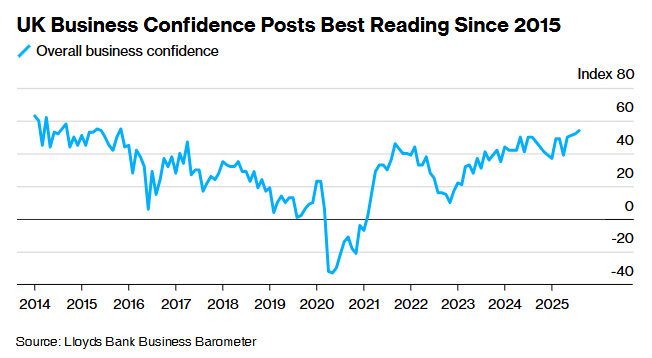
Group 1 - The core viewpoint indicates that despite tax increases implemented by UK Chancellor Reeves, business confidence in the UK rose to its highest level in nearly a decade in August, with an increased proportion of companies planning to hire more employees in the coming year [1][4]. - The Lloyds Business Barometer shows that over 80% of surveyed companies reported that the wage tax and minimum wage increases effective from April had limited impact on their hiring plans, with hiring intentions rising for the fourth consecutive month, and 62% of businesses planning to increase staff in the next 12 months [1][4]. - Approximately 35% of employers plan to raise wages by 4% or more, a 10 percentage point increase from the previous month, while the proportion of companies planning to raise prices in the next year rose to 67% in August, with only 2% expecting price declines [1][4]. Group 2 - The survey results indicate a significant increase in companies' willingness to raise prices and substantially increase wages, with nearly a quarter of surveyed businesses now expecting to raise wages by 4%, suggesting that companies are passing higher labor costs onto customers rather than employees [4]. - These findings may provide support for Chancellor Reeves, whose tax measures have faced criticism for potentially suppressing growth and increasing inflation, although they could also heighten concerns among Bank of England policymakers regarding ongoing price pressures [4][6]. - Lloyds Bank's senior economist, Hann-Ju Ho, noted that the sustained upward trend in business confidence suggests that UK companies remain optimistic about their trading prospects, despite a slight cooling in confidence regarding the broader UK economy [6].

英国财政大臣里夫斯:不排除增税的可能性。
news flash· 2025-07-05 08:06
Core Viewpoint - The UK Chancellor of the Exchequer, Reeves, does not rule out the possibility of tax increases in the future [1] Group 1 - The statement indicates a potential shift in fiscal policy that could impact various sectors and companies operating in the UK [1] - The mention of tax increases suggests that the government may be looking for ways to address budget deficits or fund public services [1] - This could lead to increased operational costs for businesses, affecting profitability and investment decisions [1]
英国财长上任周年:增税压力与财政困境交织
Xin Hua Cai Jing· 2025-07-04 09:08
Core Viewpoint - The UK Chancellor Rachel Reeves faces significant challenges in achieving her economic stability goals due to weak economic growth, market volatility, and internal divisions over welfare reforms, leading to expectations of new tax increases later this year [1][2][3] Group 1: Economic Conditions - The UK economy is experiencing stagnation, with public debt nearing 100% of GDP, prompting concerns about fiscal sustainability [1] - The government's current policies to stimulate economic growth have shown minimal effectiveness, leading to a potential need for hundreds of billions in new tax revenue to address the expanding fiscal gap [1][2] Group 2: Taxation and Fiscal Policy - Reeves initially promised up to £40 billion in tax increases, the largest in 30 years, to fund infrastructure investments and establish "non-negotiable" fiscal rules [2] - Analysts emphasize that any new tax measures must be substantial and clear to restore market confidence, avoiding fragmented approaches that raise accounting concerns [2][3] Group 3: Political Landscape - Prime Minister Keir Starmer is attempting to bolster public confidence by highlighting progress in trade agreements, foreign investment, and spending in education and healthcare, yet recent polls show the Labour Party trailing behind right-wing reform parties [2] - Investors criticize the government's leadership, noting a lack of awareness among voters and businesses regarding the necessity of fiscal tightening and structural reforms [3]
美国总统特朗普:历史上最大的减税和繁荣的经济 vs 历史上最大的增税和失败的经济。共和党人还在等什么?你们想证明什么?Maga不高兴了,这正在让你们失去选票!!!
news flash· 2025-07-03 04:19
Core Viewpoint - The statement emphasizes the contrast between significant tax cuts leading to economic prosperity and substantial tax increases resulting in economic failure, urging Republican members to take action to avoid losing voter support [1] Group 1 - The mention of "the largest tax cuts in history" suggests a focus on fiscal policy that promotes economic growth [1] - The reference to "the largest tax increases in history" indicates a warning against policies that could hinder economic performance [1] - The call to action for Republican members highlights the political implications of economic policies on voter sentiment [1]
桥水基金创始人瑞·达利欧:政府需要增税、削减开支来解决赤字和债务问题。
news flash· 2025-07-01 00:11
Core Viewpoint - Ray Dalio, founder of Bridgewater Associates, emphasizes the need for the government to increase taxes and reduce spending to address the deficit and debt issues [1] Group 1 - The government is facing significant challenges related to its deficit and debt levels [1] - Dalio suggests that without proper fiscal measures, the economic stability may be at risk [1] - The proposed solutions include a combination of tax increases and spending cuts to create a balanced approach [1]