
容量电价

Search documents
全国性容量电价政策出台,看好国内储能发展空间
2026-02-03 02:05
Summary of Conference Call on National Capacity Pricing Policy and Its Impact on Energy Storage Sector Industry Overview - The conference call focused on the national capacity pricing policy recently introduced by the National Development and Reform Commission (NDRC) and the National Energy Administration (NEA) in China, specifically its implications for the energy storage sector [1][2]. Key Points and Arguments Capacity Pricing Policy - The capacity pricing policy is designed to provide compensation based on specific capacity rather than energy pricing, addressing the issue of fixed cost recovery for power generation units [1][2]. - The policy aims to ensure sufficient effective capacity in the new power system while reflecting supply and demand in the electricity market [2][4]. Mechanisms for Cost Recovery - Three main mechanisms for capacity cost recovery were discussed: 1. Non-market-based capacity pricing set by the government. 2. Market-based capacity markets, including centralized auctions and bilateral contracts. 3. Strategic reserve mechanisms, which are not currently implemented in China [3][4]. Key Components of the Policy - The policy introduces three main concepts: capacity pricing, reliable capacity compensation mechanism, and capacity market [4][5]. - The capacity pricing mechanism has been evolving since 2021, with specific policies for different power sources, including coal and gas [5][6]. Coal and Pumped Storage Pricing - The capacity price for coal power units is set to increase from a recovery ratio of 30% to at least 50% by 2026, with a base price of 165 RMB per kW per year [6][9]. - The pumped storage pricing mechanism has been refined to ensure that new projects can recover costs effectively, with a focus on standardizing pricing across provinces [8][9]. New Energy Storage Capacity Pricing - A significant aspect of the policy is the establishment of an independent capacity pricing mechanism for grid-side energy storage, marking a shift from exploratory language to a definitive commitment [17][19]. - The compensation for energy storage will be based on reliable capacity, distinct from energy and ancillary service compensation [16][19]. Market Optimization - The policy aims to optimize the electricity market by allowing various entities, including wind and emerging storage technologies, to participate fairly [11][12]. - Adjustments to long-term electricity pricing mechanisms are intended to enhance market dynamics and reflect real-time supply and demand [13][14]. Additional Important Insights - The capacity pricing policy is expected to catalyze investment in energy storage, particularly as it aligns with the broader marketization of electricity [21][22]. - The anticipated growth in energy storage demand is driven by increasing shares of renewable energy generation and the evolving electricity market mechanisms [24][25]. - The competitive landscape for energy storage is becoming more complex, with regional disparities in growth and supply chain dynamics [26][27]. - The expected annual growth rate for the energy storage market in China is projected to be around 20-25% over the next five years, with significant contributions from various regions [28][29]. Conclusion - The national capacity pricing policy represents a pivotal shift in China's energy market, providing a structured framework for cost recovery and compensation for energy storage and generation units. This is expected to enhance investment and participation in the energy storage sector, ultimately supporting the transition to a more sustainable energy system [20][37].
新能源行业:容量电价重磅政策落地,储能发令枪响起
海通国际· 2026-02-02 02:40
Investment Rating - The report indicates a bullish stance on the energy storage sector, highlighting it as the most favored sector for investment in 2026 due to expected high growth [6][1]. Core Insights - The energy storage industry is anticipated to experience significant growth in 2026, driven by the recent implementation of the capacity tariff policy and adjustments in lithium carbonate prices, which enhance the valuation attractiveness of energy storage companies [6][1]. - The capacity tariff policy, issued by the National Development and Reform Commission and the National Energy Administration, clarifies the pricing mechanism for new-type energy storage, establishing its market position and accelerating nationwide implementation [9][3]. Summary by Sections Weekly Recommendation Logic - The energy storage sector is expected to see high certainty growth in 2026, making it a top investment choice. Recent underperformance is attributed to seasonal demand and rising raw material prices, but valuations have become attractive post-adjustment [6][1]. - The release of the capacity tariff policy and corrections in lithium carbonate prices are key reasons for the positive outlook on the energy storage sector [6][1]. Weekly Recommended Portfolio - Top Picks: Contemporary Amperex Technology Co., Limited (CATL), Sungrow Power Supply Co., Ltd., EVE Energy Co., Ltd., Hyperstrong Energy Storage Technology Co., Ltd. [7][2]. - Sustained Picks: Tsugami Machinery (China) Co., Ltd., Sunwoda Electronic Co., Ltd., Shenzhen Sinexcel Electric Co., Ltd., CALB Group Co., Ltd., Sichuan Fulin Precision Machinery Co., Ltd., Jiangsu Longpan Technology Co., Ltd. [7][2]. Commentary on the Capacity Tariff Policy - The capacity tariff policy categorizes the pricing mechanism for various energy sources, including new-type energy storage, based on local coal-fired power standards and peak-shaving capacity [8][3]. - The policy aims to establish a clear development direction and tariff formulation methodology, which is significant for the national development of the energy storage industry [9][3].
未知机构:电新周观点更新好看太空光伏储能锂钠电锂电全国容量电-20260202
未知机构· 2026-02-02 02:05
Industry and Company Analysis Summary Industry Overview Lithium Battery and Energy Storage - The national capacity electricity price policy has been implemented, expected to increase the Internal Rate of Return (IRR) for energy storage by over 3% [1] - In February, lithium battery production is projected to decrease by over 10%, indicating a strong production season despite being traditionally off-peak [1] - Sodium batteries are undergoing winter tests with multiple automotive companies, with expectations for mass shipments in Q2 [1] Key Segments Ranking - The preferred segments in the energy storage industry are ranked as follows: - Energy storage cells (Penghui) - Iron lithium cathodes - Energy storage integration (Haibo) - Separators (Enjie) - Copper and aluminum foils (Nord and Dingsheng) [1] Sodium Battery Sector - The lithium carbonate market is expected to undergo adjustments, with a new upward trend anticipated next week, maintaining a long-term positive outlook [2] - Recent price drops are not due to fundamental factors; downstream procurement has increased, with significant spot transactions indicating acceptance of the 150,000 yuan price for lithium [2] - February is expected to see price increases due to strong battery production and ongoing maintenance at lithium salt plants [2] Wind Power Sector - Recent earnings forecasts in the wind power sector have largely fallen short of expectations, primarily due to a decline in Q4 shipments and year-end impairments [2] - The main machine segment has cleared out low-priced orders, indicating a confirmed bottom, with expectations for overall gross margin recovery starting in Q1 2026 [2] - Recommended stocks in this sector include Jinlei Co., Daikin Heavy Industries, and major machine manufacturers (Goldwind, SANY, Yunda, Mingyang) [2] Photovoltaic Sector - Positive outlook for space photovoltaic technology and silver-free solutions [2] - SpaceX has applied to the FCC to deploy 1 million satellites, enhancing the logic behind space photovoltaic initiatives [2] - High silver prices and technological breakthroughs have led to a reduction in costs for copper-based batteries by an average of 0.15 yuan/W, indicating a potential explosion in silver-free industrialization [2] AIDC (Artificial Intelligence Data Center) Sector - A new round of bidding is emerging in the domestic supply chain [2] - ByteDance is shifting its bidding towards high-voltage direct current solutions, while NVIDIA's GB300 liquid cooling certification is tightening, potentially redirecting investments towards core components and ASIC overflow [2] - The production capacity of Yingwei QD is expected to increase by 20 times in Q1, closely integrating with the NVIDIA ecosystem [2]
黄金:释放风险,白银:高位回落
Guo Tai Jun An Qi Huo· 2026-02-02 01:44
Report Investment Ratings The report does not provide an overall investment rating for the industry. However, it offers trend intensities for each commodity, which can be used as a reference for investment ratings: - **Strongly bullish (2):** None - **Bullish (1):** Aluminum, industrial silicon, cotton - **Neutral (0):** Copper, zinc, lead, nickel, stainless steel, lithium carbonate, polycrystalline silicon, rebar, hot-rolled coil, ferrosilicon, silicomanganese, coke, coking coal, power coal, paraxylene, PTA, MEG, synthetic rubber, PP, pulp, glass, methanol, urea, styrene, soda ash, PVC, fuel oil, low-sulfur fuel oil, container shipping index (European Line), staple fiber, bottle chip, pure benzene, soybean meal, soybeans, corn, peanut - **Bearish (-1):** Gold, silver, platinum, palladium, rubber, LLDPE, caustic soda, offset printing paper, palm oil, soybean oil, eggs - **Strongly bearish (-2):** Pig Core Viewpoints The report provides a comprehensive analysis of various commodity futures, including their market trends, fundamental data, and macro and industry news. It suggests that investors should pay attention to the following factors when making investment decisions: - **Macroeconomic environment:** The nomination of Kevin Warsh as the next Fed Chairman, the passage of the $1.2 trillion government spending bill by the US Senate, and the release of China's January official manufacturing and non-manufacturing PMI data have all had an impact on the commodity market [5][8][13]. - **Industry supply and demand:** The report analyzes the supply and demand situation of each commodity, including production, inventory, and consumption. For example, the supply of copper is expected to be tight due to the suspension of production at the Mantoverde copper-gold mine in northern Chile and the reduction of production guidance by Lundin Mining [9]. - **Geopolitical risks:** The report also mentions the impact of geopolitical risks on the commodity market, such as the negotiation between the US and Iran and the potential shutdown of coal mines in Indonesia [7][23][53]. Summary by Section Metals - **Precious metals:** Gold and silver are releasing risks and falling from high levels, respectively. Platinum and palladium are also facing downward pressure due to the potential for panic selling and weak adjustment [2][5][20]. - **Base metals:** Copper is waiting for guidance and trading in a range, while zinc, lead, aluminum, and nickel are all showing signs of consolidation. Stainless steel is expected to be supported by the expected reduction of nickel pig iron production in February [2][9][12][15][17][25][26]. Energy - **Coal:** Coking coal and coke are trading at high levels after a round of price increases, while power coal is in a weak supply-demand balance and is expected to trade in a narrow range before the Spring Festival [2][47][48][52]. - **Petroleum and its products:** Paraxylene, PTA, and MEG are all trading in a high-level range, while fuel oil is trading strongly and low-sulfur fuel oil is adjusting narrowly [2][54][109]. Chemicals - **Synthetic rubber:** Synthetic rubber is falling from high levels due to the weakening of macro sentiment and the approaching of valuation indicators to the boundary [2][66][68]. - **Plastics:** LLDPE is facing limited demand due to the narrowing of import profits, while PP is supported by the rising oil price [2][69][72]. - **Others:** Caustic soda is expected to be supported by cost factors and has strong future expectations, while pulp is trading in a wide range [2][75][79]. Agriculture - **Grains and oilseeds:** Palm oil and soybean oil are adjusting at high levels, while soybean meal and soybeans are trading in a range. Corn is expected to have a limited downward adjustment [2][134][139][142]. - **Sugar and cotton:** Sugar is trading weakly, while cotton is expected to maintain a sideways trend [2][145][150]. - **Livestock and poultry:** Eggs are showing signs of weakness in the spot market, while pigs are facing increasing supply pressure before the Spring Festival [2][155][158]. Others - **Container shipping index (European Line):** The container shipping index (European Line) is trading in a range [2][111]. - **Offset printing paper:** Offset printing paper is recommended to hold short positions and conduct a 3-4 reverse spread [2][126].
容量电价,因何而来?向何处去?
Changjiang Securities· 2026-02-02 00:42
Investment Rating - The report suggests a positive outlook for the utility sector, particularly for coal-fired power operators, with a recommendation to focus on quality transformation operators such as Huaneng International, Datang Power, Guodian Power, Huadian International, China Power, China Resources Power, and Funiu Co., Ltd. [7] Core Insights - The report highlights the importance of the capacity compensation mechanism in addressing the long-standing issue of fixed cost recovery in the coal-fired power sector. The implementation of a reliable capacity compensation mechanism is expected to resolve the dual pricing system between long-term contracts and spot market prices, leading to a more balanced electricity market. [2][5][7] - The report anticipates that by 2026, the national capacity supply-demand ratio will reach 84%-96%, with capacity prices ranging from 276 to 316 RMB/year·kW. This is expected to alleviate the downward pressure on long-term contract prices significantly. [7] - The report emphasizes that the introduction of the capacity compensation mechanism will decouple the fixed cost recovery from long-term contract pricing, thus allowing coal-fired power to return to being a public utility. [7] Summary by Sections Introduction - The report discusses the recent announcement by the National Development and Reform Commission regarding the improvement of the capacity price mechanism, which aims to unify various types of regulatory power sources under a new reform initiative. [18] Importance of Capacity Compensation Mechanism - The capacity price is designed to compensate for fixed costs associated with power plants, which include capital costs, fixed operating and maintenance costs, and taxes. This mechanism is crucial for ensuring that power companies can recover their fixed costs effectively. [21][22] International Examples and Domestic Innovations - The report references the PJM capacity market mechanism in the U.S. and the innovative capacity compensation mechanism trialed in Gansu Province, which aims to achieve near-full recovery of fixed costs. [6] Breaking the Profitability Dilemma - The report concludes that if the reliable capacity compensation mechanism is implemented nationwide, it will significantly reduce the profitability challenges faced by coal-fired power plants under the current dual pricing system. [7]




独立储能全国性容量电价政策出台,国内大储需求可期
Ping An Securities· 2026-02-01 13:52
Investment Rating - The industry investment rating is "Outperform the Market," indicating that the industry index is expected to perform better than the market by more than 5% over the next six months [10]. Core Insights - The introduction of the national capacity price policy for independent energy storage is expected to significantly boost domestic demand for large-scale energy storage [4][6]. - The capacity price policy recognizes the value of independent energy storage as a regulatory power source, allowing it to earn revenue through a combination of capacity pricing and spot market arbitrage [8]. - By the end of 2025, the installed capacity of new energy storage in China is projected to reach 136 GW and 351 GWh, representing a net increase of 62.24 GW and 183 GWh from 2024 [5][8]. Summary by Sections Policy Development - The national capacity price policy for independent energy storage was successfully implemented, allowing local governments to set capacity prices based on local coal power capacity standards and peak contribution factors [8]. Revenue Model - The revenue model for independent energy storage has evolved to include both capacity pricing and spot market arbitrage, enhancing the attractiveness for project owners to invest in energy storage systems [6][8]. Market Outlook - The report anticipates a rapid growth in energy storage installations in China, driven by the new capacity pricing policy and the increasing recognition of independent energy storage's role in the power system [5][8].
新华财经晚报:黄金白银价格双双跳水
Xin Hua Cai Jing· 2026-01-31 01:46
Key Points - The Ministry of Finance announced that the securities transaction stamp duty is expected to reach 203.5 billion yuan in 2025, representing a growth of 57.8% [1] - The total operating revenue of state-owned enterprises for the year 2025 is projected to be 8,488.865 billion yuan, with a year-on-year increase of 0.5%, while the total profit is expected to decline by 6.3% to 403.805 billion yuan [1] - The software and information technology services industry in China is expected to generate a revenue of 15,483.1 billion yuan in 2025, reflecting a year-on-year growth of 13.2%, with total profits reaching 188.48 billion yuan, up by 7.3% [1] - The export of software services is anticipated to be 62.73 billion USD, marking a year-on-year increase of 7.7% [1] - The National Development and Reform Commission and the National Energy Administration have announced an increase in the proportion of fixed cost recovery for coal-fired power plants to no less than 50% through capacity pricing [2] - The domestic smartphone market is projected to see a shipment of 30.7 million units in 2025, a decrease of 2.4% year-on-year, with 5G smartphones accounting for 86.9% of total shipments [2]

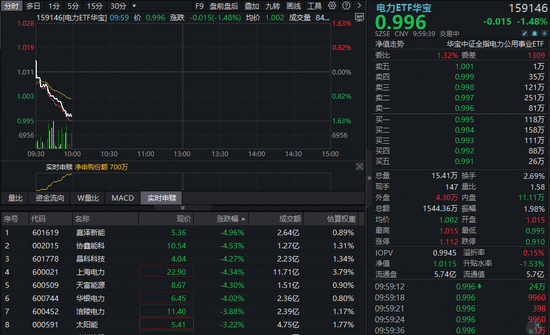
上海电力领跌超4%,电力ETF华宝(159146)回调逾1%,资金揽筹800万份,看好AI驱动电力需求增长
Xin Lang Cai Jing· 2026-01-27 02:17
27日早盘,A股普遍回调,电力板块走弱,成份股全线飘绿。其中,嘉泽新能领跌5%,上海电力、协 鑫能科、晶科科技等多股下挫4%。热门ETF方面,电力ETF华宝(159146)场内价格跌逾1%下探上市 新低,资金进场揽筹800万份,或看好未来AI驱动下的能源机遇。 | | | 分时 多日 1分 5分 15分 30分 ■ | | | | | | | F9 盘船盘后 露加 九转 画纸 工具 @ 2 > | | | 电力ETF华审 | | 159146 | | --- | --- | --- | --- | --- | --- | --- | --- | --- | --- | --- | --- | --- | --- | --- | | 1.028 | | | | | | 159146(电力ETF华应] 09:59 价 0.996 涨跌 -0.015(-1.48%) 均价 1.002 服交量 84 | | | | | | 0.996 | | -0.015 -1.48% | | | | | | | | | | | | | | SZSE CNY 9-59-39 DURCH | | / 0 + | | 1.019 | | ...

全国冬季用电负荷创历史新高,关注绿色电力ETF易方达(562960)配置价值
Mei Ri Jing Ji Xin Wen· 2026-01-26 06:46
Core Insights - The national winter electricity load in China surpassed 1.4 billion kilowatts for the first time on January 20, reaching a peak of 1.417 billion kilowatts, with daily electricity consumption exceeding 30 billion kilowatt-hours [1] - The supply-demand balance in China's electricity system is tightening, indicating a potential decline in actual reserve rates during the 14th Five-Year Plan period, highlighting the value of electricity capacity and the need to pay attention to capacity pricing [1] - The explosive growth of AI is driving electricity demand, emphasizing the scarcity of leading power companies in China, with total electricity consumption expected to exceed 10 trillion kilowatt-hours by 2025, indicating continuous industry demand expansion [1] - Improvements in capacity pricing, green electricity trading mechanisms, and rising electricity price standards are enhancing the profitability stability of the electricity sector, with an increasing probability of market style shifting towards dividend value [1] - The investment value of the electricity sector is becoming clearer as the market transitions [1]
行业周报:负荷新高与零电价共存,碳排双控激活双碳政策-20260125
SINOLINK SECURITIES· 2026-01-25 11:10
Investment Rating - The industry is rated as "Buy" with an expectation of an increase exceeding 15% over the next 3-6 months [5]. Core Insights - The dual control of carbon emissions in terms of total volume and intensity will be fully implemented, with a focus on the 14th Five-Year Plan's dual carbon policy. The aim is to peak carbon emissions by 2030, with key areas of focus including energy transition, industrial upgrading, comprehensive conservation, and scientific assessment of carbon emissions [1]. - Winter electricity load has reached a new high, exceeding 1.4 billion kilowatts, with multiple instances of zero/negative electricity prices in Northeast China. This reflects an imbalance in electricity supply and demand, highlighting the need for attention to capacity pricing and the potential for improved profitability in thermal power [2]. - Recent adjustments in stock prices of leading companies in the sector have been significant, driven by funding impacts and unclear performance expectations. Key areas to watch include market capitalization management, capital operations, and the performance of hydropower and thermal power companies [3]. Summary by Sections Section 1: Carbon Emission Control - The government is committed to implementing a dual control system for carbon emissions, focusing on policies that will guide industrial structure and capacity planning [1]. Section 2: Electricity Demand and Pricing - The national winter electricity load has surpassed historical records, indicating a rising trend in electricity demand. The occurrence of negative pricing in the electricity market suggests a need for adjustments in capacity pricing to stabilize profitability [2]. Section 3: Stock Performance and Investment Opportunities - The recent decline in stock prices of major companies presents opportunities for investment, particularly in firms with clear market capitalization management strategies and those positioned to benefit from upcoming performance improvements in hydropower and thermal power sectors [3].