
数字人民币升级

Search documents
每日机构分析:12月31日
Zhong Guo Jin Rong Xin Xi Wang· 2025-12-31 09:42
Group 1: Digital Currency and Banking - CITIC Securities reports that digital RMB is evolving from a "central bank liability" model to a "deposit currency" model, which will enhance the stability of bank liabilities and improve the efficiency of monetary policy transmission [1] - The transition to a deposit currency model will provide banks with stronger internal incentives to promote digital RMB, making it a crucial tool for both corporate and retail sectors [1] - Banks are advised to shift their focus from qualification to capability in digital RMB services, emphasizing scenario-based professional services to capitalize on the increasing penetration rate of digital RMB [1] Group 2: Federal Reserve and Treasury Bonds - A survey indicates that respondents expect the Federal Reserve to purchase approximately $220 billion in short-term Treasury bonds over the next 12 months, with a monthly purchase of about $40 billion planned [2] - The Federal Reserve has already purchased around $38 billion in short-term Treasury bonds this month and will conduct two more operations in January [2] Group 3: Gold Market - Gold prices are expected to achieve their best annual increase since 1979, having risen over 65% this year, driven by central bank purchases and concerns over sovereign debt [2] - Despite recent volatility, both gold and silver prices are stabilizing, with analysts predicting further increases due to ongoing economic conditions [2] Group 4: Indian Market Dynamics - The Indian rupee's weakness and expectations of an end to the interest rate cut cycle are leading to record outflows from Indian sovereign bonds, with $1.6 billion sold in December alone [3] - The Indian stock market is projected to have its worst performance relative to other Asian markets in nearly 30 years, influenced by high valuations, slowing profit growth, and lack of credible AI-related investment opportunities [3] - Foreign investors withdrew $1.7 billion in December, contributing to a record annual outflow of $17.9 billion, exacerbated by the declining rupee and stalled trade agreements with the U.S. [3]
中信证券:如何看待数字人民币2.0升级?
Zhi Tong Cai Jing· 2025-12-31 01:16
Core Viewpoint - The digital renminbi is transitioning from a "central bank liability" cash model (1.0) to a "deposit currency" model (2.0) integrated into the commercial banking liability system, allowing for interest accrual and reserve requirements, effectively becoming a general deposit [1][2]. Group 1: Upgrade of Digital Renminbi - The core positioning of e-CNY has fundamentally changed from a cash-type model to a deposit currency model, integrating into the commercial banking liability system and allowing for interest payments and reserve requirements [2]. - This upgrade represents a global innovation in Central Bank Digital Currency (CBDC), enhancing internationalization effects and serving as a model for other central banks, particularly in cross-border trade applications [2]. Group 2: Impact on Banking Stability and Monetary Policy - The transition to a deposit currency will strengthen the stability of bank liabilities by returning digital renminbi management to the banking system [3]. - It will enhance the efficiency of monetary policy transmission, as deposit-type digital renminbi can be included in reserve and interest rate frameworks, improving the flow of policy tools from central banks to commercial banks and then to the real economy [3]. - The new framework increases banks' motivation to promote digital renminbi, as it becomes a core liability for them, enhancing their promotional incentives [3]. Group 3: Strengthening Payment Business Advantages - Digital renminbi is expected to become a crucial tool for linking corporate and retail banking, enhancing customer loyalty through applications in corporate accounts and payment settlements [4]. - It will provide a competitive advantage over third-party platforms in payment processes, as it remains under the central bank's payment infrastructure, which has already achieved unconditional access to major internet platforms [4]. Group 4: Focus on Capability Building - The number of digital renminbi operating institutions is expected to increase, with a shift in competition from licensing to service capabilities [6]. - Digital renminbi will leverage new technology applications, requiring banks to enhance their system construction, product design, and specialized service teams, making service capability a key competitive factor [6]. Group 5: Development Outlook - There is significant room for growth in the domestic account openings and transaction amounts for digital renminbi, with only 230 million personal wallets and 18.84 million corporate wallets opened by November 2025, compared to over 15.395 billion total bank accounts [7]. - The internationalization of the renminbi is expected to drive increased usage of e-CNY, with substantial cross-border transaction volumes anticipated as banks promote its adoption [7].


中信证券:银行需把握数字人民币渗透率提升机会
Di Yi Cai Jing· 2025-12-31 00:18
Core Viewpoint - The digital renminbi is transitioning from a "central bank liability" model (1.0) that replaces cash to a "deposit currency" model (2.0) integrated into the commercial banking liability system, allowing for interest-bearing accounts and reserve requirements [1] Industry Impact - This institutional adjustment is expected to enhance the stability of bank liabilities and improve the efficiency of monetary policy transmission under the reserve and interest rate framework [1] - The digital renminbi is anticipated to become a significant tool linking corporate and retail sectors, while also posing a competitive threat to third-party payment platforms [1] - Future development focus for banks regarding digital renminbi will shift from qualification to capability, necessitating a transition from account operations to specialized scenario-based services to capitalize on the increasing penetration of digital renminbi [1]
新一代数字人民币对你我有啥影响?
Sou Hu Cai Jing· 2025-12-30 12:31
Group 1 - The new generation of digital RMB will officially be implemented on January 1, 2026, with significant changes including the ability to earn interest, transforming its nature from cash to deposits [1] - For commercial banks, digital RMB deposits will become a source of usable funds, enhancing their motivation to participate in the digital RMB ecosystem and allowing for the development of more deposit, wealth management, and credit products [1] - Individuals and enterprises will benefit as digital RMB wallets will start to earn interest like demand deposits, providing returns on held digital RMB [1] Group 2 - The digital RMB will be supported and regulated by the central bank, with commercial banks responsible for customer security and compliance, including anti-money laundering responsibilities, and will be included in the deposit insurance scheme with a maximum compensation limit of 500,000 RMB [2] - Unlike WeChat Pay and Alipay, which are payment tools that access bank-held funds, digital RMB is essentially "money" in digital form, allowing for transactions without fees and functioning offline [2] - Digital RMB offers enhanced privacy protection, collecting less transaction information and not sharing it with third parties [2]
博时市场点评12月30日:两市继续分化,沪指收盘微跌
Xin Lang Cai Jing· 2025-12-30 08:29
Market Overview - The Shanghai Composite Index closed slightly down, while the Shenzhen Component and ChiNext Index recorded gains, with total trading volume increasing to 2.16 trillion yuan [1][5] - The market anticipates two interest rate cuts totaling 50 basis points by the Federal Reserve next year, influenced by political factors such as the U.S. midterm elections and the appointment of a new Fed chair [1][8] - China's export scale and trade surplus have reached historical highs this year, indicating resilience in export structure and direction, with expectations for continued strong performance in exports next year amid improving Sino-U.S. trade relations [1][8] Digital Currency Developments - The People's Bank of China has introduced a digital yuan action plan, with a new framework set to launch on January 1, 2026, transitioning from a cash-based to a deposit currency model [2][9] - This upgrade is expected to create a win-win situation for businesses and individuals, providing interest income and a wider range of financial products, while also incentivizing commercial banks [2][9] Tariff Adjustments - The State Council's tariff adjustment plan for 2026 will implement lower temporary import tariffs on 935 items starting January 1, 2026, aimed at enhancing the linkage between domestic and international markets [2][10] - The plan focuses on high-quality development and open markets, reducing tariffs on key components and advanced materials, and dynamically adjusting tariff structures to support industrial development [10] Agricultural Policy - The Central Rural Work Conference emphasized the importance of agricultural modernization and set key tasks for 2026, including enhancing grain production and improving agricultural policies to stabilize prices and increase farmers' income [4][11] - The conference aims to strengthen agricultural technology and equipment, which could lead to long-term investment opportunities in the agricultural sector and stimulate county-level consumption [4][11] Market Performance - On December 30, the A-share market showed mixed results, with the Shanghai Composite Index at 3965.12 points (down 0.004%), Shenzhen Component at 13604.07 points (up 0.49%), and ChiNext Index at 3242.90 points (up 0.63%) [5][12] - The oil and petrochemical, automotive, and non-ferrous metals sectors saw the highest gains, while retail, real estate, and public utilities experienced the largest declines [5][13] Capital Tracking - The market's trading volume reached 21,617.04 billion yuan, showing an increase from the previous trading day, with the margin financing balance also rising to 25,517.34 billion yuan [6][14]
数字人民币计息时代来了
Di Yi Cai Jing Zi Xun· 2025-12-30 03:05
Core Viewpoint - The People's Bank of China has introduced an action plan to transition digital renminbi from a cash-based system to a deposit currency system, set to be implemented on January 1, 2026, allowing interest to be paid on digital renminbi wallet balances [2][3][4] Group 1: Digital Renminbi Transition - The digital renminbi will shift from being classified as M0 (cash in circulation) to a deposit currency, which will allow it to earn interest, thus enhancing its appeal to users [3][4] - The new framework will enable banks to pay interest on customer digital renminbi wallet balances based on their respective current deposit rates, aligning with market expectations [2][4] - This transition is expected to improve the willingness of individuals and markets to use digital renminbi, as it addresses concerns about inflation and the time value of money [3][4] Group 2: Banking Sector Implications - The adjustment will transform digital renminbi from a direct liability of the central bank to a liability of commercial banks, integrating it into their balance sheets [4][6] - Banks will gain the ability to manage digital renminbi assets and liabilities, shifting their role from cost centers to profit centers, which is anticipated to enhance their motivation to promote digital renminbi [7][6] - The new system will allow for a more efficient management of digital renminbi, leveraging traditional account payment efficiencies while incorporating innovative features like smart contracts [4][6] Group 3: Regulatory Framework - The action plan establishes a "separation of management and operation" principle, creating a management committee to oversee digital renminbi operations and ensure regulatory compliance [11][12] - The plan aims to enhance the regulatory framework for non-bank payment institutions, ensuring consistency in the management of digital renminbi and customer funds [5][12] - Future pilot programs for digital renminbi will shift from geographic trials to scenario-based trials, with an emphasis on expanding operational institutions under controlled risks [12][11] Group 4: Market Impact - The digital renminbi's usage is expected to expand significantly, with transaction volumes projected to reach 34.8 billion by November 2025, amounting to over 16.7 trillion yuan [9] - The digital renminbi's integration into the banking system is anticipated to facilitate its application across various sectors, supporting the broader economy and enhancing consumer spending [12][9] - The transition is also seen as a strategic move to solidify China's position in the global central bank digital currency landscape [9][10]


数字人民币迎来“升级”7只概念股获主力资金抢筹
Sou Hu Cai Jing· 2025-12-30 01:28
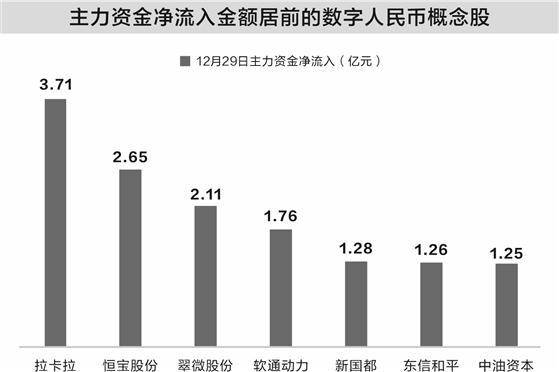
Group 1 - The People's Bank of China will implement a new action plan for the management and service system of digital RMB, with a new framework and ecosystem set to launch on January 1, 2026, marking an upgrade from digital cash to digital deposit currency [2] - As of November 2025, digital RMB has processed 3.48 billion transactions with a total transaction amount of 16.7 trillion yuan, and 230 million personal wallets have been opened through the digital RMB app [2] - The mBridge project has processed 4,047 cross-border payment transactions, amounting to approximately 387.2 billion yuan, with digital RMB accounting for about 95.3% of the total transaction volume [2] Group 2 - On December 29, 2022, seven digital RMB concept stocks saw net inflows exceeding 100 million yuan, with Lakala leading at 371 million yuan [3] - The "14th Five-Year Plan" emphasizes the steady development of digital RMB, with applications expanding from personal consumption to industrial finance, cross-border trade, and public services [3] - Various regions are exploring innovative applications of digital RMB, including its use in debt settlement and industrial internet scenarios [3] Group 3 - Guotai Junan Securities believes that digital RMB will accelerate penetration across the supply chain, with significant growth potential in banking IT and fintech sectors [4] - The demand for bank system upgrades and digital wallet development will be driven by digital RMB, while the payment ecosystem will see increased demand for POS machines and ATMs [4] Group 4 - A total of 64 A-share companies are involved in digital RMB-related businesses, with the computer industry having the highest representation at 43 companies [5] - Eight digital RMB concept stocks have been heavily favored by institutional investors, with a total market value of 2.939 billion yuan held by social security funds and pension funds [5] - Unisoc Microelectronics has seen significant investment from social security funds, with a market value of 1.89 billion yuan, and has made technological advancements in digital currency hardware [5]
可以付息了!数字人民币迎来2.0版
Sou Hu Cai Jing· 2025-12-30 00:55
Core Viewpoint - The new generation of digital RMB will officially launch on January 1, 2024, transitioning from a cash-based system to a deposit currency system, allowing for interest payments on digital RMB balances held in banks [1][4]. Group 1: Transition to Deposit Currency - The People's Bank of China has introduced a plan to enhance the management and service system for digital RMB, marking a shift from digital cash to digital deposit currency [1][2]. - This transition will significantly improve the liquidity of digital RMB within the banking system, as it allows for interest accrual on digital RMB held in bank accounts [2][4]. Group 2: Operational Changes - Digital RMB will now be classified as a liability of commercial banks rather than the central bank, indicating a major upgrade from version 1.0 to version 2.0 [3][4]. - Commercial banks will be responsible for the operation, security, and reliability of digital RMB, which will incentivize them to offer more financial services related to digital RMB [4][6]. Group 3: User Experience and Security - The user experience for payments will remain largely unchanged, but the ability to earn interest on digital RMB deposits will be a significant enhancement [5]. - Digital RMB will be supported by the central bank's technology and regulatory oversight, with commercial banks responsible for customer security and compliance, including deposit insurance coverage up to 500,000 RMB [6][7]. Group 4: Implementation and Impact - Since its inception in 2014, the digital RMB has seen successful trials across various sectors, with significant transaction volumes reported, including 34.8 billion transactions totaling 16.7 trillion RMB by November 2025 [7]. - The dual-layer operational system of "central bank-commercial institutions" aims to steadily advance the integration of digital cash and electronic payments into a robust digital currency framework [7].
牛市早报|贵金属重挫,2026年关税调整方案公布
Xin Lang Cai Jing· 2025-12-30 00:26
Market Data - As of December 29, the Shanghai Composite Index rose by 0.04% to 3965.28 points, while the Shenzhen Component Index fell by 0.49% to 13537.1 points and the ChiNext Index decreased by 0.66% to 3222.61 points [1] - In the U.S. market, all three major indices closed lower, with the Dow Jones down by 0.51%, the Nasdaq down by 0.5%, and the S&P 500 down by 0.35% [1] - International oil prices increased, with light crude oil futures for February 2026 rising by $1.34 to $58.08 per barrel (up 2.36%) and Brent crude oil futures for February rising by $1.30 to $61.94 per barrel (up 2.14%) [1] Economic News - The State Council Tariff Commission announced a tariff adjustment plan effective January 1, 2026, which includes a temporary import tariff rate lower than the most-favored-nation rate for 935 items to enhance the linkage between domestic and international markets [2] - From January to November 2025, state-owned enterprises in China reported a total operating revenue of 7,562.576 billion yuan, a year-on-year increase of 1.0%, while total profits decreased by 3.1% to 371.945 billion yuan [2] - The asset-liability ratio of state-owned enterprises was reported at 65.2% as of the end of November, an increase of 0.3 percentage points year-on-year [2] Regulatory Developments - The State Administration for Market Regulation has set key tasks for 2026, focusing on fair competition governance, breaking administrative monopolies, and enhancing the quality of business entities [3] - The Ministry of Finance and the State Taxation Administration announced new tax deduction rules for advertising and business promotion expenses, effective from January 1, 2026, allowing certain companies to deduct up to 30% of their annual sales revenue [3] - A new regulation on food entrusted production management will take effect on December 1, 2026, aimed at clarifying responsibilities and preventing food safety risks [4] Corporate Developments - The restructuring plan for 38 companies under Suning Electric Group has been approved, with total debts amounting to 238.73 billion yuan, including 18.807 billion yuan of confirmed debts [6] - Airbus secured a significant order from domestic airlines for 55 A320 series aircraft, with a catalog price exceeding $8.2 billion, to be delivered between 2028 and 2032 [6]
从现金“进阶”为存款 数字人民币迈入2.0时代
Shang Hai Zheng Quan Bao· 2025-12-29 23:46
Core Viewpoint - The digital renminbi will start accruing interest from January 1, 2026, marking a significant transition from cash-type version 1.0 to deposit currency version 2.0, as outlined in the action plan by the People's Bank of China [1] Group 1: Transition to Deposit Currency - The digital renminbi will shift from being classified as cash to being treated as a deposit, changing its status from central bank liabilities to bank liabilities [1] - This upgrade will allow individuals and businesses to earn interest on their digital renminbi wallets, initially at the same rate as current deposit rates [2] - The digital renminbi will be included in banks' balance sheets, enabling banks to manage assets and liabilities more effectively and incentivizing them to offer diverse financial products [2] Group 2: Financial Services and Stability - Financial services associated with digital renminbi will increasingly resemble those of traditional deposits, expanding its usability beyond cash scenarios [2] - The new framework aims to enhance macro-financial stability and mitigate financial disintermediation risks by incorporating digital renminbi into the reserve requirement system [3] - Banks will no longer face a liquidity contraction effect as digital renminbi will be treated as M1 or M2, allowing them to meet reserve requirements similar to regular deposits [3] Group 3: Non-Bank Payment Institutions - Non-bank payment institutions will still be required to maintain a 100% reserve for digital renminbi, as they do not have the qualifications to conduct deposit business and lack the ability to create money [4]