
数字化风控

Search documents
面对城商行突袭,华夏银行打起业绩「防御战」
Hua Er Jie Jian Wen· 2025-11-02 10:45
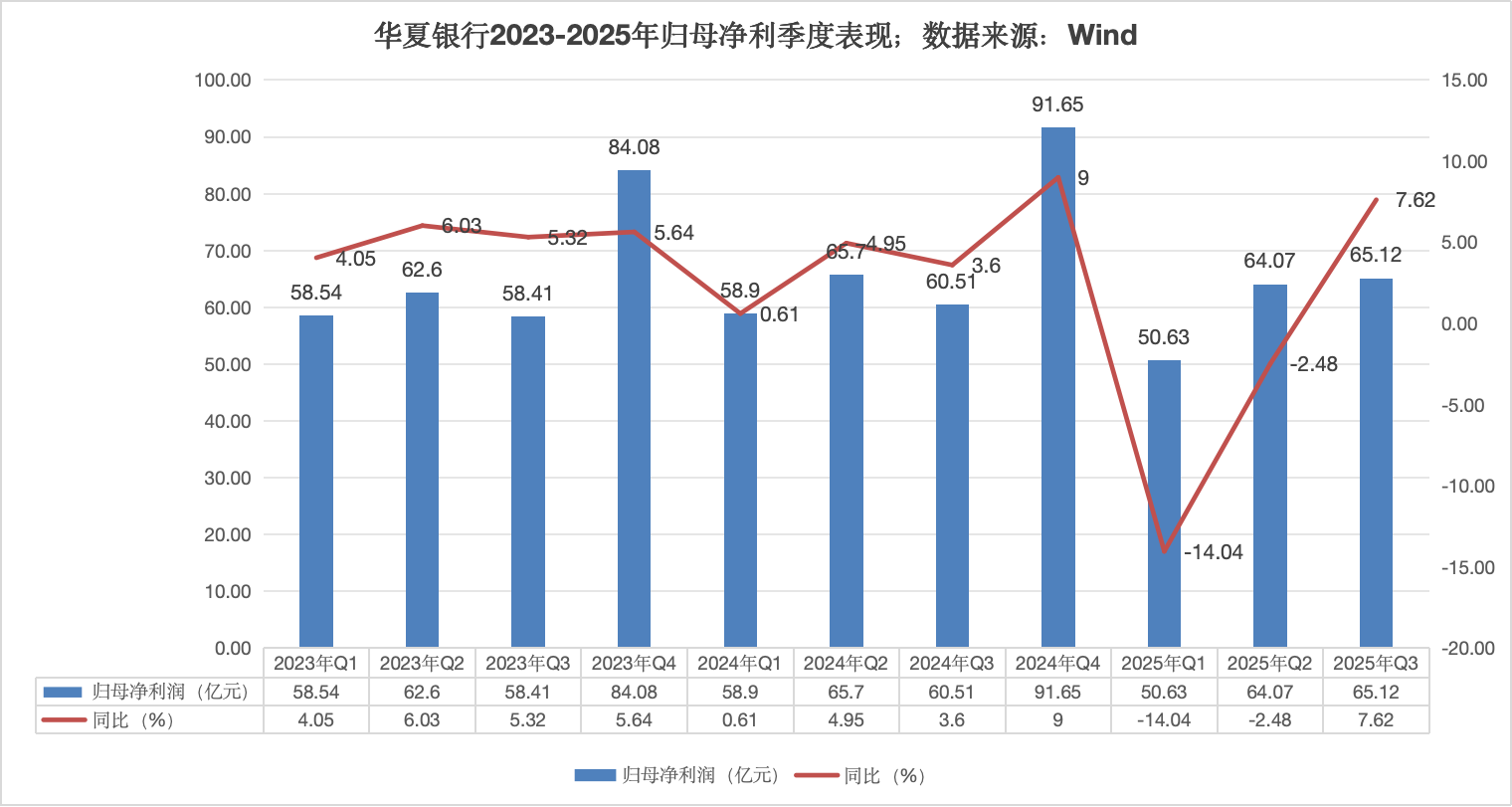
Core Viewpoint - Under the reshuffling of commercial banks, city commercial banks are gaining momentum, increasing growth anxiety for lagging joint-stock banks like Huaxia Bank [1][2]. Group 1: Financial Performance - Huaxia Bank reported a revenue of 64.881 billion and a net profit of 17.982 billion for the first three quarters, representing declines of 8.79% and 2.86% year-on-year, respectively [1][6]. - Among 42 listed banks in A-shares, Huaxia Bank ranked 40th and 37th in revenue and net profit growth rates, indicating a significant lag behind most banks [2]. - In the third quarter, Huaxia Bank experienced a revenue decline of 15.02% but a net profit increase of 7.62%, marking a V-shaped reversal in profit growth [7][9]. Group 2: Asset Quality and Risk Management - As of the end of the third quarter, Huaxia Bank's non-performing loan ratio stood at 1.58%, the worst among A-share joint-stock banks [4][14]. - The bank faces a dilemma between sacrificing risk control for growth or tightening risk management and potentially losing market share to aggressive city commercial banks [5][16]. - The bank's management has undergone significant changes, including the appointment of a new chairman and several key executives, aimed at addressing long-standing governance and risk management issues [18][19]. Group 3: Strategic Adjustments - Huaxia Bank is implementing a "cutting inward" strategy to optimize its organizational structure and improve operational efficiency [20][21]. - The bank's focus is shifting towards retail transformation and digital risk control, with an emphasis on supporting technological innovation and green finance [29]. - The bank's capital adequacy ratio is at 12.63%, which, while above the regulatory requirement, is still at the lower end compared to peers, indicating a weak capacity to absorb risks [14][23]. Group 4: Competitive Landscape - Huaxia Bank's profits have been surpassed by five city commercial banks, which are experiencing higher growth rates, intensifying competitive pressure [25][26]. - The bank's main markets, the Beijing-Tianjin-Hebei and Yangtze River Delta regions, are also the battlegrounds for these aggressive city commercial banks [28].


遭罚不停,徽商银行被疑风控跟不上业务
Hua Xia Shi Bao· 2025-10-30 00:12
Core Viewpoint - Huishang Bank has faced multiple regulatory penalties due to inadequate risk management and compliance, highlighting the need for digital risk control and enhanced compliance awareness to address its operational challenges [2][4][6]. Regulatory Penalties - Huishang Bank received three penalties from the Anhui Financial Supervision Administration for improper loan product management and inadequate loan checks, totaling 2.4 million yuan, with one individual banned from the banking industry for ten years [3]. - Previous penalties include a fine of 410,000 yuan for false credit data and a fine of 350,000 yuan for inadequate pre-loan investigations, indicating a pattern of regulatory issues related to loan management [3][4]. Internal Management Issues - The bank's internal management reveals two core problems: ineffective risk control systems and insufficient supervision of loan personnel, leading to repeated failures in loan management processes [4][5]. - Despite mentioning "risk control" in annual reports, the bank's frequent credit management issues contrast sharply with its stated commitment to risk management [4]. Loan Growth and Risks - As of June 2025, Huishang Bank's total customer loans and advances reached 1,100.53 billion yuan, an increase of 98.37 billion yuan or 9.82% year-on-year, but this growth raises concerns about a "scale-first" approach that may lead to future risks [4][5]. - The bank's non-performing loan balance increased to 10.765 billion yuan, with a non-performing loan rate of 0.98%, indicating potential underlying issues despite a slight decrease in the non-performing loan ratio [4]. Industry Context - The trend of increasing regulatory penalties for credit violations is not unique to Huishang Bank, as many financial institutions face similar scrutiny for inadequate loan management practices [6]. - The traditional model of linking loan issuance to employee compensation is becoming unsustainable, necessitating a shift towards more refined risk management practices [7][8]. Recommendations for Improvement - Experts suggest that the key to overcoming these challenges lies in the deep integration of digital risk control, utilizing technologies like big data and AI to enhance risk management efficiency [8]. - Regulatory measures are being strengthened, with new guidelines aimed at improving the precision and standardization of credit management across the banking sector [8].

助贷新规落地观察:银行向头部化平台集中
Bei Jing Shang Bao· 2025-10-23 16:21
Core Insights - The implementation of the "New Lending Regulations" is leading to a significant restructuring of collaborations between banks and internet platforms, with a focus on consolidating partnerships with major platforms like Douyin, JD.com, Ant Group, and Du Xiaoman, while smaller platforms are being pushed out of the market [1][3][5]. Group 1: Industry Trends - The new regulations have prompted banks to prioritize partnerships with large platforms due to their compliance, risk management capabilities, and extensive user bases, which help mitigate risks [3][5]. - The shift towards major platforms is seen as a response to increasing competition in retail finance, narrowing interest margins, and rising customer acquisition costs [3][10]. - The focus on a "head platform" strategy is expected to enhance industry concentration and standardization, rather than lead to monopolistic practices [5][11]. Group 2: Risk Management - The introduction of a 24% interest rate cap is a critical aspect of the new regulations, aimed at preventing high-risk clients from entering the financial system, as clients with rates above 36% have shown a 60% default rate [6][7]. - Banks are encouraged to implement differentiated pricing based on credit scores, income stability, and consumption scenarios, while also utilizing big data for dynamic interest rate adjustments [7][11]. - There are concerns that the tightening of lending channels may lead to credit chain disruptions for high-risk clients, potentially increasing default rates and impacting banks' asset quality [6][8]. Group 3: Operational Adjustments - Banks are advised to enhance their digital risk management capabilities and innovate service offerings to balance compliance with profitability [8][11]. - The competitive landscape is shifting, with larger banks focusing on self-operated loan businesses while smaller banks struggle with high customer acquisition costs and reliance on external platforms [9][10]. - The transition from high-interest, high-risk lending to a model of "thin profit, high volume, and value-added services" is becoming essential for banks to maintain profitability in a regulated environment [11][12].

助贷新规落地观察:银行分化调整,流量争夺进入“下半场”
Bei Jing Shang Bao· 2025-10-23 13:31
Core Viewpoint - The implementation of the "New Lending Regulations" is leading to a significant restructuring of cooperation between banks and internet platforms, with a trend towards consolidation among major platforms, pushing smaller ones out of the market [1][3]. Group 1: Industry Trends - The new regulations have prompted banks to focus their partnerships on major platforms like Douyin, JD.com, Ant Group, and Du Xiaoman, reflecting a shift towards larger, more established entities [3][5]. - Banks are increasingly discontinuing partnerships with mid-tier platforms due to rising customer acquisition costs and declining traffic quality, favoring collaborations with larger platforms that offer better risk management and customer data [3][4]. Group 2: Risk Management - The introduction of a 24% interest rate cap is a critical focus, as it aims to prevent high-risk clients from entering the financial system, with previous high-interest clients potentially facing credit disruptions due to reduced funding channels [6][8]. - Banks are adopting stricter due diligence processes for selecting partners, emphasizing the need for platforms with strong compliance and risk management capabilities [4][5]. Group 3: Customer Acquisition and Costs - The cost of acquiring a customer has increased significantly, from approximately 1400 yuan to around 2000 yuan, highlighting the challenges faced by banks in attracting clients in a competitive environment [11]. - Smaller banks, particularly private and regional banks, are struggling with high customer acquisition costs and are heavily reliant on platform traffic for client growth [10][11]. Group 4: Strategic Responses - Banks are encouraged to refine their risk management strategies and develop differentiated pricing models based on customer behavior data to enhance competitiveness [12]. - The shift in focus from high-interest, high-risk lending to a model of "thin profit margins and value-added services" is seen as essential for maintaining profitability while adhering to regulatory requirements [12].

小贷公司ABS发行额接近去年全年 小微与消费成融资主力
Zhong Guo Jing Ying Bao· 2025-10-17 19:15
Core Viewpoint - The issuance of asset-backed securities (ABS) for micro-loan companies has been gaining momentum in 2023, with significant regulatory support and a shift towards a more diversified market structure [1][2][7]. Industry Overview - As of October 2023, the total issuance of ABS projects by micro-loan companies reached 761.38 billion yuan, accounting for 40% of the total annual issuance of credit asset securitization products, which is 1,866.1 billion yuan [1]. - The approval process for micro-loan ABS has improved since 2025, indicating a growing recognition of quality assets in the market [2][7]. Market Dynamics - The concentration of ABS issuance among top micro-loan companies is decreasing, with the top three companies accounting for 79.2% of the total issuance in 2024, down from 55.8% in 2025 [3][4]. - The diversification of original rights holders for ABS projects is evident, with new entrants like Zhongrong Micro Loan and Tencent's Financial Payment Loan Company gaining approval for significant ABS issuances [5][6]. Regulatory Environment - The new regulations for micro-loan companies emphasize the importance of small, diversified loans aimed at supporting small and micro enterprises, individual businesses, and consumers [8]. - The regulatory framework allows for increased leverage in financing, enabling compliant institutions to expand their capital space [11][12]. Asset Composition - The underlying assets of micro-loan ABS are primarily directed towards consumption and small business support, with a notable focus on personal operating loans [9][10]. - Companies like QFIN and Meituan are leveraging their platforms to provide financing services, enhancing their market competitiveness through diversified funding sources [10]. Future Outlook - The trend towards a decrease in issuance concentration is seen as a sign of industry maturation, with new players entering the ABS market and focusing on specific scenarios to attract capital [7]. - The favorable policy environment and low-interest rates are expected to further enhance the financing capabilities of micro-loan companies, supporting their growth and market expansion [12].
南京银行无锡分行跨境金融服务再升级 “出口快贷2.0”赋能外贸企业高质量发展
Yang Zi Wan Bao Wang· 2025-09-25 14:10
Core Insights - Nanjing Bank has successfully launched the upgraded "Export Quick Loan 2.0" product, providing a comprehensive financing solution for small and micro foreign trade enterprises [5][6] - The product allows for quick approval and disbursement of international trade financing, addressing liquidity pressures faced by exporters [5] Group 1: Product Features - The "Export Quick Loan 2.0" offers a financing limit of up to 3.87 million yuan and an additional 100,000 yuan for derivative trading [5] - The product utilizes digital risk control technology and scenario-based service concepts to enhance the foreign trade financing experience [5] - It provides online approval without the need for collateral, with a maximum credit loan of 10 million yuan available [5] Group 2: Service Efficiency - The financing and derivative trading limits were approved on the same day the application was made via mobile scan, demonstrating the efficiency of the service [5] - The entire process from application to the completion of export financing and forward exchange business took only two working days [5] Group 3: Future Plans - Nanjing Bank's Wuxi branch plans to continue focusing on the actual needs of foreign trade enterprises, enriching its financial product system and innovating service models [6] - The bank aims to enhance its cross-border financial service capabilities to support the high-quality development of foreign trade enterprises [6]


徽商银行资产总额突破2.25万亿元,服务实体经济质效双升
Zhong Guo Jin Rong Xin Xi Wang· 2025-09-19 03:46
Core Viewpoint - Huishang Bank demonstrates strong performance in supporting local economic development while achieving steady growth in scale and optimizing its business structure [1][2]. Group 1: Financial Performance - As of June 2025, Huishang Bank's total assets exceeded 2.25 trillion yuan, an increase of 11.82% from the end of the previous year [1]. - Total deposits reached 1.252 trillion yuan, growing by 9.92% year-on-year [1]. - Total loans amounted to 1.100 trillion yuan, reflecting a 9.82% increase compared to the previous year [1]. - The bank reported operating income of 21.157 billion yuan, up 2.25% year-on-year, and net profit of 9.328 billion yuan, a 3.81% increase from the same period last year [1]. Group 2: Business Structure Optimization - Huishang Bank has actively promoted business structure optimization, with significant performance in investment banking and transaction banking [2]. - The bank completed 98 debt financing tool issuances totaling 79.342 billion yuan, with an underwriting scale of 29.420 billion yuan [2]. - Supply chain finance in transaction banking increased by 64.53% year-on-year, and asset management scale surpassed 1.2 trillion yuan, growing by 7.4% [2]. Group 3: Financial Inclusion and Technological Innovation - The bank focuses on technology finance, green finance, and inclusive finance, with technology loans reaching 201.794 billion yuan, a 19.57% increase from the previous year [3]. - Inclusive loans for small and micro enterprises totaled 168.028 billion yuan, reflecting continuous growth [3]. - Green credit balance reached 144.468 billion yuan, increasing by 35.63% year-on-year [3]. Group 4: Asset Quality and Risk Management - Huishang Bank maintains a stable asset quality, with a non-performing loan ratio of 0.98%, down by 0.16 percentage points year-on-year [4]. - The non-performing loan provision coverage ratio improved to 289.94%, an increase of 17.43 percentage points from the previous year [4]. - The bank has enhanced its digital risk management capabilities through the integration of big data and artificial intelligence [4]. Group 5: Future Outlook - Huishang Bank aims to continue its high-quality development journey, focusing on digital transformation and deepening financial reform to better serve the real economy [5].
从普惠冠军到催收标兵:银行人变形记 | 巴伦精选
Tai Mei Ti A P P· 2025-09-03 00:14
Core Viewpoint - The banking industry is undergoing a significant transformation as loan collection becomes a key focus due to rising non-performing loans, shifting the role of customer managers from sales to debt collection [1][5][9] Group 1: Transformation of Roles - Customer managers, once celebrated as champions of inclusive finance, are now primarily engaged in debt collection, reflecting a drastic change in their job responsibilities [1][2] - The transition from "new customer acquisition" to "debt recovery" has led to a standardized process for collections, including reminders and follow-ups based on the duration of overdue payments [2][3] - The emotional and psychological aspects of debt collection are emphasized, with customer managers needing to balance empathy and pressure in their communications with clients [4][9] Group 2: Rising Non-Performing Loans - The trend of increasing non-performing loans is evident, with several banks reporting rising delinquency rates in personal loans and real estate sectors [5][6] - Specific banks, such as Guiyang Bank and Qingnong Bank, have seen significant increases in their non-performing loan ratios, particularly in real estate [5][6] - The overall asset quality of banks is under pressure, prompting a shift in focus towards the recovery of non-performing loans as a critical revenue source [6][8] Group 3: Changes in Collection Strategies - Banks are increasingly forming in-house collection teams, moving away from outsourcing, to enhance control and efficiency in debt recovery [7][8] - The integration of technology, such as AI and data analytics, is being explored to automate and personalize the collection process, improving recovery rates [8] - The new approach to collections emphasizes a balance between achieving recovery targets and maintaining ethical standards in client interactions [9]
直击光大银行业绩会:加快数字化转型 用AI全面赋能高质量发展
2 1 Shi Ji Jing Ji Bao Dao· 2025-08-30 06:50
Core Viewpoint - The bank aims to enhance its service to the real economy and maintain steady growth through various strategic initiatives, including increasing credit supply, optimizing business structure, and deepening digital transformation with AI applications [2][3][4]. Financial Performance - For the first half of 2025, the bank reported operating income of 65.918 billion yuan, a decrease of 5.57% year-on-year, while net profit reached 24.741 billion yuan, an increase of 0.53% [3]. - The bank's total assets amounted to 7.238591 trillion yuan, up 279.57 billion yuan or 4.02% from the end of the previous year [2]. - Loan and advance principal totaled 4.08407 trillion yuan, increasing by 150.168 billion yuan or 3.82% [2]. - Deposit balance reached 4.253182 trillion yuan, up 217.495 billion yuan or 5.39% [2]. Asset Quality - As of May 2025, the bank's non-performing loan balance was 50.915 billion yuan, an increase of 1.663 billion yuan, with a non-performing loan ratio of 1.25%, unchanged from the end of the previous year [3]. - The provision coverage ratio stood at 172.47%, down 8.12 percentage points from the end of the previous year [3]. Digital Transformation and AI Application - The bank has established a "Digital Financial Development Committee" to enhance its digital transformation efforts, focusing on mechanisms, processes, and platforms [4][5]. - The bank's AI capabilities currently support over 120 algorithm models and 840 application scenarios, with six major AI assistants launched to improve operational efficiency [5][6]. - The bank is committed to integrating AI in customer service, risk management, and internal operations to drive high-quality development [6][8]. Risk Management - The bank has made progress in risk prevention in key areas, particularly in managing real estate risks and supporting small and micro enterprises [7][8]. - The bank's risk management strategy includes proactive asset management and enhanced credit support for new industrial sectors [8]. - The bank is focusing on digital risk control, utilizing intelligent models for credit approval and fraud prevention [8][9]. Technology and Innovation - The bank has developed a proprietary "Science and Technology Innovation Power" evaluation system to better assess the value of enterprises [9][10]. - The bank's digital marketing capabilities have enabled it to create a whitelist of over 80,000 key clients, enhancing service efficiency for small and micro technology enterprises [9][10].

当风控遇上大数据:探析中国人寿寿险公司风险防控体系的“数字实践”
Zhong Guo Jing Ji Wang· 2025-08-08 07:26
Core Viewpoint - China Life Insurance Company is deeply integrating ESG development concepts into its comprehensive risk management system, maintaining an A-class risk rating for 27 consecutive quarters, and establishing itself as an innovative model for risk management in the financial sector [1][3]. Group 1: Risk Management Framework - The company has established a comprehensive risk management system characterized by a "1+7+N" framework, which includes a set of regulations and guidelines for managing various types of risks [1][3]. - A risk management responsibility assessment mechanism has been implemented, incorporating risk management compliance into the performance evaluation of departments and senior management [3]. - The company emphasizes proactive risk management, shifting from a reactive to a proactive governance approach, and aims to enhance its risk management capabilities through advanced technologies and frameworks [4]. Group 2: Financial Risk Control - China Life Insurance Company prioritizes financial risk prevention, adhering to the principle of not allowing systemic risks to occur, and continuously improving its risk management strategies [1][2]. - The company aligns its risk management framework with its strategic goals, organizational structure, and business characteristics to effectively identify, measure, and control risks [2][3]. - The company aims to balance risk and return under its risk appetite, ensuring the safety and adequacy of capital while protecting policyholders' interests [2]. Group 3: ESG Integration - The company has developed an ESG risk management approach, focusing on identifying, assessing, and controlling ESG-related risks within its overall risk management framework [3][4]. - It adheres to five key principles in its ESG risk management: comprehensiveness, prudence, foresight, applicability, and dynamism [3]. - The company is committed to enhancing its financial services to support sustainable development while ensuring financial safety [4].
