
新能源汽车出口

Search documents
历史性时刻!出口乘用车中,新能源占比首次超一半
Di Yi Cai Jing· 2026-02-12 00:48
Group 1 - In January, China's new energy vehicle (NEV) exports reached 302,000 units, a year-on-year increase of 100%, with new energy passenger car exports at 295,000 units, accounting for over 50% of total passenger car exports, marking a 111% increase year-on-year [1] - The overall automobile exports in January were 681,000 units, representing a year-on-year growth of 44.9%, with passenger car exports at 589,000 units (up 48.9%) and commercial vehicle exports at 93,000 units (up 23.6%) [1] - The export structure of NEVs shows that pure electric vehicle exports were 202,000 units (up 100%), while plug-in hybrid vehicle exports were 99,000 units (up 97.3%) [1] Group 2 - The export growth of plug-in hybrid vehicles has been significant, with expectations for 2025 indicating that plug-in hybrids and hybrids will become new growth points, particularly in the pickup segment [2] - Chinese plug-in hybrid vehicles are rapidly gaining market share due to technological advantages and cost competitiveness, especially in the European market where they face lower tariffs compared to pure electric vehicles [2] - Despite potential trade policy disruptions, the growth of Chinese automobile exports has shown resilience, with a projected total export of 8.32 million vehicles in 2025, reflecting a 30% year-on-year increase [3] Group 3 - In January, among the top ten vehicle exporters, nine companies reported positive growth, with Chery leading at 119,000 units, followed by BYD (100,000 units), SAIC (97,000 units), Geely (77,000 units), and Tesla (51,000 units) [3] - The Chinese automotive industry has seen a significant increase in export volume since 2021, with a strong focus on building overseas channels and brand investments [3] - The export performance has shifted towards regions like Central and South America and Europe, with strong growth expected as long as the international market environment remains stable [4]

中国1月汽车行业保持平稳运行
Jin Rong Jie· 2026-02-11 06:20
中国汽车工业协会今天发布的最新数据显示,2026年1月份,我国汽车行业保持平稳运行。1月份,汽车 产销分别完成245万辆和234.6万辆,产量同比增长0.01%,销量同比下降3.2%。其中, 新能源汽车市场 平稳运行,产销分别完成104.1万辆和94.5万辆,同比分别增长2.5%和0.1%。此外,商用车市场延续向 好态势,1月份,产销同比均保持两位数增长。1月份,汽车出口方面,继续保持增长。其中,新能源汽 车出口保持高速增长,出口30.2万辆,同比增长1倍。 ...
一月上海南港码头国产新能源汽车出口同比增115.92%
Zhong Guo Xin Wen Wang· 2026-02-09 15:21
Core Viewpoint - In January, Shanghai's Nanguo Port exported 82,000 vehicles, marking a year-on-year increase of 65.2%, significantly surpassing historical levels. Notably, the export of domestically produced new energy vehicles reached 61,000 units, reflecting a remarkable growth of 115.92% [1] Group 1: Export Performance - Shanghai Nanguo Port is a crucial automotive export hub in China and globally, with a substantial increase in vehicle exports driven by rising demand [1] - The export of new energy vehicles from China has seen a significant surge, indicating a strong market presence and competitiveness in the international arena [1] Group 2: Customs Facilitation Measures - The Yangshan Customs has implemented a series of facilitation measures, including the establishment of a green channel for customs inspection, which has effectively reduced non-operational waiting times and improved vehicle turnover rates [1] - The digital and intelligent regulatory applications by customs have enhanced the visibility of the entire export process, contributing to cost reduction and efficiency improvements in the new energy vehicle export chain [1] Group 3: Industry Support and Logistics - The operational director of Shanghai Haitong International Automotive Logistics Co., Ltd. highlighted that customs measures have significantly shortened clearance times and reduced logistics costs, facilitating smoother vehicle exports and enabling companies to seize international market opportunities [1] - The full operation of the second phase of the roll-on/roll-off terminal and the expansion of roll-on/roll-off shipping routes, along with ongoing improvements in customs services, are expected to accelerate the export of domestic new energy vehicles [1]
上海南港码头今年1月汽车出口8.2万辆,同比增长65.2%
Xin Lang Cai Jing· 2026-02-09 11:01
Core Insights - In January, Shanghai South Port achieved an automobile export of 82,000 units, representing a year-on-year increase of 65.2%, significantly surpassing historical levels [1] - The export of domestic new energy vehicles reached 61,000 units, marking a year-on-year growth of 115.92%, indicating a strong start to the new year [1] Group 1 - Shanghai Customs has actively responded to the growing demand for automobile exports by implementing a green channel for customs clearance, significantly reducing non-operational waiting times [3] - The optimization of inspection logic at checkpoints has effectively improved vehicle flow rates, enhancing the overall efficiency of the export process [3] - The integration of smart technology has enabled a fully visualized regulatory process, embedding "invisible" supervision into the logistics chain, thereby improving service quality and efficiency for new energy vehicle exports [3] Group 2 - With the full operation of the second phase of the roll-on/roll-off terminal at South Port and the expansion of roll-on/roll-off shipping routes, customs supervision and digital regulatory applications are continuously deepening [3] - Shanghai Customs aims to leverage its advantages to enhance supervision and services, supporting the acceleration of domestic new energy vehicles during the 14th Five-Year Plan period [3]

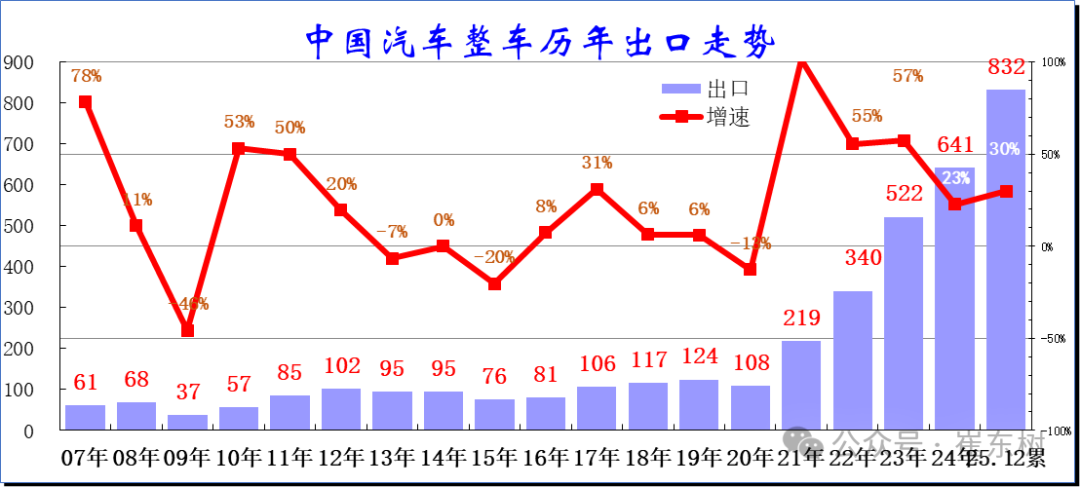
崔东树:2025年12月中国汽车实现出口99万辆 同比增73% 环比增23% 同比和环比走势总体较强
智通财经网· 2026-01-25 11:34
Core Insights - In December 2025, China's automobile exports reached 990,000 units, marking a year-on-year increase of 73% and a month-on-month increase of 23%, indicating strong overall growth trends [1][9] - For the entire year of 2025, China's automobile exports are projected to total 8.32 million units, reflecting a 30% increase compared to 2024 [1][9] - The export of new energy vehicles (NEVs) in December 2025 reached 420,000 units, a significant year-on-year increase of 174%, with an annual total of 3.43 million units, up 70% from 2024 [1][5] Export Performance - The top ten countries for China's automobile exports in December 2025 included the UAE (106,398 units), Russia (69,660 units), and the UK (54,791 units), with notable increases in exports to the UAE and the UK [2] - For the entire year, the cumulative export totals to the top ten countries were led by Mexico (625,187 units), Russia (582,738 units), and the UAE (571,937 units), with significant growth observed in exports to the UAE and Mexico [2] Vehicle Type Distribution - In December 2025, the composition of China's automobile exports included 25% pure electric vehicles (up 4% year-on-year), 17% plug-in hybrids (up 11%), 7% hybrids (up 2%), and 40% traditional fuel vehicles (down 18%) [3] - For the full year of 2025, the export composition was 28% pure electric vehicles (up 2%), 13% plug-in hybrids (up 8%), 6% hybrids (up 2%), and 43% traditional fuel vehicles (down 11%) [3] New Energy Vehicle Trends - The performance of China's NEV exports in 2025 exceeded expectations, with plug-in hybrids and hybrids emerging as new growth points, particularly in the pickup segment [5] - The export market for NEVs is showing high-quality development, particularly in the Middle East and developed countries, while the Russian market for fuel vehicles is experiencing a decline [5] Historical Context - China's automobile exports have seen significant growth since breaking the one million unit mark in 2021, with a sustained high growth rate continuing into 2025 [8][9] - The export volume has rebounded from a low point during the global economic downturn from 2013 to 2016, with a steady increase observed from 2017 to 2020 [8] Seasonal Trends - The monthly export trends indicate a seasonal characteristic, with stronger exports typically observed in the summer months, and fluctuations due to external trade policies affecting the early months of the year [10][12] Export Structure Characteristics - The share of passenger vehicles in total exports has been steadily increasing, reaching 85% by 2023, while the shares of trucks and buses have been declining [15][17] - The export of gasoline vehicles has seen a decrease, while the export of hybrid vehicles has shown strong growth, particularly in the plug-in hybrid segment [16][17]
2025年湖南电动汽车出口首破10万辆 同比激增128.2%
Chang Sha Wan Bao· 2026-01-22 09:39
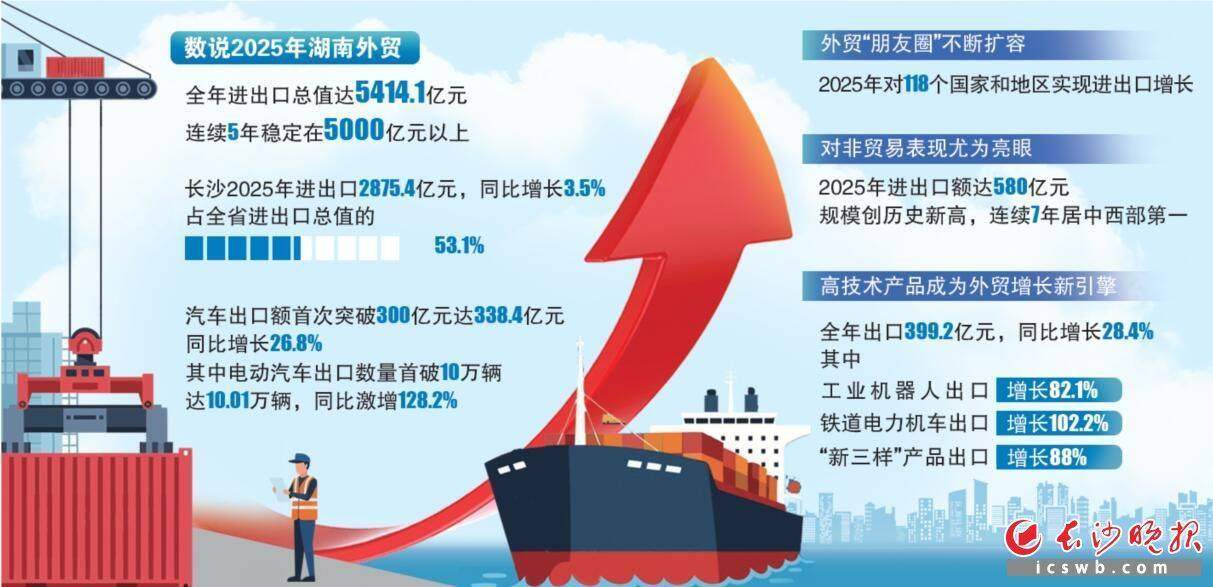
Core Insights - In 2025, Hunan's foreign trade demonstrated resilience, achieving a total import and export value of 541.41 billion yuan, maintaining stability above 500 billion yuan for five consecutive years, and contributing significantly to the province's economic goals during the 14th Five-Year Plan [2] Group 1: Trade Performance - Hunan's foreign trade showed steady growth, with a quarter-on-quarter increase of 7.7% in Q4 and a year-on-year increase of 5.7% in December, marking a strong finish for the year [3] - The automotive export value reached 33.84 billion yuan, a 26.8% increase year-on-year, with electric vehicle exports exceeding 100,000 units, a staggering increase of 128.2% [3] - The number of enterprises engaged in import and export activities surpassed 9,000 for the first time, reaching 9,113, with export enterprises increasing by 9.6% and import enterprises by 10.4% [3] Group 2: Key Contributions from Changsha - Changsha accounted for 287.54 billion yuan in import and export value, representing 53.1% of the province's total, and contributed significantly to high-tech product exports and machinery imports [4] - The city played a crucial role in stabilizing Hunan's foreign trade landscape, contributing over three-quarters of the province's high-tech product exports and machinery imports [4] Group 3: Trade Expansion and New Markets - Hunan's trade network expanded to cover 118 countries and regions, with imports and exports to Belt and Road countries reaching 320.08 billion yuan, accounting for 59.1% of the province's total [5] - Exports to Africa reached a record high of 58 billion yuan, growing by 5.8% year-on-year, with significant increases in engineering machinery and "new three samples" products [5] - The province benefited from zero-tariff policies for least developed countries in Africa, leading to increased imports of African specialty products [5] Group 4: Export Structure Optimization - Hunan's exports totaled 320.76 billion yuan, with traditional industries maintaining stability and emerging industries showing strong growth, particularly in high-tech products [6] - High-tech product exports grew by 28.4%, with industrial robots and electric locomotives seeing significant increases of 82.1% and 102.2%, respectively [6] - The customs department implemented measures to support high-tech enterprises, significantly improving the efficiency of material flow for companies requiring timely imports [6] Group 5: Logistics Improvements - The construction of international logistics channels has strengthened Hunan's foreign trade, with new international air routes and increased container throughput at ports [8] - The "Xiangyuefei" rail-sea intermodal transport reduced logistics costs by nearly 30% for enterprises [8] - Future plans include optimizing regulatory services and expanding innovative logistics models to further enhance Hunan's position in high-quality foreign trade development [8]
厦门港新能源汽车跨省铁海联运出海实现新年“开门红”
Zhong Guo Xin Wen Wang· 2026-01-17 11:59
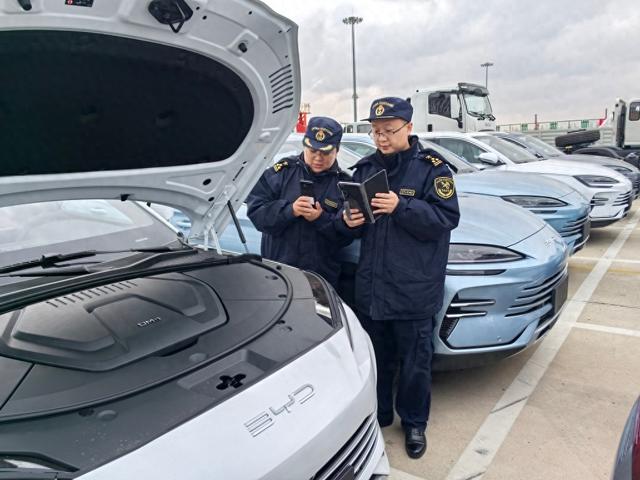
Group 1 - The first batch of 300 electric vehicles has been successfully transported from Wuhan to Xiamen for export to Gdansk, Poland, marking a new phase of efficient operation for the "Hubei production - Xiamen export" channel [1] - The implementation of a full-process "one box system" by Xiamen maritime authorities has significantly shortened the shipping cycle by 5 to 7 days, ensuring seamless transitions from container loading to shipping [1] - Xiamen's maritime department has introduced "cloud review" and "priority channels" to expedite customs and approval times, enhancing the overall efficiency of the export process [1] Group 2 - Safety is critical for the maritime transport of electric vehicles, classified as Class 9 hazardous goods, requiring adherence to stringent safety standards [2] - Upon arrival, maritime enforcement personnel conduct thorough inspections of containers and vessels to ensure compliance with safety regulations, preventing potential risks [2] - With the increasing export volume of Chinese electric vehicles, Xiamen port is leveraging cross-regional collaboration and efficient oversight to attract more inland cargo, aiming to facilitate smoother global market access for "Made in China" products [2]
跨省联动 厦门港铁海联运助力新能源汽车“出海”
Zhong Guo Xin Wen Wang· 2026-01-17 11:49
Core Viewpoint - The successful transportation of 300 electric vehicles from Wuhan to Xiamen marks a new phase in the efficient operation of the "Hubei production - Xiamen export" channel, indicating a regularized cross-province iron-sea transport service for electric vehicles [1] Group 1: Transportation Efficiency - Xiamen's maritime department implemented a full-process "one box system" management to ensure efficient cargo transfer, enhancing collaboration with Wuhan's maritime, railway, terminal, and shipping companies [1] - The seamless tracking of container trajectories and vessel dynamics allows for a "no box change, no box opening" process, reducing the cargo export cycle by 5 to 7 days [1] Group 2: Market Implications - As China's electric vehicle export volume continues to rise, Xiamen Port is leveraging its advantages in cross-regional collaboration, comprehensive supervision, and high-efficiency connections to attract more inland cargo [1] - The maritime department plans to further optimize regulatory services and improve cross-regional collaboration mechanisms to facilitate smoother global market access for "Made in China" products [1]
中信期货晨报:贵金属延续涨势,央行加量续作呵护资金面-20260115
Zhong Xin Qi Huo· 2026-01-15 00:30
1. Report Industry Investment Rating - Not provided in the report 2. Core Viewpoints of the Report - Overseas macro: US economic data shows a continued slowdown, with concerns about the Fed's independence increasing. Key events such as the Supreme Court's ruling on Trump's tariffs, US CPI data, new Fed chair nomination, and Q4 GDP data should be closely monitored [7]. - Domestic macro: The domestic macro - environment is expected to improve moderately, with a focus on the investment side. Policies are being implemented, and the central bank is increasing liquidity through a 300 - billion - yuan net injection of 6 - month repos [7]. - Asset views: Recommend long positions in stock indices, non - ferrous metals (copper, aluminum, tin), and gold on a monthly basis. Treat silver as a short - term standard allocation and consider overweighting it after volatility stabilizes [7]. 3. Summary by Relevant Catalogs 3.1 Market Data Summary 3.1.1 Index Futures and Related Financial Instruments - Stock index futures: CSI 300 futures closed at 4740 with a daily decline of 0.44%, SSE 50 futures at 3114 with a daily decline of 0.57%, CSI 500 futures at 8197.8 with a daily increase of 0.66%, and CSI 1000 futures at 8156 with a daily increase of 0.09% [2]. - Bond futures: 2 - year bond futures closed at 102.334 with no daily change, 5 - year at 105.655 with a daily increase of 0.04%, 10 - year at 107.93 with a daily increase of 0.07%, and 30 - year at 111.27 with a daily decline of 0.03% [2]. - Foreign exchange: The US dollar index was at 99.1842 with a daily increase of 0.29%, and the US dollar mid - price was 6.9777 with a 46 - pip increase [2]. - Interest rates: The 7 - day inter - bank pledged repo rate was 1.5668% with a 1.94 - bp increase, the 10 - year Chinese government bond yield was 1.8494% with a 0.25 - bp decrease, and the 10 - year US government bond yield was 4.18% with a 1 - bp decrease [2]. 3.1.2 Industry Indexes - Computer, comprehensive finance, and media industries showed significant monthly increases of 17.81%, 6.64%, and 25.84% respectively, while banking and real estate industries had monthly decreases of 2.68% and 2.91% respectively [4]. 3.1.3 Domestic Commodities - Precious metals: Gold had a daily increase of 1.29% and a monthly increase of 6.51%, silver had a daily increase of 1.53% and a monthly increase of 2.54% [5]. - Energy and chemicals: Fuel oil had a daily increase of 5.1%, low - sulfur fuel oil had a daily increase of 6.15%, and crude oil had a daily increase of 0.38% [5]. - Non - ferrous metals: Stainless steel had a daily increase of 0.93%, tin had a daily increase of 8.84% [5]. 3.1.4 Overseas Commodities - Crude oil: NYMEX WTI crude oil was at 61.1 with a daily increase of 2.69%, and ICE Brent crude oil was at 65.46 with a daily increase of 2.49% [6]. - Precious metals: COMEX gold was at 4594.4 with a daily decline of 0.44%, and COMEX silver was at 86.86 with a daily increase of 2.08% [6]. - Agricultural products: CBOT soybeans were at 1039 with a daily decline of 0.95%, and CBOT corn was at 420.25 with a daily decline of 0.3% [6]. 3.2 Sector - Specific Views 3.2.1 Financial Sector - Stock index futures are expected to fluctuate upward, awaiting incremental funds. Stock index options are expected to fluctuate, and treasury bond futures are also expected to fluctuate, with long - end sentiment remaining weak [9]. 3.2.2 Precious Metals Sector - Both gold and silver are expected to fluctuate upward, influenced by factors such as US fundamentals, Fed policy, and geopolitical conflicts [9]. 3.2.3 Shipping Sector - The container shipping route to Europe is expected to fluctuate, with attention on 2026 shipping company resumption plans, year - end long - term contract freight rates, and pre - Spring Festival cargo volume [9]. 3.2.4 Black Building Materials Sector - Steel products, iron ore, and other related products are expected to fluctuate, with attention on factors such as special bond issuance, steel exports, and iron ore production and transportation [9]. 3.2.5 Non - Ferrous Metals and New Materials Sector - Copper, aluminum, tin, and other non - ferrous metals are expected to fluctuate, with different influencing factors for each metal, such as supply disruptions and policy changes [9]. 3.2.6 Energy and Chemical Sector - Most energy and chemical products are expected to fluctuate, with geopolitical factors and raw material prices being important influencing factors. Asphalt is expected to decline [11]. 3.2.7 Agricultural Sector - Some agricultural products such as natural rubber, synthetic rubber, and cotton are expected to fluctuate upward, while sugar is expected to fluctuate downward [11].
第一创业晨会纪要-20260112
First Capital Securities· 2026-01-12 06:25
Macro Economic Group - In December, China's CPI increased by 0.8% year-on-year, matching expectations, and up from 0.7% in November. Core CPI also remained stable at 1.2% year-on-year [5] - December's PPI decreased by 1.9% year-on-year, slightly better than the expected decline of 2% [6] - The U.S. non-farm payrolls increased by 50,000 in December, below the expected 60,000, while the unemployment rate fell to 4.4% [7][8] Industry Comprehensive Group - TSMC reported a revenue of NT$335 billion in December 2025, a 2.5% decrease from November but a 20.4% increase year-on-year. The fourth quarter revenue reached NT$1.05 trillion, approximately US$33.1 billion, exceeding market expectations [10] - The competition for satellite orbital resources between China and the U.S. has officially begun, with significant implications for satellite manufacturing and commercial rocket industries [11] Advanced Manufacturing Group - Starting April 1, 2026, China will cancel the VAT export rebate for photovoltaic products and reduce the rebate for battery products from 9% to 6%. This is expected to stabilize export prices and enhance product structure upgrades in the battery industry [13] - In December, the retail sales of new energy passenger vehicles reached 1.337 million units, a year-on-year increase of 2.6%, with a penetration rate of 59.1% in the domestic market [14] Consumer Group - Mao Geping has launched new products and formed a strategic partnership with LVMH's investment firm, aiming to enhance its global presence in the beauty market. This collaboration focuses on expanding high-end retail channels and establishing a beauty investment fund [16] - The CES 2026 highlighted the importance of LiDAR technology, which is expected to drive the growth of smart lawn mowers and other intelligent devices, with the global market projected to reach US$4 billion by 2028 [17]