止盈

Search documents
X @Yuyue
Yuyue· 2025-09-20 19:25
Price Targets - The document suggests two potential take-profit price points for a cryptocurrency or token [1] - First take-profit target is around 2.088 (currency unspecified) for "MC chasing peak PUMP" [1] - Second take-profit target is around 2.66 (currency unspecified) if the Fully Diluted Valuation (FDV) reaches 1/4 of Binance Coin (BNB)'s value [1] Market Analysis - The document implies a speculative trading strategy based on market momentum ("PUMP") [1] - The document uses Binance Coin (BNB) as a benchmark for valuation [1]
关于如何卖出的话题总结一下
猛兽派选股· 2025-09-15 08:05
Group 1 - The article emphasizes that trading strategies and tactics are interconnected, and there is no isolated buy or sell action, only an acceptable plan [1] - A reasonable risk-reward ratio should be at least 2:1, meaning a 7% stop-loss should correspond to a 14% profit expectation [1] - For breakout buying, if there is no floating profit within five trading days, it may indicate a wrong choice, and a stop-loss should be considered at a 3-5% loss [1] Group 2 - After achieving a floating profit of over 8%, three tactical options are available: using a 7-8% retracement as a stop-loss threshold, calculating a moving stop-loss based on the breakout candle, or employing the TR holding line as a stop-loss threshold [3] - A stable strong trend stock typically will not easily breach the TR holding line, and when it does, selling can be done in batches or all at once [5] - For most stocks outside of leading stocks, selling a portion of the position after achieving a 20% floating profit is often a good choice, as excessive greed can lead to profit loss [6] Group 3 - The volume-weighted moving average is superior in support and sensitivity compared to EMA and SMA, and practical comparisons are encouraged [8] - Momentum divergence remains an essential technique in selling strategies, with VAD and BIAS indicators being particularly useful for identifying buy and sell timing [10]


投资股票基金,该如何止盈?|投资小知识
银行螺丝钉· 2025-09-01 13:58
Group 1 - The article discusses strategies for managing investment portfolios, particularly focusing on automatic profit-taking mechanisms in advisory portfolios [2][3]. - It highlights two scenarios for profit-taking: when certain assets are overvalued while others are undervalued, and when the overall market is deemed overvalued [2][3]. - The article mentions a feature of the advisory portfolio that allows for automatic rebalancing, which helps investors to take profits from overvalued assets and reinvest in undervalued ones without manual intervention [2][3]. Group 2 - The process of profit-taking involves gradually converting investments from a stock and fund combination to a more stable bond fund combination as market valuations increase [3][4]. - The article indicates that the conversion will be executed in phases, with a larger proportion being converted as market valuations rise, ultimately transitioning to a conservative investment strategy when the market is fully overvalued [4]. - It provides a call to action for readers to engage with a course assistant for detailed guidance on setting up automatic profit-taking strategies [4][5].

市场调整,牛市未尽:你的基金该止盈了吗?
Sou Hu Cai Jing· 2025-08-28 03:35
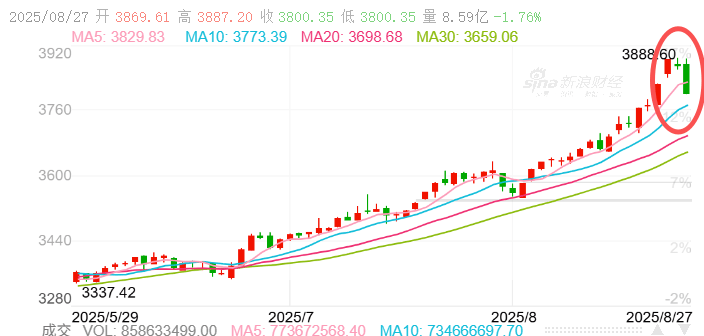
Market Overview - The Shanghai Composite Index has recently broken a nearly decade-long high, but experienced a significant pullback today, dropping by 1.76%, while the ChiNext Index fell by 0.69%. Despite this, the trading volume in both markets remained high at 3.17 trillion yuan [1] - The market seems to have entered a "buy on dips" mode, where slight adjustments quickly attract capital inflows, although today saw a notable late-session sell-off that disrupted this trend [1] Market Dynamics - The market has shown two significant changes: a faster pace of increase, shifting from gradual to rapid gains, and a rotation of popular sectors from high-tech fields like AI and robotics to undervalued sectors such as consumer goods, livestock, liquor, and chemicals, which aligns with characteristics of a bull market [3] - This bull market differs from previous ones, as it lacks signs of retail investor frenzy, such as massive fund sales or a surge in new retail accounts. Instead, the driving force appears to be institutional capital and high-net-worth individuals participating through private equity funds [3] Investor Sentiment - Investor sentiment remains cautious, with no signs of excessive enthusiasm. While some new investors are entering the market, there is no large-scale inquiry about investment directions. Long-term fund investors are considering redemption or profit-taking, indicating that as the market improves, redemption pressure on public funds increases [4] - The rapid growth of China's ETF market, expanding from 4 trillion to 5 trillion yuan in just four months, reflects active participation from institutional investors [4] Investment Strategies - In light of the market adjustment, investors are advised to consider their selling strategies carefully. The bull market has not yet peaked, and significant adjustments are normal. Investors should act decisively to avoid missing opportunities [4] - Suggested profit-taking strategies include setting clear profit targets (e.g., selling after an 8% or 10% gain), prioritizing the sale of underperforming funds, and making decisions based on market conditions, despite the difficulty in predicting market tops [4][5] - For hesitant investors, partial profit-taking and optimizing portfolio structure by reducing the number of funds held are recommended, with an emphasis on maintaining appropriate position management over merely pursuing profit-taking [5]
宝城期货水满则溢
Bao Cheng Qi Huo· 2025-08-27 05:22
Report Core View - The success in the futures market lies in long - term survival rather than short - term huge profits. Traders should be aware of the risk of profit retracement and adopt a modest and retreat strategy when making profits [2][3] - To prevent profit retracement, one should use stop - loss as a shield, position as a formation, discipline as an order, and self - reflection as a teacher [3] Report Industry Investment Rating - Not mentioned Summary According to Related Catalog - The futures market is volatile, and investors often pursue high - leverage and heavy - position trading at the beginning, ignoring the risk of profit retracement and the need for stop - profit rules, which can lead to losses [2] - History shows that wise people like Zhang Liang and Tang He knew when to retreat. In the futures market, traders should learn from them and think about the risk of retracement during profitable periods [3]
到底何时止盈?2025年8月26日 市场温度
Sou Hu Cai Jing· 2025-08-26 16:32
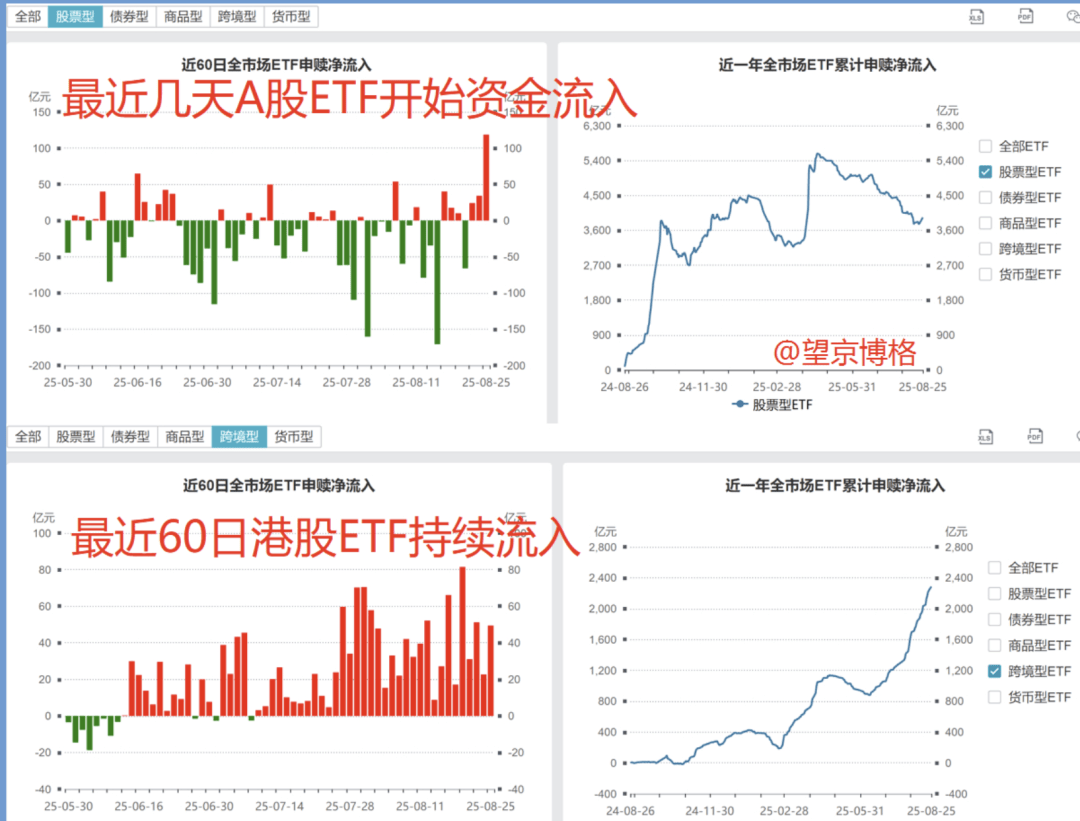
Group 1 - The market experienced a loss today, with on-market ETF accounts losing 11,000 and off-market fund accounts losing 7,000, totaling a loss of 18,000 [1] - Compared to a profit of 130,000 yesterday, this pullback is considered minor [2] - Retail investors have not entered the market on a large scale, as there has been no significant growth in the shares of both active funds and A-share ETFs this year [2][4] Group 2 - The recent growth in ETF scale is primarily due to net value growth rather than retail subscriptions, indicating that retail investors may be entering through insurance wealth management instead [4] - As of the end of 2024, the scale of China's insurance asset management industry reached 33.26 trillion, leading the asset management sector [4] - In the first half of 2025, there is a structural adjustment in insurance asset management, with a contraction in debt investment scale and significant growth in asset securitization (ABS) and equity investments, increasing by 46.15% and 188% year-on-year, respectively [4] Group 3 - The current market conditions suggest that there is no need to wait for a large-scale entry of retail investors before reducing positions [5] - There is a conflict regarding whether to reduce or increase positions, with memories of the 2014-2015 bull market causing hesitation to take profits too early, while the 2022-2023 bear market raises concerns about losing unrealized gains [6][7] Group 4 - Recent trading strategies include reducing positions in Hong Kong innovative drugs while increasing positions in the chemical index, resulting in a nearly 10% profit from the chemical sector within a month [9] - The current valuation levels of major indices are high, with the CSI 300 at 14.11, the CSI 500 at 33.09, and the CSI 1000 at 46.39, all reflecting high historical percentiles [11][13][15] Group 5 - The A-share market has shown significant gains this week, with valuation levels rising sharply, particularly in the Sci-Tech 50 and CSI 2000, both reaching 100% historical valuation percentiles [25] - The difference in valuation perception between the ChiNext Index and the ChiNext Composite Index is clarified, as the former includes only leading stocks while the latter encompasses all listed companies, leading to a higher average valuation [26] Group 6 - The current temperature of the A-share market is 67.61, surpassing the previous high of 63 in 2021 and the peak of 93 in 2015, while the Hong Kong market temperature stands at 48.37 [40]
上涨了,该如何止盈?|第397期直播回放
银行螺丝钉· 2025-07-25 13:58
Core Viewpoint - The article discusses various strategies for profit-taking in index funds, highlighting their advantages and disadvantages, and emphasizes the importance of market valuation in making investment decisions [1][3][20]. Summary by Sections Profit-Taking Strategies - Three main profit-taking strategies for individual index funds are outlined: 1. Profit-taking based on return rate 2. Profit-taking based on overvaluation 3. Long-term holding without selling, relying on dividends for profit [3][4][30]. Strategy 1: Profit-Taking Based on Return Rate - This strategy suggests considering profit-taking when the return reaches a predetermined level, typically around 30% [4][5]. - The advantage is its simplicity, while the downside is the potential to miss out on gains during bull markets [7][8]. Strategy 2: Profit-Taking Based on Overvaluation - Investors can use valuation metrics to determine when to sell, with a reference to a star rating and valuation table updated regularly [11][14]. - The valuation table indicates: - Green for undervalued (suitable for investment) - Yellow for normal valuation (hold) - Red for overvalued (consider selling) [12][18]. Strategy 3: Long-Term Holding - This strategy emphasizes the benefits of holding investments for the long term, particularly for high-dividend stocks [30][34]. - It is considered low-maintenance but requires careful selection of high-dividend stocks [35]. Market Valuation Insights - The article provides historical context on market valuations, noting significant changes from 5-star ratings in 2018 to 3-star ratings in 2021, indicating effective investment strategies during these periods [20][23]. Monthly Cash Flow Investment Strategy - The "Monthly Salary" investment strategy allows for flexible cash flow options, with a projected annual payout of approximately 6% of total assets [50][56]. - The strategy has shown stability even during market downturns, with a maximum drawdown of only 9.13% since inception [56]. Automated Portfolio Management - The article discusses automated features in investment portfolios that help manage profit-taking and rebalancing without requiring manual intervention [60][64]. - This includes automatic adjustments between equity and bond allocations based on market conditions [68][80].

投资有收益了,该如何止盈呢?|投资小知识
银行螺丝钉· 2025-07-23 13:57
Core Viewpoint - The article emphasizes the importance of profit-taking strategies in investment, particularly during market uptrends, and suggests that investors should consider various methods to secure gains while managing risk [1] Summary by Relevant Sections - **Profit-Taking Strategies** - The article discusses different approaches to profit-taking, highlighting the need for a structured plan to maximize returns while minimizing potential losses [1] - **Market Trends** - It notes that understanding market trends is crucial for effective profit-taking, as investors should be aware of when to exit positions to capitalize on gains [1] - **Educational Resources** - The article promotes a live session that provides detailed insights into profit-taking strategies, encouraging readers to engage with educational content for better investment decisions [1]

如果牛市来了,基金投资牢记这5点!
天天基金网· 2025-07-19 05:01
Core Viewpoint - The article emphasizes the importance of maintaining discipline in investment strategies during a bull market, highlighting five key recommendations to avoid common pitfalls and maximize returns [1][16]. Group 1: Investment Discipline - Investors should adhere to their regular investment plans and continue systematic investment even in a bull market, avoiding the temptation to make large, impulsive investments [4][15]. - It is crucial to set specific limits for additional investments, such as a percentage of monthly income, and to avoid going "all in" [5][15]. - The tendency to sell existing investments to chase higher returns can lead to losses; therefore, investors should focus on holding quality funds [7][8]. Group 2: Profit Management - Caution is advised when considering adding to positions after realizing profits; a "pyramid" approach should be used, buying more at lower valuations and less as prices rise [11][15]. - Setting clear profit-taking targets before entering a position is essential, with recommendations to sell portions of holdings at predetermined profit levels [14][15]. - Maintaining awareness of market conditions and avoiding emotional decisions during periods of market euphoria is critical to prevent significant losses [13][15]. Group 3: General Market Awareness - The article warns that bull markets can create a false sense of security, and investors should remain vigilant against the risks of market bubbles and emotional trading [16]. - It is highlighted that the A-share market typically experiences short bull runs followed by longer bear markets, necessitating a calm and disciplined approach to investing [16].