
氢能和核聚变能

Search documents
第一观察 | 开局之年中央政治局首次集体学习聚焦未来产业发展
Xin Hua She· 2026-02-02 11:29
Core Insights - The central message emphasizes the importance of cultivating and developing future industries to seize technological and industrial advantages, enhance productivity, and improve the quality of life for citizens [2][3]. Group 1: Future Industry Development - Future industries are characterized by being driven by cutting-edge technologies and are seen as strategic, forward-looking, and disruptive [1]. - Key areas identified for development include quantum technology, biomanufacturing, hydrogen and nuclear fusion energy, brain-computer interfaces, embodied intelligence, and sixth-generation mobile communications [1]. - The contribution of the industrial and information sectors to China's economic growth is projected to exceed 40% by 2025, with over 6,000 AI companies and biomanufacturing evolving into a trillion-dollar industry [2]. Group 2: Strategic Planning and Coordination - A scientific and comprehensive approach is required for planning future industries, focusing on national strategic needs, technological maturity, and resource support [3]. - Emphasis is placed on avoiding a rush into future industries without proper integration with traditional and emerging sectors, promoting continuous industrial convergence [3]. Group 3: Innovation and Technology Integration - The speed and depth of future industry development are significantly influenced by technological breakthroughs, necessitating seamless integration between innovation and industry [4]. - The government is urged to enhance support for key technological advancements and accelerate the application of scientific achievements [4]. Group 4: Role of Enterprises - Enterprises are recognized as the main drivers of innovation, and there is a call to create an ecosystem centered around businesses to foster collaboration and resource aggregation [5]. - The development of leading technology enterprises and support for specialized small and medium-sized enterprises are crucial for advancing industries towards high-end sectors [5]. Group 5: Support and Governance - The cultivation of future industries involves long cycles and significant market risks, requiring government support and a robust governance framework [6]. - Policies related to finance, talent development, and effective regulatory measures are essential to ensure a balance between flexibility and control in the industry [6].
探访全国首家人形机器人7S店(奋进“十五五”·一线见闻)
Ren Min Ri Bao· 2026-01-28 22:05
Group 1 - The article discusses the development and commercialization of humanoid robots in Wuhan, highlighting the establishment of the first humanoid robot 7S store in the country, which offers various humanoid robots priced between 7,999 yuan and 700,000 yuan for multiple applications [2][4] - The humanoid robot "Yuan You," developed in Wuhan, is designed for various services, including guidance and health care, and has been operational in a local hospital for nine months [2][3] - The production of humanoid robots in Wuhan is supported by a robust supply chain, with over 20 core suppliers and nearly 1,000 related enterprises, enabling efficient manufacturing and assembly of components [3] Group 2 - The Wuhan government has launched a three-year action plan and policy measures to promote the application of humanoid robots across various sectors, offering financial incentives for both application and product development [4] - The 7S store has generated over 600,000 yuan in revenue from experiences, sales, and rentals, indicating a growing market for humanoid robots in the region [4] - The establishment of the Humanoid Robot Innovation Center aims to enhance the training and data collection for humanoid robots, facilitating their evolution and integration into various industries [3][4]

“6G通信有了超宽高速公路”
Ren Min Wang· 2026-01-26 22:38
Group 1 - The "14th Five-Year Plan" suggests forward-looking layouts for future industries, exploring diverse technological routes, typical application scenarios, feasible business models, and market regulatory rules to promote quantum technology, biomanufacturing, hydrogen energy, nuclear fusion energy, brain-computer interfaces, embodied intelligence, and sixth-generation mobile communication as new economic growth points [1] - 6G, as the next generation of wireless communication networks, requires high-speed transmission of wireless signals across various frequency bands in diverse scenarios. Traditional electronic hardware is limited to single frequency bands, making it challenging to achieve cross-band or full-band operation [1] - A joint team from Peking University and City University of Hong Kong has successfully developed an ultra-wideband optoelectronic integrated system for 6G communication, achieving the first full-band, flexibly tunable high-speed wireless communication, ensuring smoother and more reliable 6G wireless communication in the future [1] Group 2 - The development of ultra-high-frequency optoelectronic fusion chips is a research hotspot both domestically and internationally, with many global teams concurrently working on this technology. The collaboration between Peking University and City University of Hong Kong demonstrates effective cooperation despite geographical distance [1] - The new system, enhanced by AI algorithms, will create a more flexible and intelligent AI wireless network capable of operating in various complex scenarios, achieving real-time data transmission and precise environmental perception while automatically avoiding interference signals for safer and smoother network signal transmission [2]
超70亿“爆款”重现!市场风向变了
Zhong Guo Zheng Quan Bao· 2026-01-26 14:13
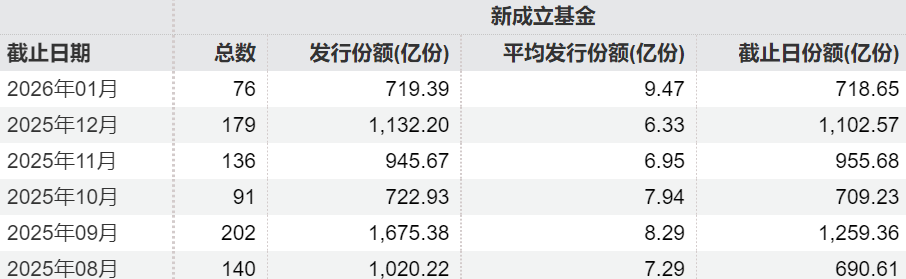
Group 1 - The core viewpoint of the articles indicates a significant rebound in the issuance of actively managed equity funds, highlighted by the launch of the Guangfa Research Smart A fund, which achieved an issuance of 7.221 billion shares, marking it as a "blockbuster product" [1][4] - As of January 25, 76 new funds have been established in 2026, with a total issuance of 71.939 billion shares, showing a recovery in the fund issuance market [2][3] - The average issuance of new funds in January 2026 reached 9.47 billion shares, significantly higher than the 6.33 billion shares in December 2025, indicating a notable improvement in market conditions [3] Group 2 - The issuance of actively managed equity funds is gaining momentum, with several funds exceeding 2 billion shares, including the E Fund Balanced Selection with 3.408 billion shares [5] - The upcoming issuance of 50 new funds before the Spring Festival suggests a balanced market between actively managed equity funds and passive index funds, with both types of funds having equal representation [5] - Institutions are cautiously optimistic about the equity market in 2026, with expectations of significant style and structural shifts, driven by positive policies and improving fundamentals [6]

苏州“十五五”规划建议出炉:将培育更多千亿级规模上市企业
Zheng Quan Shi Bao Wang· 2026-01-21 12:18
Core Insights - Suzhou has officially released its "14th Five-Year Plan" proposal, focusing on promoting industries such as embodied intelligence, quantum technology, hydrogen energy, nuclear fusion energy, and brain-computer interfaces as new economic growth points [1] Group 1: Development of New Productive Forces - The proposal emphasizes the importance of the real economy and aims to implement the "Suzhou Intelligent Manufacturing" project, maintaining the manufacturing sector's contribution above 40% [2] - It aims to enhance the competitiveness of emerging industries by advancing innovation infrastructure, technology R&D, and product upgrades, particularly in sectors like electronic information, equipment manufacturing, and new materials [2] - The plan includes fostering world-class advanced manufacturing clusters in biomedicine, high-end medical devices, and semiconductor industries, among others [2] Group 2: Cultivation of Future Industries - The proposal outlines plans to actively develop future industries such as future manufacturing, information, materials, energy, space, and health [3] - It encourages diverse technological routes and application scenarios to accelerate the formation of new economic growth points in areas like embodied intelligence and quantum technology [3] - The plan aims to promote venture capital development to create a multi-faceted investment landscape for future industries [3] Group 3: Building an Innovation Hub - The proposal calls for strengthening the regional innovation system and integrating into the Shanghai (Yangtze River Delta) international technology innovation center [4] - It emphasizes the need for breakthroughs in key core technologies and aims to establish national innovation centers in quantum technology and deep-sea information technology [4] - The plan includes enhancing the role of enterprises in technological innovation and fostering a gradient cultivation system for technology-driven enterprises [4] Group 4: Promoting Large-scale Listed Companies - The proposal highlights the importance of reform in key areas and encourages differentiated reform explorations to enhance systemic coherence [5] - It aims to improve the financial service system, focusing on technology finance, green finance, and digital finance, among others [5] - The plan seeks to support the listing of more large-scale companies and enhance their growth [5] Group 5: High-level Opening Up - The proposal emphasizes deepening international cooperation and implementing high-level opening-up initiatives to attract global high-end resources [7] - It aims to expand institutional openness and engage in innovative trials in various sectors, including biomedicine and smart manufacturing [7] - The plan includes building the Yangtze River Delta ecological and green integration development demonstration zone [7] Group 6: Accelerating Urban Integration - The proposal focuses on enhancing the integration of Suzhou with Shanghai, promoting cooperation in technology innovation and resource sharing [8] - It aims to collaboratively develop world-class high-end industrial clusters in sectors like integrated circuits and artificial intelligence [8] - The plan includes improving transportation infrastructure and public services to facilitate urban integration [8]
方正证券:A股与美股ROE长期对比分析与启示
智通财经网· 2026-01-15 22:46
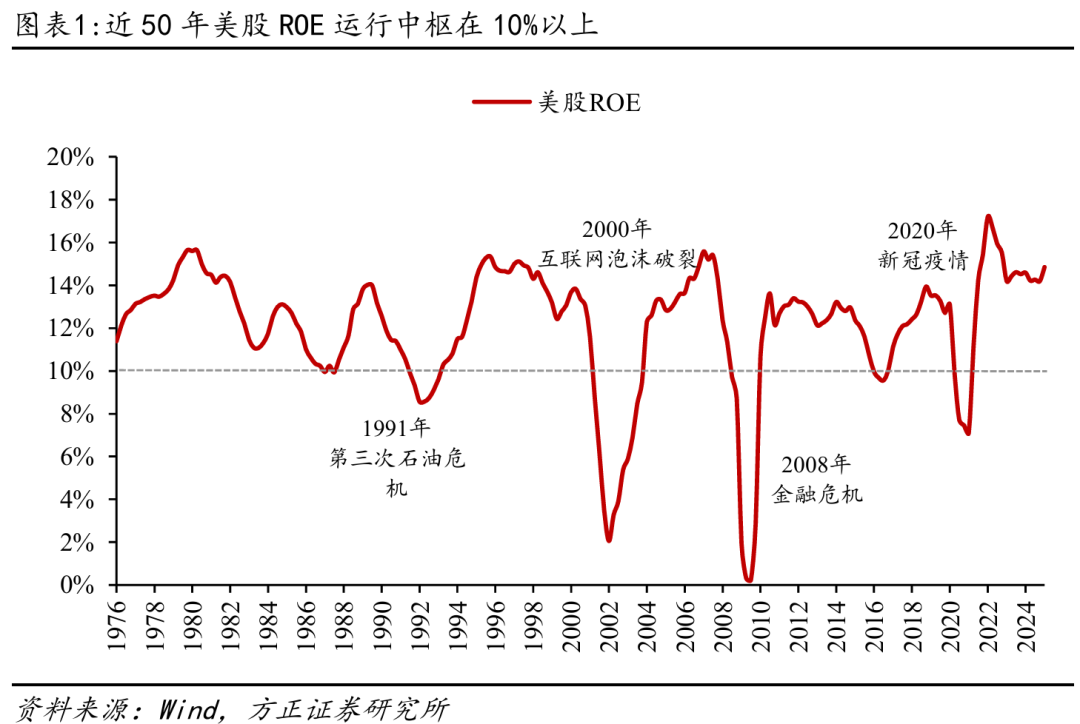
Group 1 - The core conclusion of the report is that there is a relative misalignment in ROE levels between A-shares and US stocks, with US stocks at historical highs and A-shares recovering from a bottom [2][12] - The primary reasons for the ROE misalignment are the divergence in net profit margins and asset turnover rates between A-shares and US stocks [2][17] Group 2 - Net profit margin is identified as the most critical factor influencing the strong ROE in US stocks, with A-shares experiencing a gradual decline in net profit margins [3][20] - A-shares' net profit margin decreased from 5.8% to 3.9%, a change rate of -32.2%, while US stocks' net profit margin increased from 7.3% to 8.6%, a change rate of +17.7% [20][22] - The asset turnover rate for A-shares has also declined significantly, from 87% to 60%, while US stocks' turnover rate remained relatively stable [20][43] Group 3 - The leverage ratio for US stocks is significantly higher than that of A-shares, with US stocks maintaining a stable leverage ratio around 460% [5][56] - A-shares' leverage ratio is expected to rise slowly but will remain significantly lower than that of US stocks due to different corporate financing strategies [59][60] Group 4 - The report emphasizes that the long-term trend of A-shares' ROE will improve, driven by the "14th Five-Year Plan" which aims for high-quality development and increased corporate profitability [6][62] - The focus on technological innovation and the establishment of a unified national market are expected to enhance the profitability of A-share companies, leading to a systematic improvement in ROE [62][64]

天津经开区加力培育未来产业
Xin Lang Cai Jing· 2026-01-11 19:16
Core Insights - Tianjin Economic and Technological Development Zone has released the "Future Industry Cultivation and Development Action Plan (2025-2027)" aiming to establish a "4+2+X" future industry layout by 2027, focusing on key technologies, products, applications, talent, and competitive enterprises in future industries [1][2] Group 1: Future Industry Development Strategy - The action plan aims to create a world-class future industry ecosystem, emphasizing "future-oriented advantages" and "industrialization of future technologies" as the two main lines of development [1] - The "4+2+X" future industry development system will focus on four cornerstone tracks: nucleic acid drugs, biomanufacturing, general artificial intelligence, and basic and key materials [1] - The plan also includes two cutting-edge tracks: embodied intelligence and automotive-grade chips, along with several potential tracks such as future healthcare, nano-manufacturing, and software-defined interconnect chips [1] Group 2: Implementation Actions - To achieve the development goals, the Tianjin Economic and Technological Development Zone will focus on a complete innovation ecosystem, implementing ten key actions including technology innovation source actions and future enterprise cultivation actions [2] - The technology innovation source action will concentrate on building high-level innovation platforms, aiming for 1 to 3 key source platforms for each track [2]
十六连阳后续如何演绎?
Soochow Securities· 2026-01-11 10:17
Group 1 - The report highlights that the Shanghai Composite Index has achieved a remarkable 16 consecutive days of gains, with growth styles, particularly in commercial aerospace, nuclear fusion, and 6G themes, significantly outperforming the market. This trend is attributed to China's economic transformation and the initiation of the 14th Five-Year Plan, which emphasizes new economic growth points such as quantum technology and hydrogen energy [1][2][3] - Historical data indicates that occurrences of ten consecutive days of gains in the A-share market are extremely rare, with only seven instances since 1990. The report notes that while short-term (5-day) gains are highly probable following such streaks, longer-term performance shows mixed results, necessitating an analysis of the core factors driving the market [2][4] - The report discusses the historical context of previous consecutive gain streaks, particularly from 1990 to 1992, where institutional reforms and stock scarcity propelled market growth. The completion of the stock split reform in 2006 is also noted as a significant factor that led to a bull market, supported by a healthy macroeconomic environment [3][5][7] Group 2 - The report emphasizes that strong fundamentals provide room for valuation recovery, and the smooth progress of reforms has catalyzed the current bull market. Short-term catalysts for consecutive gains stem from adjustments due to policy constraints, while mid-term factors include the ongoing stock split reform that boosts market sentiment [7][10] - Long-term market pricing remains anchored to fundamentals, with indicators suggesting that PPI growth is expected to converge, leading to an increase in corporate profit margins and subsequently driving A-share earnings recovery. The report suggests that the bull market is not yet over [11][12] - Investment recommendations focus on three key areas: the AI industry chain, sectors highlighted in the 14th Five-Year Plan such as aerospace and new materials, and cyclical price increases in industrial metals and chemicals, which are expected to show strong performance due to supply-demand dynamics and policy support [12]
科创产业新词频现政府工作报告
Chang Jiang Ri Bao· 2026-01-07 01:16
Group 1: Government Initiatives and Innovations - The government report highlights the launch of the world's first Beidou high-precision chip and the fastest magnetic levitation technology, showcasing advancements in various fields [1] - The report emphasizes the establishment of "Wan Zhao Pioneer" cities, aiming to enhance high-performance computing capacity by over 2500P, which is crucial for future industrial ecosystems [5] - The construction of facilities like the magnetic confinement deuterium-deuterium fusion neutron source is accelerated, representing a significant step towards sustainable energy solutions [8] Group 2: Smart Manufacturing and Industry Leadership - Two companies, Wuhan Changfei Optical Fiber and Cable Co., Ltd. and Wuhan BOE Optoelectronics Technology Co., Ltd., have been recognized as the first batch of national leading smart factories, marking Wuhan's leadership in intelligent manufacturing [4] - The concept of "root technology, root enterprises, and root industries" is introduced, focusing on fostering innovation and long-term growth within the local ecosystem [10] - The establishment of "Silicon Alleys" aims to create innovation clusters that facilitate the transformation of technological achievements into market applications, enhancing the local entrepreneurial environment [9] Group 3: Future Technologies and Research - The government report outlines a strategic focus on emerging industries such as embodied intelligence, future displays, 6G, synthetic biology, quantum technology, brain-machine interfaces, hydrogen energy, and nuclear fusion [3] - The emphasis on building a robust computing infrastructure is seen as essential for meeting the increasing demands of artificial intelligence across various sectors [7]



新赛道升级 塑造发展新优势
Jing Ji Ri Bao· 2026-01-06 22:35
Core Insights - The "15th Five-Year Plan" emphasizes the cultivation and expansion of emerging and future industries, aiming to create new pillar industries and strategically position future industries for growth [1] Group 1: Emerging Industries - During the "14th Five-Year Plan," China's emerging industries accelerated development, forming significant scale effects with several trillion-yuan market opportunities emerging by 2025 [2] - The commercial aerospace industry is on the verge of explosion, with advancements such as the successful launch of the Zhuque-3 rocket and accelerated deployment of satellite internet constellations [2] - The low-altitude economy is entering a commercial phase, marked by the issuance of operational certificates for manned civil unmanned aerial vehicles and the promotion of typical application scenarios by the Ministry of Transport [2] - New materials are crucial for breakthroughs in aerospace performance, with innovations in high-strength stainless steel and carbon fiber composites being utilized in key projects [2] Group 2: Energy Transition - China's energy transition has accelerated, establishing the world's largest power infrastructure and renewable energy systems, with plans to increase the share of renewable energy significantly by 2026 [3] - The "15th Five-Year Plan" aims to enhance emerging pillar industries, focusing on innovation in sectors like renewable energy, new materials, aerospace, and low-altitude economy [3] Group 3: Future Industries - Rapid advancements in future industries such as artificial intelligence, quantum information, and biomanufacturing have been noted, with significant breakthroughs achieved during the "14th Five-Year Plan" [4] - The development of 6G technology is prioritized, with expectations for commercial applications to begin around 2030, indicating a deep integration with AI [4][5] - Future industries are characterized by their potential to create new demands and economic forms, with quantum technology and nuclear fusion energy expected to play pivotal roles [6] Group 4: Market Opportunities and Challenges - Emerging industries are entering a rapid growth phase, with key scenarios being validated and replicable business models established, while future industries are still in the exploratory phase [7] - The uncertainty in future industries stems from both technological and commercial aspects, requiring significant R&D investment and policy support [8] - The collaboration between emerging and future industries is essential for driving new economic engines, with a focus on innovation and long-term value creation [9]