水风光一体化

Search documents
水电给光伏“撑腰”?全球最大水光互补项目藏了什么玄机?
Sou Hu Cai Jing· 2026-01-04 04:01
Group 1 - The core project involves the simultaneous commissioning of two large photovoltaic power stations by the Yalong River, creating the world's largest hydropower and solar energy complementary project with a total installed capacity of 6 million kilowatts, sufficient to meet the annual electricity needs of over 5 million households [2] - The project addresses the instability of solar power generation by integrating hydropower, allowing hydropower stations to act as a stabilizing partner for solar energy, thus providing a reliable electricity supply to the grid [4] - The Yalong River project is part of a national strategy to develop nine large clean energy bases, with the Yalong River basin planned to have a total installed capacity of 78 million kilowatts by 2035, capable of generating 200 billion kilowatt-hours of electricity annually, enough for two cities the size of Beijing [6] Group 2 - The construction of power stations in remote areas, such as at an altitude of 4,400 meters, brings significant economic benefits, including over 1 billion yuan in tax revenue and approximately 5,000 job opportunities during the construction phase [8] - The clean energy projects are transforming the development logic of western regions from merely exporting resources to establishing sustainable green energy bases, with ongoing benefits from tax revenues and infrastructure improvements [8] - The Yalong River basin's integrated hydropower and solar energy base currently has nearly 23 million kilowatts of installed capacity, with plans to reach 30 million kilowatts by 2035 [8][9]

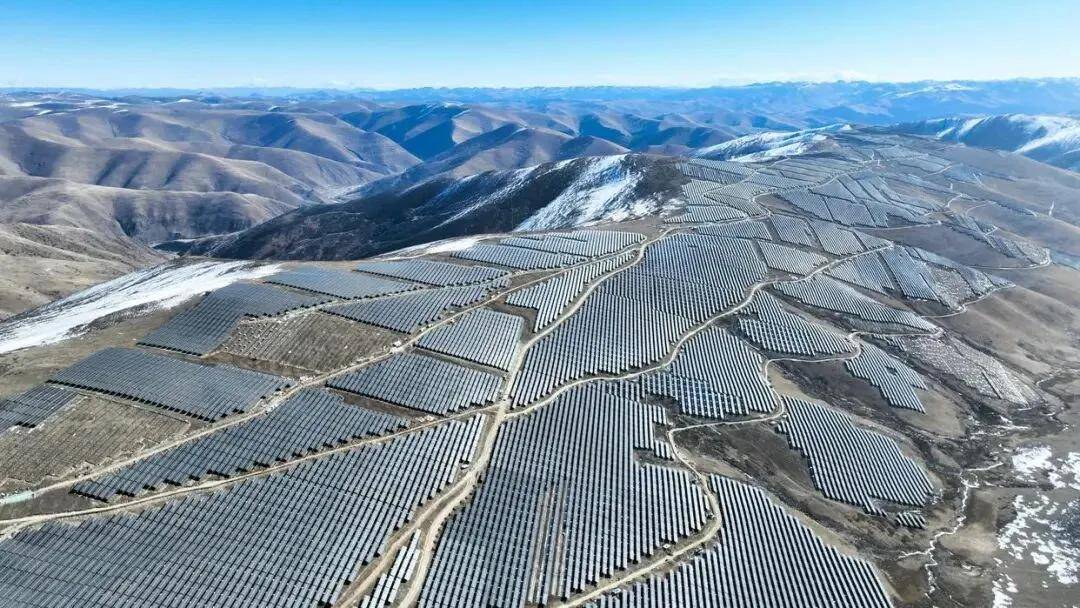
四川雅砻江两座百万千瓦光伏电站同步投产发电
Zhong Guo Xin Wen Wang· 2026-01-04 01:58
Core Viewpoint - The simultaneous commissioning of the 1 million kW solar power stations, Suorong and Chaburang, marks a significant step in the development of the world's largest water-solar complementary project, which aims to enhance the stability and reliability of renewable energy generation in China [1][2]. Group 1: Project Details - The Suorong Solar Power Station is located in Litang County, Garze Prefecture, Sichuan Province, with an installed capacity of 1 million kW [1]. - The Chaburang Solar Power Station is situated in Muli County, Liangshan Prefecture, Sichuan Province, also with an installed capacity of 1 million kW, and is noted as the largest ultra-high-altitude mountain solar project in China [1]. - The project site for Chaburang ranges from 4150 meters to 4700 meters above sea level, featuring steep terrain with some slopes exceeding 30 degrees, making it one of the most challenging ultra-high-altitude solar projects in the country [1]. Group 2: Technological Innovations - To address the challenges of steep terrain, the project has innovatively introduced "flexible support" technology, allowing solar panels to be installed on steel cables that can traverse complex landscapes [2]. - The project has also implemented an "aerial passage" solution using drones for transporting solar components, achieving a 2.5 times increase in efficiency compared to traditional manual transportation methods [2]. Group 3: Future Developments - With the commissioning of the Suorong and Chaburang solar power stations, the integrated water-solar-wind energy base in the Yalong River Basin has nearly 23 million kW of clean energy capacity in operation and approximately 12 million kW under construction [2]. - The Yalong River Basin Hydropower Development Company aims to leverage its advantages in hydropower development to further explore integrated development, joint scheduling, and market absorption of renewable energy [2].
我国首个水风光一体化基地两座百万千瓦光伏电站同步投产
Xin Lang Cai Jing· 2026-01-01 11:33
Core Insights - The Yalong River Basin has accelerated the construction of the first integrated water, wind, and solar energy base in China, with two solar power stations, Yalongjiang Suolong and Chaburang, set to start operations on December 31, 2025, contributing significantly to the new energy system and national energy security [1][2] Group 1: Project Details - The Suolong Solar Power Station, located in Ganzi Prefecture, Sichuan, has a capacity of 1 million kilowatts, while the Chaburang Solar Power Station, located in Muli County, Liangshan Prefecture, also has a capacity of 1 million kilowatts, making it the largest ultra-high-altitude mountain solar project in China [1] - Together with the Kela Phase I and II solar power stations and the Lianghekou Hydropower Station, these projects form the world's largest water-solar complementary project with a total capacity of 3 million kilowatts for hydropower and 3 million kilowatts for solar power [1] Group 2: Environmental Impact - The two solar power stations are expected to generate approximately 3.9 billion kilowatt-hours of clean electricity annually, saving about 1.2 million tons of standard coal and reducing carbon dioxide emissions by approximately 3.1 million tons each year [1] - The Yalong River Basin has established the three largest reservoirs in Sichuan Province, with a total storage capacity of 24.9 billion cubic meters and a regulation capacity of 14.8 billion cubic meters, accounting for 51% of the total regulation capacity of large reservoirs in the province [2]
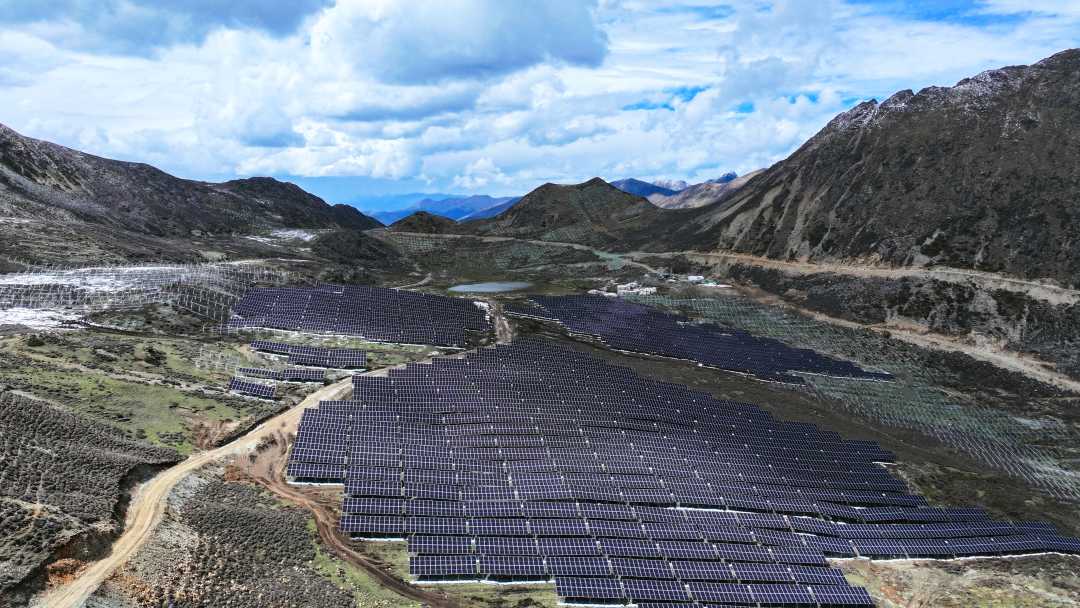
两座百万千瓦光伏电站同步投产!
中国能源报· 2026-01-01 09:59
Core Viewpoint - The simultaneous commissioning of two 1 million kilowatt photovoltaic power stations in the Yalong River Basin marks a significant advancement in the integrated development of water, wind, and solar energy in the region [1][3]. Group 1: Project Details - The Yalong River Suorong Photovoltaic Power Station and the Chaburang Photovoltaic Power Station, each with an installed capacity of 1 million kilowatts, are set to begin operations by December 31, 2025 [3]. - The Suorong Photovoltaic Power Station is located in Litang County, Garze Tibetan Autonomous Prefecture, Sichuan Province, while the Chaburang Photovoltaic Power Station is situated in Muli County, Liangshan Yi Autonomous Prefecture, Sichuan Province [5]. Group 2: Environmental Impact - The two photovoltaic power stations are expected to generate approximately 3.9 billion kilowatt-hours of clean electricity annually, which will save about 1.2 million tons of standard coal and reduce carbon dioxide emissions by approximately 3.1 million tons each year [7]. - With the commissioning of these two power stations, the Yalong River Basin's integrated water and solar energy base has nearly 23 million kilowatts of clean energy capacity in operation and about 12 million kilowatts under construction [7].

雅砻江流域水风光一体化基地计划2035年建成
Yang Shi Xin Wen· 2025-12-31 21:11
Core Insights - The Yarlung Tsangpo River Basin Integrated Water and Wind Power Base is the first of its kind in the country, with a planned installed capacity of 78 million kilowatts, aiming for full completion by 2035 [1] - Currently, the base has nearly 23 million kilowatts of installed capacity in operation and about 12 million kilowatts under construction [1] - The base includes three major reservoirs with a total regulation capacity of 14.8 billion cubic meters, facilitating large-scale and intensive development of wind and solar energy [1] Group 1 - The Yarlung Tsangpo base will effectively coordinate the construction and operation of 30 large hydropower stations, pumped storage power stations, and 40 million-kilowatt-level wind and solar power stations [3] - Once completed, the base is expected to contribute approximately 200 billion kilowatt-hours of clean electricity annually, sufficient to meet the annual electricity needs of 110 million households [3]

中国最大超高海拔山地光伏电站投产发电
Zhong Guo Xin Wen Wang· 2025-12-31 06:24
Core Viewpoint - The Yalong River Chaburang Photovoltaic Power Station, China's largest ultra-high-altitude mountain solar power station, officially commenced operation on December 31, 2025, with a total installed capacity of 1 million kilowatts [1][3]. Group 1: Project Details - The Yalong River Chaburang Photovoltaic Power Station is located in Muli County, Liangshan Yi Autonomous Prefecture, Sichuan Province, with an elevation ranging from 4,150 meters to 4,700 meters [3]. - The project is recognized as one of the most challenging ultra-high-altitude solar projects in China due to its steep terrain, with some slopes exceeding 30 degrees [3][5]. - Innovative "flexible support" technology was introduced to address construction challenges on steep slopes, allowing solar panels to be installed on steel cables that can traverse complex terrains [3]. - To tackle transportation difficulties in high-altitude areas, the project utilized an "aerial passage" solution, employing drones to transport solar components, achieving a 2.5 times increase in efficiency compared to traditional manual handling [3][5]. Group 2: Related Projects and Capacity - On the same day, the Yalong River Suorong Photovoltaic Power Station, also with an installed capacity of 1 million kilowatts, began operations [5]. - The Suorong station will work in conjunction with the Kela Phase I and II photovoltaic stations and the Lianghekou Hydropower Station to form the world's largest water-solar complementary project, totaling 3 million kilowatts of hydropower and 3 million kilowatts of solar power [5]. - As of now, the Yalong River basin's integrated wind-solar-hydro base has nearly 23 million kilowatts of clean energy capacity in operation, with an additional 12 million kilowatts under construction [5].
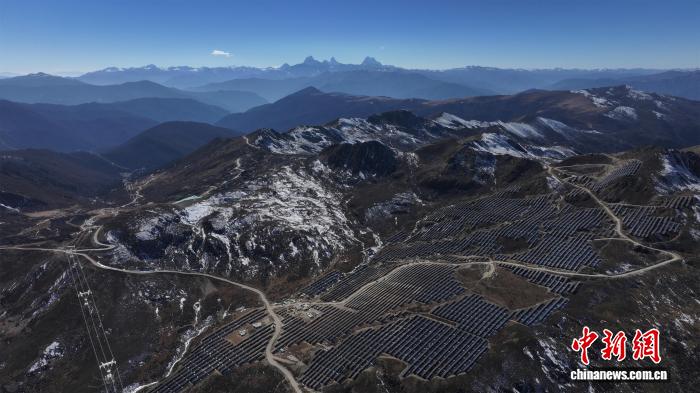
雅砻江流域水风光一体化基地两座百万千瓦光伏电站同步投产
Xin Hua She· 2025-12-31 03:04
Core Insights - The Yalong River region has accelerated the construction of integrated hydropower and solar energy bases with the simultaneous commissioning of two 1 million kilowatt solar projects, the Suolong and Chaburang solar power stations [1] Group 1: Project Details - The Suolong solar power station is located in Litang County, Garze Tibetan Autonomous Prefecture, Sichuan Province, with an installed capacity of 1 million kilowatts [1] - The Chaburang solar power station is situated in Muli County, Liangshan Yi Autonomous Prefecture, Sichuan Province, also with an installed capacity of 1 million kilowatts [1] - Together with the Ke La Phase I and II solar power stations and the Erhekou hydropower station, these projects form a complementary system of 3 million kilowatts of hydropower and 3 million kilowatts of solar power [1] Group 2: Environmental Impact - The two solar power stations are expected to generate approximately 3.9 billion kilowatt-hours of clean electricity annually, saving about 1.2 million tons of standard coal and reducing carbon dioxide emissions by approximately 3.1 million tons each year [1] Group 3: Overall Capacity - With the commissioning of these two solar power stations, the Yalong River integrated hydropower and solar energy base has nearly 23 million kilowatts of clean energy capacity in operation and about 12 million kilowatts under construction [1]
鹰眼视角带你云端俯瞰叶巴滩水电站大坝
Xin Lang Cai Jing· 2025-12-27 10:26
©2025中央广播电视总台版权所有。未经许可,请勿转载使用。 今天(27日),"十四五"规划重大工程、我国在建海拔最高的双曲拱坝电站——叶巴滩水电站首批两台 机组正式投产发电,标志着金沙江上游"水风光"一体化基地建设取得重要进展。别眨眼,鹰眼视角带你 在云端俯瞰叶巴滩水电站大坝。 ...
四川率先迈入水电“亿千瓦时代”
Xin Lang Cai Jing· 2025-12-21 18:36
年发电量可满足约5亿人一年的生活用电需求 多能互补协同发展 12月19日,随着金沙江银江水电站全面投产发电,四川水电装机容量正式突破1亿千瓦,在全国省份中 率先迈入水电"亿千瓦时代"。1亿千瓦有多大?约占全国水电装机总量的四分之一,相当于约4.4个三峡 电站。 "亿千瓦"意味着什么? 1亿千瓦装机年发电量预计可达4000亿千瓦时,足以满足约5亿人口一年的生活用电需求。 "这意味着四川在全国确立了清洁能源强省的核心地位。"中国储能协会秘书长刘勇评价道,"这也证明 流域梯级开发取得了重大的阶段性成果,四川建设巨型水电工程的技术实力已经十分领先。" 从70千瓦到1亿千瓦 四川水电的百年发展史,是中国能源百年建设的缩影。 1925年,泸州洞窝水电站发出四川第一度水电,装机仅70千瓦。1978年,装机70万千瓦的龚嘴水电站全 面建成投产,推动四川迈入"大水电"时代。1998年,二滩水电站投产,成为中国首个突破300万千瓦装 机的电站。 进入21世纪,在国家西部大开发和西电东送战略推动下,金沙江、雅砻江、大渡河"三江"流域水电开发 全面展开。溪洛渡、白鹤滩、锦屏、两河口等世界级水电站相继建成,四川水电开发按下"快进键"。 ...
“水电王国”四川 率先迈进“亿千瓦”时代丨川报早读
Xin Lang Cai Jing· 2025-12-19 22:31
Core Insights - Sichuan province has officially surpassed 100 million kilowatts in hydropower installed capacity, becoming the first province in China to enter the "100 million kilowatt" era in hydropower generation [1][4] - This capacity is equivalent to 4.4 Three Gorges dams, with an annual generation potential of 400 billion kilowatt-hours, sufficient to meet the electricity needs of 500 million people for a year or power 178 million electric vehicles for a year [1] - Sichuan's hydropower development has grown over 700,000 times since the first hydropower station was established, showcasing its significant advancements in hydropower engineering technology [1][8] Resource Endowment and Historical Development - Sichuan has the largest technically exploitable hydropower resources in China, estimated at approximately 148 million kilowatts [1] - The province's hydropower development began slowly in the early years of the People's Republic of China, with significant milestones achieved from 1978 to 1999, marking the transition to a "large hydropower" era [4] - Major hydropower stations, such as Gongzui and Ertan, were completed during this period, contributing to the rapid increase in installed capacity [4] Strategic Importance and Future Directions - The achievement of 100 million kilowatts is seen as a milestone for Sichuan, reinforcing its position as a clean energy hub in China and supporting the national "West-East Power Transmission" strategy [6] - Sichuan's clean energy structure is currently 85% hydropower, and the province aims to further integrate wind and solar energy into its energy mix, creating a "Wind and Solar Sichuan" [5][6] - Experts suggest that while hydropower development may face limitations, there remains 30-40% of exploitable capacity, with a shift towards more challenging upstream projects and energy storage solutions [4][5] Challenges and Considerations - The reliance on hydropower poses risks, particularly in extreme weather conditions, which can lead to significant fluctuations in energy supply [6][7] - Environmental concerns and high construction costs in ecologically sensitive areas present challenges for future hydropower development [7] - Balancing local electricity demand with the need to export power during peak periods is becoming increasingly complex, necessitating strategic planning and coordination at the national level [7]