
油价冲击

Search documents
复盘过去50年油价冲击
财联社· 2026-03-10 06:09
Core Viewpoint - The article discusses the recent volatility in major asset classes due to geopolitical tensions, particularly the joint attack by the US and Israel on Iran, leading to a significant surge in oil prices, marking one of the most intense price increases on record [1]. Group 1: Historical Context and Analysis - Wall Street strategists are analyzing various scenarios for the market and global economy, with a focus on the duration of oil price shocks and the response of central banks, particularly the Federal Reserve [2][3]. - Historical events that led to oil price surges include the 2022 Russia-Ukraine conflict, the 2003 Iraq War, the 1990 Gulf War, the 1979 Iranian Revolution, and the 1973 OPEC oil embargo [4]. - Kabra notes that three out of five oil shocks historically resulted in US economic recessions, with the last two occurring during periods of stronger economic resilience [5]. Group 2: Asset Performance Post-Oil Shock - Historical data indicates that during oil shock events, the US stock market tends to outperform international peers, and the US dollar typically strengthens [6]. - A table summarizes the average returns of major asset classes one week, three months, and six months after such events, showing oil with a one-week return of 9.90% and a three-month return of 33.20% [8]. Group 3: Federal Reserve's Role - The response of the Federal Reserve is crucial, as past experiences suggest that oil price shocks usually dissipate within three months, but the Fed's actions can significantly influence market dynamics [10]. - Recent trading in interest rate futures indicates that traders are betting on the likelihood of the Fed not lowering rates again this year due to rising oil prices, with some even speculating on potential rate hikes if inflation rises [10]. - Despite the oil price surge, long-term inflation expectations among investors have not shown significant volatility, suggesting a belief that the inflation impact may be temporary [11].


50 years of oil-price shocks have taught us that only 2 things matter to markets right now
MarketWatch· 2026-03-09 20:13
Core Viewpoint - The recent combined military actions by the U.S. and Israel against Iran have led to significant volatility across major asset classes, particularly resulting in one of the fastest increases in crude oil prices on record [1] Group 1: Market Impact - Major asset classes have experienced volatility due to geopolitical tensions [1] - Crude oil prices have seen a rapid spike, indicating heightened market sensitivity to geopolitical events [1]
2026年2月通胀数据点评:油价冲击与降息前景
Bank of China Securities· 2026-03-09 13:58
1. Report Industry Investment Rating - No industry investment rating is provided in the report [1][3] 2. Core Viewpoints of the Report - The monetary policy rate cut this year may be more flexible. If the oil price shock persists strongly, the rate cut may be postponed [1][3] - The CPI reading in February basically conforms to the characteristics of the month - shifting effect. The year - on - year increases of CPI and core CPI from January to February are close to those in December last year, but the month - on - month increase of core CPI in February and the cumulative month - on - month increase from January to February both reached the highest level in the same period since 2013. Attention should be paid to whether there is an acceleration sign in core CPI [3] - The oil price shock may affect the prospect of China's monetary policy rate cut this year. The oil price shock caused by the geopolitical situation in the Middle East has a certain impact on China's imported inflation. Although China has great potential to adjust the crude oil supply structure, the supply - chain adjustment may take a certain time [3] - The government work report of the Two Sessions in 2026 requires to promote the overall price level to turn positive from negative and the consumer price to rise reasonably and moderately by improving the total supply - demand relationship, so as to promote the virtuous cycle of the economy [3] - If the oil price shock lasts for a short time (within 1 - 2 months), it is expected to have little impact on the rhythm of China's monetary policy. However, if the oil price shock persists strongly, the policy rate cut this year may be later. If the key shipping routes for crude oil transportation are blocked due to geopolitical conflicts for a long time and the oil price remains at the recent high level, the central bank may wait until the adjustment of the imported crude oil supply chain is sufficient and the oil price has an obvious negative impact on the global economy and external demand before cutting the policy rate [3] - Overall, the report maintains the view in last week's weekly report that this year's monetary policy will be more flexible. China may conduct 1 - 2 policy rate cuts of 10BP each this year, and the persistence of the oil price shock may affect the timing of the rate cut [3] 3. Summary by Related Catalog Inflation Data - The CPI reading in February basically conforms to the month - shifting effect. The year - on - year increases of CPI and core CPI from January to February are similar to those in December last year. The month - on - month increase of core CPI in February and the cumulative month - on - month increase from January to February are the highest in the same period since 2013 [3] Oil Price Impact on Monetary Policy - China imported about 42% of its total crude oil from six Gulf countries (Saudi Arabia, Iraq, Oman, Kuwait, the UAE, and Qatar) in 2025. The oil price shock caused by the geopolitical situation in the Middle East has an impact on China's imported inflation [3] - A short - term oil price shock (1 - 2 months) has little impact on China's monetary policy rhythm, while a long - term shock may postpone the policy rate cut. The central bank may wait for supply - chain adjustment and negative impacts on the global economy and external demand before cutting rates [3] Policy Outlook - The government work report of the Two Sessions in 2026 aims to promote price level recovery and economic virtuous cycle [3] - The report maintains the view that the monetary policy this year is more flexible, with 1 - 2 possible 10BP policy rate cuts, and the oil price shock may affect the timing [3]
美油日涨17%!欧天然气翻倍!国际油价正冲向“100大关”,后续走势及影响会如何发展?一文读懂
美股IPO· 2026-03-07 01:59
Core Viewpoint - The global energy market is experiencing significant turmoil, with oil prices surging dramatically due to geopolitical tensions, particularly the closure of Qatar's LNG facilities and potential disruptions in the Strait of Hormuz [1][13]. Group 1: Oil Price Surge - Brent crude oil prices increased by over 12% to $94, while WTI surged by 17%, marking a 35% weekly gain, the largest in history [1]. - Goldman Sachs warns that if the blockade continues for five weeks, oil prices could exceed $100 per barrel, with Qatar's energy minister predicting prices could reach $150 within two to three weeks [1][13]. - Macquarie's global energy strategist suggests that a closure of the Strait of Hormuz for several weeks could trigger a series of reactions, pushing oil prices to $150 or higher [3]. Group 2: Economic Implications - Investors are increasingly concerned that sustained high oil prices could lead to severe economic consequences, drawing parallels to the oil price shocks of the 1970s that resulted in stagflation [3]. - Goldman Sachs has set a target oil price of $76 for Q2 but acknowledges that the risks are skewed to the upside, depending on the duration of the blockade [3]. - If oil prices rise above $100, it could lead to inflationary pressures similar to those seen after the outbreak of the Russia-Ukraine conflict, with potential consumer price increases of up to 9% [6][7]. Group 3: Market Reactions - Morgan Stanley's chief investment officer indicates that a rise to $100 per barrel could disrupt bullish market sentiments, primarily due to oil's impact on economic growth [8]. - Historical data suggests that oil price increases of 75%-100% often correlate with poor stock market performance [9]. - The closure of the Strait of Hormuz, a critical passage for about 20% of global oil flow, has led to significant supply chain disruptions, prompting countries like Saudi Arabia to reroute oil shipments [11][12]. Group 4: LNG Market Impact - The LNG market is also directly affected, with Qatar's LNG export facilities closing due to drone attacks, impacting global supply [15]. - The supply-side pressures are prompting discussions within the EU regarding the potential re-evaluation of Russian gas import bans [17][18].
油价暴涨后,后续怎么走?一文读懂
财联社· 2026-03-07 01:28
Core Viewpoint - The ongoing conflict between the U.S. and Iran has significantly impacted oil production in the Middle East, leading to a surge in international oil prices, with both WTI and Brent crude experiencing their largest weekly gains on record since 1983 and 1991 respectively [1][3]. Oil Price Impact - Brent crude oil rose over 8% and WTI crude futures increased by more than 12%, both surpassing $90 per barrel, raising concerns about potential severe economic consequences if high oil prices persist [3]. - Historical comparisons are being made to the oil price shocks of the 1970s, which led to stagflation, indicating that current price levels could trigger similar economic issues [3]. Market Predictions - Macquarie's global energy strategist Vikas Dwivedi expressed confidence that without a ceasefire, the oil market could collapse within days, potentially pushing prices above $150 per barrel if the Strait of Hormuz remains closed for weeks [5]. - Goldman Sachs analysts set a target oil price of $76 per barrel for Q2 but acknowledged the risk of prices exceeding $100, depending on the duration of the Strait's closure [5]. Economic Consequences of Price Levels - Analysts suggest that if oil prices exceed $80 and remain elevated, it could lead to increased inflation expectations [7]. - A price of $100 per barrel could signify a genuine oil shock, potentially causing inflation rates to rise and hindering the Federal Reserve's ability to lower interest rates, increasing the risk of stagflation [9][10]. - Morgan Stanley's chief investment officer noted that a rise to $100 per barrel could disrupt bullish market sentiments due to its adverse effects on economic growth [11]. Severe Price Thresholds - Marathon Asset Management's CEO indicated that oil prices reaching $120 per barrel could trigger a recession in the U.S., with such levels likely leading to a stagnation in economic growth [12]. - Nobel laureate Paul Krugman predicted that a spike to $120 could raise overall inflation by approximately 1 percentage point and exacerbate recession risks, although he does not believe that oil price volatility alone would lead to uncontrolled inflation [12].


刚刚,伊朗确定最高领袖候选人!以军,发动大规模袭击!
券商中国· 2026-03-04 10:14
Group 1 - Iran has identified several candidates for the Supreme Leader position, with an election expected to take place soon [1][2] - The Israeli Defense Forces have initiated a new wave of large-scale attacks on targets in Tehran, Iran [5] - An Iranian naval ship, the "Dena," encountered difficulties in the waters south of Sri Lanka, with 35 crew members rescued so far [5] Group 2 - The Iranian Assembly of Experts is responsible for electing, supervising, and dismissing the Supreme Leader, highlighting its significant political role [4] - The election process for the Supreme Leader is reportedly in its final stages, with security measures in place to ensure a smooth voting process [3]

Stock Volatility Surges as U.S.-Iran Conflict Stokes Oil Price Shock Fears
Barrons· 2026-03-03 12:34
Core Viewpoint - Wall Street's recent rally has been overshadowed by rising concerns regarding the potential impact of U.S. military actions against Iran on global energy markets [1] Group 1: Market Reactions - The rally observed on Wall Street has been interrupted by fears related to geopolitical tensions [1] - Investors are increasingly wary of how U.S. attacks on Iran could disrupt energy supply chains [1] Group 2: Energy Market Implications - The potential for increased volatility in global energy prices is a significant concern among market analysts [1] - Analysts are monitoring the situation closely, as any escalation could lead to substantial shifts in oil and gas prices [1]

这一次不一样?美军“最早本周末打击伊朗”,油价会如何?
Hua Er Jie Jian Wen· 2026-02-19 02:36
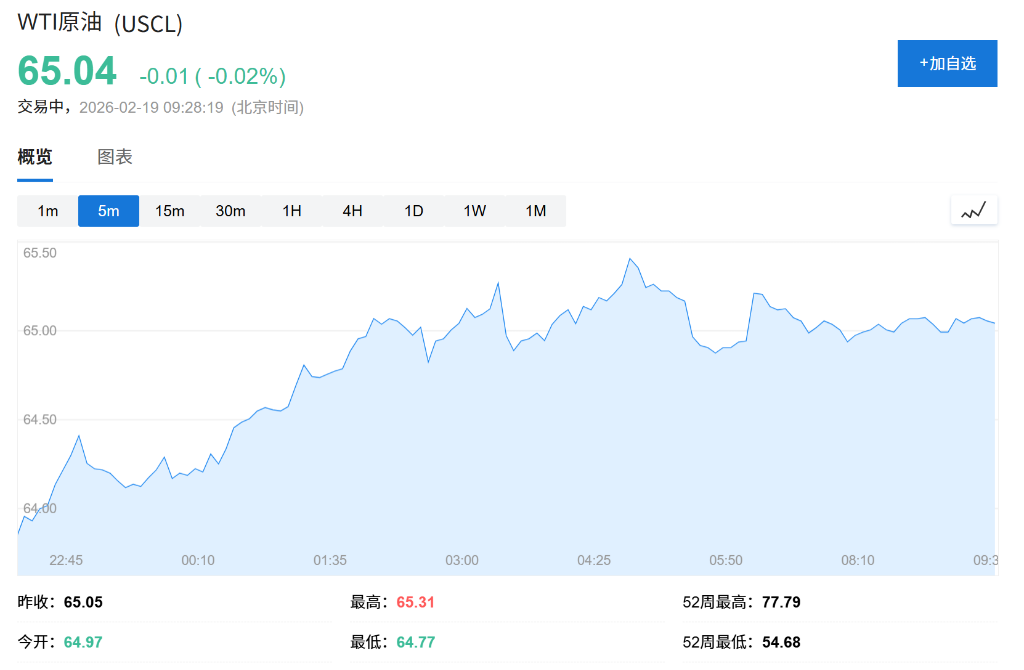
Group 1 - The core viewpoint of the articles highlights the escalating tensions between the US and Iran, leading to a significant increase in oil prices due to potential military actions [1][3] - The US military has assembled the largest air force presence in the Middle East since the 2003 Iraq War, with operations expected to last several days to weeks [3][4] - Oil prices have surged, with WTI crude oil rising by 5% to $65.04 per barrel, and various scenarios predicting further increases based on potential disruptions to Iranian oil exports [1][7] Group 2 - Four main scenarios are being assessed regarding oil supply disruptions: 1. A blockade of Iranian oil exports could disrupt up to 1.6 million barrels per day, potentially raising prices by $10-12 [7] 2. Iranian interference in oil transport through the Strait of Hormuz could affect up to 18 million barrels per day, pushing prices above $90 [8] 3. Direct attacks on Iranian oil facilities could lead to prices exceeding $100 due to long-term supply impacts [8] 4. Iranian attacks on Gulf oil facilities could result in historic price spikes above $130 [8] - Market skepticism exists regarding the likelihood of military action by the Trump administration, especially in an election year where domestic oil prices are a concern [9]
石油ETF(561360)大涨3%,地缘局势紧张,市场进入新一轮“油价冲击”?
Sou Hu Cai Jing· 2026-01-26 03:11
Core Viewpoint - The oil and gas sector is experiencing heightened activity due to international geopolitical conflicts, particularly involving the U.S. actions against Venezuela and potential military actions against Iran, both of which are major oil producers, leading to concerns over oil supply fluctuations and rising oil prices [1]. Group 1: Geopolitical Impact - The U.S. has escalated tensions with Iran by canceling all talks and advising allies to withdraw, causing significant volatility in the global energy market [1]. - Venezuela, holding the world's largest proven oil reserves, has seen its oil exports nearly halted due to U.S. military actions, creating short-term supply disruptions in the global market [1]. Group 2: Domestic Oil Companies' Strategies - Domestic oil companies are reducing their sensitivity to oil price fluctuations through upstream and downstream integration, while also seeking diversified sources of crude oil supply and exploring overseas investment opportunities [3]. - Companies are focusing on domestic resource exploration and development to ensure stable resource supply [3]. Group 3: Oil Market Fundamentals - Oil supply growth is expected to slow significantly due to OPEC+ halting production increases, limited capital expenditure in U.S. shale oil, and production constraints on Russia due to sanctions [4]. - Demand is showing a moderate structural recovery, primarily driven by India, the Middle East, and China, with jet fuel and petrochemical demand expected to outperform gasoline consumption affected by renewable energy alternatives [4]. - The global oil market is anticipated to exhibit a "weak balance recovery" pattern, with significantly slowed supply growth and moderate demand recovery, which may support rising oil prices [4]. Group 4: Dividend Characteristics - The oil and gas sector is characterized by high dividend yields, with stable cash dividends in recent years, making it attractive in a declining interest rate environment and amid external uncertainties [4]. - Projected dividend yields and total cash dividends for upcoming years are as follows: - 2025: 3.45%, 125.847 billion - 2024: 4.20%, 135.578 billion - 2023: 4.40%, 121.462 billion - 2022: 5.74%, 106.990 billion - 2021: 4.14%, 66.251 billion [5].
美联储主席鲍威尔:任何油价冲击都取决于事实和环境,美国石油行业更加谨慎,专注于回报。
news flash· 2025-06-24 15:29
Core Insights - The Federal Reserve Chairman Jerome Powell stated that any oil price shocks will depend on facts and circumstances, indicating a cautious approach from the U.S. oil industry focused on returns [1] Industry Summary - The U.S. oil industry is becoming more cautious and is prioritizing returns over aggressive expansion [1]