
煤炭供需平衡

Search documents
年末供应收缩叠加需求回暖,价格底部区间逐步确认
Datong Securities· 2025-12-30 12:57
Investment Rating - The industry investment rating is "Positive" [1] Core Viewpoints - The report indicates that the supply contraction at the end of the year, combined with a recovery in demand, is gradually confirming the price bottom range [1] - The report highlights that the thermal coal price continues to decline but at a reduced rate, with pessimistic sentiment gradually being released. After the New Year, low temperatures in the central and eastern regions are expected to boost heating demand, alongside supply contraction and policy support expectations, leading to a potential stabilization of coal prices [8][9] - Coking coal prices are stable with support, despite weak short-term demand. The report anticipates a narrow fluctuation in prices, supported by low inventory levels and supply contraction, with winter storage replenishment expected to start after the New Year [21][22] Summary by Sections Market Performance - The A-share market showed a significant increase with an average daily trading volume of 1.95 trillion yuan, indicating a clear recovery in market sentiment. The coal sector underperformed compared to the Shanghai Composite Index and the CSI 300 [4][6][36] - The coal sector's weekly performance showed a decline of 0.68%, closing at 2772.29 points, with notable fluctuations among individual coal companies [4][6] Thermal Coal - The report notes a continued decline in thermal coal prices, with the Qinhuangdao port price for Q5500 thermal coal reported at 672 yuan/ton, down 31 yuan/ton week-on-week. The supply side is tightening due to safety inspections and production limits, while demand is showing marginal improvement [8][9][10] - The report indicates that the utilization rate of sample thermal coal mines has dropped to 86.4%, a decrease of 4.0 percentage points week-on-week [8] Coking Coal - Coking coal prices have remained stable, with premium coal types showing notable price increases. The report anticipates that despite weak short-term demand, the combination of low inventory levels and supply contraction will support prices [21][22] - The average price for main coking coal at the port is reported at 1740 yuan/ton, reflecting a recovery trend [23] Shipping Situation - The number of anchored vessels in the Bohai Rim increased, with an average of 67 vessels per day, indicating a rise in shipping activity. Shipping prices showed differentiated changes across routes [30][31] Industry News - Significant breakthroughs in coal exploration in Shandong province were reported, with over 10 billion tons of coal discovered. This is part of a broader initiative to enhance geological technology and promote high-quality development in the coal sector [33] - The report also highlights the upcoming national coal production and transportation coordination conference aimed at improving efficiency in coal supply chains [33]
煤炭供需弱平衡,政策或利于红利布局
Datong Securities· 2025-12-09 05:45
证券研究报告——煤炭行业周报 【2025.12.1-2025.12.7】 行业评级:看好 核心观点 发布日期:2025.12.9 煤炭行情走势图 数据来源:Wind 大同证券 分析师:刘永芳 执业证书编号:S0770524100001 煤炭供需弱平衡,政策或利于红利布局 liuyongfang@dtsbc.com.cn 西世贸中心 A 座 F12、F13 网址:http://www.dtsbc.com.cn 风险提示 终端需求大幅回落,板块轮动加快,板块突发利空。 请务必阅读最后一页免责声明 1 动力煤供给基本稳定,期待需求释放。本周,煤炭主产区供应 量基本稳定,由于终端需求不及预期,煤价继续回调,市场观 望情绪浓烈,随着供暖需求释放,煤价有望企稳回升。 焦煤需求压缩,预计煤价震荡运行。本周,焦炭首轮提降落地, 需求进一步压缩,导致煤价继续承压运行,随着下游冬储补库 需求释放、国内煤矿供应低位,预计煤价震荡运行。 权益市场涨跌互现,煤炭跑赢指数。美股科技继续反弹,外部 流动性宽松预期支撑风险资产;我国金融监管总局调整险资投 资股票的风险因子,预计将为 A 股带来超千亿元增量资金;证 监会放宽券商杠杆限制、起草 ...
浙商证券:煤炭需求仍有韧性 价格中枢抬升
智通财经网· 2025-12-01 07:49
Core Viewpoint - The coal supply is expected to peak in 2025 and then decline, with resilient demand leading to a V-shaped price recovery. The outlook for 2026 indicates stable domestic economic conditions, with a potential increase in coal prices due to balanced supply and demand dynamics [1][5]. Group 1: Supply Overview - In 2025, the national raw coal production reached 3.973 billion tons from January to October, showing a year-on-year increase of 1.5%. The production trend is characterized by a peak in the first half of the year followed by a decline in growth from July to October [2]. - Coal imports from January to October 2025 totaled 388 million tons, a decrease of 11% year-on-year, with negative growth observed from March onwards [2]. Group 2: Demand Analysis - The total coal consumption in China from January to October 2025 was approximately 4.24 billion tons, reflecting a slight year-on-year increase of 0.1%. The growth was primarily driven by strong demand in the chemical and steel sectors [3]. - By sector, chemical coal consumption was 360 million tons (up 10.9% year-on-year), steel coal consumption was 590 million tons (up 0.2% year-on-year), while construction materials and power coal consumption saw declines [3]. Group 3: Price Trends - Coal prices experienced a V-shaped recovery, with prices for thermal coal, coking coal, and anthracite starting at 767, 1520, and 980 yuan per ton respectively at the beginning of the year, dropping to lows of 609, 1230, and 820 yuan per ton, and rebounding to 816, 1670, and 930 yuan per ton by November 28 [4]. Group 4: 2026 Outlook - The policy environment in 2026 will focus on balancing production limits with supply stability, with measures to ensure orderly supply and energy security [5]. - Coal consumption is projected to reach 4.95 billion tons in 2026, a year-on-year increase of 1%, with growth primarily driven by the electricity and chemical sectors [7]. - Production is expected to slightly increase to 4.87 billion tons in 2026, with demand growth anticipated to outpace supply growth, leading to a potential increase in coal price levels [7].

调节供需动态平衡,维持煤价合理区间
Hua Tai Qi Huo· 2025-11-30 08:42
Report Industry Investment Rating - Not provided in the content Core Viewpoints - In 2025, the coal price showed a V-shaped trend. The price rebounded after hitting the bottom in July, and the current thermal coal price has exceeded the beginning - of - year level and reached the upper limit of the reasonable price range [6][21]. - In 2025, coal production was affected by policies, and imports decreased year - on - year. The demand from the power, chemical, metallurgical, and building materials industries showed different trends. In 2026, the overall coal supply and demand will remain basically balanced, with possible seasonal mismatches. The coal price may fluctuate, but it will remain within a reasonable range in the medium - and long - term [5][104]. Summary by Directory 1. Introduction - Coal price fluctuations in the past decade were mainly due to the contradiction between growing consumption and periodic supply mismatches, with policy changes playing a key role. In 2025, coal prices rebounded after the introduction of anti - involution policies and over - production inspections [18]. 2. 2025 Review of the Thermal Coal Market - In 2025, the coal price showed a V - shaped trend. In the first half of the year, due to increased production and weak demand, prices dropped significantly. After July, with policy intervention, prices rebounded [21]. 3. 2025 Analysis of Thermal Coal Supply 3.1 Super - production Inspections Restrained Supply, and Raw Coal Output Increased Slightly - In the first half of 2025, coal policies were relatively loose, and production increased significantly. After July, with the implementation of anti - involution policies and over - production inspections, production was controlled. From January to October 2025, the national raw coal cumulative output was 3.973 billion tons, a year - on - year increase of 2.1% [26][27]. 3.2 The Transportation of Xinjiang Coal Became More Critical, and Costs Restricted the Growth Scale - Xinjiang will be a key area for coal supply, and the scale of Xinjiang coal transportation will be an important marginal variable affecting supply. However, transportation costs limit its economic viability. From January to October 2025, the railway transportation volume of Xinjiang coal reached 81 million tons, a year - on - year increase of 6.9% [36][37]. 3.3 The Sharp Decrease in Imports from Indonesia Affected the Performance of Imported Coal - In the first half of 2025, coal imports were in a difficult situation. After July, imports gradually recovered, but the overall volume from January to October decreased by 11% year - on - year. Imports from different countries showed different trends [39]. 4. 2025 Analysis of Thermal Coal Demand 4.1 Thermal Power Played a Major Role in Power Generation, and Coal Consumption in the Power Industry Decreased Slightly - In 2025, new energy sources squeezed the market share of thermal power in the first half of the year, but thermal power gradually regained strength in the second half. From January to October 2025, the cumulative thermal power generation of large - scale enterprises was 5,213.1 billion kWh, a year - on - year decrease of 0.19%. From January to September, the cumulative coal consumption in the power industry was 1.948 billion tons, a year - on - year decrease of 0.9% [55][57]. 4.2 The Prosperous Development of the Chemical Industry Drove a Significant Increase in Coal Consumption - The coal - chemical industry developed rapidly during the "14th Five - Year Plan" period. From January to September 2025, the cumulative coal consumption in the chemical industry was 247 million tons, a year - on - year increase of 17.2% [70]. 4.3 The Metallurgical Industry Increased Coal Consumption, and the Drag of the Building Materials Industry on Coal Consumption Eased - In 2025, the metallurgical industry outperformed expectations, driving an increase in coal consumption. The building materials industry was still at the bottom of the cycle, but the decline in coal consumption narrowed. From January to September, the cumulative coal consumption in the metallurgical and building materials industries was 130 million tons (a year - on - year increase of 1.2%) and 186 million tons (a year - on - year decrease of 4.6%) respectively [74]. 5. 2025 Analysis of Thermal Coal Inventory - In 2025, the thermal coal inventory remained high - level volatile. In the first half of the year, high inventory was not effectively reduced, and in the second half, inventory decreased compared to the same period last year [81]. 6. 2026 Deduction of Thermal Coal Supply 6.1 Expecting Active Policies to Dynamically Adjust Coal Supply - In 2026, domestic coal supply is still uncertain, and policies will be decisive. Overall, coal supply will maintain moderate growth, but production rhythm may have a greater impact on prices [87]. 6.2 Overseas Supply Is Not Optimistic, and Imports Will Play a Regulatory Role - In 2026, the coal import situation may still be challenging. Indonesia plans to reduce production and increase export restrictions, Russia's coal export is restricted by sanctions, and imports from other countries also face various problems. Overall, imports will likely have a slight increase and play a regulatory role [89]. 7. 2026 Deduction of Thermal Coal Demand 7.1 The Power Market Will Continue to Expand, and Coal - fired Power Consumption Has Not Peaked - In 2026, coal consumption is likely to continue to grow. Although the proportion of thermal power will decline in the long - term, the absolute amount will increase in the short - term [96]. 7.2 The Chemical Industry Will Increase Coal Consumption, and the Drag of the Building Materials Industry Will Continue to Ease - In 2026, the chemical industry will still be the main source of increased coal consumption. The metallurgical industry will maintain slight growth, and the drag of the building materials industry on coal consumption will further weaken [99]. 8. 2026 Deduction of Thermal Coal Price - In 2026, coal supply and demand will be basically balanced, but seasonal mismatches may still exist. Coal prices may fluctuate, but will remain within a reasonable range in the medium - and long - term [104].
煤炭开采行业10月数据全面解读:10月供需缺口显著,煤价大幅上涨
Guohai Securities· 2025-11-16 15:22
Investment Rating - The report maintains a "Buy" rating for the coal mining industry [1] Core Views - The coal mining industry is experiencing a tightening supply due to reduced production and imports, with October coal production down 2.3% year-on-year, and imports down 9.76% [6][25] - Demand has significantly improved in October, primarily driven by increased coal consumption in thermal power and chemical industries, while the construction and metallurgy sectors have shown a decline [6][26] - The report highlights a notable increase in coal prices, with port prices rising by 56 yuan/ton in October, reflecting the improved supply-demand dynamics [10][11] Supply Side Summary - Coal production in October was 407 million tons, a decrease of 2.3% year-on-year, with daily production averaging 13.12 million tons, down 596,000 tons from the previous month [4][19] - The decline in production is attributed to maintenance, adverse weather, and stricter safety checks [6][19] - Coal imports in October were 41.74 million tons, down 9.76% year-on-year, with a cumulative import of 388 million tons from January to October, reflecting an 11.0% decrease [25][26] Demand Side Summary - Thermal power generation increased by 7.3% year-on-year in October, reversing a decline from September [6][26] - The total industrial electricity generation in October was 800.2 billion kWh, up 7.9% year-on-year, with a daily average of 25.81 billion kWh [5][18] - Chemical industry coal consumption rose significantly, with a year-on-year increase of 35.38% in October [10][26] Inventory Summary - By the end of October, coal inventories at production enterprises decreased by 135,000 tons, while inventories at northern ports increased by 432,000 tons [10][11] - The report notes that inland power plants have increased their coal inventories, indicating a trend towards replenishment as winter approaches [10][11] Investment Recommendations - The report suggests focusing on robust coal companies such as China Shenhua, Shaanxi Coal, and China Coal Energy, which exhibit strong cash flow and profitability [10][12] - It emphasizes the value attributes of the coal sector, particularly in light of the current market conditions and potential for price increases [10][11]






煤炭周报:预期扰动不改供弱需强格局,涨价动能持续-20251115
Minsheng Securities· 2025-11-15 09:13
Investment Rating - The report maintains a "Buy" recommendation for several companies in the coal sector, including Shanxi Coal International, Lu'an Environmental Energy, and Yanzhou Coal Mining [2][3][12]. Core Insights - The report highlights a strong demand-supply imbalance in the coal market, with prices expected to continue rising due to seasonal demand and regulatory constraints on supply [1][7][8]. - October saw a decrease in national raw coal production, with a daily average of 13.12 million tons, down 4.3% month-on-month [1][37]. - The report anticipates that coal prices may peak at around 1000 RMB/ton by the end of the year, driven by tight supply and increasing demand as winter approaches [1][8]. Summary by Sections 1. Weekly Insights - The report notes that seasonal demand is gradually being realized, with port coal prices continuing to rise and stabilizing in the latter half of the week [1][7]. - Regulatory inspections have led to a significant contraction in coal supply, particularly in regions like Ulanqab and Linfen [2][11]. 2. Market Performance - As of November 14, the coal sector's weekly decline was 0.8%, outperforming the broader market indices [14][17]. - The report identifies that the coking coal sub-sector experienced the highest weekly increase of 6.2% [17]. 3. Company Dynamics - The report recommends focusing on companies with high spot market exposure, such as Shanxi Coal International and Lu'an Environmental Energy, as well as stable growth companies like Jinko Coal and Huayang Co [12][21]. - Notable stock performance includes An Tai Group, which saw a significant increase of 57.29% in its stock price [21]. 4. Industry Developments - The report discusses the impact of international coal trade dynamics, including increased imports by India and Taiwan, which may influence domestic supply and pricing [25][35]. - It also highlights the ongoing safety inspections and regulatory measures that are expected to limit coal production capacity in the near term [1][26]. 5. Coal Data Tracking - The average price of Shanxi thermal coal remained stable at 682 RMB/ton, while coking coal prices increased slightly to 1484 RMB/ton [45].


煤价如期大涨,继续全面看好板块机会 (1)
2025-11-10 03:34
Summary of Coal Industry Conference Call Industry Overview - The coal industry is experiencing significant price increases, with domestic coal prices rising due to a surge in overseas coal prices, specifically a 3.3% increase in Australian coal prices and a 2.1% increase in Indonesian coal prices [1][3] - Despite the rise in overseas prices, the imported coal's landed price remains 50-100 RMB lower than the northern port prices, potentially exerting downward pressure on domestic coal prices [1][3] Key Points on Coal Prices - Northern nine ports have seen a significant year-on-year decrease in coal inventory, down 18% compared to 2023 and 12% compared to 2024, indicating that the inventory accumulation phase is not meeting expectations, which is a key driver for the current price increase [1][5] - The strong performance of coking coal is attributed to reduced imports from Mongolia, production cuts in Shanxi, and environmental reductions in Wuhai, leading to tight supply and expected price increases due to winter storage and steel production [1][6] - The stock performance of thermal coal companies has been robust, with leading Hong Kong thermal coal companies seeing price increases of 6%-10%, supported by favorable domestic and international factors [1][7][8] Supply and Demand Dynamics - The primary reasons for the continued rise in coal prices in 2025 include a significant reduction in imported coal (approximately 10 million tons year-on-year) and negative domestic production growth, compounded by seasonal demand not decreasing as expected and policy-driven supply contractions [1][9] - The current market dynamics suggest that if supply does not recover significantly, the supply-demand gap will widen in the fourth quarter, with prices potentially rising to 900-1,000 RMB if the situation does not improve [1][9][15] Challenges Faced by Traders and Power Plants - Traders are facing challenges due to the significant price gap between pit and port coal, leading to losses when shipping coal to ports, which diminishes their willingness to stockpile [1][10] - Power plants are struggling with procurement issues, as long-term contract prices are significantly lower than current market prices, leading to limited purchasing capabilities and potential rapid inventory depletion if demand increases [1][11] Future Outlook - The coal market is expected to maintain a tight supply situation, with limited immediate relief from increased imports or production from Xinjiang due to regulatory constraints [1][12][14] - The fourth quarter is anticipated to see a supply-demand gap comparable to 2020, when coal prices surged from 600 RMB to 1,000 RMB, indicating a potential for significant price increases [1][15] - Predictions for 2025 suggest an average price of around 700 RMB, with a confirmed upward trend for 2026, influenced by fourth-quarter performance [1][16] Investment Recommendations - Short-term investment strategies should focus on flexible varieties such as thermal and coking coal, with specific recommendations for companies like Liu'an Huanneng, Yanzhou Coal, Jinko Coal, and Shanxi International [1][17]
黑色金属周报:双焦:焦煤价格偏强运行,焦化利润维持低位-20251107
Hong Yuan Qi Huo· 2025-11-07 10:01
Report Information - Report Title: Black Metal Weekly - Coking Coal and Coke [1] - Date: November 7, 2025 [2] - Analyst: Bai Jing [2] Industry Investment Rating - Not provided in the report Core Viewpoints - For coking coal, the current supply recovery is slow due to factors such as underground issues and environmental protection, while downstream demand remains stable. With the successful third round of coke price increases and expectations of a fourth round, coking coal prices are strongly supported in the short - term, with an expected fluctuation range of 1200 - 1320 yuan/ton [7]. - For coke, both supply and demand have weakened recently. Although there is short - term support from coal supply constraints and cost factors, and the third round of price increases has been implemented with expectations of a fourth round, the narrowing profit of downstream steel mills may lead to price negotiations. Therefore, coke prices are expected to fluctuate in the short - term [46]. Summary by Sections Part 1: Coking Coal Price - As of October 23, the warehouse receipt price of Meng 5 raw coal was 1322 yuan/ton (-15), and that of Shanxi single coal was 1338 yuan/ton (+70). The warehouse receipt price of Canadian Lukin was 1302 yuan/ton (+98). The price of the coking coal main contract fluctuated narrowly, down 1.24% from the previous trading week, and the JM1 - 5 spread was -46.5 yuan/ton (+21.5) [5]. Fundamentals - Supply: In Shanxi, coal mines further reduced production this week, with a significant decline in production in the Lvliang area. Some state - owned large mines in the Liulin area also controlled production independently. The coking coal production of a large open - pit mine in Jiaokou stopped due to the expiration of the mining license. The开工 rate of 523 coking coal mines was 83.76%, a decrease of 1.02 percentage points, and the daily average clean coal output was 73.83 tons, a decrease of 2.01 tons [6]. - Demand: The molten iron output continued to decline this period, and the profit of the steel products end was in a larger loss. The short - term trend may remain weak. After the successful implementation of the coke price increase, the raw material market sentiment was optimistic, and most mines had sufficient pre - sales orders [6]. - Inventory: The clean coal inventory of the 523 - caliber steel union was 189.54 tons, a decrease of 15.87 tons. The price of imported Mongolian coal decreased slightly, with the price of Meng 5 raw coal dropping to about 1150 - 1170 yuan/ton [6]. Part 2: Coke Price - As of November 7, the CCI Rizhao quasi - first - grade metallurgical coke was reported at 1570 yuan/ton (-), the Rizhao Port quasi - first - grade coke warehouse receipt was 1715 yuan/ton (+11), and the port dry - quenched coke warehouse receipt was 1815 yuan/ton (+55). The price of the coke main contract fluctuated, down 1.15% from the previous trading week, and the J1 - 5 spread was -129.5 yuan/ton (+10) [44]. Fundamentals - Supply: Recently, affected by factors such as losses, environmental protection, maintenance, and tight coal resources, coke production has continued to shrink. After the third - round price increase was implemented, coke enterprises became more active in shipping. The capacity utilization rate of all - sample independent coke enterprises was 72.31%, a decrease of 1.13 percentage points, and the daily average output of all - sample independent coking plants was 63.59 tons, a decrease of 1 ton. The daily average output of 247 steel mill coking plants was 46.09 tons, a decrease of 0.12 tons [45]. - Demand: The molten iron output continued to decline this period, and the daily coke consumption decreased. The daily average molten iron output was 234.22 tons, a decrease of 2.14 tons [45]. - Inventory: The coke inventory of 247 steel mills was 633.16 tons, a decrease of 6.23 tons (1%). The coke inventory of all - sample independent coking plants was 58.3 tons, a decrease of 1.57 tons (2.6%). The coke inventory at ports was 202.11 tons, a decrease of 8.99 tons [45].
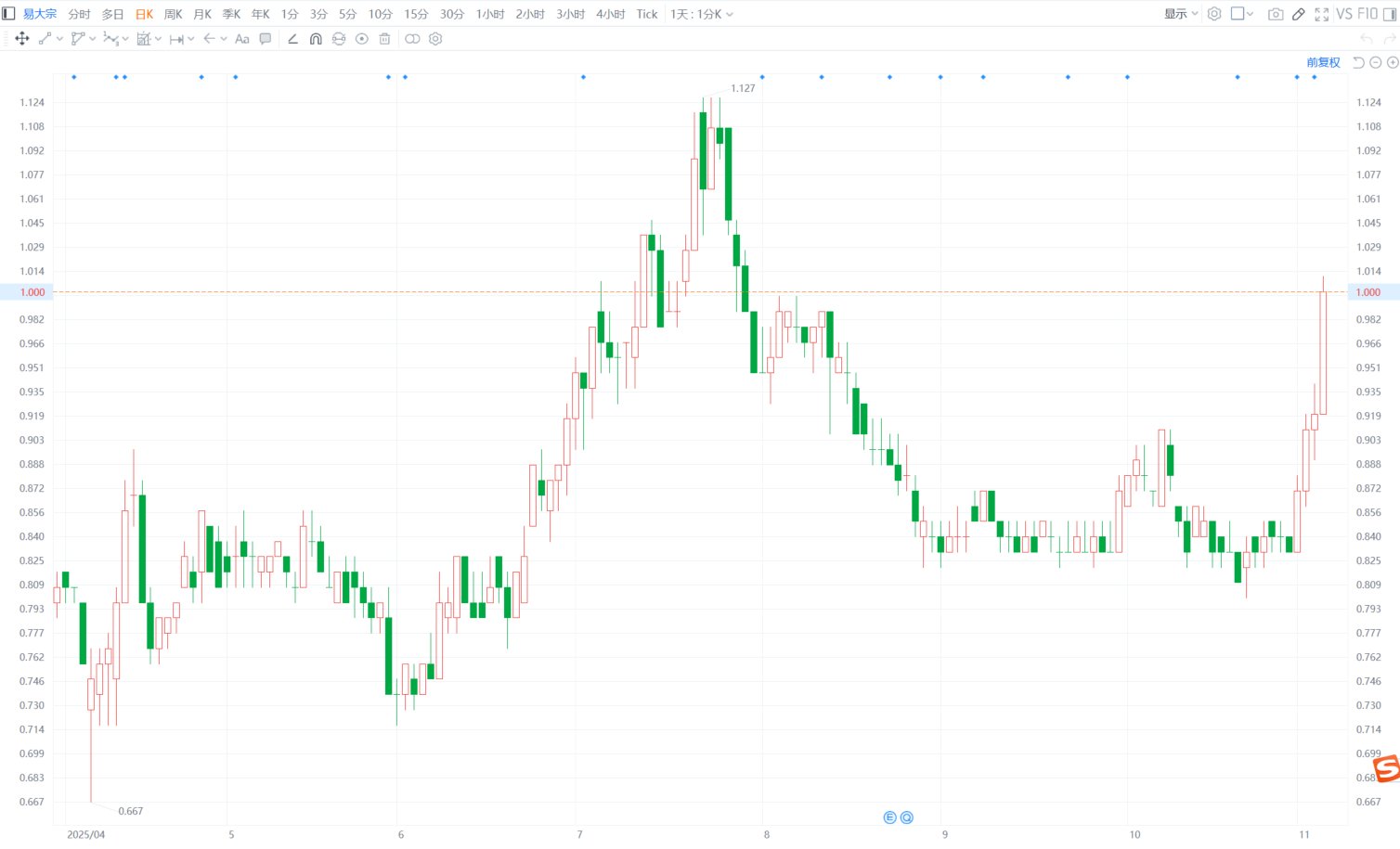
港股异动丨易大宗4日连升累涨超21% 股价创逾3个月新高
Ge Long Hui· 2025-11-06 08:00
Company - 易大宗 (1733.HK) shares increased by 9.78% to HKD 1.01, reaching a new high since July 31, with a market capitalization of HKD 2.696 billion [1] - The company has announced a strategic alliance with Bridge Mining Pte. Ltd., focusing on integrated coal mining, logistics, and marketing services, with a minimum monthly supply of 100,000 tons of coal products expected [1] - The official operation of this partnership is anticipated to commence on December 1, 2025, with plans to expand upstream resource cooperation and related washing and selection services in Mongolia [1] Industry - According to Guangfa Securities, the coal industry showed overall stabilization in Q3, with expectations for improved performance in Q4 as coal prices continue to rise [1] - The coal supply and demand situation has been favorable since Q3, particularly strong after the National Day holiday, driven by better-than-expected demand and a general decline in supply [1] - It is projected that coal prices will remain stable with a slight upward trend in Q4 and 2026, with medium to long-term demand expected to maintain resilient growth while supply remains constrained, leading to a balanced but slightly tight market [1]

煤炭行业周报(10月第3周):寒潮提升日耗,电厂采购推动第二轮行情-20251026
ZHESHANG SECURITIES· 2025-10-26 10:28
Investment Rating - The industry rating is "Positive" [1] Core Viewpoints - The cold wave has increased daily coal consumption, leading to a second round of market activity driven by power plant procurement [6] - The coal sector has seen a weekly increase of 1.46%, underperforming the CSI 300 index which rose by 3.24% [2] - Key monitored enterprises reported an average daily coal sales volume of 7.34 million tons, a week-on-week increase of 4.1% and a year-on-year increase of 2.8% [2] - The report anticipates that if heating demand increases earlier than expected, an additional 50 million tons of inventory may be required, potentially leading to a supply gap [6] Summary by Sections Coal Market Performance - The coal sector's performance was 1.46% up, lagging behind the CSI 300 index by 1.78 percentage points [2] - Major coal companies saw price increases, with Daqo Energy leading with a 37.27% rise [2] Supply and Demand Dynamics - Average daily coal production from monitored enterprises was 7.15 million tons, a week-on-week increase of 3.5% but a year-on-year decrease of 2% [2] - Total coal inventory (including port storage) was 23.04 million tons, down 5.4% week-on-week and down 18.6% year-on-year [2] - Power and chemical industries showed a year-on-year coal consumption decrease of 2.6% and an increase of 15%, respectively [2] Price Trends - The price of thermal coal (Q5500K) was 684 RMB/ton, up 0.59% week-on-week, while imported thermal coal prices rose by 5.11% to 884 RMB/ton [3] - Coking coal prices also saw increases, with major ports maintaining stable prices [4] Investment Recommendations - The report suggests focusing on flexible thermal coal companies and those in turnaround situations in coking coal and coke sectors [6] - Key companies to watch include China Shenhua, Shaanxi Coal and Chemical, and Yanzhou Coal Mining [6]