
绿证交易

Search documents
报名中|新能源电力市场交易系列课
Xin Lang Cai Jing· 2025-12-30 11:04
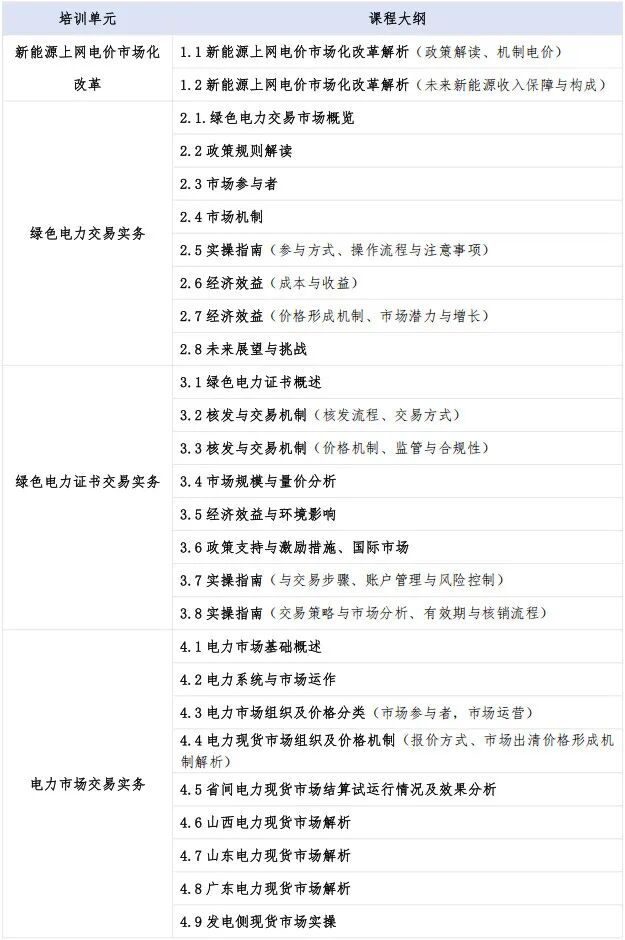
Core Insights - The renewable energy sector is increasingly participating in the electricity market, with several major provinces announcing their entry into the market as of early 2025, when the pricing reform for renewable energy grid connection will take effect [1][12] - All renewable energy projects will enter the electricity market, with grid connection prices determined through market transactions, necessitating a comprehensive understanding of market frameworks and rules by renewable energy companies [1][12] - Companies are encouraged to optimize their trading volume, pricing, and contract signing while actively participating in green electricity and green certificate trading to realize environmental value [1][12] Training Overview - The training will cover various aspects of market policies, trading rules, strategies, and practical demonstrations related to medium and long-term trading, electricity spot trading, and green electricity/green certificate trading [1][12] - The training is organized by the North Polar Power Network and North Polar Power Market Network, utilizing the North Polar Learning Community as the learning platform [2][13] Training Content - The curriculum includes modules on the marketization of renewable energy grid connection prices, green electricity trading market overview, policy rules interpretation, market participants, and mechanisms [3][14] - Practical guides on participation methods, operational processes, economic benefits, and future challenges in green electricity trading will also be provided [3][14] Trainers - The training will feature experts such as Yang, who has extensive experience in electricity trading processes and has worked on green electricity trading and certificate issuance policies [5][16] - Wu, another trainer, has a strong background in electricity production processes and has been involved in market research and rule modifications [6][17] Target Audience - The training is aimed at management and related personnel from renewable energy generation, sales, and user sectors, as well as those from virtual power plants, energy storage, and load aggregators [20] Training Highlights - The training will be conducted entirely online, allowing for flexible learning and repeated access to course materials, enhancing participants' work capabilities [18] Fees and Certification - The training fee is set at 2699 yuan per person, which includes online training and electronic materials, with an option for a higher fee that includes certification [21][22]

国家能源局:11月核发绿证2.58亿个
中国能源报· 2025-12-26 11:35
Green Certificate Issuance - In November 2025, the National Energy Administration issued 258 million green certificates, covering 509,700 renewable energy generation projects, with 150 million being tradable, accounting for 58.25% of the total [1] - The green certificates corresponding to renewable energy generation in October 2025 amounted to 225 million, representing 87.17% [1] - From January to November 2025, a total of 2.736 billion green certificates were issued, with 1.743 billion being tradable [1] Green Certificate Issuance by Type - Wind power accounted for 75.96 million certificates in November and 946.25 million from January to November [2] - Solar power generated 58.04 million certificates in November and 624.64 million from January to November [2] - Conventional hydropower contributed 108.22 million certificates in November and 994.26 million from January to November [2] - Biomass power produced 13.31 million certificates in November and 154.04 million from January to November [2] - Other renewable energy sources issued 2.80 million certificates in November and 16.73 million from January to November [2] Green Certificate Trading - In November 2025, a total of 132 million green certificates were traded, including 25.39 million for green electricity [4] - From January to November 2025, the total number of traded green certificates reached 728 million, with 228 million for green electricity [4] Green Certificate Trading by Type - Wind power accounted for 54.75 million traded certificates in November and 347.01 million from January to November [5] - Solar power generated 68.97 million traded certificates in November and 331.60 million from January to November [5] - Biomass power contributed 3.14 million traded certificates in November and 30.99 million from January to November [5] - Other renewable energy sources had 5.27 million traded certificates in November and 18.20 million from January to November [5] Green Certificate Trading Prices - The average trading price for certificates from the year 2024 was 4.28 yuan per certificate, with a month-on-month increase of 66.80% [7] - The average trading price for certificates from the year 2025 was 5.16 yuan per certificate, with a month-on-month decrease of 1.19% [7]

“十四五”能源成就·新能源篇丨我国新能源开创跃升式、集成式发展新阶段
Zhong Guo Dian Li Bao· 2025-12-16 07:29
Core Insights - China's renewable energy sector is experiencing a transformative leap, characterized by both quantitative and qualitative advancements, marking a new era of green electricity [1][2][10] Development Milestones - By 2025, China's wind and solar power installations are expected to reach approximately 370 million kilowatts, with a cumulative capacity exceeding 1.7 billion kilowatts, contributing about 22% to the total electricity consumption [3][4] - The average utilization rate of renewable energy in China remains stable at over 94%, indicating a balance between large-scale development and efficient consumption [4] Policy and Strategic Support - The Chinese government has prioritized the development of renewable and clean energy, implementing a series of strategic policies since the 14th Five-Year Plan to support rapid growth in this sector [5][6] Industry Infrastructure - China has established the world's largest and most complete renewable energy industry chain, with renewable energy generation accounting for 60% of total installed capacity [6][10] - The integration of renewable energy with traditional energy sources is being pursued, leading to a multi-energy complementary transformation [9] Systematic Upgrades - The development model of renewable energy is shifting from isolated advancements to a more integrated and collaborative approach, with large-scale wind and solar bases being developed in previously uninhabitable areas [7][8] - New energy storage solutions are being developed to enhance the flexibility of the power system, with a projected installed capacity of over 100 million kilowatts by 2025, accounting for more than 40% of the global total [8] Market Dynamics - The market for green certificates is expanding, with approximately 2.9 billion green certificates issued in 2025, reflecting a significant increase in market participation and value realization of green energy [9] Societal Impact - Renewable energy is becoming a part of daily life in China, with significant growth in electric vehicle charging infrastructure and distributed solar installations, enhancing the accessibility of clean energy [11][12] - The renewable energy sector is also contributing to ecological restoration and job creation, demonstrating a dual benefit for economic growth and environmental protection [12] Global Influence - China's renewable energy products are exported to over 200 countries, significantly contributing to global carbon reduction efforts, with the country accounting for over 70% of the world's solar components and 60% of wind power equipment [12]

观氢 - 综述:日升月恒,氢风破浪
2025-12-01 00:49
Summary of Hydrogen Energy Industry Conference Call Industry Overview - The hydrogen energy policy framework in China is gradually improving, with hydrogen energy being included in government work reports since 2019 and officially recognized in the 2024 Energy Law, enhancing its status alongside oil, natural gas, and coal [5][4][3] - The hydrogen industry is transitioning from laboratory research to commercial application during the 14th Five-Year Plan (2021-2025), currently in a small-scale demonstration phase [5][4] Key Points and Arguments - **Hydrogen Production Technologies**: - **Coal-based Hydrogen**: Lowest cost at approximately 10.2 CNY/kg but has high carbon emissions and is limited by resource availability [6] - **Natural Gas-based Hydrogen**: Widely used globally, costing about 22.3 CNY/kg, but still non-renewable and resource-scarce [6] - **Industrial By-product Hydrogen**: Low cost but limited by production volume, suitable for short-term transitional solutions [6] - **Electrolysis-based Hydrogen**: Encouraged as a low-carbon option, with costs significantly influenced by electricity prices; current costs exceed 50 CNY/kg but can drop below 11.5 CNY/kg with lower electricity rates [6][7] - **Hydrogen Storage and Transportation**: - Gaseous storage is the mainstream method but has low efficiency; liquid storage is denser but costly and requires low temperatures [8] - Over 200 hydrogen refueling stations are expected to be operational by the end of 2024, primarily in regions like Beijing-Tianjin-Hebei and the Yangtze River Delta [8] - **Climate Change Impact**: - Stricter global emission reduction targets are accelerating the transition to clean energy, with supportive policies from various governments enhancing the hydrogen industry's development [9] - **Future Competition in Hydrogen Industry**: - Competition will shift from price to quality, focusing on technology level, energy consumption control, lifespan, and after-sales service [10] Additional Important Insights - **Challenges in Hydrogen Storage and Transportation**: - Current storage methods face challenges such as low density in gaseous storage and high costs in liquid storage; solid-state storage is still in the experimental phase [11] - Transportation primarily uses compressed gas, which is economical for short distances but not suitable for long-distance transport [11] - **Hydrogen Refueling Station Challenges**: - High construction costs and profitability issues hinder the establishment of refueling stations; government subsidies are necessary to support these initiatives [12] - Integrated energy stations combining various fuel types are emerging as a solution to improve economic viability [12] - **Industrial Decarbonization Using Green Ammonia**: - Green ammonia can significantly reduce carbon emissions in industrial applications such as methanol synthesis and steel production [13] - **Fuel Cell Vehicle Development**: - Fuel cell vehicles are primarily used in commercial applications, facing high costs that require policy support for wider adoption; potential for significant economic benefits by 2030 with technological advancements [14] - **Trends in the Hydrogen Industry**: - The industry is expected to grow rapidly during the 14th Five-Year Plan, driven by policy support and technological advancements, moving towards commercial operation [15]
今年前10个月我国共核发绿证24.78亿个
Jing Ji Guan Cha Wang· 2025-11-25 09:20
Core Insights - The National Energy Administration of China reported that 2.478 billion green certificates were issued in the first ten months of this year, with 1.592 billion being tradable [1] - In October alone, 370 million green certificates were issued, covering 374,100 renewable energy generation projects [1] - A total of 596 million green certificates were traded nationwide in the first ten months, including 202 million green electricity trading certificates [1] - In October, 66.7 million green certificates were traded, with 22.99 million being green electricity trading certificates [1]
南网能源:广州虚拟电厂完成50个客户代理聚合,总代理容量146MW
Zheng Quan Ri Bao Wang· 2025-11-06 13:12
Core Insights - Company has obtained electricity trading qualifications in five provinces of Southern China, with a focus on establishing a stable trading operation in Guangdong by mid-2025 [1] - The company has registered as one of the first virtual power plant operators in Guangzhou, successfully signing 27 user resource agency contracts within a week [1] - The company is actively expanding its green certificate trading channels, achieving a trading volume of 456,000 green certificates by the end of October, generating approximately 1.4 million yuan in sales [1] Group 1 - The company has secured electricity trading qualifications in five provinces, with ongoing trading activities in Guangdong [1] - The company has initiated its electricity trading business with a focus on accurate load forecasting and optimization of electricity purchases [1] - The company has registered as a virtual power plant operator in Guangzhou, aggregating a total capacity of 146MW from 50 customer agents [1] Group 2 - The company has developed a dynamic pricing monitoring and response mechanism for green certificate trading [1] - The company has implemented differentiated sales strategies and a three-tier price review mechanism for green certificates [1] - The company has participated in two virtual power plant responses in Guangzhou, achieving an effective load response of approximately 16MWh [1]
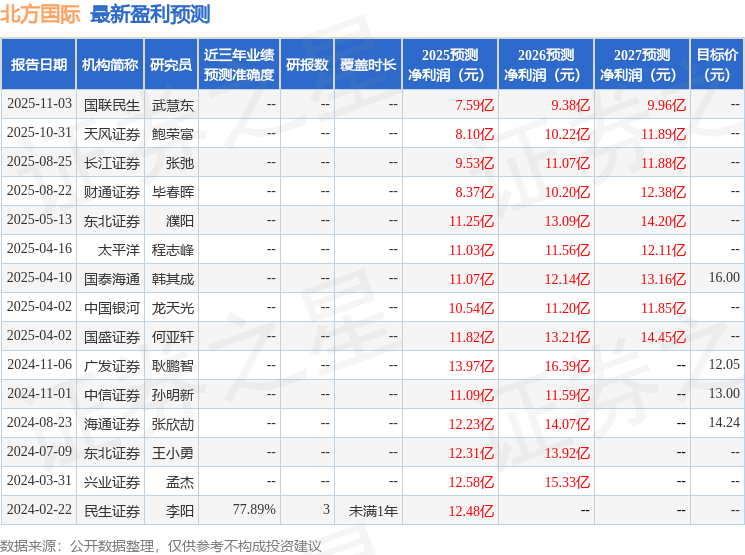
北方国际(000065):Q3业绩降幅环比收窄,电力运营规模稳步扩张
GOLDEN SUN SECURITIES· 2025-11-05 12:11
Investment Rating - The report maintains a "Buy" rating for the company [4][6]. Core Insights - The company's Q3 performance showed a significant narrowing of revenue decline, primarily driven by increased coking coal sales, with Q3 coking coal trade volume reaching 1.54 million tons, a year-on-year increase of 75% and a quarter-on-quarter increase of 32% [1][2]. - The overall gross margin improved, with a Q1-3 gross margin of 14.24%, up 2.5 percentage points year-on-year, and a Q3 gross margin of 16.68%, up 0.44 percentage points year-on-year [2]. - The electricity operation segment is steadily expanding, with significant contributions expected from ongoing projects, including a projected annual net profit of USD 100 million from the Bangladesh thermal power station starting next year [3]. Financial Performance Summary - For the first three quarters of 2025, the company reported total revenue of CNY 9.9 billion, a year-on-year decline of 30%, and a net profit attributable to shareholders of CNY 480 million, down 36% [1]. - The company’s operating cash flow showed a significant increase, with a net inflow of CNY 900 million for Q1-3, up CNY 1.36 billion year-on-year, indicating improved cash flow management [2]. - The forecast for net profit attributable to shareholders for 2025-2027 is adjusted to CNY 882 million, CNY 1.187 billion, and CNY 1.382 billion, reflecting a year-on-year decline of 16% in 2025, followed by growth of 35% and 16% in subsequent years [4].

北方国际:11月4日接受机构调研,财通基金、易方达基金等多家机构参与
Sou Hu Cai Jing· 2025-11-05 01:21
Core Viewpoint - The company, North International (000065), is actively engaging with institutional investors to enhance communication and improve its operational quality, focusing on its role in international engineering and capacity cooperation, particularly in relation to the Belt and Road Initiative [2][3]. Group 1: Company Positioning and Strategy - The company is positioned as a key player in supporting national strategies, particularly in the context of the Belt and Road Initiative, aiming to strengthen its international operations in civilian products [2]. - North International leverages its Norinco brand and overseas investment network to establish a strong presence in key markets, especially along the Belt and Road, focusing on energy, resource, and industrial engineering projects [3]. - The company emphasizes a market-oriented approach to resource integration, maintaining close partnerships with leading global enterprises to enhance its operational capabilities [4]. Group 2: Competitive Advantages - The company has implemented an investment-driven transformation, integrating investment, construction, and operation to enhance its management capabilities and achieve good returns on investment projects [5]. - A high-quality, professional talent pool familiar with international operations supports the company's ability to manage overseas projects effectively [6]. - The company adopts a localized operational strategy, establishing a comprehensive management system to support its international business across various countries [7]. Group 3: Financial Performance - In the first three quarters of 2025, the company reported a main revenue of 9.915 billion, a year-on-year decrease of 29.79%, and a net profit of 485 million, down 36.02% [12]. - The company’s electricity operation segment showed stable performance, with significant growth in generation and revenue, particularly from projects in Croatia and Laos [8][9]. - The company plans to continue expanding its overseas electricity asset portfolio and explore new revenue channels, enhancing the profitability and strategic value of its electricity operations [9]. Group 4: Future Outlook and Shareholder Returns - The company has a long-standing commitment to stable shareholder returns, with a cash dividend ratio of 15% for 2024, an increase of 5 percentage points from the previous year, amounting to 158 million, a 72.55% increase year-on-year [11]. - Future dividend policies will balance operational funding needs with shareholder returns, aiming to gradually enhance dividend levels [11].
国家能源局发布9月全国可再生能源绿色电力证书核发及交易数据
Zhong Guo Dian Li Bao· 2025-11-04 05:04
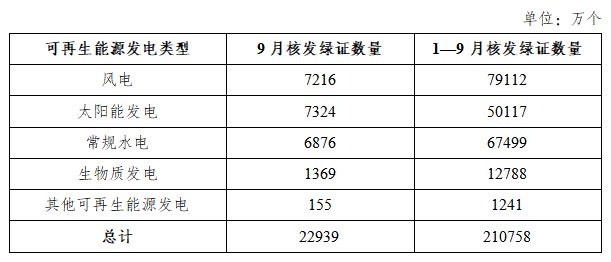
Core Insights - The National Energy Administration issued 229 million green certificates in September 2025, with 68.86% being tradable [2][4] - From January to September 2025, a total of 2.108 billion green certificates were issued, with 1.435 billion being tradable [2] Green Certificate Issuance - In September 2025, 2.29 million green certificates were issued across 306,500 renewable energy projects [2] - The breakdown of green certificates issued in September by renewable energy type includes: - Wind Power: 721,600 - Solar Power: 732,400 - Conventional Hydropower: 687,600 - Biomass Power: 136,000 - Other Renewable Energy: 124,100 - Total green certificates issued from January to September 2025 reached 2.10758 billion [3] Green Certificate Trading - In September 2025, 65.12 million green certificates were traded, with 21.02 million being for green electricity [4] - The total number of green certificates traded from January to September 2025 was 529 million, with 179 million for green electricity [4] - The average trading price for green certificates in September was 4.99 yuan per certificate, reflecting an 11.78% decrease from the previous month [5][7]
新能源高比例消纳靠什么
Jing Ji Ri Bao· 2025-11-02 21:55
Core Insights - The "Energy Transformation Index Blue Book 2025" indicates rapid growth in global wind and solar power capacity, with solar power installation rates significantly outpacing wind power [1] - China has set ambitious new targets for renewable energy, aiming for non-fossil energy consumption to exceed 30% of total energy consumption by 2035, with total installed wind and solar capacity reaching six times that of 2020 [1] Group 1: Renewable Energy Growth - Global wind and solar power capacity is experiencing rapid growth, particularly in solar energy, although some high-penetration countries are seeing a slowdown in solar installation rates due to structural challenges in grid management and market mechanisms [1] - China's renewable energy targets include achieving a total installed capacity of 3.6 billion kilowatts for wind and solar by 2035, which is six times the capacity in 2020 [1] Group 2: Integrated Development of Water, Wind, and Solar Energy - Integrated development of water, wind, and solar energy is a key trend in the energy sector, enhancing resource complementarity, efficiency, and cost optimization [2] - Hydropower plays a crucial role in stabilizing the power system and supporting the large-scale development of wind and solar energy, with hydropower generation accounting for 14% of total electricity and 41% of renewable energy in China in 2024 [1][2] Group 3: Market Efficiency and Green Certificates - The electricity market is essential for optimizing resource allocation and facilitating the high-level utilization of renewable energy [4] - Suzhou has established a comprehensive green electricity and green certificate service network, achieving significant growth in green electricity trading, with over 53 billion kilowatt-hours traded in 2024 [4][5] - The national green certificate trading system has been fully implemented, with 464 million certificates traded from January to August 2025, reflecting a 120% year-on-year increase [7]