
美国关税

Search documents
特朗普声称,所有国家似乎都因为害怕美国关税而决定退出金砖国家
Sou Hu Cai Jing· 2025-10-14 22:40
Group 1 - The core viewpoint of the article suggests that there are claims that member countries of the BRICS organization are considering exiting due to concerns over potential U.S. tariffs [2] - U.S. President Donald Trump stated that he informed leaders of countries interested in joining BRICS that the U.S. plans to impose tariffs, leading them to decide to exit [2] - Despite these claims, it is noted that since the establishment of the BRICS alliance, no member country has actually exited [3] Group 2 - In September, BRICS leaders highlighted that trade has become a tool for interfering in other countries' internal affairs, which undermines global development [4] - They emphasized that unilateral actions and intimidation have negative impacts on the international order, threatening international law and existing norms [5] - BRICS, established in 2006, is an intergovernmental cooperation organization [6] Group 3 - On January 6 of this year, Brazil, as the rotating presidency, announced the addition of new members, with Indonesia officially joining BRICS [7] - Russian netizens reacted with skepticism to the claims made by Trump, suggesting that the situation is absurd and questioning the rationale behind it [7][8]


日本央行暗示加息需耐心,紧盯美国关税与工资增长动向
智通财经网· 2025-10-06 08:23
Core Viewpoint - The Bank of Japan maintains a cautiously optimistic outlook on the economic prospects but warns of persistent uncertainties regarding the impact of U.S. tariffs on corporate profits, suggesting a wait-and-see approach before any interest rate hikes [1][2]. Economic Assessment - The Bank of Japan's assessment of eight regions indicates a "moderate recovery or rebound" in the economy, although one region's evaluation was downgraded [1]. - Some businesses are delaying spending plans due to uncertainties surrounding tariff impacts, while others are facing upward pressure on wages due to labor shortages and rising costs [2]. Wage and Capital Expenditure Trends - There is a potential for continued wage growth driven by structural labor shortages, but the actual impact of U.S. tariffs on corporate profits is just beginning to manifest, complicating wage negotiations for the following year [1][2]. - Many companies plan to increase capital expenditures to optimize operations and meet IT demands, although some are postponing or reviewing their spending plans due to tariff uncertainties [2]. Monetary Policy Context - The next policy meeting of the Bank of Japan is scheduled for October 29-30, where the regional economic assessment will be a key reference for deciding whether to raise the current interest rate of 0.5% [1]. - The recent election of new Liberal Democratic Party president, who supports fiscal expansion and a loose monetary policy, may influence the Bank of Japan's stance on interest rates [2][3]. Market Implications - The new leadership's support for stimulus plans is expected to boost the stock market but may exert pressure on the yen [3]. - Expectations regarding the Bank of Japan's policies could support short-term government bonds, while long-term bonds may face challenges due to concerns over increased fiscal spending [3].
瑞士央行将利率维持在零水平
Xin Hua Cai Jing· 2025-09-25 08:04
Core Viewpoint - The Swiss National Bank (SNB) has maintained its key interest rate at zero, the lowest among major central banks, in response to the impact of U.S. tariffs on the Swiss economy [1] Summary by Relevant Sections Interest Rate Decision - The decision to keep the interest rate at zero aligns with market expectations and follows a slight increase in inflation over recent months [1] - This marks the first pause in rate cuts after seven consecutive meetings, with the SNB having started to lower rates in March 2024 [1] Economic Forecast - The SNB projects Swiss GDP growth for 2025 to be between 1% and 1.5%, an increase from the previous forecast of 1.0% to 1.5% [1] - The inflation rate for 2025 is expected to remain at 0.2%, unchanged from prior predictions [1] Global Economic Impact - The SNB anticipates a slowdown in global economic growth in the first half of 2025, influenced by U.S. tariffs and ongoing high uncertainty [1] - It is expected that U.S. inflation will remain elevated for some time, while inflation in the Eurozone is projected to stay near target levels [1] Swiss Economic Outlook - The outlook for the Swiss economy has worsened due to significantly increased U.S. tariffs, which are likely to suppress exports and investments [1] - In the current environment, the unemployment rate in Switzerland is expected to continue rising [1]
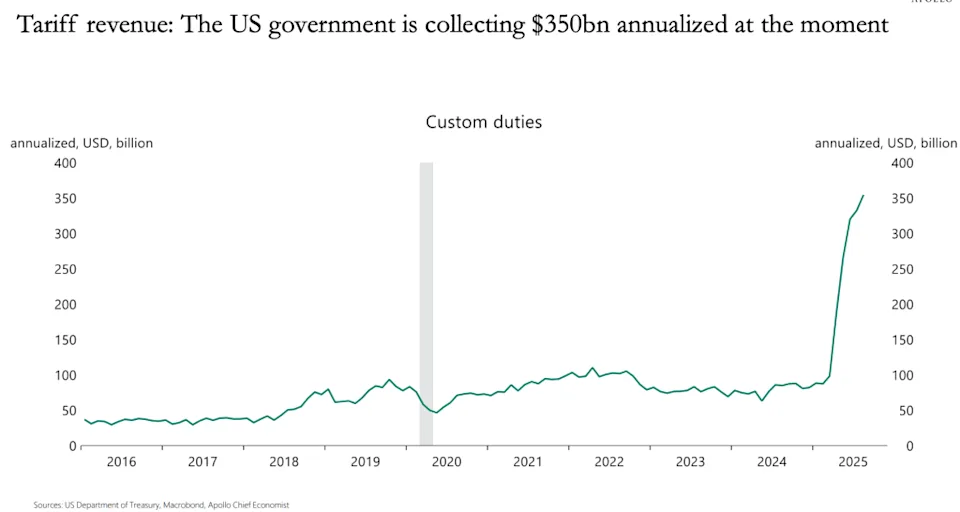
特朗普关税有多“赚钱”?知名经济学家估算:每年3500亿美元
Feng Huang Wang· 2025-09-23 03:22
Core Insights - The U.S. government currently collects approximately $350 billion annually in tariff revenue, which is considered a significant amount [1][6] - This tariff revenue accounts for about 18% of annual household income tax payments, highlighting its importance as a revenue source in shaping the U.S. economy and trade landscape [3][6] Tariff Impact on Households - Tariffs, essentially taxes on imported goods, have been a controversial tool in U.S. economic policy, traditionally used to protect domestic industries or raise public funds [6] - The burden of tariffs is not evenly distributed, as economists believe that the costs are passed on to consumers, leading to increased prices for a range of products from electronics to household goods [6][7] - Tariffs act as an indirect tax on households, disproportionately affecting low-income families who spend a higher percentage of their income on everyday consumer goods [7][8] Implications for National Debt - The rise in tariff revenue is recognized as an important step towards managing the U.S. national debt, which stands at $37 trillion [9] - The Congressional Budget Office (CBO) estimates that this could help reduce the deficit by up to $4 trillion over the next decade, although experts caution against overestimating the ability of tariffs to significantly reduce the deficit [10] - While tariff revenues are substantial, they represent only a small part of the funding needed to fully address the national debt, especially considering commitments to welfare programs and rising interest costs [10]
国际时政周评:聚焦中美关系后续进展
CMS· 2025-09-21 08:34
Group 1: US-China Relations - The fourth round of US-China trade talks occurred on September 14-15, focusing on resolving short-term risks and stabilizing market expectations, with a consensus on addressing issues like TikTok[4] - A phone call between the US and Chinese presidents on September 19 provided strategic guidance for the stable development of bilateral relations[9] - Future interactions between the US and China are anticipated, including potential discussions on fentanyl tariffs and agricultural exports, with a significant meeting at the APEC summit in late October[16] Group 2: Geopolitical Conflicts - Ongoing geopolitical tensions include US military actions against alleged drug trafficking vessels from Venezuela and escalating conflicts in the Middle East and Ukraine[12] - The EU has proposed new sanctions against Russia, covering energy, financial services, and trade restrictions, amid continued military actions in Ukraine[12] - The signing of a strategic defense agreement between Saudi Arabia and Pakistan highlights the shifting dynamics in regional security[12] Group 3: US Domestic Policies and Tariffs - The US Supreme Court will hear arguments on the legality of tariffs imposed by the Trump administration on November 5, which may influence future tariff policies[20] - The Trump administration is focusing on reinforcing domestic industry security through ongoing Section 232 investigations in various sectors, including semiconductors and pharmaceuticals[20] - A new fee of $100,000 on H-1B visas has been introduced, reflecting the administration's political motivations and potential impacts on the tech industry[20]
弘则出口企业八月调研反馈
2025-09-17 14:59
Summary of Conference Call Records Industry Overview - The global export market is showing a divergent trend, with U.S. tariffs impacting labor-intensive products like sports shoes and toys, leading to order shifts to other countries. The high base from U.S. export rush in 2024 is affecting this year's performance [1][5] - The automotive industry is performing exceptionally well, driven by U.S. auto parts export rush and strong demand for new energy vehicles in emerging markets. Pure electric vehicle sales in Europe have increased by over 20%, and infrastructure demand in regions like Africa and Vietnam has boosted heavy machinery sales [1][6] - The medical device industry has seen a slowdown in growth to around 5%, primarily due to negative growth in the European market, although it remains higher than most industries. The rapid growth in the first half of the year (15%-20%) contributed to this slowdown [1][7] - In the current inflationary environment, government and institutional procurement decisions are significantly impacted, leading to delays in large equipment purchases and a reduction of over 18% in consumer electronics orders. However, upstream electronic components have shown slight growth [1][8] - The photovoltaic and lithium battery sectors have seen a narrowing decline in orders, with significant demand for lithium batteries in non-U.S. regions. Although shipments of photovoltaic components in Europe and North America have decreased, some growth has been maintained through rerouting via Southeast Asia to avoid tariffs [1][10] - The small tools and gardening tools market has experienced significant order growth due to promotions and increased brand recognition. New factory capacities in Vietnam may reduce exports of small tools from China [1][11] Key Insights - Over half of the companies reported an increase in export prices, primarily due to rising tariff costs, premium pricing for high-end products, and the introduction of new products that enhance value. Some companies are adopting a price-for-volume strategy to cope with competition [2][16] - In July and August, companies reported a year-on-year improvement in export orders, with the proportion of companies seeing improvement rising from about 55% to approximately two-thirds. Most industries, including consumer goods, machinery, and automotive, exceeded expectations, except for the photovoltaic and lithium battery sector [3][6] - The automotive sector is highlighted as the strongest performer, with a surge in orders due to export rush operations and robust demand for new energy vehicles in emerging markets [6] - The medical device sector's growth is slightly below seasonal expectations, with a year-on-year increase of about 5%, influenced by earlier rapid growth and recent negative trends in Europe [7] - The inflationary environment is causing significant impacts on procurement decisions, leading to a decline in overall order volumes, particularly in the consumer electronics sector [8] - The communication and IoT sectors are performing well due to increased demand for data centers and AR applications, with significant growth in orders for optical communication modules and related products [9] Additional Observations - The global machine tool market is experiencing a downward trend, with demand in Southeast Asia lagging while the U.S. sees a 20% growth due to manufacturing reshoring [13] - Strong demand for mining and port machinery is noted in South America and the Middle East, driven by high copper prices and new port constructions [14] - Companies are optimistic about Q4 2025, with about two-thirds expecting year-on-year order growth, particularly in the U.S. consumer electronics, data center construction, and light communication sectors [15] - The competitive environment is leading to a general decline in export prices for ordinary household appliances and daily necessities, particularly in the U.S. market [17] - The adjustment of the euro exchange rate has resulted in a 7% decrease in the price of automotive parts in the European market [18] - The structure of export orders is shifting, with most companies still focused on B2B sales, while C2C orders are primarily through cross-border e-commerce platforms [19] - The C2C online channel is growing rapidly, especially in the smart hardware and 3C electronics sectors, with annual growth rates reaching 20% [21] - U.S. tariff policies have led to a noticeable decline in overall orders since April, with significant impacts on industries like tires, photovoltaics, and automotive [22] - Overall, the survey reflects a marginal increase in growth, rising export prices, and rapid growth in C2C online channels, despite ongoing tariff challenges [23]
Japan's exports down in August as automakers grapple with US tariffs
Reuters· 2025-09-17 00:18
Core Insights - Japan's exports have declined for the fourth consecutive month as of August, primarily due to the impact of elevated U.S. tariffs on the automotive and manufacturing sectors [1] Export Performance - The decline in exports is attributed to the ongoing trade tensions and tariffs imposed by the U.S., which have significantly affected Japan's automotive industry [1] - The manufacturing sector is also experiencing a downturn, indicating broader economic challenges faced by Japan [1]

国际时政周评:关注中美第四轮经贸会谈
CMS· 2025-09-14 13:30
Geopolitical Conflicts - The escalation of the Middle East conflict led to a 1.8% increase in Brent crude oil prices, despite concerns over oversupply and weak demand[4] - Israel's airstrike on Qatar was described as a "precision strike" against Hamas leaders, with potential implications for U.S.-Qatar relations[10] - The ongoing Russia-Ukraine conflict saw Poland shoot down a drone allegedly from Russia, raising tensions in the region[15] U.S.-China Trade Relations - The fourth round of U.S.-China trade talks is scheduled from September 14-17 in Spain, focusing on unilateral tariffs and export controls[17] - The U.S. Commerce Department added several Chinese entities to the export control "entity list," indicating ongoing trade tensions[17] - Trump's administration is pressuring the EU and NATO to impose significant tariffs (50-100%) on Russian oil buyers, contingent on their cooperation[16] Economic Indicators - The Shanghai Composite Index rose by 1.5% this week, while the Shenzhen Component increased by 2.6%[6] - The Dow Jones Industrial Average saw a 1.0% increase, and the S&P 500 rose by 1.6%[6] - Brent crude oil is currently priced at $66.88 per barrel, reflecting geopolitical tensions in the Middle East and Ukraine[6] Federal Reserve and Tariff Issues - The U.S. Supreme Court will expedite the review of the legality of tariffs imposed by the Trump administration, with oral arguments scheduled for early November[22] - The independence of the Federal Reserve is under scrutiny, with a court ruling temporarily blocking the dismissal of a Fed official[22] - Ongoing investigations into tariffs on various sectors, including pharmaceuticals and semiconductors, are expected to influence future trade negotiations[22]
掌握议价权 中国商品无惧关税挑战
Jin Tou Wang· 2025-09-04 07:26
Core Insights - Chinese exporters appear to have strong bargaining power in trade with the U.S., bearing only 9% of the costs from tariffs imposed by President Trump earlier this year [1] - The findings contradict statements from U.S. officials who claimed that Washington emerged victorious in the global tariff storm in April [1] - The analysis indicates that U.S. importers are unable to fully pass on costs to end consumers or exporters, leading them to compress profit margins [1] Group 1 - The study aimed to verify the hypothesis that exporters can alleviate tariff burdens through price reductions, using regression analysis to compare shipping volumes, tariff rates, and changes in U.S. import prices [1] - From April to July, the average price of goods imported from China decreased by 2.4%, while actual tariffs increased by 27 percentage points [1] - This suggests that Chinese goods possess strong competitive advantages and bargaining power [1] Group 2 - ASEAN, Japan, and the EU bear a significantly larger share of tariff costs, with ASEAN and Japan expected to shoulder 20% and 37% respectively [2] - The 9% tariff rate for Chinese exporters is much lower than the 66% rate proposed by some U.S. retail giants to their Chinese suppliers, indicating that Chinese firms have managed to limit their tariff burden [2] - Looking ahead, the tariff costs are expected to gradually impact U.S. consumer inflation, with a potential CPI increase of about 1 percentage point if actual rates remain between 16% and 17% [2]

欧洲央行行长拉加德表示,美国关税不会破坏欧元区经济
Shang Wu Bu Wang Zhan· 2025-08-28 15:33
Core Viewpoint - European Central Bank President Christine Lagarde stated that increased U.S. tariffs will not undermine the recovering Eurozone economy, which is gradually returning to potential growth despite current economic challenges [1][2] Group 1: Economic Impact - Lagarde mentioned that higher tariffs will have only a "slight" impact on GDP, indicating resilience in the Eurozone's economic fundamentals such as consumption and investment [1] - The Eurozone unexpectedly achieved growth in the second quarter, with private sector activity expanding at the fastest pace in 15 months in August, signaling a recovery from three years of manufacturing downturn [1] Group 2: Monetary Policy - The European Central Bank (ECB) is likely to maintain interest rates unchanged in the upcoming month, following a previous decision to keep rates steady in July [1] - Joachim Nagel, President of the German Central Bank, noted that the threshold for further action is high after eight previous rate cuts [1] Group 3: Inflation Control - Stronger growth momentum is expected to help keep inflation within the ECB's medium-term target of 2% [2] - Lagarde emphasized that the latest inflation data and medium-term forecasts align with the 2% target, and the impact of the recent trade agreement on inflation is anticipated to be "very slight" [2]