资本市场制度改革

Search documents
证监会:深化科创板、创业板改革
Zhong Zheng Wang· 2025-10-24 13:35
Core Viewpoint - The meeting led by Wu Qing emphasized the importance of enhancing the inclusiveness and adaptability of the capital market, aligning with the spirit of the 20th Central Committee's Fourth Plenary Session [1] Group 1 - The meeting focused on the implementation of measures to deepen reforms in the Sci-Tech Innovation Board and the Growth Enterprise Market [1] - It highlighted the need to fully utilize the nurturing functions of the New Third Board, private equity, and venture capital within the multi-tiered equity market [1] - The meeting also stressed the importance of strengthening the functions of the bond and futures markets [1]

国泰海通:多重因素支持中国权益表现 建议战术性超配黄金、A/H股
智通财经网· 2025-10-22 13:22
Group 1 - The report from Guotai Junan highlights the increasing enthusiasm for China's technological breakthroughs and emerging industries, supported by stable policy expectations and capital market reforms that enhance market risk appetite [1] - The demand for quality assets in China is surging, particularly in the context of geopolitical uncertainties affecting capital market volatility, which may provide investment opportunities [1] - The report maintains a tactical overweight position on A/H shares, indicating a positive outlook for Chinese equities due to multiple supportive factors [1] Group 2 - The expectation of a more accommodative monetary policy in the U.S. may lead to a mild decline in real interest rates, supporting a tactical allocation to U.S. Treasuries [2] - The report suggests that the recent regional bank crises could accelerate the process of adjusting monetary policy and liquidity expectations [2] Group 3 - The imbalance in credit supply and demand, along with stable liquidity, continues to support the bond market, maintaining a tactical allocation to government bonds [3] - The report notes that geopolitical uncertainties and rising risk aversion are influencing domestic interest rates, which may experience wide fluctuations [3] Group 4 - Global macro liquidity improvements and rising risk aversion are expected to support gold prices, with a tactical overweight position on gold maintained [4] - The report indicates that gold has recently surpassed key resistance levels, driven by factors such as U.S. interest rate cuts and ongoing purchases by the Chinese central bank [4] Group 5 - The resilience of the Chinese economy and reduced risks from extreme geopolitical conflicts are supporting the stability and appreciation of the RMB [5] - The report anticipates that the RMB will exhibit a two-way fluctuation pattern, with a tendency for central stability and appreciation in the context of a complex global macro environment [5]

刘纪鹏:A股慢牛面临最大考验,大股东全面减持潜在规模达15万亿
Xin Lang Zheng Quan· 2025-09-25 10:41
Core Viewpoint - The A-share market is gradually showing a slow bull trend one year after the "924" policy was introduced, but it remains in a value trap due to underlying economic challenges [1][2]. Economic Fundamentals - The current Chinese economy is in a downward cycle, with significant fiscal pressure on local governments and a severe employment situation, making it difficult for the fundamentals to provide effective support [1]. - The total social financing in China is heavily reliant on bank loans, which amount to approximately 36 trillion yuan, indicating a low proportion of direct financing from the capital market [1]. Market Liquidity - The coordination efficiency between the central bank and the securities regulatory commission has significantly improved, with the central financial committee playing a key role in injecting ample liquidity into the market [2]. - Despite a rebound of about 800 points from the market's low, systemic optimization of the institutional framework is necessary to avoid resistance to further market growth [2]. Institutional Reforms - The issue of major shareholder reductions is identified as a core bottleneck affecting market confidence and long-term healthy development [2]. - There are over 5,400 listed companies in the A-share market with a total share capital of approximately 77 trillion shares, of which over 90% are tradable [2]. Shareholder Behavior - Current major shareholders are criticized for focusing on reducing their holdings rather than improving company operations, which undermines the original intent of the capital market to serve the real economy [3]. - A warning is issued regarding the potential market crash if major shareholders are allowed to reduce their holdings indiscriminately, with an estimated funding requirement of about 15 trillion yuan for comprehensive reductions [3].


田轩解读 "924 政策" 一周年:流动性托底见效 结构性改革塑造长期生态
Xin Lang Zheng Quan· 2025-09-23 06:43
Core Insights - The central viewpoint of the article emphasizes the effectiveness of the central bank's policy tools introduced on September 24, 2024, in stabilizing the market and guiding capital flow, while also highlighting existing structural challenges in the capital market [1][3][5]. Policy Implementation and Market Stability - The combination of monetary, fiscal, and industrial policies has played a crucial role in stabilizing market expectations, with the central bank's tools effectively alleviating liquidity pressure on non-bank institutions, particularly during quarter-end and holiday periods [3][5]. - Following the implementation of these policies, the volatility of the CSI 300 index significantly decreased, and risk premiums converged, indicating a positive impact on market stability [3][5][6]. Structural Challenges - Despite the positive effects, the policies primarily served as a "floor" rather than a "lift," with some tools showing insufficient transmission efficiency and a cautious approach from smaller financial institutions regarding the use of swap facilities [5][6]. - The slow pace of macroeconomic recovery and the lack of significant improvement in corporate profit expectations continue to pose structural challenges in the capital market [5][6]. Capital Flow Characteristics - The liquidity released by the policies has been directed towards key sectors such as small and medium-sized enterprises and manufacturing, with a notable increase in the proportion of medium to long-term loans [6][7]. - Market behavior has shown a trend towards long-term investment, with institutional investors focusing on financial, consumer, and growth sectors, while individual investors are shifting from short-term speculation to medium to long-term holding [6][7]. Beneficiaries of Policy Measures - The sectors and companies that have truly benefited from the policies are primarily stable cash flow blue-chip enterprises and those in technology innovation and advanced manufacturing, including finance, energy, and consumption [7][8]. - Stock buybacks and increased loans have been widely applied in high-end manufacturing, new energy, and biomedicine, effectively alleviating capital expenditure pressures and promoting technological upgrades [7][8]. Coordination of Macro Policies - The coordination between monetary, fiscal, and industrial policies has formed a comprehensive "macro policy combination," effectively addressing economic downward pressure and stabilizing growth [8][9]. - The combination of active fiscal policies and prudent monetary policies has successfully reduced production and financing costs for enterprises, enhancing market vitality and creativity [8][9]. Long-term Market Improvement Factors - Among various factors driving the market, capital market reforms and policies encouraging long-term capital inflow are deemed crucial for the long-term improvement of market fundamentals [9][10]. - Reforms aimed at optimizing listing systems, enhancing the quality of listed companies, and improving the mechanisms for mergers and acquisitions have strengthened market stability and investor confidence [9][10].

美联储降息对中国的三重机遇与双向冲击
Sou Hu Cai Jing· 2025-09-20 00:54
Group 1 - The potential interest rate cut by the Federal Reserve in September 2025 is a key external factor influencing the Chinese economy, with a 92% probability of a rate cut reflected in the U.S. interest rate futures market [1] - The U.S. labor market shows signs of weakness, with a 0.8 percentage point decline in GDP growth from the first to the second quarter, and the core PCE price index year-on-year growth falling to 2.3%, creating room for the Fed to ease monetary policy [1] Group 2 - The narrowing of the China-U.S. 10-year government bond yield spread from 2.1 percentage points in 2023 to 0.3 percentage points is a significant positive development, potentially allowing for a 150 basis point reduction in China's reserve requirement ratio [3] - The aviation and real estate sectors are expected to benefit first, with the former holding $38.7 billion in dollar-denominated debt and the latter having approximately $52.6 billion in outstanding dollar debt, alleviating financial cost pressures from exchange rate fluctuations [3] Group 3 - Over the past 12 months, northbound capital has net flowed into the A-share market by 243 billion yuan, with the consumer electronics, new energy vehicles, and high-end equipment manufacturing sectors accounting for 62% of this inflow [3] - In the MSCI China index, stocks with foreign ownership exceeding 5% have an average valuation below the central value of the past five years by 23%, indicating potential for value reassessment during the Fed's rate cut cycle [3] Group 4 - The CFETS RMB exchange rate index, if it rises to the 101-103 range, could reduce the average procurement cost of basic imported goods by 6.3%, significantly impacting strategic materials like iron ore and crude oil [4] - The apparel and textile sectors may face pressure, with a 1% appreciation in the RMB potentially eroding profit margins by 4.7%, affecting over 120,000 export enterprises [4] Group 5 - The manufacturing PMI has remained above the threshold for four consecutive months, with the new export orders index rising to 51.6, indicating effective structural adjustments [4] - The recent 9.2% increase in the global commodity price index may offset some benefits from alleviating input deflationary pressures [4]

证监会:科学谋划“十五五”时期资本市场重点任务举措
Shang Hai Zheng Quan Bao· 2025-08-29 19:52
Core Viewpoint - The meeting focused on how to effectively implement the "15th Five-Year" plan for the capital market, emphasizing targeted and forward-looking suggestions for improvement [1] Group 1: Capital Market Development - Suggestions include enhancing the multi-tiered capital market system and further deepening institutional reforms to strengthen market functions [1] - There is a call to improve the quality and investment value of listed companies, fostering the growth of long-term, patient, and strategic capital to encourage more medium to long-term funds to enter the market [1] Group 2: Legal and Regulatory Framework - The need to further improve legal systems in key areas of the capital market, such as stocks, bonds, derivatives, and cross-border regulation, is highlighted [1] - A comprehensive accountability system should be established to rigorously combat financial fraud, market manipulation, and insider trading [1] Group 3: Market Openness - The plan includes a gradual expansion of high-level institutional openness in the capital market, optimizing the Qualified Foreign Institutional Investor (QFII) system [1] - Support for high-quality foreign enterprises to return to the A-share market is also emphasized [1]
中证A500指数继续上攻,A500ETF易方达(159361)成交持续活跃,机构称股指还有新高
Mei Ri Jing Ji Xin Wen· 2025-08-21 15:40
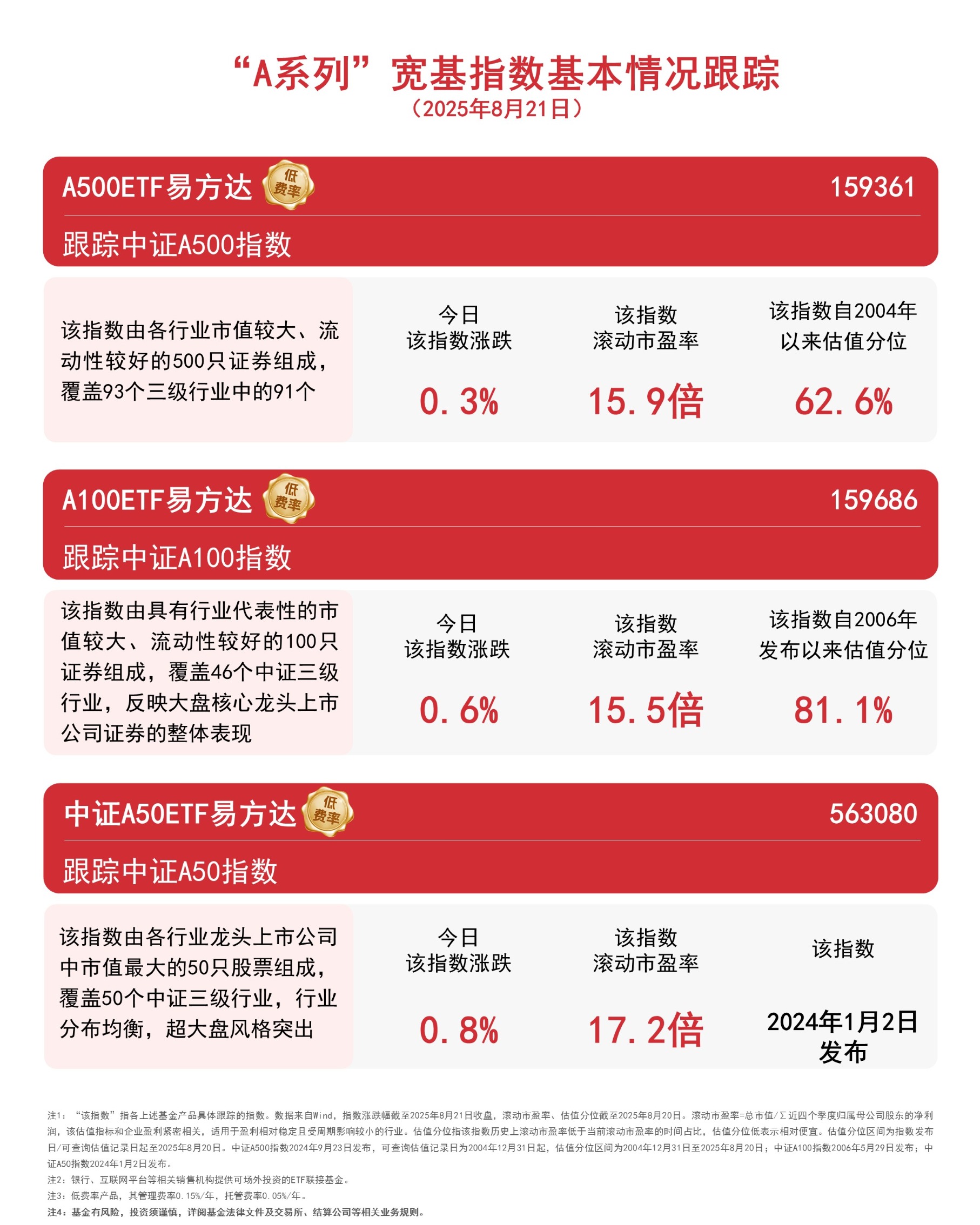
Group 1 - The core viewpoint is that the capital market reforms aimed at "increasing investor returns" are not only changing the system but also altering societal perceptions of the value of Chinese assets and reducing the risk assessment of the stock market [1] - The acceleration of China's transformation, the decline of risk-free returns, and capital market reforms are collectively establishing the foundation for a "transformation bull market" in the Chinese stock market, suggesting that stock indices may reach new highs [1] Group 2 - The CSI A500 index rose by 0.3%, the CSI A100 index increased by 0.6%, and the CSI A50 index went up by 0.8% [1] - The E Fund A500 ETF (159361) has seen a trading volume exceeding 2 billion yuan for nine consecutive trading days [1]
中证A500指数创年内新高,A500ETF嘉实(159351)整固蓄势,成分股中油资本10cm涨停
Xin Lang Cai Jing· 2025-08-21 02:57
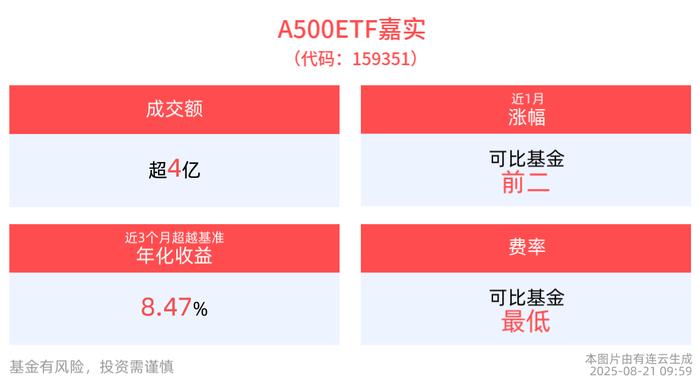
Core Viewpoint - The A500 index has reached a new high in 2025, indicating a positive market trend, with various sectors showing potential for investment opportunities despite some areas being overheated [4]. Group 1: A500 Index Performance - As of August 21, 2025, the A500 index increased by 0.05%, with notable stocks such as Oil Capital and Zhaoyi Innovation showing significant gains [1]. - The A500 index has risen by 1.2% as of August 20, 2025, marking a new annual high [4]. Group 2: A500 ETF Performance - The A500 ETF managed by Jiashi has a trading turnover of 3.35% and a transaction volume of 4.23 billion yuan [3]. - The latest scale of the A500 ETF is 125.83 billion yuan, with a net value increase of 10.43% over the past six months [3]. - Since its inception, the A500 ETF has achieved a maximum monthly return of 4.48% and a longest consecutive monthly gain of 3 months, with a total increase of 10.04% [3]. Group 3: Top Weighted Stocks - As of July 31, 2025, the top ten weighted stocks in the A500 index include Kweichow Moutai, CATL, and Ping An Insurance, collectively accounting for 19.83% of the index [3]. - The performance of these stocks varies, with Kweichow Moutai down by 0.38% and Longjiang Power up by 0.69% as of the latest data [6]. Group 4: Market Sentiment and Future Outlook - Despite the index reaching new highs, most industries remain in a moderate congestion zone, suggesting no overall market overheating, with opportunities for investment in lower congestion sectors [4]. - The ongoing reforms in the capital market aimed at improving investor returns are expected to reshape perceptions of Chinese assets and contribute to a "transformation bull market" [4].

港股回调引资金逆势“抢筹”,恒生科技ETF易方达(513010)单日净流入1.3亿元,规模再创新高
Mei Ri Jing Ji Xin Wen· 2025-08-20 02:43
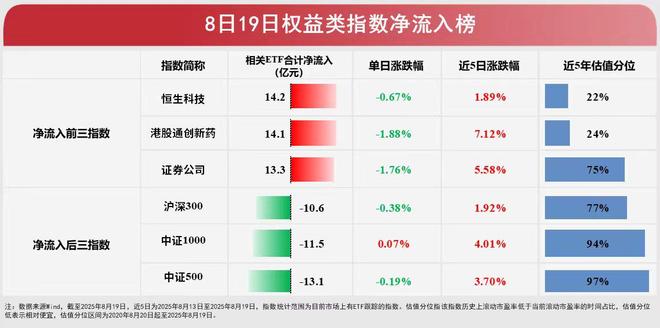
Group 1 - A-shares experienced a high and then a pullback, with total trading volume exceeding 2.6 trillion yuan, while Hong Kong stocks showed fluctuations and adjustments, with net inflows from southbound funds exceeding 18.5 billion HKD, particularly in the innovative drug sector which led the decline [1] - The ETF market saw a net inflow of over 5 billion yuan, with the top three ETFs being related to the Hang Seng Technology Index, the Guozheng Hong Kong Stock Connect Innovative Drug Index, and the CSI All Share Securities Company Index, each exceeding 1.3 billion yuan [1] - The report from Guotai Junan Securities highlighted that reforms aimed at "increasing investor returns" are not only changing the system but also altering societal perceptions of the value of Chinese assets, contributing to a "transformation bull market" in Chinese stocks [1] Group 2 - The net inflow rankings for equity indices on August 8 showed that the Hang Seng Technology Index had a net inflow of 14.2 billion yuan, while the Hong Kong Stock Connect Innovative Drug Index and the Securities Company Index had net inflows of 14.1 billion yuan and 13.3 billion yuan respectively [2] - Conversely, the CSI 300 Index experienced a net outflow of 10.6 billion yuan, while the CSI 1000 and CSI 500 indices saw net outflows of 11.5 billion yuan and 13.1 billion yuan respectively [2] - The recent performance of these indices indicates varying investor sentiment, with the Hang Seng Technology Index and the Hong Kong Stock Connect Innovative Drug Index showing positive five-day performance, while others like the CSI 500 are underperforming [2]
国泰海通|策略:2025中国股市上升的关键动力二:资本市场制度改革
国泰海通证券研究· 2025-08-18 13:56
Core Viewpoint - The article emphasizes that institutional changes significantly impact stock market valuations in China, with the new round of capital market reforms aimed at "increasing investor returns" positively influencing perceptions of Chinese assets and risk assessments [1][2]. Group 1: Capital Market Reform - The capital market reform aims to enhance the investability of the Chinese stock market and improve societal perceptions of Chinese assets. Past issues such as poor corporate governance and insufficient shareholder returns have hindered investor willingness to enter the market [2]. - Key reforms include the implementation of stricter regulations on delisting, share reduction, trading supervision, and penalties for financial fraud, which collectively enhance the investability of the Chinese stock market [2]. - The focus of the capital market has shifted towards prioritizing investor returns, with measures such as mandatory dividends and incentives for share buybacks being introduced [2]. Group 2: Risk Evaluation and Market Stability - The establishment of mechanisms to stabilize the market serves as a "firewall" that systematically reduces risk evaluations of the Chinese stock market, encouraging long-term capital inflows [3]. - Regulatory requirements for large state-owned insurance companies to allocate 30% of new premiums to A-shares, along with innovations in equity investment reforms, are part of the efforts to create a "long money, long investment" system [3]. - The interconnectedness of market stabilization mechanisms, long-term investments, and improved regulations creates a robust framework for both risk management and long-term market development [3]. Group 3: Market Outlook - The combination of declining risk-free returns and capital market reforms is identified as a key driver for the anticipated rise of the Chinese stock market, referred to as the "transformation bull market" [4]. - Historical instances of stock market rallies linked to capital market reforms, such as the 2005 split share structure reform and the 2019 registration system reform, support the belief in the potential for a significant market upturn [4]. - The article asserts that the evolving perceptions of stock prices reflect investors' expectations for the future, highlighting the stock market's role in boosting societal confidence and optimizing resource allocation [4].