高水平科技自立自强

Search documents
财政部发布重磅报告!继续实施好提振消费专项行动
Sou Hu Cai Jing· 2025-11-07 09:51
Core Viewpoint - The Ministry of Finance emphasizes the implementation of a more proactive fiscal policy to stimulate domestic demand, enhance consumption, and support economic recovery amid complex external challenges [2][3]. Group 1: Fiscal Policy Implementation - The report highlights the need for a more proactive fiscal policy, focusing on improving budget execution and ensuring effective use of funds [2][3]. - It mentions the allocation of 300 billion yuan in special bonds to support consumption, particularly in key sectors like automotive and home appliances, which has already driven sales of 1.6 trillion yuan [3][12]. - The report outlines the importance of local government special bonds and long-term treasury bonds in enhancing financial cooperation and encouraging private investment [2][3]. Group 2: Economic Growth and Investment - The report indicates that the central government has allocated 398.12 billion yuan for technology funding, marking a 10% increase from the previous year, to support innovation and industrial upgrades [4][20]. - It emphasizes the need for effective investment in infrastructure and key industries, with a focus on modern transportation systems and manufacturing technology upgrades [15][16]. - The issuance of special bonds has accelerated, with 555 billion yuan issued in the first half of the year, representing 42.7% of the annual target [15][16]. Group 3: Employment and Social Welfare - The report states that 667.4 billion yuan has been allocated for employment support, with 6.95 million new urban jobs created in the first half of the year [27][28]. - It highlights the increase in education spending to 2.15 trillion yuan, a 5.9% year-on-year growth, to improve educational resources and quality [29][30]. - The report also mentions the enhancement of basic public health services, with 804.35 billion yuan allocated for public health service subsidies [32][33]. Group 4: Risk Management - The report stresses the importance of risk prevention and management, particularly in addressing hidden debts and ensuring local government financial stability [5][10]. - It outlines measures to curb new hidden debt and emphasizes the need for strict supervision of local government financing platforms [5][10]. Group 5: Environmental and Ecological Initiatives - The report allocates 340 billion yuan for air pollution control and 267 billion yuan for water pollution prevention, aiming to improve environmental quality [38][39]. - It highlights the commitment to carbon neutrality and ecological restoration, with significant funding directed towards these initiatives [40][41].
以实干实绩推动宏伟蓝图变为现实
Guang Xi Ri Bao· 2025-11-07 02:52
Group 1 - The report emphasized the importance of understanding and implementing the spirit of the 20th Central Committee's Fourth Plenary Session, highlighting the need for practical actions to achieve the goals set for the "14th Five-Year Plan" and the upcoming "15th Five-Year Plan" [1][2] - Various sectors, including education and natural resources, expressed commitment to integrating the session's spirit into their work, focusing on enhancing teaching quality and optimizing resource management [2][4] - The report highlighted the role of state-owned enterprises in driving innovation and technological advancement, particularly in the aluminum industry, to support regional economic transformation [3] Group 2 - The session called for a cultural innovation drive to enhance socialist culture, with organizations pledging to protect and promote local historical and cultural resources [4] - There was a strong emphasis on the need for strategic planning in key industries, such as engineering consulting and natural resource management, to align with national development goals [3][4] - The establishment of educational initiatives aimed at fostering political awareness and national pride among youth was also discussed, indicating a focus on building a strong ideological foundation [2][4]
数学书也可以有趣有温度
Ren Min Ri Bao· 2025-11-06 22:11
Core Insights - The book "Modern Mathematics Stars" by Huang Gang presents the lives and contributions of over 60 mathematicians, starting with Newton and covering various branches of mathematics such as analysis, algebra, and geometry [2][3] - It emphasizes the beauty of mathematics, highlighting its simplicity and its role in explaining natural phenomena across different fields [3] - The book also discusses the common traits among mathematicians, such as determination, humility, and dedication to their craft [4] Summary by Sections Overview of Mathematicians - The book chronicles the achievements of prominent mathematicians, showcasing their impact on the development of mathematical theories and practices [2] - It includes a section titled "The Light of China," focusing on notable Chinese mathematicians like Chen Shengshen and Hua Luogeng, who have made significant contributions to the field [2] Mathematical Beauty - Mathematics is portrayed as both abstract and practical, with applications in various domains including physics, engineering, and biology [3] - The author quotes famous mathematicians to illustrate the aesthetic qualities of mathematics, comparing mathematical laws to philosophical and literary works [3] Common Traits of Mathematicians - Mathematicians often share characteristics such as unwavering belief in their work, a focus on their research over personal gain, and a commitment to education and mentorship [4] - Examples include Hilbert's ambitious 23 problems, Riemann's dedication despite personal hardships, and Chen Shengshen's return to China to foster local talent [4] Accessibility and Impact - The book is designed to be accessible to both professional mathematicians and the general public, aiming to spark interest in mathematics among young readers and enhance public understanding of its relevance [5]

【新华社】学习贯彻党的二十届四中全会精神中央宣讲团在中国科学院宣讲
Xin Hua She· 2025-11-06 09:57
Core Points - The report emphasizes the importance of studying and implementing the spirit of the Fourth Plenary Session of the 20th Central Committee of the Communist Party of China, highlighting its significance for the modernization process during the "14th Five-Year Plan" period [1] - The report outlines the guiding ideology, major principles, main goals, strategic tasks, significant measures, and fundamental guarantees for economic and social development during the "14th Five-Year Plan" [1] Group 1 - The need to rapidly promote the learning and implementation of the plenary session's spirit, aligning thoughts and actions with the decisions of the Central Committee led by Xi Jinping [1] - The importance of strengthening party leadership and ensuring high standards in the planning and compilation of the "14th Five-Year Plan" [1] - The focus on scientific validation of key areas and careful planning of major reform initiatives to drive mission-oriented foundational research [1] Group 2 - The goal to accelerate breakthroughs in key core technologies and produce significant, original, and leading scientific achievements [1] - The aim to seize technological high ground to support the construction of a strong nation and the great rejuvenation of the nation [1] - Engagement with frontline researchers and young students to foster interaction and collaboration in scientific endeavors [1]
学习贯彻党的二十届四中全会精神|学习贯彻党的二十届四中全会精神中央宣讲团在中国科学院宣讲
Xin Hua She· 2025-11-06 09:47
Core Viewpoint - The report emphasizes the importance of implementing the spirit of the 20th Central Committee's Fourth Plenary Session, focusing on the significant role of the "14th Five-Year Plan" in achieving socialist modernization [1] Group 1: Major Significance and Goals - The report elaborates on the major significance of the 20th Central Committee's Fourth Plenary Session and its implications for the "14th Five-Year Plan" [1] - It outlines the guiding ideology, major principles, primary goals, strategic tasks, significant measures, and fundamental guarantees for economic and social development during the "14th Five-Year Plan" period [1] Group 2: Implementation and Action - There is a call to rapidly promote the learning and implementation of the session's spirit, aligning thoughts and actions with the decisions of the Central Committee led by Xi Jinping [1] - The report stresses the need for high standards in the preparation of the "14th Five-Year Plan," including scientific validation of key areas and careful planning of major reform initiatives [1] Group 3: Technological Development - The report highlights the importance of strengthening mission-driven foundational research and accelerating breakthroughs in key core technologies [1] - It aims to produce a series of critical, original, and leading technological achievements to support national construction and the rejuvenation of the nation [1]
“十四五”前四年广东GDP年均增长4.7%
Zhong Guo Xin Wen Wang· 2025-11-06 09:37
Core Insights - Guangdong's GDP has achieved an average annual growth of 4.7% during the first four years of the "14th Five-Year Plan" [1][2] - The province's economic strength has continuously improved, with the total economic output surpassing 12 trillion, 13 trillion, and 14 trillion yuan in consecutive years [1] - Guangdong has maintained its position as the top economic province in China for 36 consecutive years [1] Economic Development - The construction of the Guangdong-Hong Kong-Macao Greater Bay Area has shown significant progress, with the "Shenzhen-Hong Kong-Guangzhou" innovation cluster ranking first globally in innovation index [1] - Infrastructure connectivity has accelerated, forming a basic framework for the "railway-based Greater Bay Area" and initial development of cross-river and cross-sea passageways [1] - The "Bay Area Pass" project has been implemented, enhancing cross-border recognition of professional qualifications, talent mobility, capital flow, vehicle passage, and data circulation [1] Technological Innovation - Guangdong has accelerated high-level technological self-reliance, ranking first in regional innovation capabilities for eight consecutive years [2] - The province leads the nation in R&D funding, high-value invention patents, and the number of high-tech enterprises [2] - Over one-third of provincial technology innovation funds are directed towards basic research, with breakthroughs in key technologies such as high-end chips and surgical robots [2] Trade and Investment - In 2024, Guangdong's total import and export volume is expected to exceed 9 trillion yuan, maintaining its position as the top province in China for 39 years [2] - The province has seen a rapid increase in major foreign investment projects, with actual foreign investment reaching 626.26 billion yuan in the first four years of the "14th Five-Year Plan" [2] - Guangdong's foreign investment cooperation has developed new opportunities, with actual overseas investment totaling 83.939 billion USD in the same period [2]
学习贯彻党的二十届四中全会精神丨真抓实干 为中国式现代化建设贡献力量
Yang Guang Wang· 2025-11-05 11:28
Group 1 - The central theme emphasizes the importance of aligning actions with the decisions of the central leadership, focusing on industrial development, technological innovation, and social welfare to contribute to China's modernization efforts [1] - The "14th Five-Year Plan" period is characterized by complex international situations and significant domestic reform challenges, with the leadership aiming to enhance China's economic, technological, and comprehensive national strength [1] - The "15th Five-Year Plan" is seen as a critical period for solidifying the foundation of socialist modernization, requiring unity and confidence in achieving new accomplishments [1] Group 2 - China Mobile plans to increase research investments in key areas such as 6G technology, AI algorithms, and computing networks, positioning itself as a leader in technological advancement and digital development [2] - China Life Asset Management aims to align its financial services with the economic and social development goals set by the central government, focusing on serving the real economy and national development strategies [2] - China Construction Bank is committed to supporting the capital's functional positioning and enhancing financial services for diverse community needs, particularly in basic and inclusive projects [2] Group 3 - Tsinghua University is focused on enhancing its academic and research capabilities to support national innovation, emphasizing foundational research and key technology breakthroughs [3] - Agricultural Bank of China is prioritizing financial services for rural modernization and comprehensive rural revitalization, aiming to contribute to urban-rural integration and agricultural strength [3] - China Aerospace Science and Industry Corporation is dedicated to transforming design blueprints into practical tools for national security, contributing to the construction of a strong aerospace nation [3]
“四链融合” “中国造”越来越有分量了
Ren Min Wang· 2025-11-04 07:47
Core Insights - China has found a "golden key" to break through "bottleneck" technologies through a new type of national system under centralized leadership [1] - The concept of "four-chain integration" aims to facilitate the transformation of scientific achievements into industrial applications more efficiently [1] - The 20th National Congress of the Communist Party emphasized accelerating high-level technological self-reliance, which is a systematic elevation of valuable experiences from the 14th Five-Year Plan period [1] Investment and Innovation - A technology company in Bengbu, Anhui, has successfully mass-produced flexible foldable glass, which was previously dominated by foreign companies, showcasing China's technological self-reliance [3] - During the 14th Five-Year Plan period, R&D expenditure increased from 2.44 trillion yuan to 3.61 trillion yuan, maintaining the second position globally, with R&D intensity rising from 2.40% to 2.68%, surpassing the EU average for the first time [4] - By 2024, at least 21 out of 35 critical "bottleneck" technologies are expected to be broken through, supported by 77 major national scientific infrastructure projects [4] Mechanisms for Innovation - The "enterprise innovation points system" has helped a company in Zhejiang, founded by a returnee PhD, to secure funding without collateral, demonstrating a shift from traditional subsidy models to more innovative funding mechanisms [5] - The establishment of over 1,500 government-guided funds has mobilized more than 3 trillion yuan in social capital investments, indicating a robust investment ecosystem [5] Industry and Talent Integration - The Guangdong-Hong Kong-Macao Greater Bay Area exemplifies effective integration of industry and innovation chains, with leading enterprises collaborating with universities and research institutions [6] - The national technology contract transaction volume reached 6.8 trillion yuan in 2024, 1.8 times that of 2020, reflecting accelerated integration of innovation and industry [6] - The implementation of "dual-employment" mechanisms allows for talent mobility between academia and industry, fostering knowledge exchange and innovation [6] Future Outlook - The focus for the 15th Five-Year Plan will be on enhancing the new type of national system and deepening the integration of innovation, industry, finance, and talent [6] - Strengthening basic research and original innovation is essential for establishing a foundation for technological self-reliance [6]
【新华社】播撒科学的种子!中国科学院第八届科学节举办
Xin Hua She· 2025-11-04 03:23
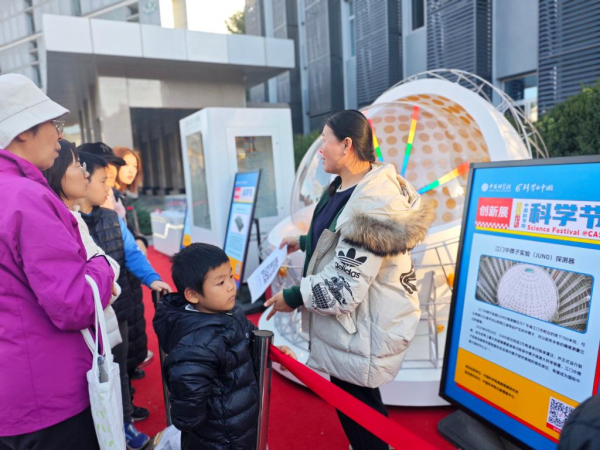
Core Points - The annual Science Festival of the Chinese Academy of Sciences (CAS) showcases various scientific innovations and engages the public, especially youth, in interactive activities [1][2][4] - The theme of this year's festival is "Hi, Science! - Curious Exploration of the Unknown, Science Connecting the Future," highlighting significant achievements in fields like neutrino experiments and quantum computing [1][2] - The festival is not limited to Beijing, with events held nationwide, emphasizing the importance of science in both urban and rural settings [2][4] Group 1 - The festival features engaging activities such as the "Creative Blind Box Show," science performances, and interactive exhibits that make science accessible and entertaining [1][2] - The event coincides with the 76th anniversary of CAS and the 70th anniversary of its academic divisions, reflecting the integration of national strategic scientific strength with the enhancement of public scientific literacy [4] - The festival serves as a platform for fostering curiosity and knowledge among children and teenagers, which is essential for driving technological self-reliance and innovation in the future [2][4]
太空千日 收获满满
Ren Min Ri Bao· 2025-11-04 03:02
Core Insights - The article highlights the significant advancements and achievements of China's space station, emphasizing its role in promoting high-level technological self-reliance and innovation in the country [6][7][12]. Group 1: Space Station Operations - The Shenzhou 21 astronaut crew launched from the Jiuquan Satellite Launch Center, marking a new chapter for the Chinese space station [7]. - Since its completion over 1000 days ago, the Chinese space station has supported seven astronaut crews and over 200 space science and application projects, showcasing China's technological capabilities [7][12]. - The space station has undergone various upgrades, including a new wireless communication system and an intelligent material management system, enhancing operational efficiency [8][9]. Group 2: Scientific Research and Experiments - The space station has successfully conducted numerous scientific experiments, including the cultivation of zebrafish and studies on microgravity's effects on vertebrate protein homeostasis [10][11]. - Research projects have exceeded expectations in several basic science fields, leading to innovative outcomes, such as the growth of high-quality indium selenide single crystals in microgravity [12] [11]. - The space station's experimental facilities have been designed to support a wide range of scientific research, with a focus on life sciences, materials science, and new technologies [11][12]. Group 3: Ground Support and Future Plans - The ground support team plays a crucial role in ensuring the stable operation of the space station, providing continuous monitoring and support for various missions [13][14]. - The integration of ground and digital support systems enhances the operational capabilities of the space station, allowing for real-time communication and troubleshooting [14][15]. - Future plans include expanding the capabilities of the space station and developing new missions, such as the "巡天空间望远镜" (巡天 Space Telescope) project [15][16].