
人工智能泡沫

Search documents
美股科技巨头市值蒸发5.7万亿,发生了什么?
Zheng Quan Shi Bao· 2025-11-09 05:33
Core Viewpoint - The recent sell-off in the U.S. tech sector, particularly in AI-related stocks, has led to significant market losses, raising concerns about overvaluation and potential market instability [1][3][4]. Group 1: Market Performance - The Nasdaq index, heavily weighted with tech stocks, experienced a weekly decline of over 3%, marking its worst performance since April [1][3]. - Eight major AI-related companies saw a combined market value loss exceeding $800 billion in a single week, with the total market loss for U.S. AI-related companies nearing $1 trillion [1][3]. - Nvidia alone lost approximately $348.5 billion in market value, with its stock dropping over 7% [3]. Group 2: Investor Sentiment - Concerns over high valuations in AI companies have prompted investors to withdraw from the market, resulting in the first weekly decline in three weeks for U.S. stocks [3][4]. - Retail investors, known for buying on dips, chose to remain cautious this week, reducing their holdings following Palantir's disappointing earnings report [4]. Group 3: Company-Specific Issues - Palantir's recent earnings report triggered a sell-off, as investors expressed worries about its high valuation [3][4]. - Meta has been implicated in generating significant revenue from fraudulent advertisements, with internal documents revealing that about $16 billion, or 10% of its projected 2024 revenue, comes from such ads [7][8]. Group 4: Broader Economic Concerns - The tech sector's struggles coincide with signs of weakness in the U.S. labor market and declining consumer confidence, as indicated by the Michigan Consumer Sentiment Index hitting a three-year low [4]. - Analysts are increasingly concerned that if investor confidence does not rebound, other sectors may also face repercussions, leading to broader market volatility [5].


降息生变,黄金新一轮突破!
Sou Hu Cai Jing· 2025-11-07 09:33
Market Overview - Gold prices experienced significant volatility, with a daily fluctuation of $55, closing at $3977.03, a slight decrease of nearly 0.1%. Currently, gold is trading around $4012 [1] - The U.S. stock market saw all three major indices decline, with the Nasdaq dropping by 445.81 points (1.90%), the S&P 500 down by 1.12%, and the Dow Jones falling by 0.84% [2] Employment Data - Revelio Labs reported a downward revision of September's job additions from 60,000 to 33,000, with October showing a loss of 9,100 jobs, marking the second worst performance of the year [4] Monetary Policy Uncertainty - Uncertainty regarding monetary policy is increasing market volatility, with mixed signals from Federal Reserve officials about future interest rate cuts. The expectation for a December rate cut has sharply decreased following a hawkish cut in October [5] - Cleveland Fed President Mester expressed concerns about persistent inflation levels, indicating that the Fed may not be prepared for further rate cuts, despite acknowledging issues in the labor market [5] - Chicago Fed President Goolsbee voiced unease about rate cuts due to a lack of inflation data during the government shutdown, contributing to a "policy vacuum" that typically leads to heightened market volatility [7] Tariff and Trade Issues - The U.S. Supreme Court is reviewing the legality of Trump's comprehensive tariff policy, which could have significant implications if the government loses the case. Trump has stated he will not announce new tariffs during the court's deliberation [8][10] AI Investment Concerns - A scenario reminiscent of the 2008 financial crisis is unfolding around AI investments, with Michael Burry publicly shorting Nvidia and Palantir, while Deutsche Bank considers shorting AI stocks to hedge against risks in data center loans [11] - Global regulatory bodies are warning about an AI asset bubble, with the Monetary Authority of Singapore highlighting "tense valuations" in the tech and AI sectors, suggesting a potential sharp correction [13] - CEOs from Goldman Sachs and Morgan Stanley have issued warnings about high valuations in the U.S. stock market, predicting at least a 10% correction [14]


刚刚,20%涨停!重磅利好引爆
天天基金网· 2025-11-07 05:32
Market Overview - On November 7, the A-share market opened lower but rebounded, with the Shanghai Composite Index and Shenzhen Component Index down by 0.16% and 0.37% respectively, while the North Star 50 Index rose nearly 1% [3] - The total market turnover for the half-day was 1.27 trillion yuan, slightly lower than the previous day, with over 2,300 stocks rising [5] Sector Performance - The basic chemical sector saw significant gains, with stocks in phosphorus chemical, fluorine chemical, organic silicon, and titanium dioxide experiencing high activity. Notable stocks included Dongyue Silicon Materials and Haixin Energy Technology, which hit the 20% daily limit [10][11] - The photovoltaic equipment sector also performed well, with companies like Hongyuan Green Energy and Yijing Photovoltaic reaching their daily limits [12] - The electric power equipment sector rose in tandem, with stocks like Ruitai New Materials and Tianji Shares also hitting the daily limit [13] Lithium Battery Sector - The lithium battery sector experienced a surge, with the price of lithium hexafluorophosphate rising due to increased market demand and reduced inventory. Companies reported full orders and strong product demand [14] Storage Chip Sector - The storage chip sector showed localized activity, with stocks like Demingli hitting the daily limit and reaching a historical high of 271.85 yuan per share. The supply-demand situation for storage chips remains tight, with SK Hynix completing negotiations for HBM4 supply with Nvidia [16][20] AI Sector - The AI application sector faced declines, with stocks related to operating systems, servers, and ChatGPT collectively underperforming. Concerns over high valuations in AI-related companies have intensified, leading to discussions about a potential "AI bubble" [21][24]



历史重演?“大空头2.0”再现了!
华尔街见闻· 2025-11-06 10:31
Group 1 - Michael Burry is heavily shorting Nvidia and Palantir, with 80% of his portfolio focused on these positions, indicating a bearish outlook on the AI sector [2][3] - Deutsche Bank is considering shorting AI stocks to hedge against significant loan risks in the data center sector, reflecting a cautious approach similar to strategies used during the 2008 financial crisis [1][6] - Global regulatory bodies are warning about the potential AI asset bubble, with specific alerts from the Monetary Authority of Singapore and the Korean Exchange regarding overvalued tech and AI sectors [1][2] Group 2 - Deutsche Bank has made substantial loans to major tech companies like Alphabet, Microsoft, and Amazon, with estimates of total loans reaching several billion dollars [5][6] - The bank is exploring options for risk hedging, including shorting a basket of AI-related stocks and utilizing synthetic risk transfer (SRT) derivatives to manage loan default risks [6][8] - There is a notable internal contradiction within Deutsche Bank, as some analysts downplay concerns about an AI bubble while simultaneously considering risk mitigation strategies [8]



Stock Market News for Nov 6, 2025
Yahoo Finance· 2025-11-06 09:45
Market Performance - Wall Street closed higher with all three major stock indexes ending in positive territory, driven by optimism regarding potential tariff recalls and strong economic data [1] - The Dow Jones Industrial Average (DJI) rose 0.5% or 225.76 points to close at 47,311.00, with 16 of the 30 components in positive territory [2] - The Nasdaq Composite increased by 0.7% or 151.16 points, closing at 23,499.78, largely due to the strong performance of AI infrastructure companies [2] - The S&P 500 gained 0.4% to finish at 6,796.29, with nine out of eleven sectors in positive territory, particularly the Consumer Discretionary and Materials sectors [3] Volatility and Trading Activity - The CBOE Volatility Index (VIX) decreased by 5.2% to 18.01, indicating reduced market fear [4] - A total of 19.17 billion shares were traded, which is lower than the 20-session average of 20.96 billion, suggesting a decrease in trading volume [4] - Advancers outnumbered decliners on the NYSE by a ratio of 2.09-to-1, and on the Nasdaq, the ratio was 1.84-to-1, indicating overall positive market sentiment [4] Legal Context of Tariffs - The Supreme Court began hearing arguments regarding the legality of tariffs imposed by the Trump administration, questioning the authority under the International Emergency Economic Powers Act (IEEPA) [5] - U.S. Solicitor General argued that the tariffs are incidental and not primarily revenue-raising, but justices expressed skepticism about the President's authority [6] - Chief Justice John Roberts highlighted that imposing taxes is traditionally a power of Congress, raising doubts about the tariffs' legal standing [7]
美国人工智能泡沫在周二迎来第一次公开的冲击,华尔街日报:目前仍投注人工智能上的是散户
Sou Hu Cai Jing· 2025-11-06 07:45
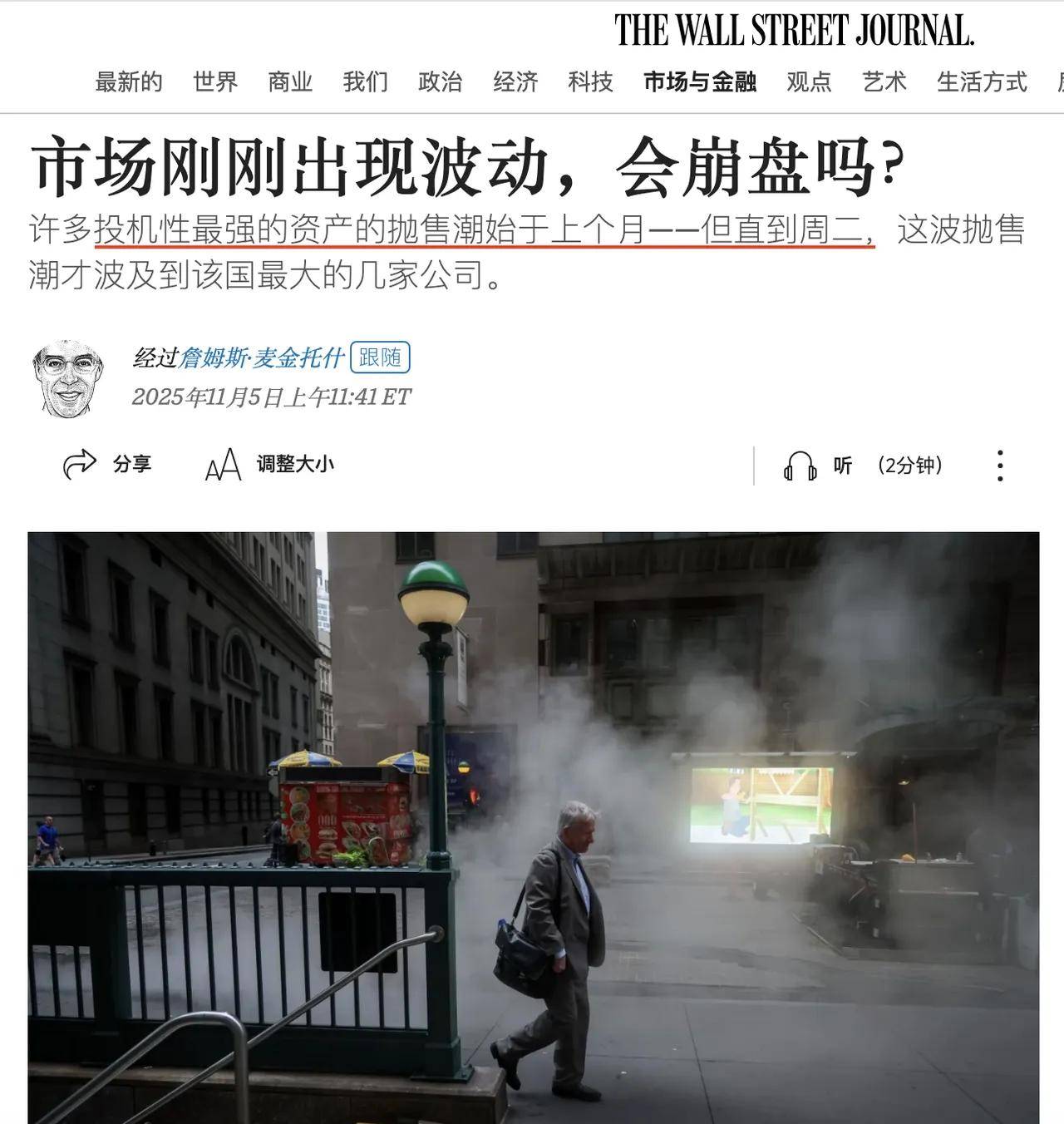
美国人工智能泡沫周二首遭公开冲击,据《华尔街日报》披露,投机性资产抛售潮上月已悄然开启,当前仍在人工智能领域冒险的,多为散户群体。 在人工智能泡沫讨论中,tsl周二股价大幅下挫,跌幅远超同行,引发市场关注。然而,有观点指出,若美国人工智能泡沫破裂,马斯克财富或迎新一轮暴 涨。原因在于,马斯克拥有实业基础,且被视为美国最有可能将人工智能与工业产品深度融合的人物。因此,他可能成为"华丽七雄"中的救命稻草,引领美 国人工智能走向成熟。 不过,也有质疑声音认为,尽管马斯克确实拥有实业支撑,但其产业链相对较短,难以对整体行业产生颠覆性影响。人工智能的广泛应用需要链接众多领 域,覆盖面越广的产业,受人工智能颠覆的效应也越显著。马斯克虽在人工智能与工业结合方面走在前列,但仅凭一己之力,难以改变整个行业的格局。人 工智能的发展,仍需更多力量共同推动,方能实现全面而深刻的变革。 股市泡沫中,散户常扮演"敢死队"角色,而机构则更似"督战队"。当下,人工智能泡沫成为热议话题,美国股民亦深陷其中。散户普遍坚信自身智慧超群, 尤其在股市长期上扬后,更觉能巧妙避开风险,如乌克兰战场上那些自信满满的南美雇佣兵,尽管身处险境,仍不乏认为自己 ...
德银在怕什么?砸数十亿贷款后,该行正秘密布局“做空AI泡沫”!
Jin Shi Shu Ju· 2025-11-06 06:08
Core Insights - Deutsche Bank is exploring methods to hedge its exposure to data center risks after providing billions in loans to meet the demand for artificial intelligence and cloud computing [1][2] - Concerns are rising about a potential bubble in the AI infrastructure spending, reminiscent of the internet bubble, as significant investments are made in an untested industry [2][3] Group 1: Risk Management Strategies - The bank is considering shorting a basket of AI-related stocks to mitigate downside risk [1] - Deutsche Bank is also looking into synthetic risk transfer (SRT) transactions to purchase default protection on some debts [1][2] Group 2: Industry Investment and Concerns - The scale of spending on AI infrastructure is estimated to reach $3 trillion, driving demand for services from companies in this sector [3] - Deutsche Bank has provided debt financing to companies like EcoDataCenter and 5C, totaling over $1 billion for their expansion [2] - Analysts at Deutsche Bank believe concerns about an AI bubble are exaggerated, suggesting that the real bubble is the discussion around the "bubble theory" itself [3]
历史重演还是纯属巧合?先是Burry做空,后是德银对冲,“大空头2.0”真实再现了!
Hua Er Jie Jian Wen· 2025-11-06 02:47
Core Insights - A situation reminiscent of the 2008 financial crisis is unfolding around the AI investment frenzy, with Michael Burry heavily shorting Nvidia and Palantir, echoing his previous actions during the housing bubble [1][2] - Deutsche Bank is considering shorting AI stocks to hedge against significant loan risks in the data center sector, marking a shift from real estate to AI-related loans [1][3] Group 1: Michael Burry's Actions - Michael Burry has concentrated approximately 80% of his portfolio on shorting Palantir and Nvidia, with a notional value exceeding $1 billion [1][2] - His bearish stance is supported by a belief that AI investment returns are too low and that many leading companies may ultimately collapse, similar to the internet bubble [2] Group 2: Deutsche Bank's Strategy - Deutsche Bank has made substantial bets on data center financing, primarily lending to major tech firms like Alphabet, Microsoft, and Amazon, with estimated loans reaching several billion dollars [3][4] - The bank is exploring options to hedge risks, including shorting a basket of AI-related stocks and utilizing a synthetic risk transfer (SRT) strategy to package and sell loan default risks to external investors [3][4] Group 3: Market Reactions and Concerns - Global regulatory bodies have issued warnings about the AI asset bubble, with Singapore's Monetary Authority highlighting "stretched valuations" in the tech and AI sectors [1] - Analysts have noted that Deutsche Bank's consideration of SRT structures resembles the debt collateralized obligations (CDOs) from the past, raising concerns about potential risks [4]
【UNforex财经事件】美元稳步上涨,黄金受限3970,ADP报告成市场分水岭
Sou Hu Cai Jing· 2025-11-05 10:35
Group 1 - The Chinese Ministry of Finance announced the cancellation of tariffs on certain U.S. agricultural products starting November 10, and the suspension of a 24% tariff on U.S. goods for one year, signaling a positive shift in U.S.-China trade relations [1] - U.S. President Trump indicated plans to initiate a new round of trade negotiations after meeting with Swiss officials, slightly increasing market risk appetite despite ongoing demand for safe-haven assets [1] - The Euro fell over 0.3% to 1.1480, while the British Pound dropped nearly 1% to 1.3010, its lowest point in seven months, influenced by comments from UK Chancellor Rachel Reeves about potential tax increases [1] Group 2 - Gold (XAU/USD) rebounded from a low of $3930 to $3970, supported by safe-haven demand amid global stock market declines and geopolitical uncertainties, although it failed to break the $4000 mark [2] - The upcoming ADP employment data is expected to show an addition of 24,000 jobs in October, reversing a loss of 32,000 jobs in September, making the report increasingly significant due to the government shutdown delaying other employment data [2] - If the ADP data exceeds expectations, it could reinforce the Federal Reserve's hawkish stance and boost the U.S. dollar; conversely, weak data may lead to renewed bets on a Fed rate cut in December [2] Group 3 - The U.S. Dollar Index (DXY) is consolidating above the 100 mark, with resistance levels at 100.25, 100.55, and 101.25, while support levels are at 99.55 and 98.90 [3] - Gold's short-term support is at $3970 and $3940, with key resistance at $4000 and $4035; a weak ADP report could push gold above $4000, attracting bullish sentiment [3] - Investors are advised to focus on the ADP employment data and ISM services PMI data, as these will influence market sentiment and the performance of both the dollar and gold [3]

【UNFX财经事件】黄金坚守3970美元关口,市场焦点集中ADP报告
Sou Hu Cai Jing· 2025-11-05 10:18
黄金在避险情绪的支持下从3930美元低点反弹,稳步上升至3970美元附近。尽管黄金未能突破4000美元 关口,但在全球股市大跌和地缘政治紧张的背景下,黄金吸引了逢低买盘。全球股市因对人工智能泡沫 的担忧大幅下跌,进一步促使避险资金流入黄金。然而,由于美联储的鹰派立场以及市场对12月降息预 期的降温,黄金的上涨空间受到压制。目前黄金价格受制于3970美元附近的区间,短期涨幅仍然受美元 强势和市场谨慎情绪的抑制。尽管如此,地缘政治风险和美国政府停摆的背景下,黄金依旧拥有一定支 撑。 美国自动数据处理公司(ADP)将于北京时间周三21:15公布10月就业变化报告。市场预期,美国私营 部门新增就业岗位为2.4万个,扭转9月的3.2万减少数据。由于政府停摆导致JOLTS和非农数据的推迟发 布,ADP数据的意义更加突出。分析人士认为,如果就业数据好于预期,将加强鲍威尔的鹰派言论,为 美元提供进一步支撑;如果数据疲软,市场可能会重新押注美联储12月降息。 中国财政部宣布,自11月10日起将取消部分美国产农产品关税,并暂停加征24%关税,为期一年。这一 消息被解读为中美贸易关系有望改善的积极信号。同时,美国总统特朗普透露,计 ...