
库存管理

Search documents
李宁(02331):2025H1营收稳健增长,全渠道库存处于健康可控水平
Shanxi Securities· 2025-08-25 09:14
Investment Rating - The report maintains a "Buy-A" rating for Li Ning (02331.HK) [1] Core Views - In the first half of 2025, the company achieved a revenue of 14.817 billion yuan, representing a year-on-year growth of 3.3%, while the net profit attributable to shareholders was 1.737 billion yuan, down 11.0% year-on-year [2][4] - The board proposed a mid-term dividend of 0.3359 yuan per share, with a payout ratio of 50% [2] - The company's EBITDA for the first half of 2025 was 3.513 billion yuan, reflecting a 2.0% increase year-on-year [4] Revenue and Profit Analysis - Revenue from footwear, apparel, accessories, and equipment for the first half of 2025 was 8.231 billion, 5.193 billion, 1.393 billion, and 0.139 billion yuan respectively, with year-on-year growth rates of 4.9%, -3.4%, and 23.7% [5] - The retail sales of running shoes exceeded 5.26 million pairs, with significant growth in the running and casual sports categories [5] - The company reported a gross margin of 50.0%, a slight decline of 0.4 percentage points year-on-year, attributed to a decrease in the proportion of high-margin direct sales [6][8] Channel Performance - Direct sales revenue decreased by 3.4% to 3.383 billion yuan, while e-commerce revenue grew by 7.4% to 4.300 billion yuan, indicating a strong performance in the online channel [6] - The company maintained a healthy inventory turnover with an inventory amount of 2.428 billion yuan, a year-on-year increase of 5.0% [8] Financial Forecast and Valuation - The company is expected to have EPS of 1.02, 1.14, and 1.21 yuan for 2025, 2026, and 2027 respectively, with corresponding P/E ratios of 17.5, 15.8, and 14.9 [9][11] - The report indicates a stable growth outlook for the company, particularly in the running category, and suggests a limited expansion in store numbers [9]

甲醇聚烯烃早报-20250825
Yong An Qi Huo· 2025-08-25 03:10
Report Summary 1. Report Industry Investment Rating No investment rating information is provided in the report. 2. Report Core Views - For methanol, port inventory has significantly accumulated, with high imports and actual inventory. The expected return of inland supply is on the horizon, and traditional demand will enter the peak season later. Attention should be paid to whether demand can support after the return of inland supply. If inventory deteriorates significantly, methanol's valuation may decline [1]. - For polyethylene, the inventory of the two major oil companies is neutral year - on - year. Upstream, the two major oil companies are accumulating inventory, while coal - chemical enterprises are reducing inventory. Downstream, raw material and finished - product inventories are neutral. Overall inventory is neutral. The 09 basis is around - 150 in North China and - 100 in East China. Import profit is around - 100 with no further increase for now. In August, maintenance decreased month - on - month, and domestic linear production increased. Attention should be paid to LL - HD conversion and US quotes, as well as the commissioning of new plants in 2025 [4]. - For polypropylene, upstream, the two major oil companies are accumulating inventory, while the middle - stream is reducing inventory. In terms of valuation, the basis is - 60, non - standard price difference is neutral, and import profit is around - 800. Exports have been good this year. Non - standard price difference is neutral. PDH profit is around - 200, propylene is fluctuating, and powder production is stable. In June, supply is expected to increase slightly month - on - month. Downstream orders are average currently, and raw material and finished - product inventories are neutral. Under the background of over - capacity, the 09 contract is expected to face moderate to excessive pressure. If exports continue to increase or there are many PDH plant maintenance, the supply pressure can be alleviated to a neutral level [4]. - For PVC, the basis remains at 01 - 270, and the factory - pickup basis is - 480. Downstream operation is seasonally weak, but the willingness to hold goods at low prices is strong. Mid - and upstream inventories are continuously accumulating. In summer, northwest plants have seasonal maintenance, and the load center is between the spring maintenance and the high - production period in Q1. In Q4, attention should be paid to the commissioning of new plants and export sustainability. Near - term export orders have slightly declined. Coal sentiment is positive, and the cost of semi - coke is stable. Calcium carbide's profit is under pressure due to PVC maintenance. The export counter - offer for caustic soda is FOB380. Currently, the contradiction in static inventory is accumulating slowly, cost is stable, downstream performance is average, and the macro - environment is neutral. Attention should be paid to exports, coal prices, commercial housing sales, terminal orders, and operation [4]. 3. Summary by Product Methanol - **Price Data**: From August 18 - 22, 2025, the daily change of动力煤期货 is 0, the change of江苏现货 is - 13,华南现货 is - 15,鲁南折盘面 is - 5,西南折盘面 is 0,河北折盘面 is 0,西北折盘面 is 8, CFR中国 is - 4, CFR东南亚 is 0,进口利润 is 15,主力基差 is 0, and盘面MTO利润 is 0 [1]. Polyethylene - **Price Data**: From August 18 - 22, 2025, the daily change of东北亚乙烯 is 0,华北LL is 0,华东LL is 40,华东LD is 25,华东HD is - 20, LL美金 is 0, LL美湾 is 0,进口利润 is 0,主力期货 is - 6,基差 is 0,两油库存 is - 2, and仓单 is 0 [4]. Polypropylene - **Price Data**: From August 18 - 22, 2025, the daily change of山东丙烯 is 50,东北亚丙烯 is 0,华东PP is 5,华北PP is 5,山东粉料 is 0,华东共聚 is 0, PP美金 is 0, PP美湾 is 0,出口利润 is 0,主力期货 is - 10,基差 is 0,两油库存 is - 2, and仓单 is 115 [4]. PVC - **Price Data**: From August 18 - 22, 2025, the daily change of西北电石 is 0,山东烧碱 is 10,电石法 - 华东 is - 10,乙烯法 - 华东 is 0,电石法 - 华南 is 0,电石法 - 西北 is 0,进口美金价(CFR中国) is 0,出口利润 is 0,西北综合利润 is 0,华北综合利润 is 0, and基差(高端交割品) is 0 [4].
长虹美菱20250822
2025-08-24 14:47
Summary of Changhong Meiling's Conference Call Company Overview - **Company**: Changhong Meiling - **Date**: 2025 H1 Key Points Industry Performance - **Refrigerator and Freezer Business**: Revenue decreased by 4% to 4.4 billion yuan [2][3] - **Air Conditioning Business**: Revenue increased by 36% to 11.6 billion yuan [2][3] - **Washing Machine Business**: Revenue increased by 32.7% to 1.04 billion yuan [2][3] - **Kitchen and Small Appliances**: Slight decline in revenue, close to 700 million yuan [2][3] - **Biomedical Business**: Revenue increased to 150 million yuan [2][3] Financial Performance - **Total Revenue**: 18.072 billion yuan, a year-on-year increase of 20% [3] - **Net Profit**: Remained stable compared to the previous year [3] - **Income Tax**: Increased by approximately 50% to over 80 million yuan, primarily due to profit growth in headquarters and central air conditioning department [2][8] - **Asset and Credit Impairment**: Increased due to rising inventory and accounts receivable, with potential recovery dependent on market conditions [2][9] Strategic Initiatives - **Marketing Transformation**: Implementing user direct strategies and product integration to address domestic market pressures [2][5] - **Dual-Drive Strategy for Air Conditioning**: Focusing on both B2B and B2C markets to achieve growth [2][5] - **Washing Machine Focus**: Emphasizing core channels and differentiated products, particularly in overseas markets [2][5] - **Inventory Management**: Plans to optimize inventory and improve supply chain efficiency to mitigate impairment risks [2][6] Future Outlook - **Market Challenges**: Facing intensified competition in the domestic appliance market and international trade barriers [2][3] - **Production Capacity Expansion**: Ongoing projects for air conditioning, washing machines, and high-end refrigerators to meet future demand [4][12][16][17] - **Profitability Improvement**: Aiming to enhance product structure and increase the proportion of high-value products [7][33] International Market Performance - **Emerging Markets**: Significant growth in overseas markets, particularly in Europe, with a focus on high-end and cost-effective products [22][25] - **Sales Channels**: Domestic sales channels are evenly split between online and offline, with an expected increase in online sales [26] Challenges and Responses - **External Market Pressures**: High tariffs and competitive pricing in international markets affecting profitability [14][29] - **Response Strategies**: Early production, inventory management optimization, and strengthening customer collaboration [14] Product Development - **High-End Product Focus**: Approximately 30% of sales from high-end refrigerators and washing machines, with margins between 30% to 40% [21] - **New Product Launches**: Plans to introduce new high-end product lines to enhance market performance [21] Conclusion - **Overall Strategy**: Changhong Meiling aims to leverage both domestic and international markets, focusing on innovation, resource integration, and enhancing operational efficiency to achieve growth targets in 2025 and beyond [32][33]


崔东树:7月月末全国乘用车行业库存329万辆 环比上月下降3万辆
智通财经网· 2025-08-22 08:13
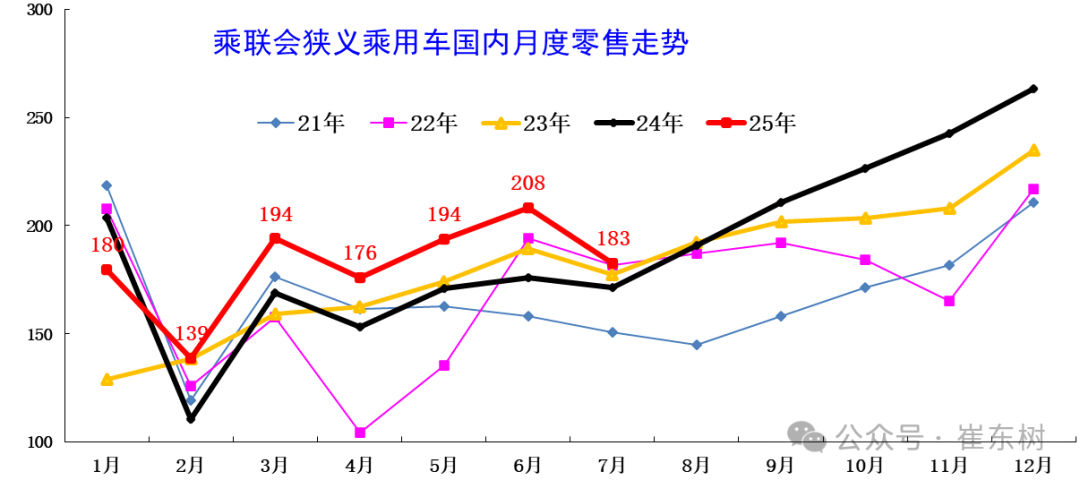
智通财经APP获悉,乘联分会秘书长崔东树发文称,2025年7月月末全国乘用车行业库存329万辆,较上月下降3万辆,较2024年7月下降4万辆,形成库存 下降良好改善的特征。目前的政策启动带来厂商的总体乐观,以旧换新推动的生产较高,厂家批发相对积极,4月行业库存350万创出近两年新高。但5-7 月的车企相对更理性控制生产,减少对经销商的库存压力,形成5-7月持续去库存,7月降到329万的较好走势。 随着中央促消费政策的推动,各地车展等营销活动的活跃,车市好于预期走势。随着6-8月的销售逐步转入季节性淡季,未来三个月的销量逐步下行。因 此车企主动降库存,根据2025年7月底的库存与未来销量综合预估的现有库存支撑未来销售天数在47天,相对于2023年7月的53天、2024年7月的51天,今 年7月的总体库存压力明显下降。仅生产新能源车的企业的库存2025年4月库存88万辆,6月降到80万,7月进一步下降到78万台,环比6月降2万。 1. 近年狭义乘用车零售走势 | 零售 | 17年 | 18年 | 19年 | 20年 | 21年 | 22年 | 23年 | 24年 | 25年 | | --- | --- | --- ...

Ross Stores(ROST) - 2026 Q2 - Earnings Call Transcript
2025-08-21 21:17
Financial Data and Key Metrics Changes - Total sales for the second quarter grew 5% to $5.5 billion, up from $5.3 billion last year, with comparable store sales increasing by 2% [7] - Earnings per share for the second quarter were $1.56 on net income of $508 million, compared to $1.59 per share on net earnings of $527 million in the prior year [7][8] - Operating margin decreased by 95 basis points to 11.5%, primarily due to tariff-related costs [6][14] Business Line Data and Key Metrics Changes - Cosmetics was the best-performing merchandise area in the second quarter, with strong performance in the ladies' business, which outperformed the chain average [8][29] - Overall comparable store sales at BB's Discounts were solid and ahead of Ross, with both chains experiencing growth in traffic and basket size [9] Market Data and Key Metrics Changes - The strongest markets were the Southeast and the Midwest, with a broad-based improvement in sales trends across nearly all major merchandise categories and regions [5][8] - Total consolidated inventories and average store inventories were up 5% compared to last year, with packaway merchandise comprising 38% of total inventories [9] Company Strategy and Development Direction - The company plans to open approximately 90 new locations this year, including 80 Ross and 10 DD's Discount stores, reflecting expansion into new and existing markets [10] - The company is focused on maintaining its value proposition relative to traditional retailers while balancing the opportunity to preserve merchandise margin [12][20] Management's Comments on Operating Environment and Future Outlook - Management expressed cautious optimism regarding the sales outlook for the second half of the year, anticipating comparable store sales growth of 2% to 3% [16][33] - The company expects to offset most of the impact of tariffs, although modest pressure is anticipated in the third quarter [12][17] Other Important Information - The company repurchased 1.9 million shares of common stock for an aggregate cost of $262 million, remaining on track to buy back a total of $1.05 billion in stock for the year [15] - Management acknowledged the retirement of CFO Adam Orvos and emphasized the importance of a smooth transition [21] Q&A Session Summary Question: Can you elaborate on the sequential top line improvement and the sharp rebound in July? - Management noted broad-based sequential improvement across nearly every merchandise category, with strong performance in July, particularly in cosmetics and ladies' business [28][29] Question: What are the gross margin drivers for the third and fourth quarters? - Management indicated that tariff costs would continue to impact gross margins, but they expect the pressure to be slightly lower than in the second quarter [31] Question: How is the customer responding to price increases? - Management stated that there has been a very modest change in prices, with a cautious approach to raising prices while monitoring competitors [38][39] Question: What initiatives are being implemented to improve store operations? - Management highlighted store refreshes, self-checkout pilots, and new marketing campaigns as key initiatives to enhance customer experience and drive sales [44][49] Question: Are there any changes in consumer demographics or trade down activity? - Management reported no significant changes in income cohorts but noted strong performance in stores with a high concentration of Hispanic customers [65][66] Question: What actions are being taken to mitigate tariff impacts? - Management emphasized efforts in vendor negotiations, diversifying sourcing, and increasing closeout merchandise to mitigate tariff impacts [71][72]

开立医疗2025上半年归母净利润暴跌72.43%,存货周转天数增长46.46%
Sou Hu Cai Jing· 2025-08-21 09:56
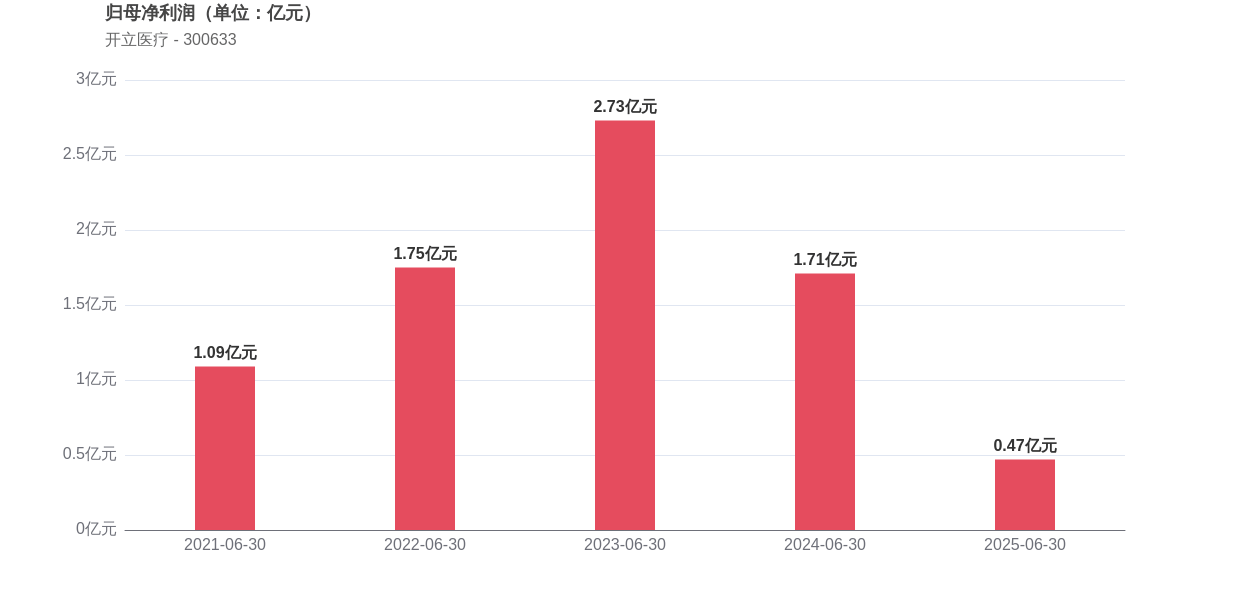
Core Insights - The core viewpoint of the news is that Kaili Medical has experienced a significant decline in its operating performance in the first half of 2025, with indications of a potential recovery in the second quarter. Financial Performance - In the first half of 2025, Kaili Medical reported operating revenue of 964 million yuan, a year-on-year decrease of 4.78% [1] - The net profit attributable to shareholders was 47 million yuan, a substantial year-on-year decline of 72.43% [1] - The second quarter net profit attributable to shareholders was 39 million yuan, showing a significant quarter-on-quarter increase of 382.45% [1] Profitability Indicators - The net profit margin dropped from 16.84% in the first half of 2024 to 4.88% in 2025 [3] - The gross profit margin decreased from 67.43% to 62.08% [3] - The return on equity fell by 3.80 percentage points to 1.50% [3] Operational Stability - Kaili Medical faced inventory management pressures, with inventory turnover days reaching 354.68 days, an increase of 46.46% year-on-year [5] - The net cash flow from operating activities was -250 million yuan, a shift from a positive 15 million yuan in the same period of 2024 [5] - The asset-liability ratio for the first half of 2025 was 22.46%, a year-on-year decrease of 1.23 percentage points, indicating better control over debt levels [5] Institutional Holdings - As of the first half of 2025, the number of institutions holding Kaili Medical's stock was 32, a significant decrease of 312 from 344 in the same period of 2024 [8] - The highest market capitalization of Kaili Medical was 26.967 billion yuan on June 9, 2023, while the current market capitalization is 15.426 billion yuan, indicating a required stock price increase of 74.82% to reach the historical peak [8] - Despite the challenges, the stock price has increased by 21.67% year-to-date, reflecting some market confidence in the company's long-term prospects [8]

甲醇聚烯烃早报-20250820
Yong An Qi Huo· 2025-08-20 01:53
Report Summary 1. Industry Investment Rating No industry investment rating is provided in the report. 2. Core Viewpoints - **Methanol**: Port inventory has increased significantly, with high imports and actual inventory. The supply in the inland region is expected to return, and the traditional demand will enter the peak season later. It is necessary to pay attention to whether the demand can be supported after the supply in the inland region returns. If the inventory deteriorates significantly, methanol is expected to see a valuation correction [2]. - **Polyethylene**: The inventory of the two major oil companies is neutral year - on - year. The two major oil companies are accumulating inventory, while the coal - chemical industry is reducing inventory. The overall inventory is neutral. The 09 basis is around - 150 in North China and - 100 in East China. The import profit is around - 100, with no further increase for the time being. The non - standard HD injection molding price is stable, and other price differences are fluctuating. The number of maintenance in August has decreased month - on - month, and the domestic linear production has increased month - on - month. Attention should be paid to the LL - HD conversion and the US quotation. The pressure from new plants in 2025 is relatively large, and the commissioning of new plants should be monitored [7]. - **Polypropylene**: The upstream two major oil companies are accumulating inventory, while the middle - stream is reducing inventory. In terms of valuation, the basis is - 60, the non - standard price difference is neutral, and the import profit is around - 800. Exports have been performing well this year. The non - standard price difference is neutral. The PDH profit is around - 200, propylene is fluctuating, and the powder production start - up rate is stable. The拉丝 production scheduling is neutral. The supply in June is expected to increase slightly month - on - month. The current downstream orders are average, and the raw material and finished - product inventories are neutral. Under the background of over - capacity, the 09 contract is expected to face moderate to excessive pressure. If exports continue to increase or there are many PDH plant maintenance, the supply pressure can be alleviated to a neutral level [7]. - **PVC**: The basis is maintained at 09 - 150, and the factory - pick - up basis is - 450. The downstream start - up rate is seasonally weakening, and the willingness to hold inventory at low prices is strong. The inventory reduction of the mid - upstream has slowed down. The northwest plants are undergoing seasonal maintenance in summer, and the load center is between the spring maintenance and the high production in Q1. Attention should be paid to the commissioning and export sustainability from July to August. The recent export orders have decreased slightly. The coal sentiment is positive, the cost of semi - coke is stable, and the profit of calcium carbide is under pressure due to PVC maintenance. The FOB counter - offer for caustic soda exports is 380. Attention should be paid to whether the subsequent export orders can support the high price of caustic soda. The comprehensive profit of PVC is - 500. Currently, the static inventory contradiction is accumulating slowly, the cost is stable, the downstream performance is average, and the macro situation is neutral. Attention should be paid to exports, coal prices, commercial housing sales, terminal orders, and start - up rates [7]. 3. Summary by Commodity Methanol - **Price Data**: On August 19, 2025, compared with August 18, the daily change in power coal futures was 0, the Jiangsu spot price decreased by 27, the South China spot price decreased by 23, the Lunan discounted price remained unchanged, the Southwest discounted price decreased by 35, the Hebei discounted price remained unchanged, the Northwest discounted price remained unchanged, the CFR China price remained unchanged, the CFR Southeast Asia price remained unchanged, the import profit increased by 5, and the main contract basis and the MTO profit on the disk remained unchanged [2]. Polyethylene - **Price Data**: On August 19, 2025, compared with August 18, the Northeast Asian ethylene price remained unchanged, the North China LL price decreased by 20, the East China LL price remained unchanged, the East China LD price remained unchanged, the East China HD price remained unchanged, the LL US dollar price remained unchanged, the LL US Gulf price remained unchanged, the import profit remained unchanged, the main futures price decreased by 27, the basis remained unchanged, the two - oil inventory remained unchanged, and the warehouse receipts increased by 379 [7]. Polypropylene - **Price Data**: On August 19, 2025, compared with August 18, the Shandong propylene price remained unchanged, the Northeast Asian propylene price remained unchanged, the East China PP price decreased by 35, the North China PP price decreased by 20, the Shandong powder price remained unchanged, the East China copolymer price decreased by 4, the PP US dollar price remained unchanged, the PP US Gulf price remained unchanged, the export profit remained unchanged, the main futures price decreased by 32, the basis increased by 10, the two - oil inventory remained unchanged, and the warehouse receipts increased by 1180 [7]. PVC - **Price Data**: On August 19, 2025, compared with August 18, the Northwest calcium carbide price remained unchanged, the Shandong caustic soda price remained unchanged, the calcium - carbide - based East China price decreased by 40, the ethylene - based East China price remained unchanged, the calcium - carbide - based South China price remained unchanged, the calcium - carbide - based Northwest price remained unchanged, the import US dollar price (CFR China) remained unchanged, the export profit remained unchanged, the Northwest comprehensive profit remained unchanged, the North China comprehensive profit remained unchanged, and the basis (high - end delivery product) remained unchanged [7].
盛景微2025上半年毛利率下滑1.88个百分点,机构持股家数大幅减少
Sou Hu Cai Jing· 2025-08-19 15:52
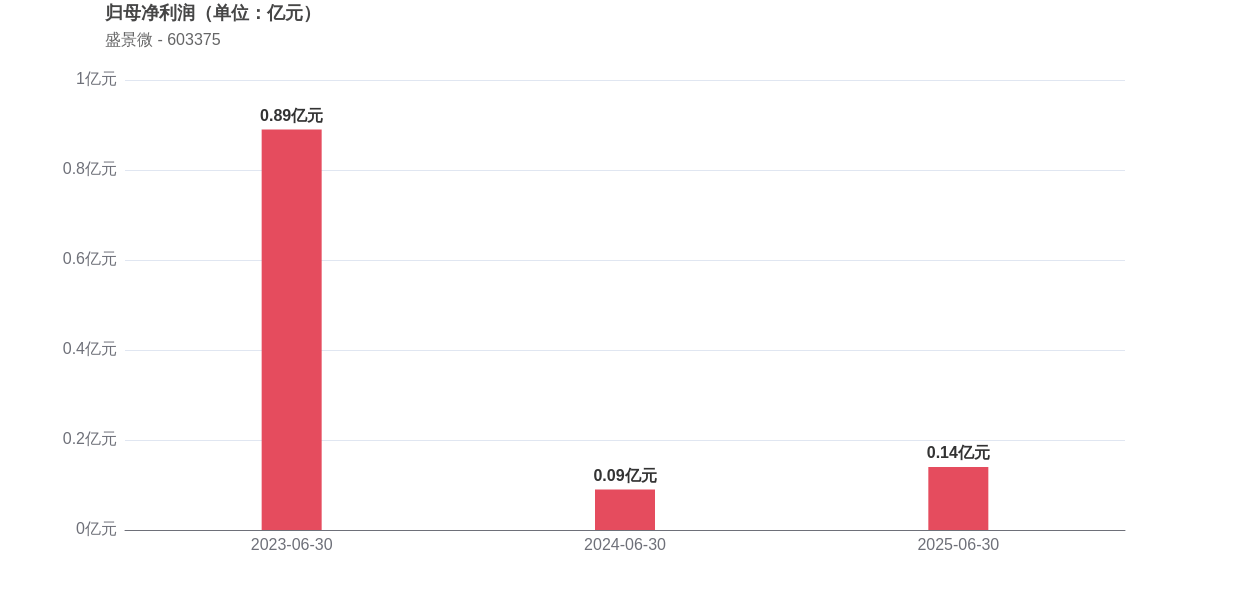
Core Viewpoint - Shengjing Micro's financial performance in the first half of 2025 shows steady growth, with revenue and net profit increasing significantly, indicating a positive trend in the company's operations [1][3]. Financial Performance - In the first half of 2025, Shengjing Micro achieved operating revenue of 235 million yuan, a year-on-year increase of 2.4% [1]. - The net profit attributable to shareholders reached 14 million yuan, reflecting a substantial year-on-year growth of 57.66% [1]. - The net profit margin improved from 2.01% in the first half of 2024 to 6.60% in 2025, an increase of 4.59 percentage points, indicating enhanced profitability [3]. - The gross profit margin decreased from 36.46% in the first half of 2024 to 34.58% in 2025, a decline of 1.88 percentage points [3]. - The return on equity (ROE) for the first half of 2025 was 0.91%, up by 0.28 percentage points year-on-year [3]. Operational Efficiency - Shengjing Micro's inventory turnover days improved to 261.74 days, a reduction of 21.86% compared to the first half of 2024, indicating better inventory management [5]. - The net cash flow from operating activities was 50 million yuan, a significant turnaround from a negative 39 million yuan in the same period of 2024, showcasing improved cash flow conditions [5]. - The asset-liability ratio for the first half of 2025 was 11.08%, down by 4.19 percentage points year-on-year, reflecting a more robust financial structure [5]. Institutional Holdings - As of the first half of 2025, the number of institutions holding Shengjing Micro's stock decreased to 10, down from 2,178 in the same period of 2024, indicating a decline in institutional investor confidence [7]. - The company's market capitalization peaked at 6.944 billion yuan on January 29, 2024, while the current market cap stands at 4.183 billion yuan, suggesting a need for a 66.02% increase in stock price to reach its historical high [7]. - Despite the decline in institutional holdings, improvements in profitability and cash flow position the company favorably for future growth [7].
华致酒行(300755) - 300755华致酒行投资者关系管理信息20250819
2025-08-19 14:30
Group 1: Market Challenges and Company Response - The liquor market is under pressure due to multiple factors, including industry cycle fluctuations and tightening macro policies, leading to increased operational challenges [2][3] - The company has actively responded to performance pressures by adjusting strategies, optimizing inventory structure, and promoting transformation [2][3] Group 2: Operational Achievements - Inventory reduction efforts have been successful, with inventory decreasing from CNY 3.259 billion to CNY 2.822 billion, resulting in a 293.7% year-on-year increase in operating cash flow [3] - The asset-liability ratio improved from 54.13% to 41.83%, enhancing the company's ability to withstand cyclical risks [3] Group 3: Cost Control Measures - The company implemented cost reduction strategies, achieving a 40.48% decrease in sales expenses and a 24.81% reduction in management expenses [4] Group 4: Business Development Strategies - The company focused on a customer-centric operational model, enhancing its marketing network through three main store formats: "Hua Zhi Wine Shop," "Hua Zhi Famous Wine Library," and "Hua Zhi Preferred" [5][6] - A service-oriented supply chain platform was established to improve efficiency and quality, catering to diverse consumer needs [6] Group 5: Instant Retail Initiatives - The company launched instant retail services through various platforms, significantly improving consumer shopping efficiency and satisfaction [7] - The integration of online and offline services allows for rapid delivery, meeting immediate consumer demands for social and business occasions [7] Group 6: Organizational and Talent Development - The company emphasized talent development and organizational restructuring to enhance operational efficiency, shifting focus from sales-centric to customer-centric approaches [8][9] Group 7: Financial Performance and Market Outlook - The company reported a significant increase in cash flow from operating activities, attributed to effective inventory management and supplier collaboration [10][11] - Despite a challenging market, the company aims to increase the sales proportion of famous wines while expanding the premium wine market [12][13]

《特殊商品》日报-20250819
Guang Fa Qi Huo· 2025-08-19 02:34
Group 1: Rubber Industry Report Industry Investment Rating Not mentioned Core View The current rubber market lacks clear directional guidance, with long and short factors intertwined, and prices mainly fluctuate within a range. The 01 contract range is expected to be between 15,000 - 16,500 yuan/ton. Follow-up attention should be paid to the raw material supply during the peak production season in the main producing areas. If the raw material supply goes smoothly, consider shorting at high prices [1]. Summary by Directory - **Spot Price and Basis**: On August 18, the price of Yunnan state - owned whole latex in Shanghai increased by 150 yuan/ton to 14,900 yuan/ton, with a growth rate of 1.02%. The whole milk basis (switched to the 2509 contract) increased by 235 to - 920, with a growth rate of 20.35%. The price of Thai standard mixed rubber decreased by 50 yuan/ton to 14,600 yuan/ton, with a decline rate of 0.34% [1]. - **Monthly Spread**: The 9 - 1 spread increased by 25 to - 1035, with a growth rate of 2.36%; the 1 - 5 spread decreased by 15 to - 80, with a decline rate of 18.75%; the 5 - 9 spread decreased by 10 to 1130, with a decline rate of 0.88% [1]. - **Fundamentals**: In June, Thailand's rubber production increased by 120,400 tons to 392,600 tons, with a growth rate of 44.23%; Indonesia's production decreased by 24,100 tons to 176,200 tons, with a decline rate of 12.03%; India's production increased by 14,700 tons to 62,400 tons, with a growth rate of 30.82%; China's production increased by 6,800 tons to 103,200 tons. The weekly开工率 of semi - steel tires decreased by 2.28 to 72.07%, and that of all - steel tires increased by 2.09 to 63.09%. In June, domestic tire production decreased by 100% to 0, and tire export volume increased by 6340,000 to 66,650,000, with a growth rate of 10.51%. The total import volume of natural rubber increased by 10,000 tons to 463,400 tons, with a growth rate of 2.21% [1]. - **Inventory Change**: As of August 18, the bonded area inventory decreased by 11,918 to 619,852, with a decline rate of 1.89%. The factory warehouse futures inventory of natural rubber on the SHFE increased by 4,234 to 46,469, with a growth rate of 10.02% [1]. Group 2: Industrial Silicon Industry Report Industry Investment Rating Not mentioned Core View Last week, the price of industrial silicon fluctuated strongly. It is recommended to try to go long at low prices. The main price fluctuation range is expected to be between 8,000 - 9,500 yuan/ton. If the price drops to the low level of 8,000 - 8,500 yuan/ton, consider going long at low prices. The main contract has shifted to SI2511 [3]. Summary by Directory - **Spot Price and Main Contract Basis**: On August 18, the price of East China oxygen - passing S15530 industrial silicon remained unchanged at 9,400 yuan/ton. The basis (based on oxygen - passing SI5530) increased by 200 to 795, with a growth rate of 33.61% [3]. - **Monthly Spread**: The 2509 - 2510 spread decreased by 5 to - 20, with a decline rate of 33.33%; the 2510 - 2511 spread increased by 5 to - 5, with a growth rate of 50.00%; the 2511 - 2512 spread remained unchanged at - 365; the 2512 - 2601 spread increased by 25 to 20, with a growth rate of 500.00%; the 2601 - 2602 spread decreased by 45 to - 30, with a decline rate of 300.00% [3]. - **Fundamentals**: In the monthly data, the national industrial silicon production increased by 10,600 tons to 338,300 tons, with a growth rate of 3.23%. Xinjiang's production decreased by 27,000 tons to 150,300 tons, with a decline rate of 15.21%. Yunnan's production increased by 24,900 tons to 41,200 tons, with a growth rate of 153.86%. Sichuan's production increased by 11,500 tons to 48,500 tons, with a growth rate of 31.05%. The national开工率 increased by 1.27 to 52.61%, with a growth rate of 2.47%. Xinjiang's开工率 decreased by 11.71 to 52.59%, with a decline rate of 18.21%. Yunnan's开工率 increased by 18.82 to 32.89%, with a growth rate of 133.76%. Sichuan's开工率 increased by 13.39 to 36.96%, with a growth rate of 56.81%. The production of silicone DMC decreased by 9,500 tons to 199,800 tons, with a decline rate of 4.54%. The production of polysilicon increased by 4,900 tons to 101,000 tons, with a growth rate of 5.10%. The production of recycled aluminum alloy increased by 1,000 tons to 625,000 tons, with a growth rate of 1.63%. The export volume of industrial silicon increased by 12,700 tons to 68,300 tons, with a growth rate of 22.77% [3]. - **Inventory Change**: The Xinjiang factory warehouse inventory increased by 0.01 to 11.70 tons, with a growth rate of 0.09%. The Yunnan factory warehouse inventory increased by 0.08 to 3.14 tons, with a growth rate of 2.61%. The Sichuan factory warehouse inventory decreased by 0.02 to 2.26 tons, with a decline rate of 0.88%. The social inventory decreased by 0.20 to 54.50 tons, with a decline rate of 0.37%. The order inventory increased by 0.06 to 25.36 tons, with a growth rate of 0.22%. The non - warehouse receipt inventory decreased by 0.26 to 29.15 tons, with a decline rate of 0.87% [3]. Group 3: Polysilicon Industry Report Industry Investment Rating Not mentioned Core View Last week, the polysilicon price fluctuated strongly. It is expected to mainly fluctuate at a high level, with the lower limit of the price fluctuation range rising to 47,000 yuan/ton and the upper limit between 58,000 - 60,000 yuan/ton. Consider going long at low prices and try shorting by buying put options at high prices when the volatility is low [4]. Summary by Directory - **Spot Price and Basis**: On August 18, the average price of N - type re -投料 remained unchanged at 47,000 yuan/ton. The N - type material basis (average price) increased by 460 to - 5280, with a growth rate of 8.01% [4]. - **Futures Price and Monthly Spread**: The main contract price decreased by 460 to 52,280 yuan/ton, with a decline rate of 0.87%. The spread between the current month and the first - continuous contract increased by 50 to - 135, with a growth rate of 27.03%. The spread between the first - continuous and the second - continuous contract increased by 30 to 75, with a growth rate of 66.67% [4]. - **Fundamentals**: In the weekly data, the silicon wafer production increased by 0.08 to 12.10 GM, with a growth rate of 0.67%. The polysilicon production decreased by 0.01 to 2.93 tons, with a decline rate of 0.34%. In the monthly data, the polysilicon production increased by 0.49 to 10.10 tons, with a growth rate of 5.10%. The polysilicon import volume decreased by 0.02 to 0.08 tons, with a decline rate of 16.90%. The polysilicon export volume increased by 0.08 to 0.21 tons, with a growth rate of 66.17%. The net export volume of polysilicon increased by 0.10 to 0.13 tons, with a growth rate of 323.61%. The silicon wafer production decreased by 6.09 to 52.75 GM, with a decline rate of 10.35%. The silicon wafer import volume decreased by 0.01 to 0.07 tons, with a decline rate of 15.29%. The silicon wafer export volume decreased by 0.08 to 0.55 tons, with a decline rate of 12.97%. The net export volume of silicon wafer decreased by 0.07 to 0.48 tons, with a decline rate of 12.59%. The silicon wafer demand increased by 0.12 to 58.54 GM, with a growth rate of 0.21% [4]. - **Inventory Change**: The polysilicon inventory increased by 0.90 to 24.20 tons, with a growth rate of 3.86%. The silicon wafer inventory increased by 0.69 to 19.80 GM, with a growth rate of 3.61%. The polysilicon warehouse receipt increased by 220 to 5,820 hands, with a growth rate of 3.93% [4]. Group 4: Glass and Soda Ash Industry Report Industry Investment Rating Not mentioned Core View - **Soda Ash**: The soda ash market has obvious over - supply. The inventory is in a re - accumulation pattern. It is recommended to try shorting at high prices. Follow - up attention should be paid to the implementation of policies and the load adjustment of soda ash plants [5]. - **Glass**: The near - month 09 contract of glass is weak, and the far - month 01 contract fluctuates. The overall spot price is difficult to increase further. The glass industry needs capacity clearance to solve the over - supply problem. Follow - up attention should be paid to the implementation of regional policies and the inventory preparation of downstream enterprises [5]. Summary by Directory - **Glass - related Price and Spread**: On August 18, the price of glass 2505 decreased by 7 to 1309 yuan/ton, with a decline rate of 0.53%. The price of glass 2509 decreased by 7 to 1046 yuan/ton, with a decline rate of 0.66%. The 05 basis increased by 7 to - 159, with a growth rate of 4.22% [5]. - **Soda Ash - related Price and Spread**: The price of soda ash 2505 decreased by 2 to 1450 yuan/ton, with a decline rate of 0.14%. The price of soda ash 2509 decreased by 1 to 1293 yuan/ton, with a decline rate of 0.07%. The 05 basis increased by 2 to - 100, with a growth rate of 1.96% [5]. - **Supply**: The soda ash production rate increased by 2.24% to 87.32%. The weekly production of soda ash increased by 1.7 tons to 76.13 tons, with a growth rate of 2.23%. The float glass daily melting volume remained unchanged at 159,600 tons. The photovoltaic daily melting volume remained unchanged at 89,290 tons [5]. - **Inventory**: The glass inventory increased by 157.9 to 6342.60 tons, with a growth rate of 2.55%. The soda ash factory warehouse inventory increased by 2.9 tons to 189.38 tons, with a growth rate of 1.54%. The soda ash delivery warehouse inventory increased by 1.7 tons to 46.66 tons, with a growth rate of 3.85%. The glass factory's soda ash inventory days remained unchanged at 23.4 days [5]. - **Real Estate Data**: The year - on - year growth rate of the newly - started area increased by 0.09% to - 0.09%. The growth rate of the construction area decreased by 2.43% to 0.05%. The growth rate of the completed area decreased by 0.03% to - 0.22%. The growth rate of the sales area decreased by 6.50% to - 6.55% [5]. Group 5: Log Industry Report Industry Investment Rating Not mentioned Core View Last week, the log futures price showed a weak correction. It is recommended to go long at low prices. Pay attention to the support level around 800 yuan/ton [6]. Summary by Directory - **Futures and Spot Price**: On August 18, the 2509 log contract closed at 811 yuan/cubic meter, down 4 yuan/cubic meter from the previous day. The spot price of the main benchmark delivery products remained unchanged. The price of 3.9 - meter medium A radiata pine in Shandong was 750 yuan/cubic meter, and the price of 4 - meter medium A radiata pine in Jiangsu was 780 yuan/cubic meter. The new round of FOB price remained unchanged at 116 US dollars/JAS cubic meter [6]. - **Cost**: The RMB - US dollar exchange rate remained unchanged at 7.182. The import theoretical cost decreased by 0.04 to 818.62 yuan [6]. - **Port Shipment and Departure**: In July, the port shipment volume decreased by 2.7 to 173.3 million cubic meters, with a decline rate of 1.51%. The number of departure ships from New Zealand to China, Japan, and South Korea decreased by 6 to 47, with a decline rate of 11.32% [6]. - **Inventory**: As of August 15, the national coniferous log total inventory was 3.06 million cubic meters, a decrease of 20,000 cubic meters compared with August 8, with a decline rate of 0.65%. The inventory in Shandong decreased by 72,000 cubic meters to 1.854 million cubic meters, with a decline rate of 3.74%. The inventory in Jiangsu increased by 55,100 cubic meters to 983,000 cubic meters, with a growth rate of 5.95% [6]. - **Demand**: As of August 15, the national log daily average shipment volume was 63,300 cubic meters, a decrease of 900 cubic meters compared with August 8, with a decline rate of 1%. The shipment volume in Shandong decreased by 500 cubic meters to 35,900 cubic meters, with a decline rate of 1%. The shipment volume in Jiangsu increased by 600 cubic meters to 23,200 cubic meters, with a growth rate of 3% [6].