
服务消费

Search documents
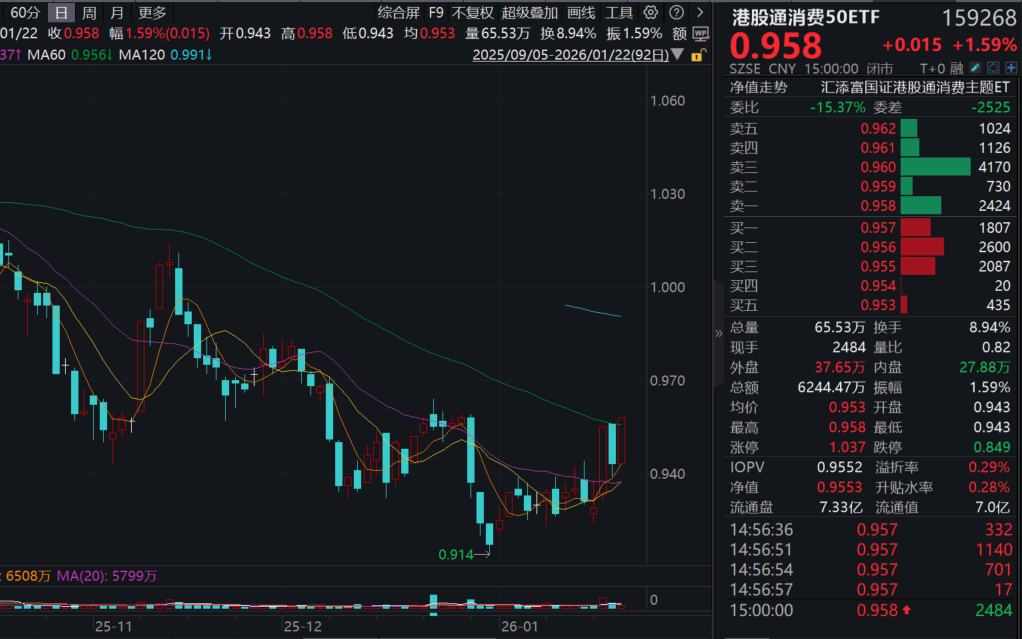
泡泡玛特再度大涨近6%,已大举回购3.5亿!港股通消费50ETF(159268)收涨1.59%,消费ETF(159928)昨日大举净流入超4亿元!
Xin Lang Cai Jing· 2026-01-22 09:59
Group 1 - Hong Kong stocks in the consumer sector experienced a significant rise, with the Hong Kong Stock Connect Consumer 50 ETF (159268) increasing by 1.59% and a total trading volume exceeding 62 million HKD, highlighting strong investor interest [1] - Pop Mart repurchased 500,000 shares for 96.49 million HKD, marking its second buyback within the week, with a total repurchase amount nearing 350 million HKD [1] - The A-share market showed a slight correction, with the Consumer ETF (159928) declining by 0.39% and a trading volume surpassing 500 million HKD, indicating a mixed sentiment in the market [2] Group 2 - Bohai Securities noted that high-level meetings are focusing on accelerating the cultivation of new growth points in service consumption, with policies being introduced to support new business models and scenarios, particularly in sports events and IP-related consumption [3] - Galaxy Securities highlighted that the optimization of holiday arrangements in 2026 is expected to significantly boost service consumption, with an increase in holiday days likely to enhance demand in tourism and dining sectors [4] - The Consumer ETF (159928) is characterized by its resilience across economic cycles, with the top ten constituent stocks accounting for over 68.55% of its weight, including major players in the liquor and agriculture sectors [5] Group 3 - The top holdings in the Consumer ETF include leading liquor companies such as Kweichow Moutai and Wuliangye, which together represent a significant portion of the ETF's weight, indicating a strong focus on essential consumer goods [6] - The Consumer 50 ETF (159268) is positioned as an efficient investment choice for the Hong Kong consumer sector, supporting T+0 trading and not occupying QDII quotas, appealing to investors targeting the new consumption trends among Generation Z [6]


中国中免跌2.03%,成交额28.03亿元,主力资金净流出2.14亿元
Xin Lang Cai Jing· 2026-01-22 05:26
Core Viewpoint - China Duty Free Group Co., Ltd. (China Duty Free) has experienced a decline in stock price and revenue, indicating potential challenges in the tourism retail sector amid changing market conditions [1][2]. Financial Performance - As of January 22, China Duty Free's stock price decreased by 2.03% to 93.16 CNY per share, with a market capitalization of 192.735 billion CNY [1]. - For the period from January to September 2025, the company reported a revenue of 39.862 billion CNY, a year-on-year decrease of 7.34%, and a net profit attributable to shareholders of 3.052 billion CNY, down 22.13% year-on-year [2]. Stock and Shareholder Information - The number of shareholders increased to 309,300 as of September 30, 2025, reflecting a rise of 6.75% [2]. - The company has distributed a total of 18.922 billion CNY in dividends since its A-share listing, with 7.758 billion CNY distributed in the last three years [3]. Market Activity - On January 22, the net outflow of main funds was 214 million CNY, with large orders showing a mixed trend in buying and selling [1]. - The stock has seen a year-to-date decline of 1.48%, but has increased by 34.60% over the past 60 days [1]. Business Overview - China Duty Free primarily engages in the retail of duty-free and taxable goods, with 72.26% of revenue from duty-free sales and 25.54% from taxable goods [1]. - The company operates in both domestic and international markets, focusing on tourism retail and property leasing [1].

多方协同发力 培育服务消费新增长点
Jing Ji Wang· 2026-01-22 02:16
Core Viewpoint - The State Council's recent meeting emphasizes accelerating the cultivation of new growth points in service consumption, supporting the emergence of new business formats, models, and scenarios to enhance the quality of service supply and meet consumer needs [1][4]. Group 1: New Growth Points in Service Consumption - The shift in consumer behavior from product-centric to a balanced focus on both goods and services is being driven by rising living standards, unlocking the potential for service consumption [1][4]. - The integration of digital technology with the service industry is leading to the emergence of innovative service consumption formats, such as interactive robot stores in Shenzhen and experiential retail spaces in Beijing [2][3]. - Cross-industry integration is becoming a key direction for innovation in service consumption, with models like "agriculture + cultural tourism" and "manufacturing + services" creating new consumption growth points [3]. Group 2: Quality Service Supply - Various regions are innovating in consumption scenarios across cultural, tourism, entertainment, and sports sectors, with projections indicating double-digit growth in retail sales for tourism consulting, transportation, and leisure services by 2025 [4]. - The meeting highlighted the need to enhance the supply of quality services and address issues related to credit, standards, and safety management [4]. - Experts suggest focusing on digital service consumption, cultural tourism integration, silver economy services, green low-carbon services, and international consumption services as potential growth areas [4]. Group 3: Enhancing Consumer Motivation - The cultivation of new growth points in service consumption requires precise policy guidance and support, with the State Council advocating for the implementation of consumption-boosting actions [7]. - Collaborative efforts between central and local governments are leading to targeted policies that enhance service consumption, such as optimizing trade-in services and promoting regional cultural tourism [7]. - Recent policies aim to stimulate consumption in lower-tier markets, with initiatives to support county-level consumption and enhance consumer capacity through loans and subsidies [8].
直击达沃斯|董俊峰:中国消费结构正发生改变,年轻人不再追逐国际大牌
Xin Lang Cai Jing· 2026-01-22 00:13
Core Insights - The chairman of China UnionPay, Dong Junfeng, highlighted significant changes in Chinese consumer behavior, indicating that the contribution of consumption to GDP has substantial growth potential [1][4]. Group 1: Consumption Trends - UnionPay processes over 1 billion transactions daily, with transaction amounts nearing 1 trillion yuan, reflecting changes in consumer behavior through transaction data [1][4]. - The contribution of consumption to GDP is currently around 53%, with considerable room for growth [1][4]. Group 2: Shifts in Consumer Preferences - There is a generational shift in consumption from goods to services, with a noted trade deficit in service trade compared to a surplus in goods trade [2][6]. - Generation Z consumers are moving away from luxury brands towards personalized and niche products, prompting manufacturers to leverage AI and technology for customized services [2][6]. - Consumption in lower-tier cities and rural areas is increasing, with high-quality products and services becoming more accessible outside major urban centers [2][6]. Group 3: Economic Structure Adjustment - The overall economic structure in China is undergoing rebalancing, with government and regulatory bodies actively promoting and guiding changes in consumption patterns [2][6].
财政如何更好支持服务消费丨冯奎专栏
2 1 Shi Ji Jing Ji Bao Dao· 2026-01-21 03:33
既然如此,那么激活服务消费的有效路径之一,可否在于适度扩大赤字规模,连续几年定向投于服务消 费及配套公共服务领域。这并非被动的财政兜底,而是契合消费升级规律、破解资金沉淀问题的主动施 策,其必要性有三方面。一是顺应消费结构转型的必然要求。我国服务消费占比虽已达46.1%,但还有 较大提升空间,教育、医疗、养老等领域供给仍需进一步完善。通过赤字投入补齐公共服务短板,能精 准对接居民升级型消费需求,推动消费结构从商品主导向服务主导跨越,筑牢内需增长底座。 二是破解储蓄沉淀问题的关键抓手。居民高额存款本质是预防性储蓄,破题的关键在于优化公共服务保 障。赤字投入能完善社保与公共服务体系,推动住户存款中的沉淀部分,逐步转化为可持续的服务消费 支出。 冯奎(中国区域科学协会副理事长) 近日,国务院常务会议专题部署加快培育服务消费新增长点,明确推动惠民生和促消费紧密结合,强调 要完善促消费长效机制。这一部署精准锚定当前稳经济的关键抓手——在消费结构向服务主导转型的当 下,服务消费占居民消费支出比重已达46.1%,对消费增长贡献率超60%,其提振成效直接关系内需扩 张质量与经济发展韧性,成为稳增长、惠民生的核心发力点。 但服 ...
再论消费重塑-AI-的-从1到10
2026-01-21 02:57
Summary of Conference Call Records Industry and Company Overview - The conference call discusses various sectors including AR technology, cross-border e-commerce, online travel agencies (OTA), human resources, the pork industry, rubber market, home appliances, and the food and beverage sector. Key Points and Arguments AR and E-commerce - 康耐特 (Kangnate) collaborates with 歌尔光学 (Goer) to expand AR business, expecting a net profit growth of over 30% by 2025 due to supply chain synergy [1] - 小商品城 (Small Commodity City) and other companies have made progress in AI-enhanced cross-border e-commerce, with Yiwu market's export growth projected at around 25% and store order growth exceeding 30% [1][2] Online Travel Agencies (OTA) - AI technology significantly improves efficiency in OTA platforms, with 携程 (Ctrip) resolving 80% of inquiries through AI customer service, leading to lower commission rates [3][4] - The overall commission rate for domestic OTAs is currently half that of international giants [4] Human Resources - AI has automated recruitment processes, reducing hiring cycles from 45 days to 15 days, enhancing job matching accuracy [4] Pork Industry - Current pork prices have risen to approximately 13 RMB per kilogram, with expectations to stabilize around 12 RMB post-holiday, indicating a potential bottoming out of prices [6] Rubber Market - The rubber market shows signs of recovery with inventory levels normalizing; future price increases are anticipated if production can meet demand by December 2025 [7] Home Appliances - AI technology is creating new product categories in home appliances, such as AI glasses and 3D printing devices, which have long-term growth potential [8][9] - Major companies like 美的 (Midea) and 海尔 (Haier) are recommended for their strong market positions and potential for increased overseas market share [10] Food and Beverage Sector - The restaurant supply chain is performing well, with a focus on companies with strong pricing power and B2B customization, such as 颐海国际 (Yihai International) and 千禾味业 (Qianhe Flavoring) [11] - In the snack sector, companies like 盐津铺子 (Yanjinpuzi) and 卫龙 (Weilong) are highlighted for their strong performance and market strategies [12] Liquor Industry - The liquor sector is expected to see a rebound due to limited stock price declines and potential for short-term recovery, with a focus on mid-tier brands like 金水源 (Jinshuiyuan) and 迎驾贡 (Yingjiagong) [13] Additional Important Insights - The policy environment is favorable for service consumption, with extended holiday periods expected to boost sectors like tourism and retail [5] - Investment opportunities may arise from mergers and acquisitions, as well as emerging consumer markets such as trendy toys and sports [5]
超越客服:当电商社区进化为“产品共创中枢”
Guan Cha Zhe Wang· 2026-01-21 02:23
Core Insights - The article discusses how leading brands are transforming user engagement from passive feedback to active co-creation, exemplified by Dongfang Zhenxuan's "Product Co-Creation Community" in its independent app [1][2][3] Group 1: User-Centric Transformation - The shift from traditional customer service feedback to deeper user involvement in product development is highlighted as a key challenge for brands [1][2] - Dongfang Zhenxuan's community aims to integrate users into the product lifecycle, allowing them to become active contributors rather than passive consumers [2][3] - This model signifies a transformation from merely collecting user demands to co-creating them, enhancing brand loyalty and trust [2][3] Group 2: Quality Control and Demand Radar - The community serves as a real-time quality control network, enabling users to act as "grassroots quality inspectors" [3][4] - Feedback from users can lead to immediate adjustments in product quality, preventing larger issues from arising [3][4] - The case of the "刺梨复合果汁气泡水" (Sour Pear Sparkling Juice) illustrates how user demand can directly influence product availability and decisions [4][5] Group 3: Organizational Culture and Role Redefinition - Dongfang Zhenxuan's approach requires a cultural shift within the organization, where product managers become active listeners and communicators with users [6][7] - The emphasis is on genuine interaction rather than mechanical responses, fostering a culture of trust and transparency [7][8] - This transformation leads to a more agile and open organizational structure, enhancing responsiveness to user feedback [6][7] Group 4: Building Emotional Connections - The community initiative transcends mere transactional relationships, fostering deeper emotional connections between users and the brand [8][9] - As users feel heard and respected, their relationship with the brand evolves from simple transactions to partnerships in co-creation [8][9] - Dongfang Zhenxuan envisions a trust-based community where both the brand and users collaboratively maintain product quality and brand reputation [8][9]
新春两场高层会议连续点题促消费,新政呼之欲出
2 1 Shi Ji Jing Ji Bao Dao· 2026-01-21 02:13
Group 1 - The core viewpoint is that consumption is becoming the main engine of economic growth in China, with retail sales expected to exceed 50 trillion yuan by 2025, contributing over half to economic growth [1] - In the past year, there has been a significant increase in diverse consumer goods such as communication equipment, cultural office supplies, and sports entertainment, all showing growth rates exceeding 10% [1] - The rural market is expected to grow faster than urban areas, with county and township consumption accounting for nearly 40% of total retail sales by 2025, indicating a shift from "buying available" to "buying quality" and "enjoying services" [1] Group 2 - The State Council meeting on January 16 emphasized the need to cultivate new growth points in service consumption, including online education, intangible cultural heritage experiences, the silver economy, and green consumption [2] - Policies such as the implementation of paid leave and the upcoming nine-day holiday during the 2026 Spring Festival are expected to boost consumer spending by providing more time for consumption [2] - The "old-for-new" policy is being expanded to stimulate the replacement of home appliances, furniture, and digital products, which not only promotes upgrades in living standards but also optimizes industrial structure [2] Group 3 - The focus on consumption and domestic demand has been a consistent theme in the recent State Council meetings, with expectations for a more substantial "policy package" to promote consumption in 2026 [3] - The early allocation of funds from the first batch of ultra-long-term special government bonds is anticipated to increase fiscal support, extending from durable consumer goods to a broader range of sectors [3] - With the implementation of income increase plans for urban and rural residents, the establishment of paid leave systems, and the optimization of the consumption environment, the potential for service consumption is expected to be deeply released, leading to faster growth in the consumption market this year [3]
财政如何更好支持服务消费
2 1 Shi Ji Jing Ji Bao Dao· 2026-01-20 22:15
但服务消费的有效激活非易事,中国人民银行发布的存款数据显示,2025年居民存款新增14.64万亿元,占全年人民币存款增量的55.4%, 创下近六年新高,巨额资金沉淀至银行体系。从结构看,住户定期存款占比超七成,非银行业金融机构存款同比也大幅增长,意味着居民 更倾向于锁定长期收益或选择低风险理财。2025年11月末住户存款余额已达163.31万亿元,这也会直接影响服务消费潜力的释放。 冯奎(中国区域科学协会副理事长) 近日,国务院常务会议专题部署加快培育服务消费新增长点,明确推动惠民生和促消费紧密结合,强调要完善促消费长效机制。这一部署 精准锚定当前稳经济的关键抓手——在消费结构向服务主导转型的当下,服务消费占居民消费支出比重已达46.1%,对消费增长贡献率超 60%,其提振成效直接关系内需扩张质量与经济发展韧性,成为稳增长、惠民生的核心发力点。 既然如此,那么激活服务消费的有效路径之一,可否在于适度扩大赤字规模,连续几年定向投于服务消费及配套公共服务领域。这并非被 动的财政兜底,而是契合消费升级规律、破解资金沉淀问题的主动施策,其必要性有三方面。一是顺应消费结构转型的必然要求。我国服 务消费占比虽已达46.1 ...

国际机构集体看好中国经济增长前景
Zheng Quan Ri Bao· 2026-01-20 16:09
Group 1: Economic Growth Outlook - The International Monetary Fund (IMF) has raised China's economic growth forecast for 2025 by 0.2 percentage points to 5% and has also upgraded the 2026 growth expectations [1] - Multiple international financial institutions have similarly increased their growth forecasts for China, indicating a resilient economic performance among major global economies [1] - Deutsche Bank's chief economist for China predicts a more balanced economic growth driver in 2026, with consumption being further activated, investment contributions rebounding, and exports expected to maintain growth [1] Group 2: Export Resilience - In 2025, China's goods trade is projected to grow rapidly, with total foreign trade reaching 45.47 trillion yuan, a 3.8% increase, and exports at 26.99 trillion yuan, up 6.1% [2] - Goldman Sachs forecasts that China's exports will continue to be a core driver of economic growth, with nominal export growth expected to rise by 5% to 6% annually in the coming years [2] - The resilience of Chinese exports is attributed to strong competitiveness, dominance in rare earth and key mineral sectors, and growth potential in high-tech exports driven by policy support and global AI-related capital expenditure cycles [2] Group 3: Consumer Spending Trends - Domestic consumption recovery and upgrade are becoming significant supports for China's economic growth, with Goldman Sachs estimating a stable consumer growth rate of around 4.5% this year [3] - Service consumption is expected to outpace goods consumption growth in 2026, driven by policy emphasis on service sector development and the potential for a virtuous cycle of employment and income growth [3][4] - The shift in consumer spending from goods to services is evident, with households increasingly willing to spend on leisure, dining, and lifestyle experiences [4] Group 4: Investment Focus - Investment is seen as a crucial lever for stabilizing growth, with key sectors becoming focal points for future growth opportunities [5] - Goldman Sachs anticipates a rebound in fixed capital formation growth to 3.5% in 2026, targeting high-tech, strategic emerging industries, urban renewal, and basic livelihood infrastructure [5] - Traditional industries are expected to undergo digital and intelligent upgrades, with significant potential in sectors like brain-computer interfaces and robotics, although they are still in early stages [5][6]
