
流动性管理

Search documents
央行10000亿买断式逆回购来了
2 1 Shi Ji Jing Ji Bao Dao· 2025-09-04 10:40
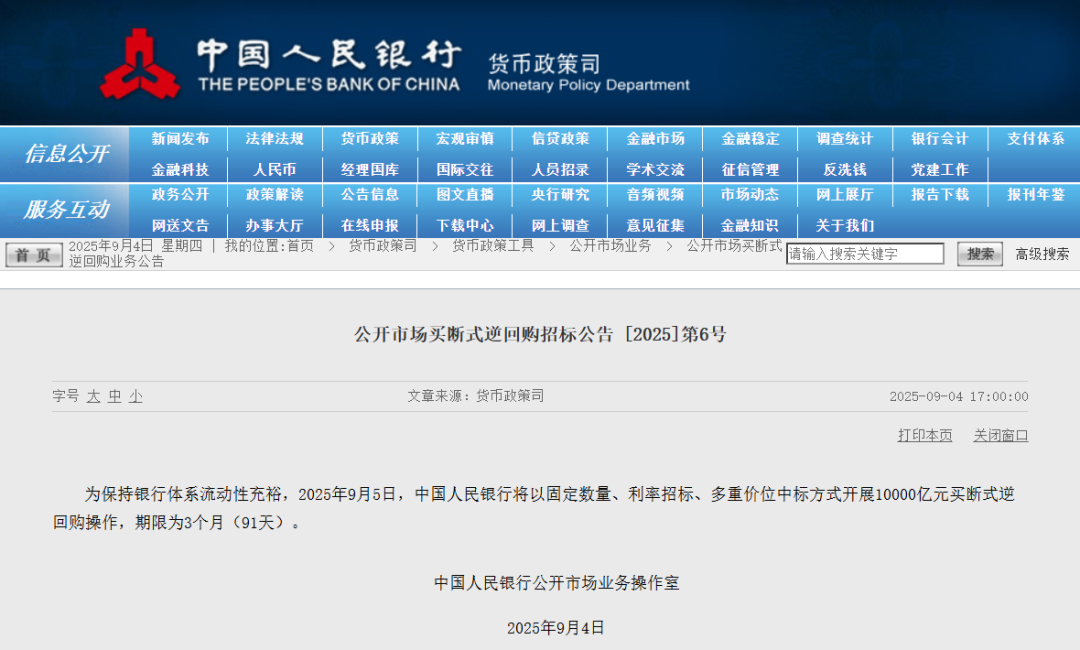
据中国人民银行网站9月4日公告,为保持银行体系流动性充裕,2025年9月5日,中国人民银行将以固定数量、利率招标、多重价位中标方式开展10000亿 元买断式逆回购操作,期限为3个月(91天)。 | 中国人民银行 | | THE PEOPLE'S BANK OF CHINA | | | 货币政策司 Monetary Policy Department | | | | | | | --- | --- | --- | --- | --- | --- | --- | --- | --- | --- | --- | | 新闻发布 法律法规 信息公开 | | | 货币政策 | 宏观审慎 | 信贷政策 | 金融市场 | 金融稳定 | 调查统计 | 银行会计 | 支付体系 | | 人民币 | 金融科技 | | 经理国库 | 国际交往 | 人员招录 | 学术交流 | 征信管理 | 反洗钱 | 党建工作 | | | 政策解读 服务互动 办事大厅 | 政务公开 网送文告 | | 公告信息 在线申报 | 图文直播 下载中心 | 央行研究 网上调查 | 音频视频 意见征集 | 市场动态 金融知识 | 网上展厅 关于我们 | 报告下载 ...

央行10000亿买断式逆回购来了
21世纪经济报道· 2025-09-04 10:37
(声明:文章内容仅供参考,不构成投资建议。投资者据此操作,风险自担。) SFC 出品 | 2 1财经客户端 南财快讯工作室 编辑 | 金珊 据中国人民银行网站9月4日公告,为保持银行体系流动性充裕,2025年9月5日,中国人民银 行将以固定数量、利率招标、多重价位中标方式开展10000亿元买断式逆回购操作,期限为3个 月(91天)。 | 中国人民银行 | 货币政策司 | THE PEOPLE'S BANK OF CHINA | Monetary Policy Department | | | | | | | | | | | | | | | | | | --- | --- | --- | --- | --- | --- | --- | --- | --- | --- | --- | --- | --- | --- | --- | --- | --- | --- | --- | --- | | 银行会计 | 新闻发布 | 法律法规 | 货币政策 | 宏观审慎 | 信贷政策 | 金融市场 | 金融稳定 | 调查统计 | 支付体系 | 信息公开 | 征信管理 | 金融科技 | 人民币 | 经理国库 | 国际交往 | ...
央行:9月5日将开展10000亿元买断式逆回购操作,期限为3个月
Zheng Quan Shi Bao Wang· 2025-09-04 09:07
Core Viewpoint - To maintain ample liquidity in the banking system, the People's Bank of China will conduct a 1 trillion yuan reverse repurchase operation on September 5, 2025, with a term of 3 months (91 days) [1] Group 1 - The operation will be conducted using a fixed quantity, interest rate bidding, and multiple price level bidding methods [1] - The total amount for the reverse repurchase operation is set at 1 trillion yuan [1]
8月MLF净投放3000亿元,券商:重新作为核心流动性管理工具
Huan Qiu Wang· 2025-09-03 00:41
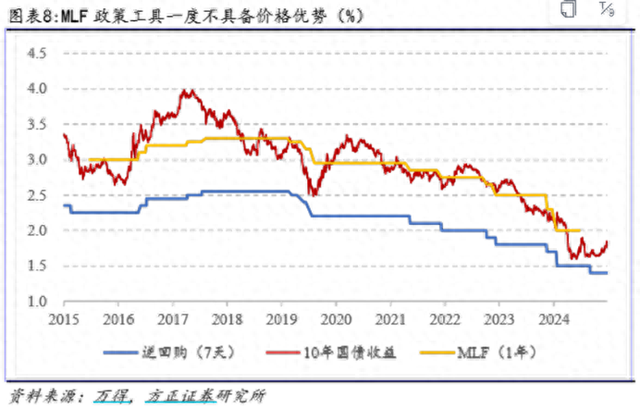
Group 1 - The central bank's liquidity injection in August included a net MLF injection of 300 billion yuan, a net withdrawal of 160.8 billion yuan in PSL, and a net MLF injection of 300 billion yuan, with no public market treasury transactions conducted [1][3] - According to a recent report by Founder Securities, the importance of price targets has significantly increased in the new monetary policy framework, indicating a shift in focus from quantity-based targets like M2 and social financing [1][3] - A notable observation is that around the second quarter of 2024, the volatility of short-term money market interest rates represented by DR001 and DR007 is expected to decrease, suggesting that the central bank is beginning to treat short-term policy rates as a core adjustment target [1][3] Group 2 - Founder Securities also noted that the central bank's recent monetary policy reports show a clear decline in focus on quantity-based targets, emphasizing a balanced approach to the use of quantity tools [3] - Despite the de-emphasis on quantity-based targets, the central bank continues to prioritize liquidity management as a crucial tool influencing interest rate trends, indicating that it has not abandoned the use of MLF as a core liquidity management tool [3] - In response to significant fluctuations in treasury bond rates, the central bank has temporarily ceased treasury transactions and has resumed using MLF as a primary liquidity management tool [3]

全球利率交易员_让数据说话-Global Rates Trader_ Let the Data Do the Work
2025-08-31 16:21
Summary of Key Points from Conference Call Industry or Company Involved - The conference call primarily discusses the global rates market, focusing on U.S. and European bond markets, including U.S. Treasuries, UK Gilts, and French OATs. Core Insights and Arguments 1. **U.S. Rates Market Dynamics** - Despite stability at the front-end of the U.S. curve, pricing cuts in 2026 have increased alongside a rise in risk premiums at the long-end, leading to a steeper curve than fundamentals would suggest [1][2][5] - The market remains hawkish regarding 2025 pricing, favoring short expiry receivers on the front-end to navigate event risks [1][2] 2. **Inflation and Fed Policy** - Concerns about Fed independence have led to a steeper curve, particularly in the belly inflation pricing, with 5-year inflation swaps reaching new post-pandemic highs [8][10] - Upcoming inflation data is critical for UK rates, with recommendations for Gilt 2s5s steepeners based on expectations of deeper cuts or resilient data leading to higher terminal rates [15][19] 3. **European Market Insights** - OAT-Bund spreads have widened due to political uncertainty in France, with expectations of contained volatility despite deficit expectations deteriorating [12][13] - Limited spillover effects from OAT weakness to other European bond markets, with a gradual cheapening expected in Bunds [12][13] 4. **Liquidity and Funding Risks** - A front-loaded TGA rebuild is expected to lessen liquidity pressure in September, although overall liquidity is projected to decline below $3 trillion by quarter-end [10][10] - Dallas Fed President Logan's remarks indicate a hawkish stance on balance sheet runoff and funding risks, suggesting potential volatility in September [10] 5. **Market Recommendations** - Recommendations include long positions in 1m2y USD receivers and Gilt 2s5s steepeners, reflecting a constructive outlook for U.S. duration and expectations of deeper cuts from the Bank of England [24][15] - The market is advised to navigate the data calendar tactically, as hard data could lead to faster cuts and support front-end outperformance [24] Other Important but Possibly Overlooked Content 1. **Political Risks in France** - The potential for fresh elections in France could lead to wider OAT-Bund spreads, with the market already pricing in substantial slippage against fiscal targets [12] 2. **Global Economic Outlook** - The improved macro outlook in Europe is expected to compress risk premiums across the Gilt curve, with a forecast for 10-year Gilts to rally towards 4.25% by year-end [24] 3. **Impact of Oil Prices on Inflation** - A potential increase in Russian oil and gas supply could lower traded inflation, with estimates suggesting a 10% negative oil price shock could reduce inflation by 10-25 basis points across various markets [21] 4. **Central Bank Policies** - The Bank of Japan's normalization cycle is expected to be prolonged, impacting yields across the curve, while the ECB's stance on tariff risks may influence market expectations for cuts in 2025 [24] 5. **Market Positioning** - Current market positioning indicates a bearish sentiment towards U.S. rates, with a notable shift in speculative positions across various Treasury futures [44][46]

投资者对货币政策充满期待 关注银价多头态势
Jin Tou Wang· 2025-08-27 03:31
Group 1 - Silver prices are currently above key support levels, with a daily increase of 1.00%, reaching a high of $38.85 per ounce and a low of $38.32 per ounce, indicating a potential upward trend towards $38.90 per ounce [1] - The Federal Reserve's potential reactivation of the Standing Repo Facility (SRF) in September is aimed at addressing liquidity pressures, as indicated by recent comments from a Federal Reserve official [2][3] - The official highlighted that the reserve levels in the U.S. banking system can be further reduced, which may lead to tighter liquidity conditions, especially during critical periods like tax settlement days and quarterly ends [2][3] Group 2 - The SRF has proven effective in alleviating short-term liquidity pressures, with expectations that market participants will utilize it again in September to ensure financial system stability [3] - Concerns were raised about the risk of the Federal Reserve's balance sheet expanding due to increased demand for short-term reserves, which could undermine policy flexibility and long-term financial stability [3][4] - Suggestions for improving liquidity management include increasing or removing limits on discount window loans and implementing daily auctions for these loans to better meet banking system liquidity needs [4] Group 3 - Technical analysis indicates a significant shift in momentum for silver prices, with a breakthrough above the triangle trendline and the psychological resistance at $38.00, suggesting a continuation of the upward trend [5] - The Relative Strength Index (RSI) is at 68, indicating strong underlying demand, while the MACD shows bullish momentum, reinforcing the positive outlook for silver prices [5] - If silver prices break above the recent high of $39.06, it could pave the way for testing the next resistance level at $39.53, which is a multi-year high [5]
中期流动性净投放创半年峰值,降准降息时点或后移
Di Yi Cai Jing· 2025-08-24 09:42
Group 1 - The central bank has significantly increased mid-term liquidity management in August, achieving a net injection of 600 billion yuan, the highest since February 2025 [2][3] - The central bank's operations include 600 billion yuan MLF and additional net injections through reverse repos, indicating a strong coordination between monetary and fiscal policies [2][3] - The net liquidity injection in August is double that of July, reflecting a robust response to market conditions and a commitment to maintaining liquidity [2][3] Group 2 - The recent liquidity pressure was caused by tax payments, maturing financial instruments, and government bond issuances, leading to a temporary tightening of funds [4][5] - The central bank responded by increasing open market operations, resulting in a net injection of 13.652 billion yuan over five days, stabilizing short-term interest rates [5][6] - The upcoming maturity of over 20 billion yuan in reverse repos is expected to be managed effectively, maintaining liquidity within a reasonable range [6][7] Group 3 - The central bank's policy focus has shifted to "implementation and detail" of monetary policy, with potential delays in rate cuts and a more flexible approach to policy tools [6][7] - Analysts expect continued monitoring and adjustments to create a conducive monetary environment for economic recovery, despite the lack of specific mentions of certain tools [8] - The emphasis will be on improving the efficiency of fund usage to foster a positive cycle between the economy and finance [8]
邢自强:中国经济温度计——基本面VS资金面?
Sou Hu Cai Jing· 2025-08-23 04:59
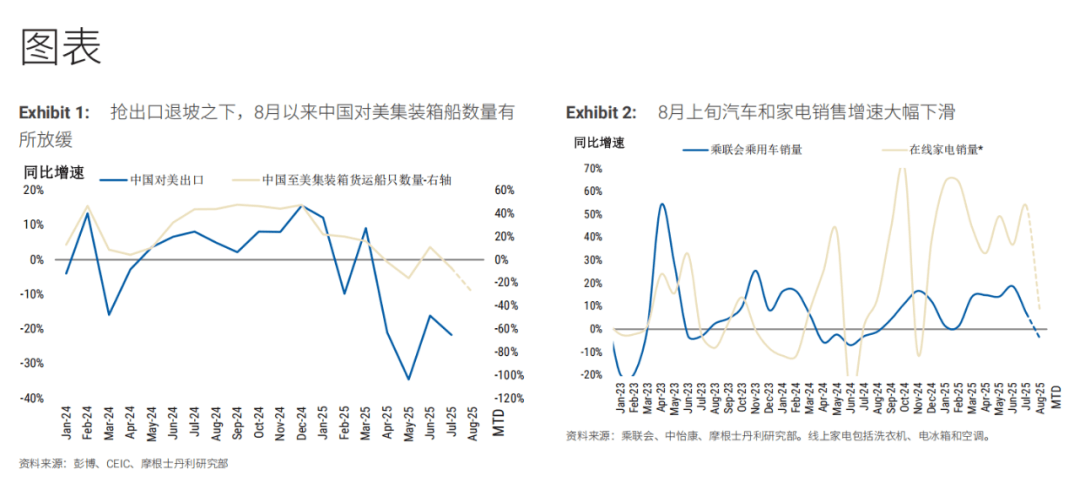
Economic Overview - The quarterly GDP growth rate is expected to decline to around 4.5%, influenced by high base effects and a decrease in export growth from 7.2% in July to a range of 5-6% in August [1] - High-frequency data indicates a continued decline in the number of container ships from China to the U.S., reflecting ongoing export downturns [1] - Domestic demand remains weak, with significant drops in automobile and online home appliance sales despite government subsidies [1] - The real estate sector's ongoing decline is likely to continue affecting consumer confidence negatively [1] Market Liquidity and Investment Trends - The Morgan Stanley Free Liquidity Index has turned positive since June, indicating improved liquidity available for financial investments [2] - Approximately 1.5 to 1.7 trillion RMB net inflow into the A-share market in the first half of the year, with two-thirds coming from insurance companies due to regulatory changes [2] - Retail investors contributed an additional 400 to 500 billion RMB in net inflows [2] - There has been a notable increase in deposits from non-bank financial institutions, suggesting a shift of household savings towards the stock market [2] Policy and Structural Adjustments - Recent government measures to combat overcapacity in the petrochemical and refining sectors indicate a deepening understanding of structural economic challenges [3] - The State Council's recent meeting emphasized the continuity of policies and the acceleration of consumer promotion measures [3] - The central bank's liquidity management is shifting towards a neutral stance, focusing more on credit quality rather than urgent support for the stock market [3] Stock Market Leverage - The A-share margin trading balance has surpassed 2 trillion RMB for the first time since 2015, but still represents only 4.8% of the free float market value, slightly below the 10-year average of 4.9% [4] - Despite the increase in margin trading, the current leverage risk in the stock market remains manageable, reducing the likelihood of short-term policy interventions [4]
放量!央行宣布6000亿MLF操作
Wind万得· 2025-08-22 09:40
Group 1 - The People's Bank of China will conduct a 600 billion MLF operation on August 25, 2025, to maintain liquidity in the banking system [2] - In August, 300 billion MLF matured, resulting in a net injection of 300 billion [2] - Year-to-date, the central bank has injected a total of 3,350 billion through MLF operations, with 2,889 billion maturing, leading to a net injection of 461 billion [2]

印尼央行行长:经济复苏势头增强 央行加码流动性支持并敦促银行降贷
Xin Hua Cai Jing· 2025-08-20 07:46
Group 1 - The core viewpoint is that Indonesia's economy showed strong performance in Q2, with GDP growth exceeding expectations driven by investment, household spending, and export growth [1] - The central bank expects the full-year economic growth for 2025 to be above the midpoint of the target range of 4.6% to 5.4%, with improved growth momentum anticipated in the second half of the year [1] - Despite global economic pressures, particularly from U.S. tariffs affecting global trade, Indonesia's economy demonstrates resilience [1] Group 2 - Inflation remains low, with July's inflation rate indicating that core inflation is expected to stay within target ranges, reflecting significant domestic capacity and manageable import inflation risks [1] - The central bank maintains its expectation for low inflation rates in 2025 and 2026, aligning with targets [1] - The central bank has cut policy rates by 100 basis points since September of the previous year, emphasizing the need for commercial banks to lower loan rates to support credit expansion and economic growth [1][2] Group 3 - The central bank has actively purchased government bonds to enhance market liquidity, with a total purchase amounting to 186.06 trillion Indonesian Rupiah as of August 19 [2] - The central bank is adjusting liquidity management tools, as indicated by a significant decrease in the outstanding balance of Indonesian Rupiah Securities (SRBI) from 916.97 trillion Rupiah at the beginning of 2025 to 720.01 trillion Rupiah by August 15 [2] - The Indonesian Rupiah has shown strength, supported by capital inflows and export revenue conversion, with the central bank implementing a "triple intervention" strategy to maintain exchange rate stability [2] Group 4 - The central bank maintains its current account deficit forecast for 2025 at 0.5% to 1.3% of GDP, with Q2's current account deficit remaining at a low level, indicating a robust external balance [3]